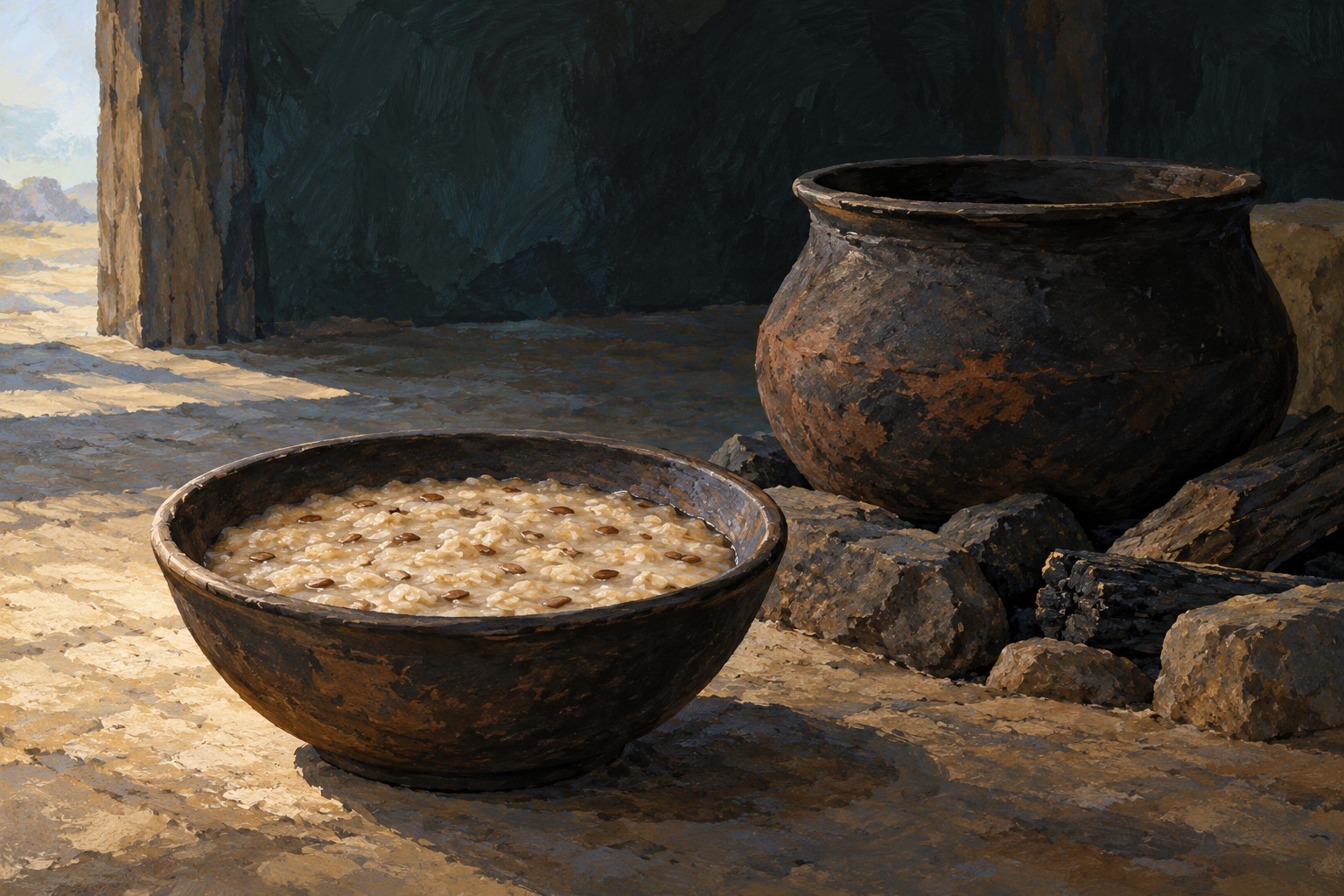
Famous Last Meals / Modern companion recipe
Barley-Flax Porridge with Gently Cooked White Fish
Pearl barley becomes a soft savory porridge while ground flax thickens its last simmer. The fish is a separately cooked modern choice prompted by the study’s probable fish evidence. Neither cod nor this measured cooking method is identified by the archaeological meal.
Read Tollund Man: A Porridge Reconsidered →
Print recipe · PDF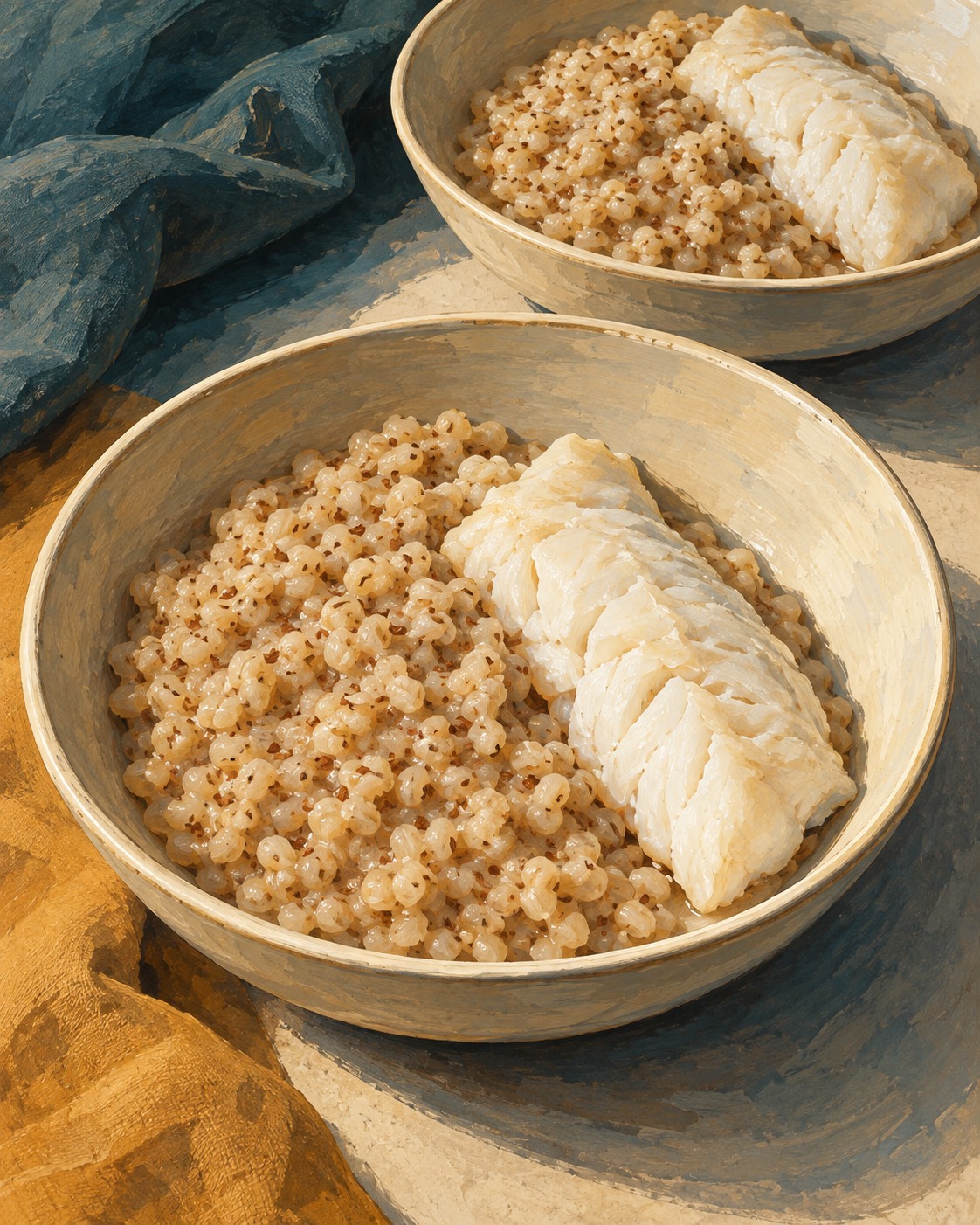
Ingredients
- ½ cup dry pearl barley (100 g/3½ oz), food-grade, with an approximately 40–50-minute packet simmer
- 2½ cups safe drinking water (600 ml) for barley, plus up to ¼ cup (60 ml) hot drinking water if needed
- 2 tablespoons commercially sold ground food-grade flaxseed (15 g/½ oz), suitable for cooking; follow any longer heating instruction on its label
- ¼ teaspoon fine salt (1.5 g), divided
- 2 plain boneless skinless cod or haddock fillets, about ¾ in/2 cm thick (4¼ oz/120 g each; 240 g total), fully thawed in the refrigerator if frozen
- 1 teaspoon neutral cooking oil (5 ml), for the fish pan
- ¼ cup safe drinking water (60 ml), for the fish pan
Set out
Stovetop with 2 burners, Heavy saucepan with lid, at least 2 qt/1.9 L, Fine-mesh sieve, 10-in/25-cm skillet with lid, Wooden spoon, Thin-probe food thermometer, Fish spatula and clean cooked-fish plate, Kitchen scale and measuring jug, Clean shallow refrigerator containers
Allergens
Fish; Barley; contains gluten. Barley is not gluten-free. Check actual grain, flax and oil labels for additional allergens and cross-contact statements.
Make it
- Read the barley and flax labels. This clock uses pearl barley requiring about 40–50 minutes; a different grain or longer packet instruction extends the total. Rinse the barley if its packet directs. Put it in the saucepan with 600 ml water and half the salt. Bring to a boil, reduce to a gentle simmer and cover with the lid slightly ajar.
- Simmer 35–40 minutes, stirring occasionally and checking the bottom. If the pan is drying before the kernels soften, add hot water from the measured 60 ml allowance a tablespoon at a time. The barley must be tender through the center rather than just swollen outside. Continue for its full packet time if longer.
- Stir in all the ground flax. Simmer gently for at least 10 minutes, stirring often, or for the flax label’s longer required cooking time. Add only enough of the remaining hot-water allowance to retain a soft, spoonable porridge. The flax should be dispersed, not left as a dry powder topping.
- During the final grain stage, check the thawed fish for bones and remove any. Do not rinse raw fish. Keep its board and utensils away from finished food. Heat oil in the skillet over medium heat, lay the fillets separately in one layer and season with the remaining salt. Add the separate 60 ml water around them, cover and reduce to a gentle simmer.
- Cook fish about 8–12 minutes, keeping the pan from boiling dry, until the thickest center of each fillet reaches at least 145°F/63°C and the flesh is opaque and separates easily. Time varies with thickness. Check from the side without touching the pan; continue cooking if below the endpoint. Use a clean spatula for the cooked fish.
- Divide all the hot barley-flax porridge between 2 bowls. Add one cooked fillet beside each portion, leaving excess pan liquid behind. Serve promptly. No unlisted wild seeds, herbs, butter or sauce are included.
A useful detail
The 80-minute total allows measuring, heating, up to 50 minutes for pearl barley plus the final flax simmer, with fish cooked alongside near the end. Grain and flax product instructions take precedence and may extend the clock. The meal deliberately uses safe drinking water and commercially sold ingredients rather than attempting an archaeological reconstruction.
Keep it well
Cool leftover grain and fish promptly in separate shallow containers and refrigerate within 2 hours, or 1 hour above 90°F/32°C, at 40°F/4°C or below. Use within 2 days or an earlier fish-label deadline. Reheat only the portion needed to 165°F/74°C throughout, stirring a little measured water into the porridge. Do not leave a deep grain pot cooling on the counter.
How this recipe relates to the story
Barley and flax are identified food remains; fish is probable. Pearl barley, ground food-grade flax, cod/haddock, measured portions, oil, salt and safe modern stovetop handling are this original adaptation. No wild seeds, historical water sources or contaminants are recreated.
Another way
- Use the same 240 g thawed plain haddock instead of cod, retaining the full 145°F/63°C fish endpoint. Neither species is claimed as the archaeological fish.
- Serve the porridge alone as 2 grain sides if omitting fish; identify that changed serving role rather than presenting the smaller dish as the same full supper.