A small ship sails across the top of the card, between flags and a broad White Star Line banner. Below it comes dinner: soup, fish, chicken, lamb, turkey, vegetables and sweets. The creases belong to an object that can still be read. Royal Museums Greenwich identifies this postcard menu as one kept by survivor Bertha J. Marshall, née Watt. Its date is 14 April 1912. See the surviving menu.
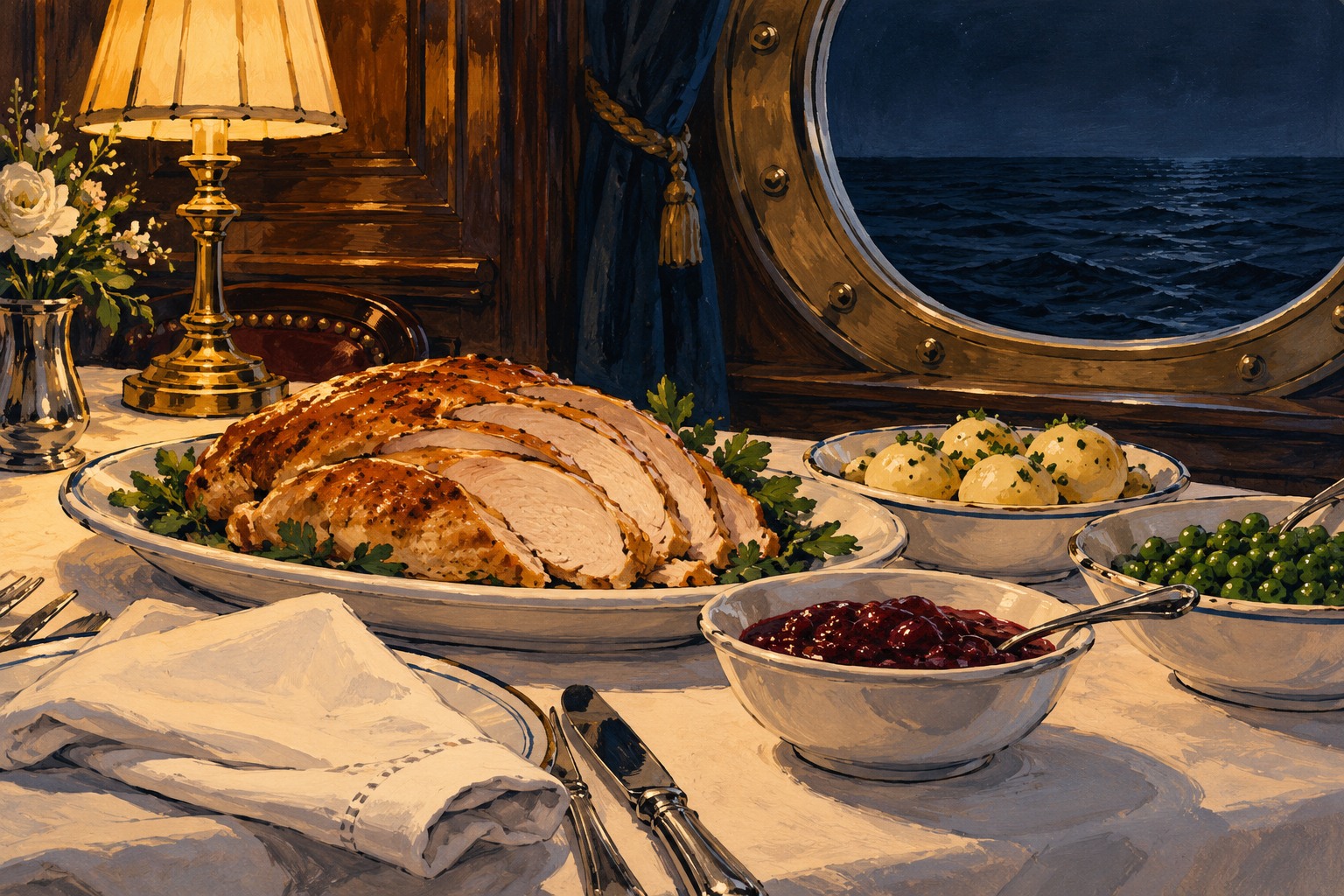
Imagined illustration of a turkey, cranberry, pea and potato meal in a quiet shipboard setting. It is not an archival image or a record of any passenger’s plate.
14 April 1912Date printed on the dinner card
Second classThe menu used for this chapter
A dinner with a date
The card is specifically second class. That detail keeps this table separate from the elaborate first-class dinners so often associated with the ship. Its turkey comes with cranberry sauce; peas and potatoes sit among the accompanying choices. The printed words are brief, but recognizable enough to begin planning a meal. They offer a connection more modest than a grand historical banquet: roast meat, something sharp beside it, a green vegetable and a potato dish. Royal Museums Greenwich, LMQ/1/12/2.
The ordinary list and the extraordinary night
The date carries knowledge that the printed menu cannot. Titanic struck an iceberg late on 14 April and sank early the following morning; the Smithsonian records the collision at 11:40 p.m. and the sinking at 2:20 a.m. A card prepared for dinner has therefore become a record from the last evening of the voyage. Smithsonian: the iceberg and the sinking.
Reading it now, the everyday dish names are arresting. A dinner menu concerns itself with what might come next from the kitchen. We approach this one knowing what came next at sea. That contrast is enough; it needs no imagined conversation at the table.
Bring three components into the kitchen
For a manageable modern meal, begin with the roast turkey and its cranberry accompaniment. Our version uses a small boneless breast roast and a fresh cranberry-orange relish, giving a household cook a defined cut and a sauce that can be prepared separately. The orange and the measured seasoning are our choices. Buttered peas make a quick side. Crisp roast potatoes supply a different texture, with a parboil and a spacious tray helping their edges brown.
These three recipes can also be cooked individually. If making them together, read their oven requirements first: the turkey and roast potatoes use different temperatures. The peas are best finished near serving, rather than left waiting while the meat is carved.
What the card leaves open
The menu records what was offered. It does not reveal which of these dishes Bertha selected, how much anyone ate or whether dinner was a particular passenger’s final food. We can cook from its named components without assigning a plate to her. The surviving card keeps her name attached to this story; the new recipes give us a practical way to spend time with the food on its list.
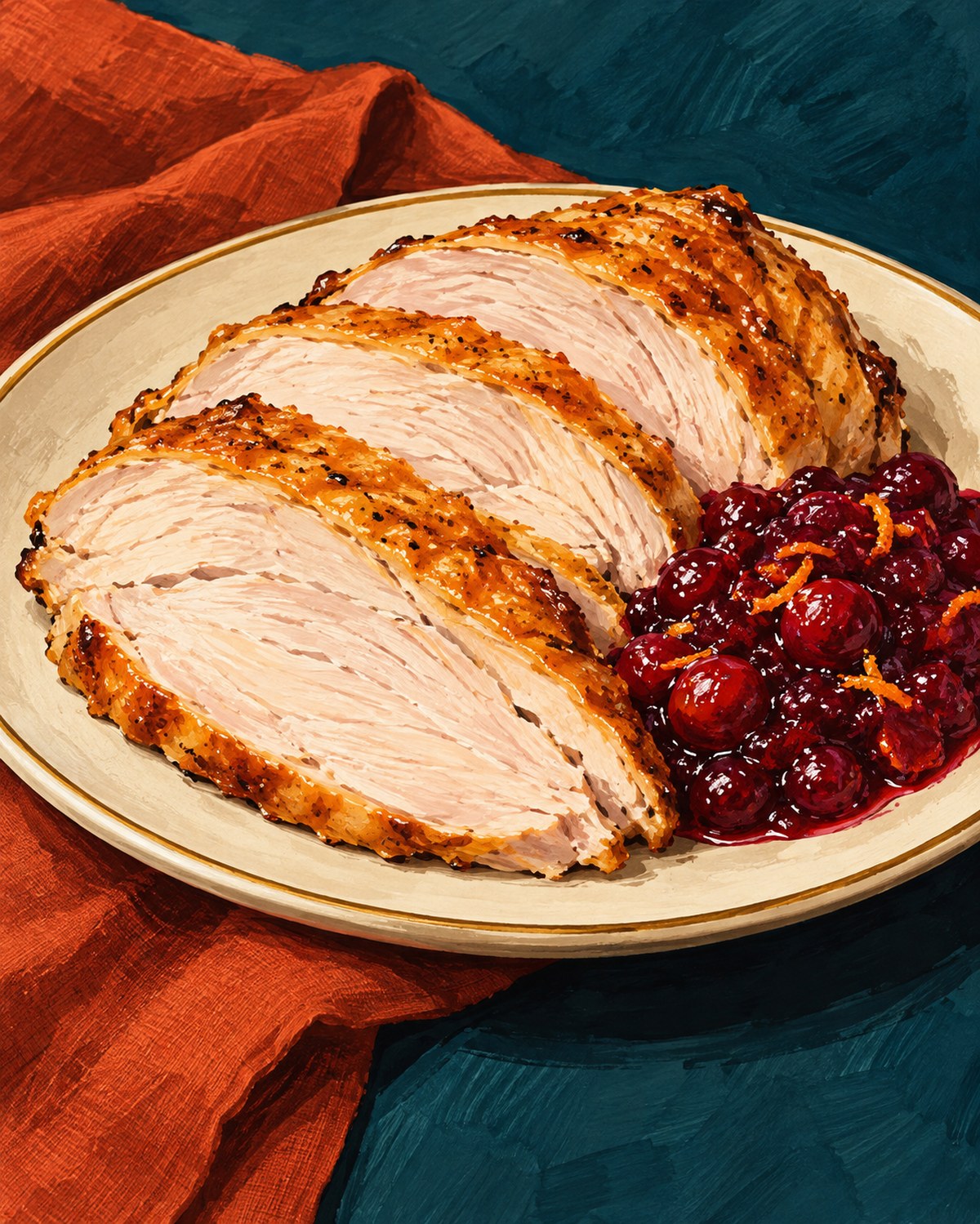
A small boneless turkey breast makes a manageable roast, with its thickest center checked before resting and carving. Cranberries simmer separately into a tart small accompaniment. This household version chooses the cut, seasoning and orange in the relish openly rather than claiming to recover a historical turkey recipe.
Turkey and cranberry are the documented connection
Roast turkey and cranberry sauce appear together on the 14 April 1912 second-class dinner menu held by Royal Museums Greenwich. The menu gives no cut, stuffing, seasoning, portion or sauce formula. Our small breast roast and orange-accented relish are new, with no claim about a named passenger’s selection or consumption.
A small breast still needs several checks
Use plain raw boneless turkey breast with skin, following any stricter label directions. Keep an evenly shaped roast secured only with food-safe butcher’s twine if necessary. Do not wash raw poultry, and keep its board and utensils away from the cranberry pan and clean carving equipment. The skin can brown before a compact center is cooked, so shield it loosely if needed. Probe more than one thick location, avoiding a false reading from the hot pan or a shallow surface layer.
Make the cranberry pan independently
Cranberries, sugar, water and orange juice simmer until many berries burst and a few shapes remain. It is a spooned fruit accompaniment, not gravy made from raw turkey drippings. Keep it separate throughout preparation. If made early in the roast, cool promptly in a shallow container and refrigerate rather than leaving the small pan out for an uncertain wait. Serve it cold or reheat the portion required. Rest the cooked turkey on a clean plate, remove twine and carve across the grain. The written four portions include the relish but no unlisted stuffing, potatoes or vegetables.
Ingredients
2 lb plain raw boneless skin-on turkey breast roast (900 g), evenly shaped
1 tablespoon neutral oil (15 ml)
1/2 teaspoon fine salt (3 g)
1/4 teaspoon black pepper
1/2 teaspoon dried thyme
5 1/4 oz fresh or plain frozen cranberries (150 g), sorted and rinsed if fresh
3 tablespoons sugar (40 g)
1/4 cup drinking water (60 ml)
2 tablespoons fresh orange juice (30 ml), seeds removed
1/2 teaspoon finely grated orange zest (1 g), from a washed orange
Set out
Oven, Small roasting pan with oven-safe rack, Food-safe butcher’s twine if needed, Thin-probe food thermometer, Foil for shielding/resting, Small saucepan, Shallow refrigerator container for relish if made early, Clean resting plate, Clean carving knife and board
Allergens
No major allergens inherent in the listed base ingredients; check actual turkey and fruit labels. Check labels and substitutions.
Make it
Heat oven to 350°F (175°C). Keep turkey cold until preparation, blot dry without rinsing and rub with oil, salt, pepper and thyme. Place skin-side up on the rack. Wash hands and clean raw-poultry surfaces.
Roast about 65–85 minutes until several thick locations reach 165°F (74°C), shielding skin loosely if it darkens before the center is ready. Follow any stricter package instruction and allow longer for a compact shape.
During roasting, simmer cranberries, sugar, water, orange juice and zest in the separate saucepan 10–12 minutes, stirring, until many berries burst and liquid lightly thickens. If not serving shortly, cool promptly in a shallow container and refrigerate at 40°F (4°C) or below; do not hold it on the counter through an extended roast.
Transfer cooked turkey to the clean plate and rest 15 minutes loosely covered. Remove twine if used and carve with clean tools into four portions. Serve each with one-quarter of the relish. Reheat refrigerated relish to 165°F (74°C) if a hot serving is wanted, or serve it cold.
A clean carve follows a measured rest
Prepare the clean plate and carving board before the roast finishes. They must not be the board or tray that held raw turkey, even when the cranberry pan is already ready.
Primary menu source
Royal Museums Greenwich, item LMQ/1/12/2: https://www.rmg.co.uk/collections/archive/rmgc-object-484157 . The original printed dinner menu was inspected; it does not establish what any named diner ate.
A useful detail
The 140-minute total includes preparing the turkey, preheating, up to 85 minutes roasting, 15 minutes resting and carving; cranberry preparation overlaps the roast. The starting cut is boneless breast, not a whole bird or raw rolled stuffing, which require different timing.
Another way
Use 150 g plain frozen cranberries directly from the freezer instead of fresh, allowing a few extra simmer minutes if needed. Do not replace turkey breast with a whole bird and retain this small-roast clock.
Keep it well
Refrigerate shallow turkey and relish portions separately within 2 hours, or 1 hour above 90°F (32°C), at 40°F (4°C) or below. Use within 3 days or an earlier product deadline. Reheat turkey leftovers and any relish served hot to 165°F (74°C). Freeze promptly cooled small portions for up to 2 months for quality and thaw in the refrigerator. Sugar and fruit acidity do not make relish shelf-stable.
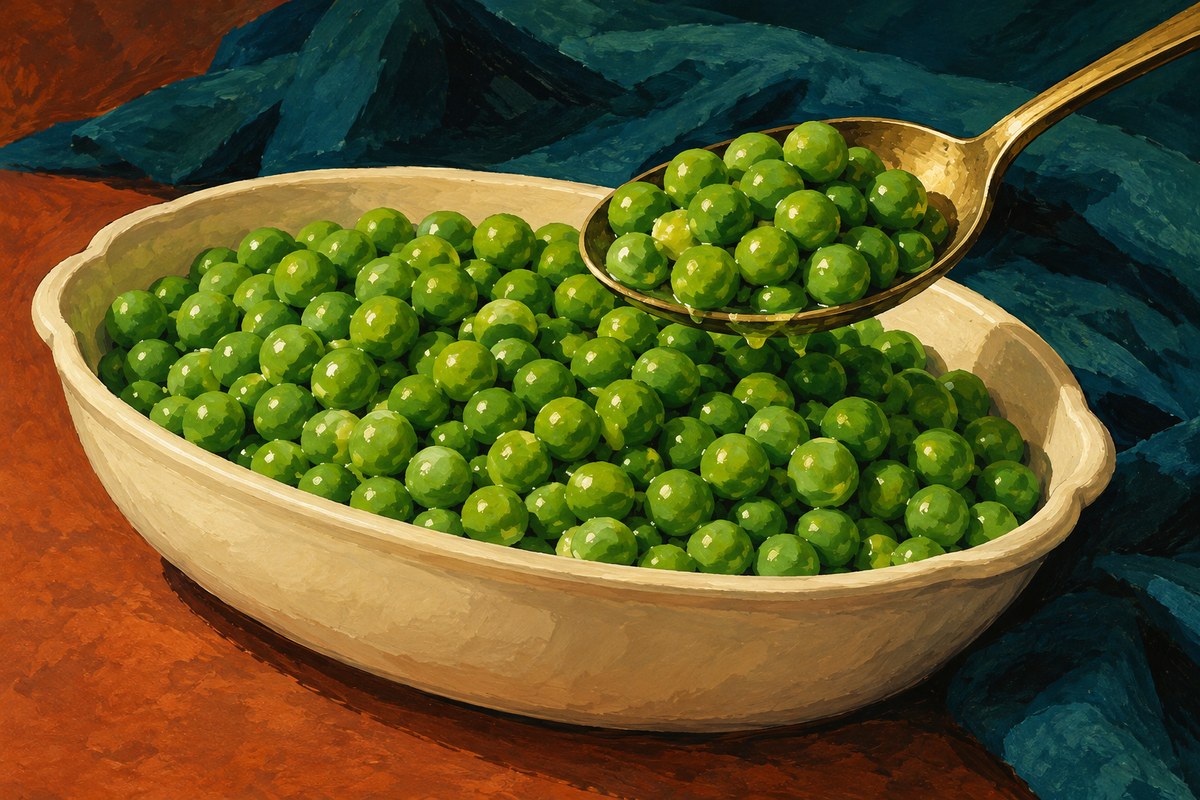
Plain peas get a little butter and white pepper after their full cooking stage. There is no cream sauce or decorative herb layer. Four small side portions are enough to put a green vegetable beside roast meat or fish without pretending this simple component is a complete meal.
Green peas appear among the vegetables on the dated second-class dinner menu. That wording does not identify whether they were fresh, preserved, buttered or seasoned in this way. Plain frozen peas are a practical modern starting choice here, and no individual diner’s plate is inferred.
Frozen does not mean already ready to serve
Choose a bag of plain peas rather than a mixed vegetable medley or a seasoned sauce pouch. Keep it frozen until the saucepan is ready. Read the label’s full cooking direction before deciding how much water to use. A pea can lose its icy center before its required cooking stage is complete, so a color change or a quick thaw is not the instruction. The small covered pan needs only enough water for the stated method, with an occasional careful stir and attention to prevent it boiling dry.
Butter follows the drain
If loose water remains after cooking, drain it before adding butter. The intended result is a light coating on warm peas, not a small bowl of diluted vegetable broth. White pepper is a newly chosen subtle seasoning; its tiny measure should not hide the vegetable’s flavor. Move to a serving dish only when the other components are ready. For a long table, make the quantity that will be eaten promptly and keep any reserve safely hot or cold rather than leaving one large bowl in an uncertain lukewarm state. A clean serving spoon and a small side portion keep this uncomplicated dish useful.
Ingredients
14 oz plain frozen green peas (400 g)
2 tablespoons drinking water (30 ml), or the packet-directed amount
1 tablespoon plus 1 teaspoon butter (20 g)
1/8 teaspoon fine salt (0.75 g)
A small pinch of white pepper
Set out
Saucepan with lid, at least 1.5 qt/1.4 L, Colander if draining needed, Spoon, Small serving bowl, Food thermometer for hot holding or reheating
Allergens
Milk; check pea and butter labels. Check labels and substitutions.
Make it
Put frozen peas and water in the saucepan. Cover, bring to a simmer and cook 4–6 minutes or for the full packet-directed time, stirring carefully once or twice and preventing the pan from boiling dry.
Drain any excessive loose water with care around steam. Take off the heat and stir in butter, salt and white pepper until peas are lightly coated.
Serve four small side portions promptly. If hot holding is necessary, use suitable equipment and verify the food remains at least 140°F (60°C); do not leave a bowl lukewarm while another course finishes.
Keep the small serving honest
Each portion begins with 100 g peas. These are companion vegetables for the table, not four large bowls or a claim to a historically recorded portion size.
Primary menu source
Royal Museums Greenwich, item LMQ/1/12/2: https://www.rmg.co.uk/collections/archive/rmgc-object-484157 . The original printed dinner menu was inspected; it does not establish what any named diner ate.
A useful detail
The 15-minute total includes reading the packet, heating a small pan, the full pea cooking stage and serving. A longer packet instruction extends it. Butter and white pepper are our additions, not details supplied by the historical menu.
Another way
Use 400 g fresh shelled peas instead of frozen, simmering in enough water until tender, usually 3–6 minutes depending on maturity. Fresh peas still have their own cooking time and do not need the same packet method.
Keep it well
Refrigerate shallow portions within 2 hours, or 1 hour above 90°F (32°C), at 40°F (4°C) or below. Use within 3 days or an earlier butter deadline. Reheat leftovers to 165°F (74°C). Refrigeration is preferred for this finished side’s texture.
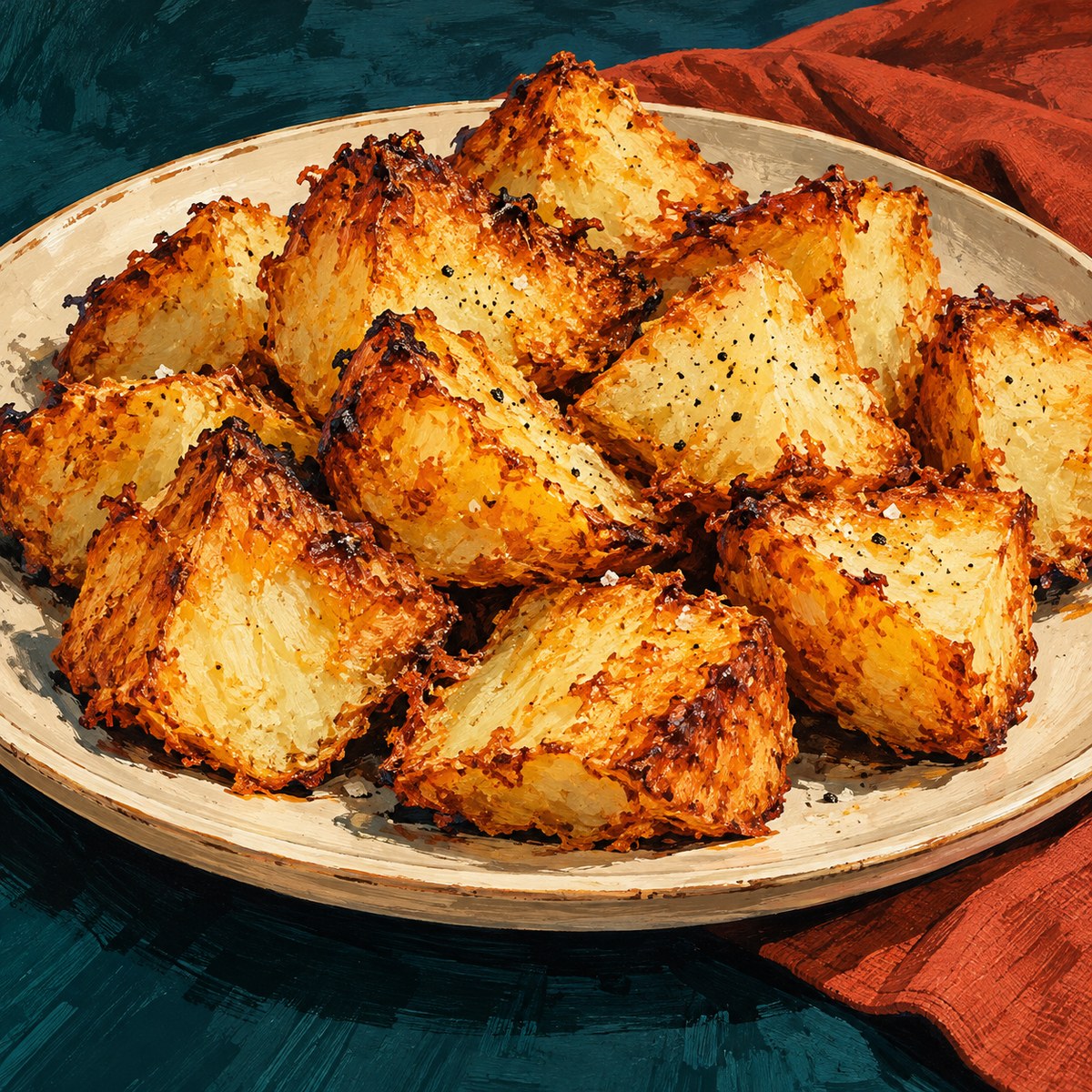
Parboiled floury potatoes are drained, steam-dried and gently roughened before roasting on a spacious tray. Oil is added to the cooled empty tray with the potatoes, avoiding a separate pan of preheated fat. The result aims for crisp golden surfaces and tender centers with a straightforward modern oven method.
A roast-potato offering, not its original technique
Roast potatoes are named alongside boiled potatoes on the preserved second-class dinner menu. It gives no potato variety, fat, tray or parboiling process. These quantities and the hot-oven method are our interpretation, without identifying a passenger’s choice or reconstructing the ship’s cooking equipment.
Use a floury potato for a roughened edge
Peel sound floury potatoes and cut generous similar chunks. A gentle parboil starts the centers and makes the outer layer soft enough to roughen. Drain, allow visible steam to escape and shake the colander lightly once or twice. The aim is a few feathery edges, not a bowl of broken mash. Waxy new potatoes keep a smoother shape and would give another finish. Taking the prepared weight after peeling keeps the oil and salt ratio useful even when potato sizes differ.
Give each piece a little bare tray
Spread on a large rimmed metal sheet so the potatoes do not press into a mound. The oil is tossed through the steam-dried pieces on the unheated tray, then everything enters the oven together. Turn with a wide spatula after the bottom has colored enough to release. Roasting until the center is tender matters as well as making a golden surface. Serve promptly while the crust is at its best, using four honest side portions rather than turning the full potato quantity into a dramatic single stack.
Ingredients
1 lb 12 oz sound floury potatoes, peeled and cut in roughly 1 1/2-in/4-cm chunks (800 g prepared)
8 cups drinking water (1.9 L), enough to cover for parboiling
2 tablespoons neutral oil suitable for roasting (30 ml)
1/2 teaspoon fine salt (3 g)
1/4 teaspoon black pepper
Set out
Oven, Large rimmed metal baking sheet about 13×18 in/33×46 cm, Saucepan, Colander, Wide spatula, Small knife, Food thermometer for reheating
Allergens
No major allergens inherent in the listed base; check oil labels and shared equipment. Check labels and substitutions.
Make it
Heat oven to 425°F (220°C). Put potato chunks in the saucepan with cold water to cover. Bring to a gentle boil and simmer 8–10 minutes until their outside softens but centers are not yet fully tender.
Drain thoroughly in the colander and let steam escape 5 minutes. Shake gently once or twice to roughen the outside without breaking the pieces apart.
Put potatoes on the unheated rimmed sheet and toss with oil, salt and pepper. Spread with gaps. Roast 40–50 minutes, turning after about 25 minutes with the wide spatula, until golden and crisp with centers tender to a knife. A crowded tray or particularly firm potatoes can need longer.
Serve four side portions promptly. No extra butter, gravy or herb garnish is part of this base recipe.
Wait before the first turn
A potato can stick while its surface is still forming. Give the first side time to color, then use a wide spatula rather than repeatedly tearing at it with a fork.
Primary menu source
Royal Museums Greenwich, item LMQ/1/12/2: https://www.rmg.co.uk/collections/archive/rmgc-object-484157 . The original printed dinner menu was inspected; it does not establish what any named diner ate.
A useful detail
The 90-minute total includes peeling and cutting, heating and parboiling, 5 minutes steam-drying, roughening, up to 50 minutes roasting and serving. A separate preheated-fat stage is not part of this method.
Another way
Cut the same 800 g prepared potatoes into slightly smaller 1-in/2.5-cm chunks for more surface area. Check parboiling and roasting earlier; their timetable will shorten and must still end with tender centers.
Keep it well
Refrigerate shallow portions within 2 hours, or 1 hour above 90°F (32°C), at 40°F (4°C) or below. Use within 3 days. Reheat leftovers to 165°F (74°C), allowing room on a tray if trying to restore some crust. Freeze promptly cooled portions for up to 1 month for quality and thaw in the refrigerator; the surface changes.