Evidence: Contemporary reporting attributed a large request and later consumption update to corrections officials.
Two strawberry milkshakes sit near the bottom of an unusually long food list. Above them are pizza, cheese, dressing and chips; below them come soft drinks, fries and ice cream. ABC News published the list two days after Gary Carl Simmons’s execution in Mississippi, attributing it to the Department of Corrections. The recognizable takeaway foods make the order easy to repeat. Understanding the event requires looking beyond its size. Russell Goldman’s contemporary ABC News report.
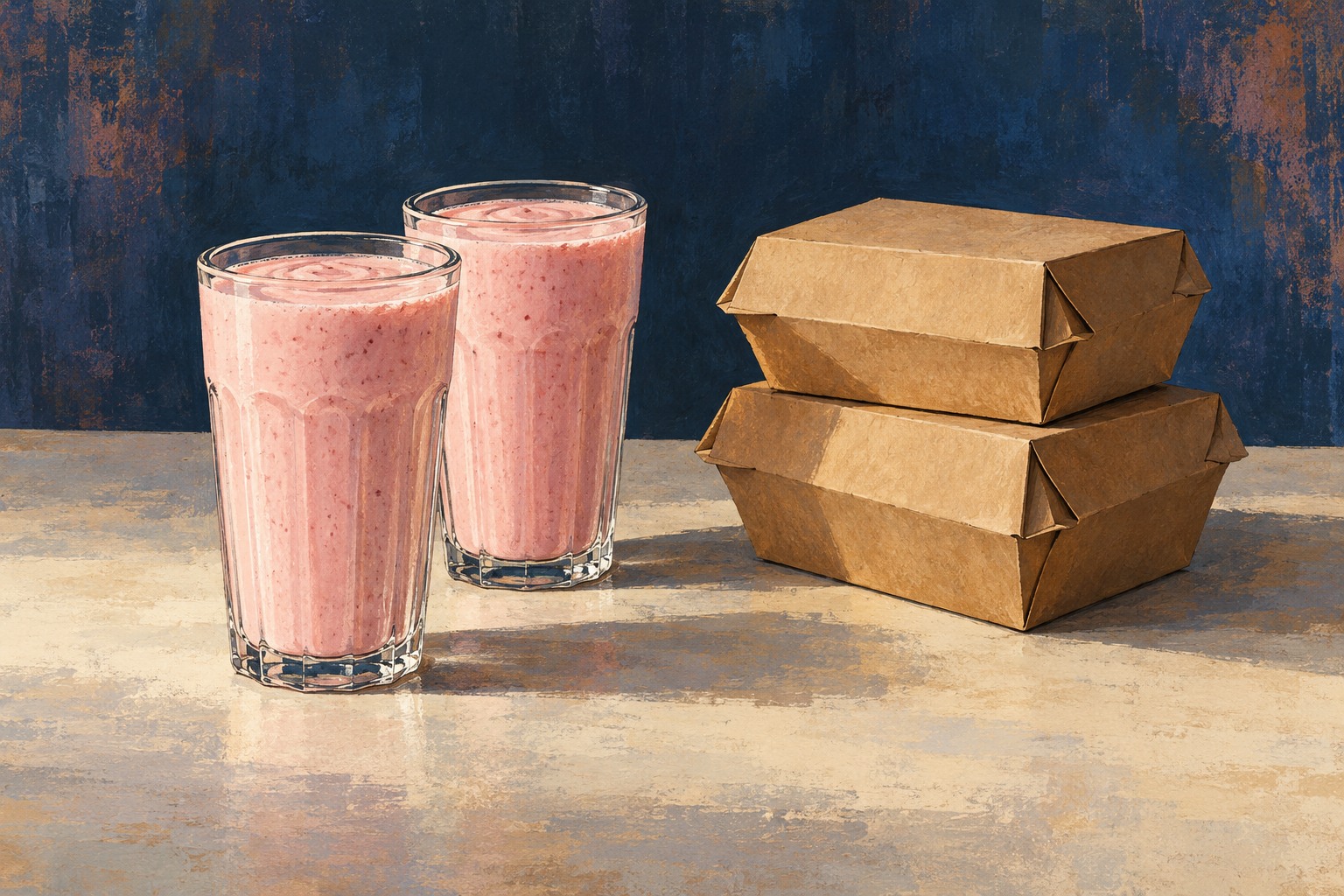
Imagined editorial still life of two plain strawberry milkshakes beside a small stack of closed takeaway cartons. It is not a reconstruction of the complete order or the prison setting.
Before the food list, a house in Mississippi
The federal appeal opens with the convictions: capital murder, rape and kidnapping, entered in 1997 in Jackson County. Its factual account returns to August 1996, when Jeffrey Wolfe and his companion, Charlene Leaser, traveled from Houston to Mississippi. Wolfe was killed. Leaser was held captive and assaulted, then escaped and reached a neighbor who called police. Her survival and action are part of the story behind the case. Fifth Circuit opinion, printed pages 1–3.
The later federal decision concerns sentencing issues and affirms the denial of relief. Its language is procedural, its pages dense with earlier decisions. The meal dispatch that followed less than a year later belongs to that longer sequence, not to a separate world of remarkable appetites.
A reporter arrives at Parchman
On 20 June 2012, WLOX reported that the Mississippi Supreme Court had denied a stay request. The local station named Doug Walker as its reporter at Parchman and one of the media witnesses selected for the execution. It is a glimpse of how the public account was assembled: court decisions reached a newsroom while a reporter traveled to the prison. Contemporary WLOX report.
ABC’s subsequent account gave the execution date and a list attributed to prison officials. It also reported an update that Simmons had eaten part of the food. The request and the update serve different purposes. One identifies what was ordered; the other gives an official observation as the afternoon progressed. Neither supplies a household recipe. ABC News.
The milkshakes inside the larger order
Among the reported foods were two large strawberry milkshakes. The word large is as far as this chapter can take the drink size: the account supplies no measured volume or ingredient ratio. There is no need to turn the whole order into a shopping challenge, or to repeat a headline calorie estimate as a tested nutritional calculation.
The drinks offer a smaller connection. Strawberry ice cream changes from something scooped to something pourable when combined with cold milk. The color is familiar, the technique brief. Reducing that one component to a modest batch gives the reader a real recipe while leaving the original order in its dated reporting context.
Two glasses, a different purpose
The modern recipe uses weighed commercial ice cream and a measured amount of pasteurized milk. Both start cold. A short blend is enough; prolonged blending warms the mixture and adds air without improving the food. Dividing it by weight also avoids pretending every ice cream brand fills an identical glass.
Wolfe and Leaser remain named above because the chapter concerns a crime and its aftermath, not a contest in excess. These two glasses belong to a present-day kitchen. Their recipe is complete, their scale is new, and their connection to the documented order is specific.
Commercial strawberry ice cream and cold pasteurized milk make two small shakes without a syrup or raw-fruit step. Strawberry milkshakes appear in contemporary reporting of Simmons’s meal request. This two-ingredient ratio and modest household yield are new choices, not a copy of the reported large drinks.
2 small milkshakes; about 11¼ oz/320 g mixture in total before blender residueActive 5 minCooking 0 minTotal 10 min
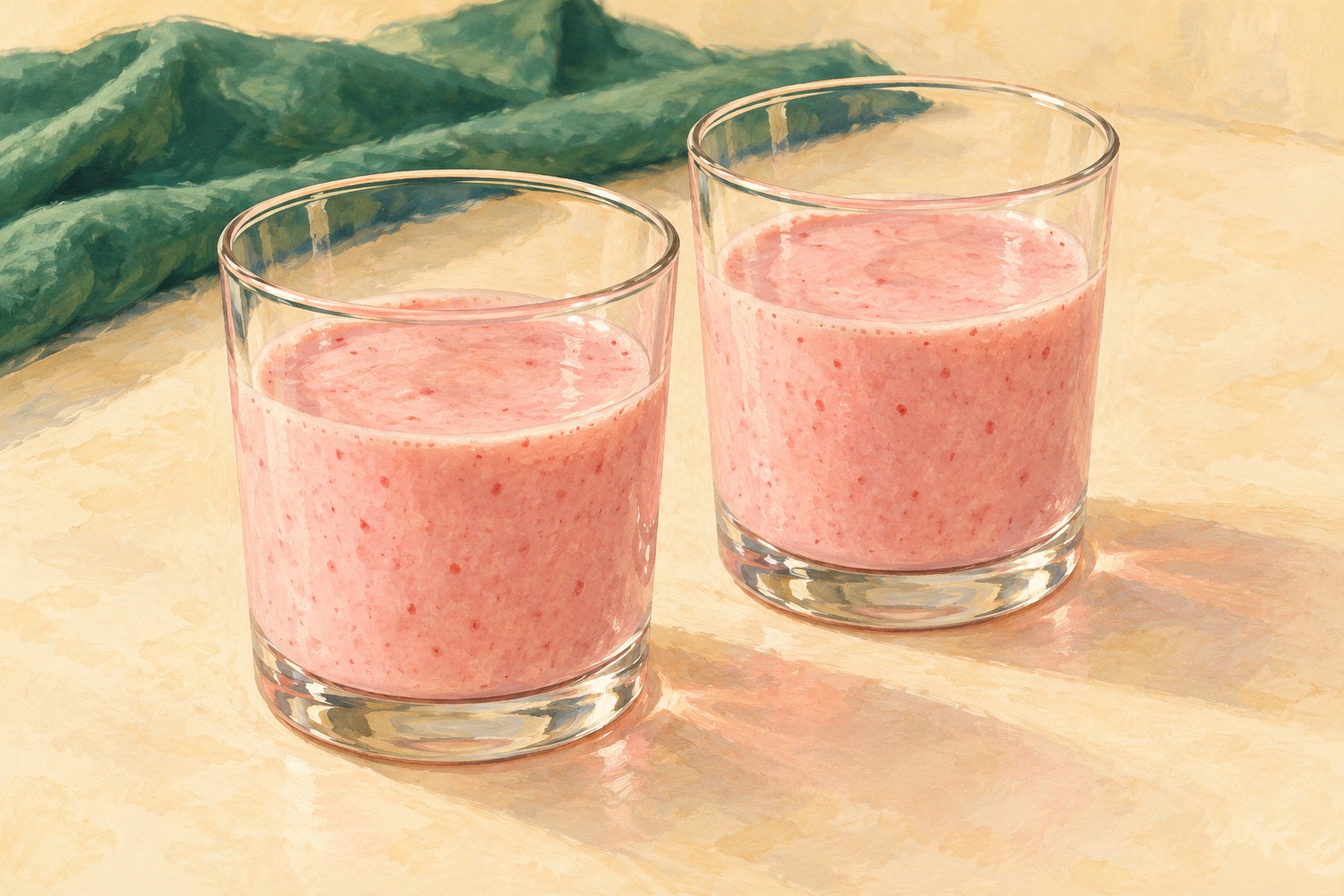
Print recipe · PDFOriginal modern recipe illustration: Small-Batch Strawberry Milkshakes. See the measured recipe for portions and cooking instructions.
Ingredients
7 oz commercial ready-to-eat strawberry ice cream (200 g), kept frozen until preparation
½ cup pasteurized milk (120 ml), chilled at 40°F/4°C or below
Set out
Blender with jug capacity at least 1 qt/1 L, Kitchen scale, measuring jug and clean spoon, 2 clean glasses, each holding at least 12 fl oz/350 ml to allow for variable aeration, Refrigerator and freezer
Allergens
Milk. Milk is required in the base recipe. Strawberry ice cream may also contain egg, wheat, soy or other labeled allergens, depending on its formula and mix-ins. Read the complete actual containers; the short recipe name is not an allergen guarantee.
Make it
Check that the ice cream is a ready-to-eat product and read its full ingredient/allergen label. Put the empty glasses ready. Measure the cold milk into the clean blender jug.
Weigh the ice cream. If it is too hard to scoop, leave its covered container out only about 5 minutes, just until workable, then return the unused ice cream promptly to the freezer. Do not let the whole tub melt. Add the measured 200 g to the milk.
Fit the lid securely. Start on low speed for about 10 seconds, then blend in short bursts only until smooth. Stop the motor before scraping with the clean spoon, refit the lid and blend briefly again if necessary. Keep utensils out while the blades move.
Divide the complete shake evenly between the 2 glasses, using weight if convenient: about 160 g each before blender residue. Different ice creams aerate differently, so no exact finished volume is promised. Serve immediately. No raw egg, syrup, cream, extra fruit or garnish is included.
A useful detail
The 10-minute total allows a brief softening interval if needed and 5 minutes for measuring, blending and serving. Commercial ice cream density varies; the household yield is therefore stated by weight, not a claimed historical cup size. Do not add unmeasured milk to the base formula.
Keep it well
Make only what will be served. Refrigerate any untouched spare shake promptly at 40°F/4°C or below and use within 24 hours; its texture will soften. Discard partly drunk glasses. Discard milkshake left at room temperature beyond 2 hours, or 1 hour above 90°F/32°C. Do not pour a prepared shake back into the ice-cream tub or refreeze the partly melted tub as a storage method.
How this recipe relates to the story
ABC News’s 22 June 2012 report lists two large strawberry milkshakes among foods attributed to the Mississippi Department of Corrections. It supplies no recipe or measured drink size. Commercial ice cream, pasteurized milk, this ratio and the small two-person yield are original modern choices.
Another way
Use the same 200 g weight of commercial vanilla ice cream for an explicitly different modern shake; that substitution is not the strawberry drink named in the meal report.
For a thinner new version, add exactly 1 tablespoon/15 ml extra cold pasteurized milk and blend briefly. Label it as the variation and divide the new total equally.