Famous Last Meals / Modern companion recipe
Small Plain Table Loaf
A small loaf of flour, water, yeast and salt has a firm golden crust and a plain, chewy crumb. Two rises give the dough time to become light without adding milk, butter or sugar. This is a new home bread to accompany the chapter; it does not identify the bread Charles ate.
Read Charles I: Bread and Claret at Noon →
Print recipe · PDF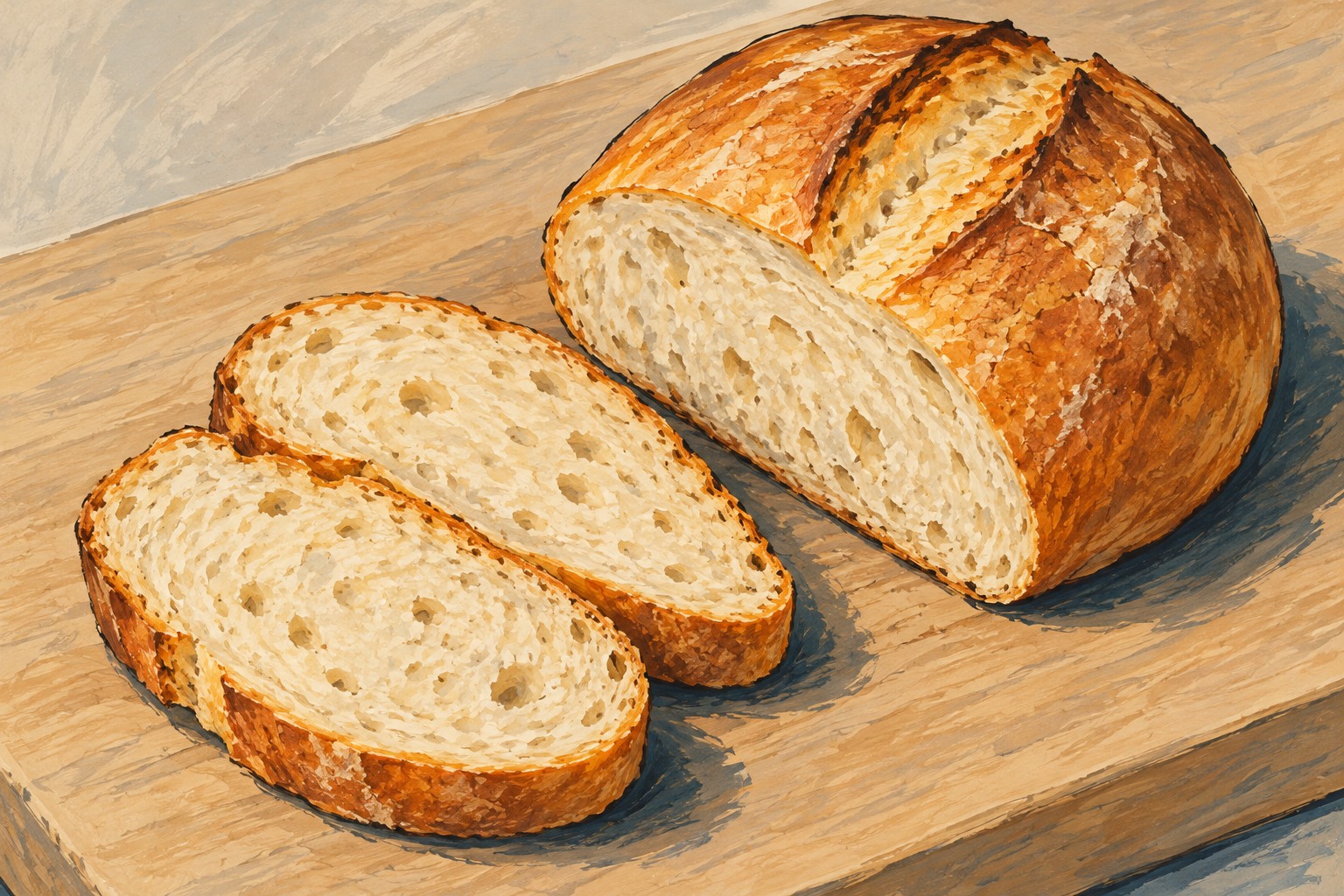
Give the small dough time to change
This dough has no added sugar to hurry it along and no fat to make a soft sandwich crumb. After kneading it should feel elastic and slightly tacky, with the measured flour fully moistened. Cover the bowl so the surface does not dry into a skin. For the first rise, look for a clear increase in volume. An extra half hour in a cool kitchen is more useful than putting the bowl against a dangerously hot surface.
A seam underneath, a cut above
Pulling the dough’s edges inward creates tension across the upper surface. Pinch the gathered seam and place it underneath so the loaf holds a round shape. After its second rise, a deliberate shallow cut gives the surface a place to open in the oven. Do not flatten the risen round to make an ornate pattern. A plain slash suits this small loaf and keeps the shaping easy to repeat.
Wait before cutting the first slice
A hot loaf is still settling inside. Put it on a rack so air reaches the base and wait through the cooling allowance. Cutting it immediately can compress the moist crumb into a gummy line even when the center was properly baked. Once cool enough, use a serrated knife with a light sawing motion. Freeze slices you will not use soon rather than leaving the cut face exposed for several days.
Ingredients
- About 2 cups plus 1 tablespoon white bread flour (250 g), weighed, plus up to 2 teaspoons (5 g) for the surface
- 2/3 cup plus 1 teaspoon drinking water (165 ml), lukewarm at about 95–100°F/35–38°C
- About 3/4 teaspoon instant yeast (2.5 g), weighed if possible; use instant yeast rather than active dry yeast for this direct-mix method
- 3/4 teaspoon plus a small pinch fine salt (5 g)
Set out
Conventional oven, Mixing bowl with cover, Kitchen scale, measuring jug and spoons, Clean kneading surface and dough scraper, Flat metal baking sheet with at least 10 by 12 inches/25 by 30 cm usable area, Baking paper rated for at least 425°F/220°C, Small sharp knife for scoring, Food thermometer, Oven gloves and wire cooling rack, Serrated bread knife, Foil for loosely covering a browning crust if needed
Allergens
Wheat. Check the flour and yeast labels for added ingredients and cross-contact warnings. The base formula has no added milk or egg; that is not a claim that the finished loaf is allergen-free.
Make it
- Mix the 250 g dough flour, instant yeast and salt in the bowl. Add all the measured lukewarm water and stir until no dry pockets remain. Knead for 8–10 minutes until smooth and elastic, using only as much of the measured 5 g bench flour as needed to prevent sticking. Keep the dough soft rather than adding unlisted flour. Do not taste raw dough; wash hands and flour-dusted tools before touching ready-to-eat food.
- Return the dough to the bowl, cover and leave in a comfortably warm room for about 75–105 minutes, until roughly doubled. A cool room may take longer. Judge the expansion rather than making an exact clock promise.
- Line the cold baking sheet with suitable paper. Gently flatten the risen dough, bring the edges toward the center and pinch them together. Turn seam-side down and cup with your hands to make a taut round about 5 1/2 inches/14 cm across. Put on the sheet, cover loosely and prove for 35–50 minutes, until puffy and a gentle fingertip indentation returns slowly. The loaf must have room to widen as it rises.
- During the final 20 minutes of proving, heat the oven to 425°F/220°C, conventional, with a middle shelf clear. Uncover the dough and cut one shallow slash about 1/4 inch/6 mm deep across the top. Bake for 10 minutes, reduce to 400°F/200°C and bake for another 20–25 minutes, until deeply golden with a firm base and a central temperature around 205–210°F/96–99°C. If it is coloring too quickly, cover the top loosely with foil and continue until the center is baked.
- Transfer to the rack and cool for at least 45 minutes before slicing. Cut into 8 slices and serve 2 as a bread portion with a separately prepared meal. The loaf is plain: no butter, wine, cheese or garnish is included in this recipe.
A useful detail
The dough weighs about 422 g before any small amount of bench flour is incorporated. Its water is 66% of the dough flour weight. The 260-minute estimate allows mixing, up to 105 minutes for the first rise, shaping, up to 50 minutes for the second rise, 35 minutes baking and 45 minutes cooling. Proving can take longer in a cool room.
Keep it well
Cool completely before wrapping. For best texture, keep the plain loaf covered in a cool, dry place and use within 2 days. Freeze individual slices once cool, well wrapped at 0°F/−18°C, for up to 2 months for quality. Thaw slices at room temperature or toast from frozen. These directions apply to this plain bread, not to a sandwich with perishable fillings.
How this recipe relates to the story
Bread is the documented food category. White bread flour, instant yeast, hydration, salt, shape, yield and oven schedule are all original modern choices. No wine is required to make or serve the loaf.
Another way
- For a different modern shape, form the same dough into one short oval rather than a round. Keep it on the same roomy sheet, preserve both rises and use the full cooked-center check; no extra filling or topping is added.