Famous Last Meals / Modern companion recipe
Small Maple Pecan Pie
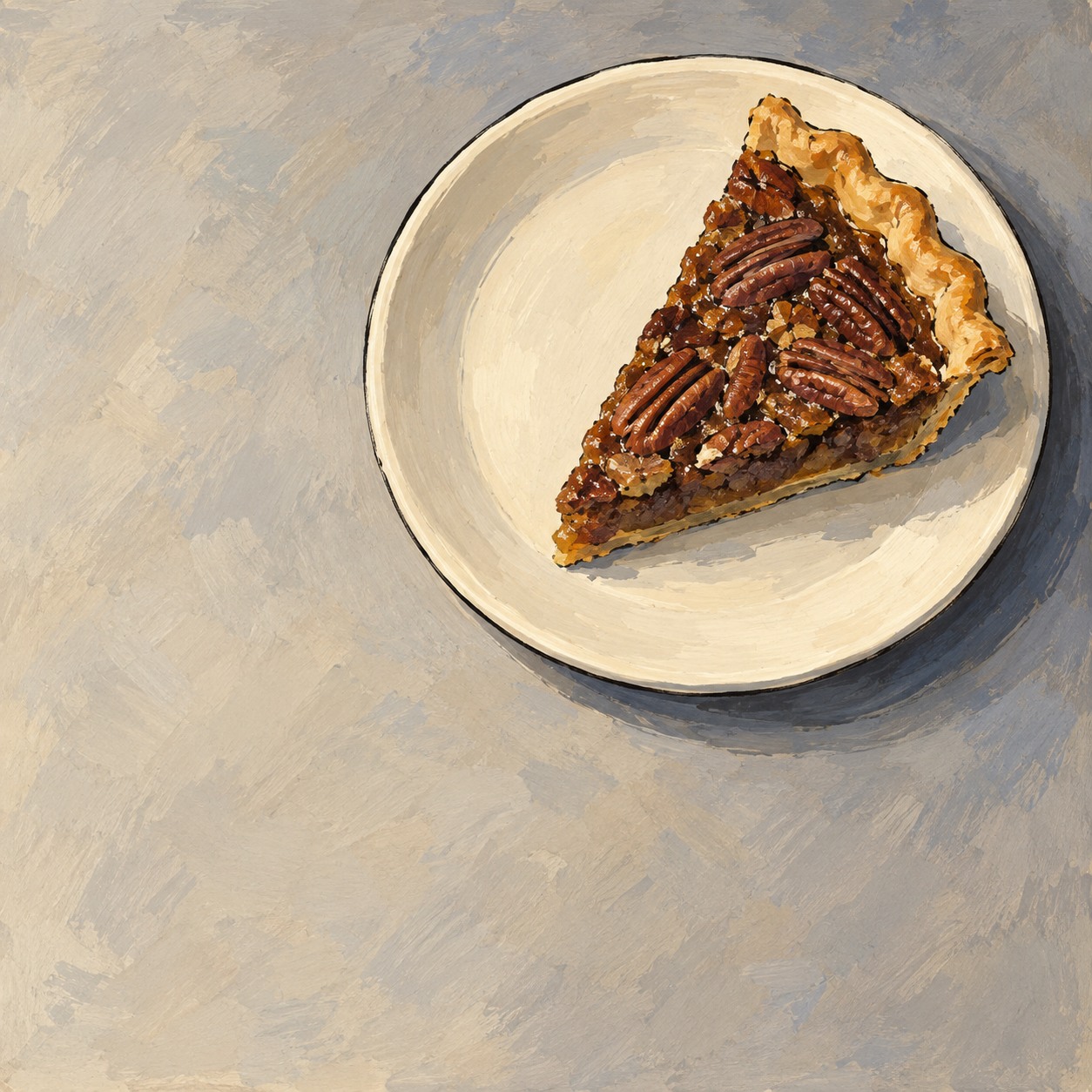
A small homemade butter crust holds chopped pecans in a maple-and-brown-sugar filling. The shallow pie cuts into four wedges once thoroughly cooled and chilled. This is a new home dessert with a measured modern formula, not a recipe for the pie described in Rector’s meal records.
Read Ricky Ray Rector: The Pie Left Behind →
Print recipe · PDF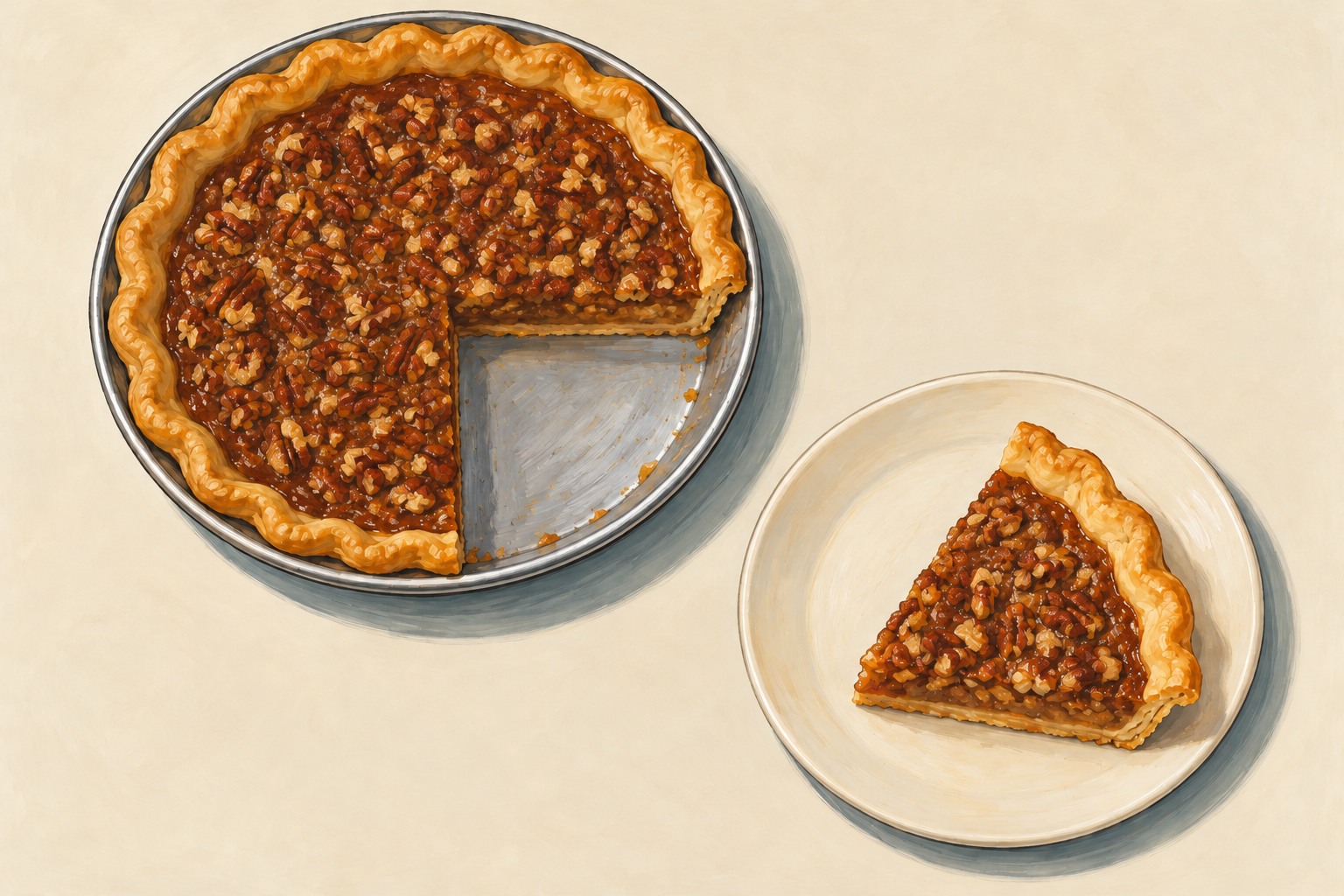
Make one small crust, not six pastry cups
Keep the butter cold and stop rubbing it in while some little pieces remain. Bring the dough together with the measured water; repeated kneading would make the pastry tougher. The small circle fits a shallow pie tin, where one filling can be checked in the center and divided after chilling. Fit it into the corners before trimming. Stretching the dough tightly up a side encourages it to pull down when it heats.
Chopped nuts make a clean small wedge
Coarse pieces distribute through the shallow filling and are easier to cut than a decorative roof of whole halves. Use the whole measured 60 g rather than adding more as a garnish. The maple syrup supplies both flavor and liquid, while the egg sets the filling. Substituting a large spoonful of dry sugar for the syrup would change that balance. This is an ordinary sweet dessert, with no dietary or historical authenticity claim.
Let the pie finish in the refrigerator
A hot pecan filling can burn and will not cut into a neat wedge. Use the rack for the short initial cool, then move the small pie to the refrigerator within the stated safety limit. Do not wait on the counter until the whole filling feels cold. Refrigerated chilling is part of the recipe’s time. Cut with a small sharp knife and put the remaining pie back promptly, keeping any serving interval brief.
Ingredients
- 2/3 cup all-purpose flour (80 g), plus up to 2 teaspoons (5 g) for rolling
- About 3 tablespoons cold unsalted butter (40 g), cut into small cubes, for the pastry
- 1/8 teaspoon fine salt (0.75 g), for the pastry
- 4 teaspoons cold drinking water (20 ml), for the pastry
- About 1/2 cup ready-to-eat pecans (60 g), coarsely chopped
- 1 large egg (50 g without shell), kept refrigerated until mixing
- 3 tablespoons pure maple syrup (45 ml; about 60 g)
- 2 tablespoons packed light brown sugar (25 g)
- 2 teaspoons unsalted butter (10 g), melted and cooled until just warm, for the filling
- 1/2 teaspoon vanilla extract (2.5 ml)
- Small pinch fine salt (about 0.4 g), for the filling
Set out
Conventional oven, Metal pie tin measuring about 6 inches/15 cm across the usable inside rim, 5 inches/13 cm across the inside base and 1 1/4 inches/3 cm deep; at least 450 ml capacity to the bare rim, Rimmed metal baking sheet to support the pie tin, Kitchen scale, measuring jug and spoons, Mixing bowls, fork and whisk, Rolling pin and clean board, Baking paper and food-safe ceramic baking weights, Foil for protecting the pastry rim if needed, Food thermometer, Oven gloves and cooling rack, Refrigerator, cover and small sharp knife
Allergens
Wheat; Milk; Egg; Tree nuts (pecans). Read the flour, butter, syrup, vanilla and nut labels for additional ingredients or cross-contact warnings. The walnut variation changes the specific tree nut; it does not remove that allergen category.
Make it
- Mix the 80 g pastry flour and 1/8 teaspoon salt in a bowl. Rub or cut in the cold 40 g butter until there are fine crumbs and some small flat butter pieces. Add the measured cold water and gather gently into a dough without kneading it smooth. Flatten to a disc, cover and refrigerate for 30 minutes. Do not taste raw pastry; keep flour dust away from ready-to-eat food and clean the surface after rolling.
- Roll the dough on the lightly floured board, using no more than the reserved 5 g flour, to a roughly 8-inch/20-cm circle about 1/8 inch/3 mm thick. Ease it into the stated tin without stretching. Trim to the rim and press small clean scraps into any thin places; refrigerate any clean unused pastry trims separately, covered at 40°F/4°C or below, and use within 24 hours in another fully cooked preparation, or discard them. Chill the lined tin for 15 minutes. Meanwhile heat the oven to 375°F/190°C, conventional, with a middle shelf clear.
- Put the pie tin on the baking sheet. Line the pastry with baking paper and fill with food-safe baking weights to support the base and sides. Bake for 15 minutes. Lift the paper and weights out carefully with protection against hot metal, then bake the empty case for 5 more minutes, until its base looks dry and lightly colored. Reduce the oven to 350°F/175°C and let the case stand on a heatproof surface for 5 minutes.
- While the case stands, whisk egg, maple syrup, brown sugar, the cooled melted 10 g butter, vanilla and filling salt until combined, without making a thick foam. Stir in all the chopped pecans. Spoon the complete filling into the pastry, keeping at least 1/4 inch/6 mm below its rim; the measured shallow filling is about 200–220 ml. If a different tin leaves insufficient headroom, use the specified tin rather than forcing food over the rim. Do not taste the raw egg mixture.
- Bake at 350°F/175°C for about 30–35 minutes, until the pastry is golden, the filling is set at the edge and the center moves gently as one mass rather than sloshing. The egg filling must reach at least 160°F/71°C in its center. Continue in short intervals if needed; cover the pastry rim loosely with foil if it browns too quickly. A safe temperature alone does not replace the set-filling check.
- Cool the pie on the rack for about 45 minutes, then cover and refrigerate for at least 2 hours until firm enough to slice. Always refrigerate within 2 hours of leaving the oven, or within 1 hour above 90°F/32°C. Cut into 4 wedges and serve chilled, or let only the needed wedge stand for about 10 minutes. No cream, ice cream, syrup drizzle or extra nut decoration is included.
A useful detail
The pastry dough is about 141 g before bench flour; clean trims are not counted as another finished dessert. The filling is about 208 g. A tin with the stated interior dimensions holds roughly 460 ml before lining; choose at least 450 ml usable capacity to the bare rim. Its lined case has ample room for the roughly 200–220 ml shallow filling while retaining at least 6 mm headroom. The 300-minute estimate includes pastry mixing, two chills, preliminary and final baking, a short case rest, 45 minutes rack cooling and at least 2 hours refrigerated chilling.
Keep it well
Keep covered at 40°F/4°C or below and use within 3 days, following any shorter ingredient limit. Put uneaten portions back promptly and keep total room-temperature serving time below 2 hours, or 1 hour above 90°F/32°C. Once completely chilled, wrap individual wedges and freeze at 0°F/−18°C for up to 1 month for quality. Thaw covered in the refrigerator. Serve cool; the filling and pastry may be softer after freezing.
How this recipe relates to the story
Pecan pie appears in both reporting accounts, while the records do not supply its formula. Homemade butter pastry, maple syrup, chopped nuts, the six-inch tin and four-wedge yield are original modern choices. Serving this companion does not imply Rector ate the retained pie.
Another way
- Use the same 60 g ready-to-eat coarsely chopped walnuts instead of pecans for a clearly different modern nut pie. Retain the egg filling, tin, cooked-center and chilling checks; tree-nut allergy still applies.