
Incoprea Research · independent re-analysis · 4 November 2026
Two checks: the storage premium, and the hydrogel negative
The surrogate null the storage dossier said it had not done, and an independent examination of the one result in this archive that is a clean negative. One headline changes; the other holds.
Independent re-analysisNo experiment performedCode published
1 · Storage chronology — the premium does not survive a spectrum-preserving null
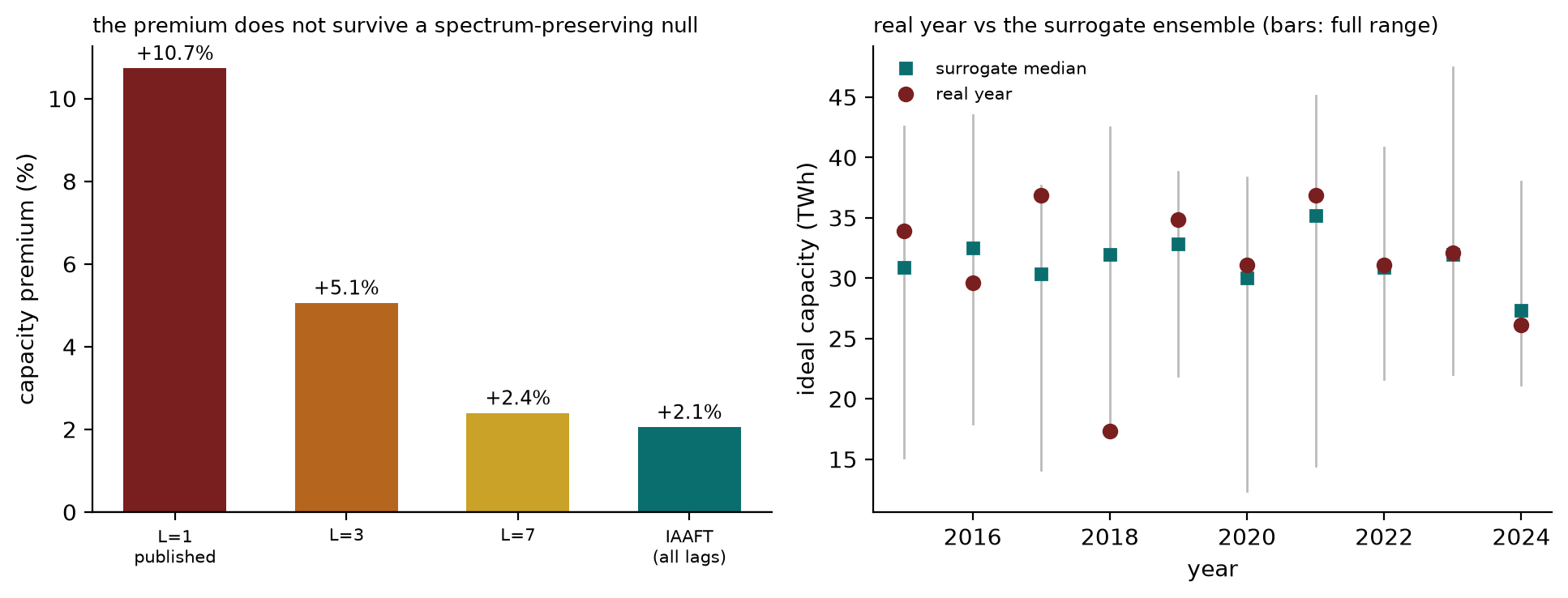
The flagship number: at fixed peak, mean and variance, reordering whole days inside each month changes the ideal cyclic storage capacity of a 70/30 wind/solar year by a median 10.7 %. The dossier had already shown this falls to 5.1 % under a 3-day block shuffle and 1.8 % under 7-day, and states in its limits section that a phase-randomised surrogate would be a stronger null and is not done.
This is that null. A surrogate is built that reproduces the exact amplitude distribution, the complete power spectrum — hence the autocorrelation at every lag — and the climatological seasonal cycle, and destroys only the sequence. Per year: residual load r; seasonal cycle c = the mean at each calendar slot over the other nine years (leave one out); anomaly a = r − c; surrogate = c + IAAFT(a), 32 draws.
| null | median premium | years below 5th pct | sign test |
|---|---|---|---|
| day shuffle (published) | +10.7 % | — | 10/10 |
| 3-day blocks | +5.1 % | — | 10/10 |
| 7-day blocks | +2.4 % | — | 8/10 |
| full-spectrum surrogate | +2.1 % | 0/10 | 7/10, p = 0.17 |
So the effect is a property of the residual-load power spectrum, not of chronology beyond it. The 10.7 % should be quoted only as a statement about a counterfactual with no multi-day persistence. The dossier’s mechanism finding is confirmed and strengthened; the headline number is not supported.
Which years remain
The dossier nominates 2017 and 2023 as the residual to investigate. Under this null 2023 is the most ordinary year in the set (+0.4 %, p = 0.50) and 2017 is the outlier (+21.6 %, p = 0.06). A second year, 2018, sits in the opposite tail (−45.8 %, p = 0.03). Two years in the tails at the 3–6 % level out of ten is roughly what chance produces, so this is a thread to pull, not a finding.
One caution for anyone quoting per-year numbers: the surrogate capacity distribution is wide, because a handful of low-frequency bins dominate the range of a cumulative sum. Splitting the 32 draws in half and comparing the two medians moves the ratio by 6 % typically and 32 % at worst, so per-year premiums carry about ±6 % resolution. The cross-year median and the sign test are the robust statistics, and both say no detectable effect.
2 · H0346 hydrogel — the negative result holds, and it is classical
The claim: perforating a dense skin never beats an area-only control. Reproduced exactly — min 0.0842, max 0.9607, median 0.5946, fraction above 1 equal to zero — and independently recomputed from the four sweep tables: 0 of 224 layouts beat the control.
The mechanism is the classical access resistance of a single aperture: a hole’s flux is limited by the surrounding gel’s ability to collect the flow, which scales as 1/a. So per unit of open area,
That is why the loss is set by hole radius over skin thickness rather than by open-area fraction, and why it can never exceed one. Two refinements follow, and one retraction of the audit’s own first pass.
Refinement 1. The exponent should be 1 for the pure access-resistance mechanism. The 0.84 is a finite-spacing correction: at fixed open area, more small holes interact less than the isolated-aperture formula assumes. The fit captures both in one exponent, which is fine for use and worth saying.
Refinement 2. Skin permeability drops out of the result entirely (regression coefficient −0.003) because the skin is the dominant resistance in every swept layout — skin-to-hole conductance ranges 10⁻⁵ to 10⁻¹. The universal statement is therefore conditional on that regime, and the regime covers the whole of the present data. That scoping should be explicit rather than implicit.
3 · What changed on this page
| claim | before | after this check |
|---|---|---|
| storage premium | 10.7 %, falling to 1.8 % under a 7-day null | +2.1 % under the strongest null, not significant (p = 0.17) |
| storage mechanism | most of the premium is multi-day persistence | the premium is the power spectrum; no residual ordering effect is detectable |
| which year is the residual | 2017 and 2023 | 2017, and separately 2018 in the opposite direction; 2023 is ordinary |
| hydrogel gain law | 1/(1 + 0.45(a/δ)0.84), fitted in-sample | same law, transfers across all sweeps; mechanism identified as aperture access resistance |
| hydrogel regime | unstated | universal when the skin is the transport bottleneck — which is the entire swept range |
4 · Status and limits
Neither check is an experiment. Both re-analyse an existing model on existing data. The storage result depends on one construction choice — leave-one-out climatology on a 365-day grid with 29 February folded onto the 28th — and a different climatology would move the median premium by a percentage point or two without changing the conclusion, since the block nulls bracket it. The hydrogel result depends on the dossier’s own solver, which was run unmodified; the independent part is the recomputation from its per-case tables and the closed-form interpretation.
A frequency-band decomposition of the storage premium was attempted and withheld: the first implementation used a zero-padded moving average that corrupts the year boundaries, so the bands were not comparable. It is not reported rather than reported badly.