Measurement Blind Spots · supplied 1 November 2026
Sources, provenance & corrections
Analytical derivations and simulations are source-reported, not independently reproduced during publication. No published dataset was directly reanalysed. Source readiness/novelty scores are author assessments, not validation or novelty clearance. Original claims, corrections and negative results are retained.
Complete originals
All 27 original files · Full SHA-256 inventory · PDF · Word · CSV · JSON
Export completeness
The received export preserves the full compiled document, structured hypotheses, code, available outputs and figures. Some paths mentioned in its prose (separate hyp/ and refined/ directories, several data/ outputs) are not present in this export. We have not invented or regenerated missing files. The 30 refined entries are extracted from the compiled Markdown; all original files retain their bytes.
Corrections and negative findings
Corrections, negative results, and superseded claims
This file records everything in the collection that changed during construction, every claim that failed a quantitative check, and every place where a hypothesis was narrowed rather than defended. It is deliberately kept separate from the hypotheses so that a reader can see what the evidence did to the original idea.
1. Two hypotheses were replaced before publication
C38 (chemistry). The original entry claimed that electrochemical ammonia synthesis rates near the detection limit are dominated by ambient and membrane-derived contamination. A check against the prior Incoprea corpus found an existing hypothesis making essentially the same claim (“Most reported electrochemical ammonia synthesis is contamination”). Rather than republish it with a new number, C38 was replaced with a different electrochemistry hypothesis: that scanning electrochemical microscopy assigns a finite rate constant to insulating regions because its feedback theory assumes a conductive substrate. The replacement has a different mechanism (diffusion-limited approach curve fitted with a conducting-substrate model), a different observable (tip-radius dependence of the apparent rate over a known insulator), and a different refutation.
P20 (physics). The original entry attributed the residual muon g−2 discrepancy to a scheme mismatch in the intermediate window between lattice and data. A prior Incoprea hypothesis already assigns the residual to lattice hadronic-vacuum-polarization systematics. The overlap was judged too close. P20 was replaced with a different precision-physics hypothesis: that optical-clock comparisons inherit an unmodelled self-gravity term from the apparatus mass. The replacement is testable with a ballast-variation experiment and does not depend on the g−2 literature.
2. A hypothesis failed its own quantitative check: R04 / B01
Original claim. Plate-reader OD600 compresses above ~0.3–0.6 because of detector saturation and stray light, suppressing fitted growth rates.
What was computed. A stray-light model, measured OD
= −log₁₀(10^(−OD_true) + S), with the bias in fitted μ obtained from a
log–log regression over four candidate windows
(R1_refinement_numbers.py, section A).
Result. - S = 10⁻³, window OD 0.2–1.0: bias −0.1% - S = 10⁻², window OD 0.2–1.0: bias −1.1% - S = 10⁻³, window OD 2.0–3.0: bias −8.0% - S = 10⁻², window OD 2.0–3.0: bias −23.4%
Conclusion. Stray light cannot explain compression
in the OD 0.3–0.6 range. The hypothesis as originally stated is
not supported. It was narrowed: the mechanism is real
but confined to OD > 1.5, and any sub-exponential growth below OD 1
must have a different cause. The entry in hyp/04-biology.md
now carries the corrected numbers and names the surviving candidate
mechanisms (detector nonlinearity, meniscus and fill volume,
evaporation, physiological shift) along with the tests that separate
them.
Why it is kept. A hypothesis that loses cleanly is the point of the collection. The failed mechanism was removed from the suspect list for the low-OD regime, which is a real gain.
3. A hypothesis was corrected in direction but not in kind: R21 / X33
Original claim. Inverse-variance weighting with variances estimated from the same data biases the weighted mean toward points whose noise fluctuated low.
What was computed. 40 000 Monte Carlo trials with four measurements and 2–30 degrees of freedom per variance estimate.
Result. The mean is unbiased (−0.000 to 0.005). The spread of the estimator exceeds its nominal value: 0.686 at 2 dof, 0.582 at 5, 0.539 at 10, 0.511 at 30, against a nominal 0.5. The quoted uncertainty is therefore 73%, 86%, 93% and 98% of the true spread.
Conclusion. The heading was wrong, the phenomenon is real. The refined entry now claims uncertainty understatement rather than mean bias, with the dof-dependent magnitude.
4. A hypothesis overstated its own effect size: R20 / X13
Original claim. Non-stationarity makes every estimated autocorrelation time too short, and hence every error bar too small, by a large factor.
What was computed. For a linear trend of amplitude a against noise σ, the ratio of the true standard error to the naive one is √(a²/12 + σ²)/σ.
Result. 1.01 at a/σ = 0.5; 1.04 at 1; 1.15 at 2; 1.53 at 4.
Conclusion. The effect is real but modest — under a factor of two even when the trend is four times the noise. The refined entry says so explicitly and restricts the claim to regimes where the trend dominates.
5. A claim about test power was softened after computation
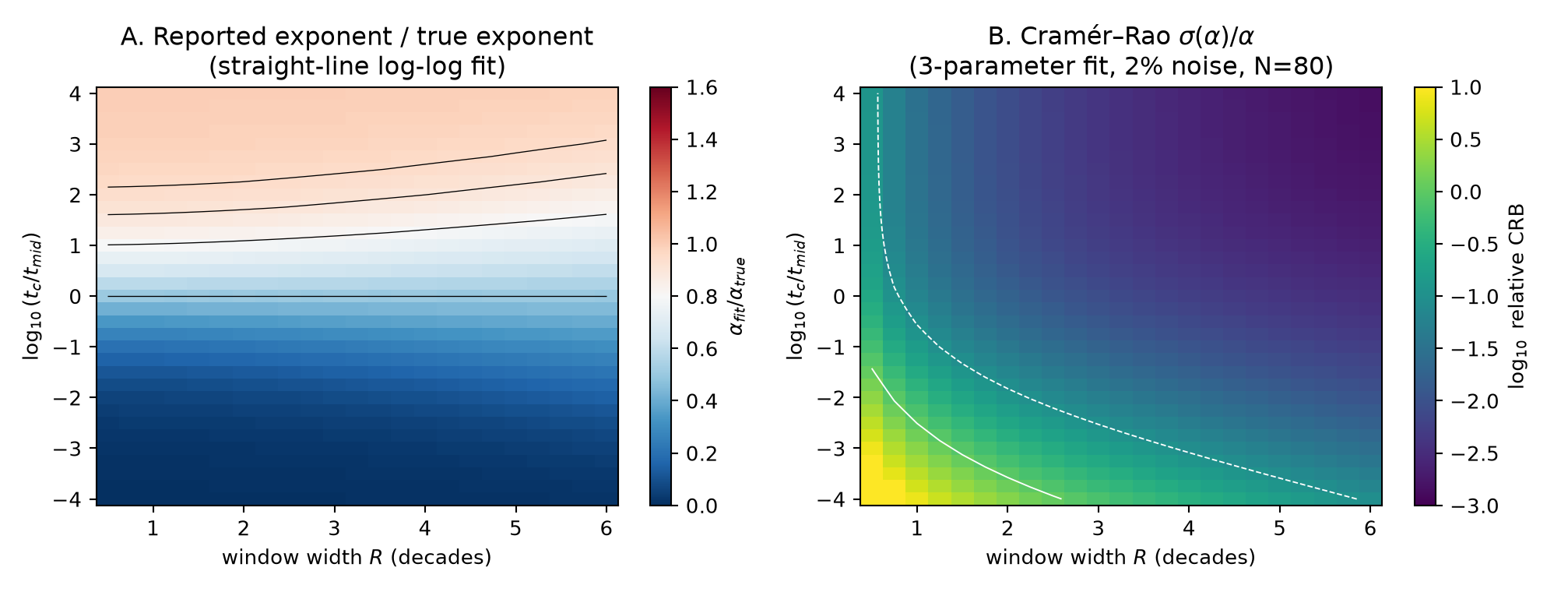
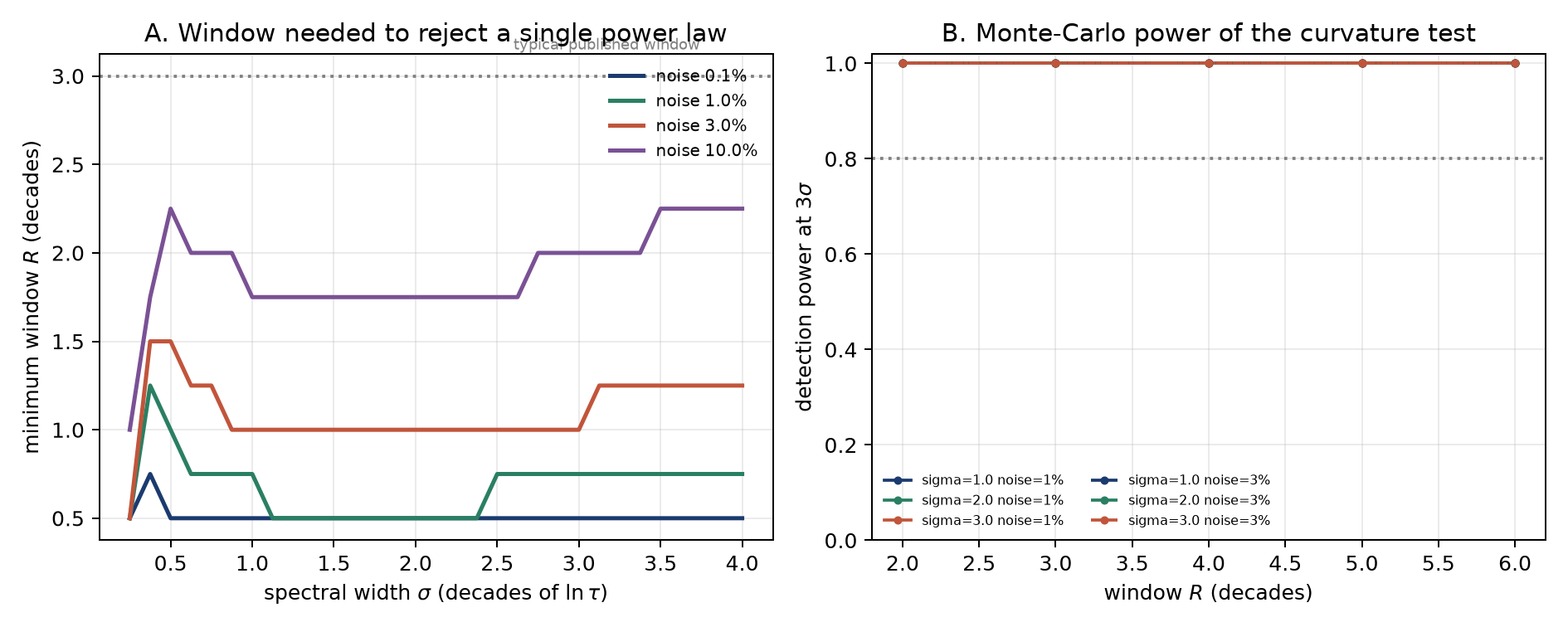
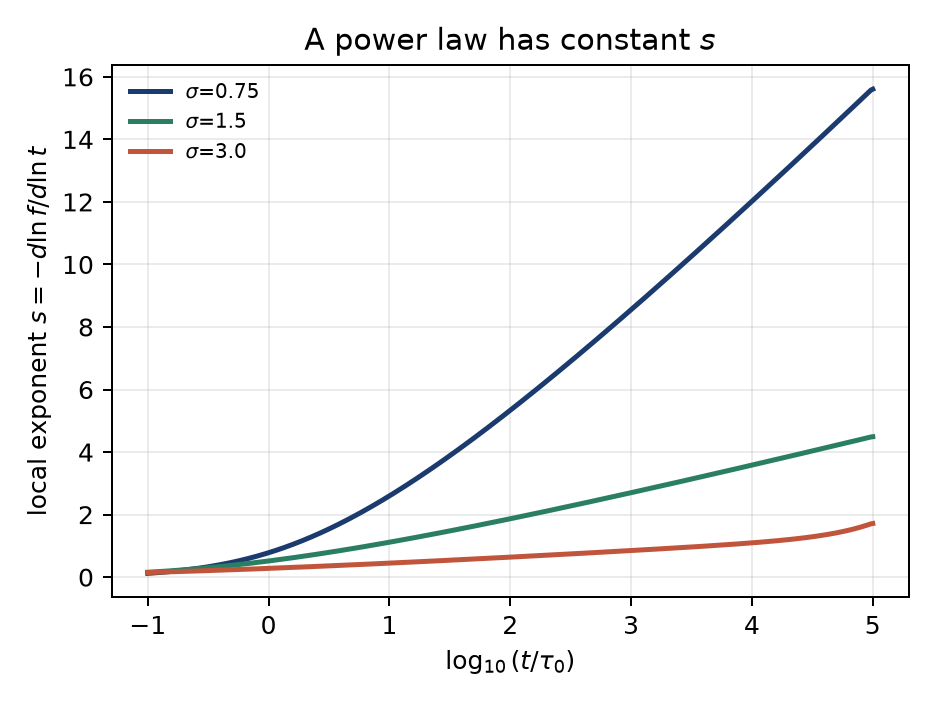
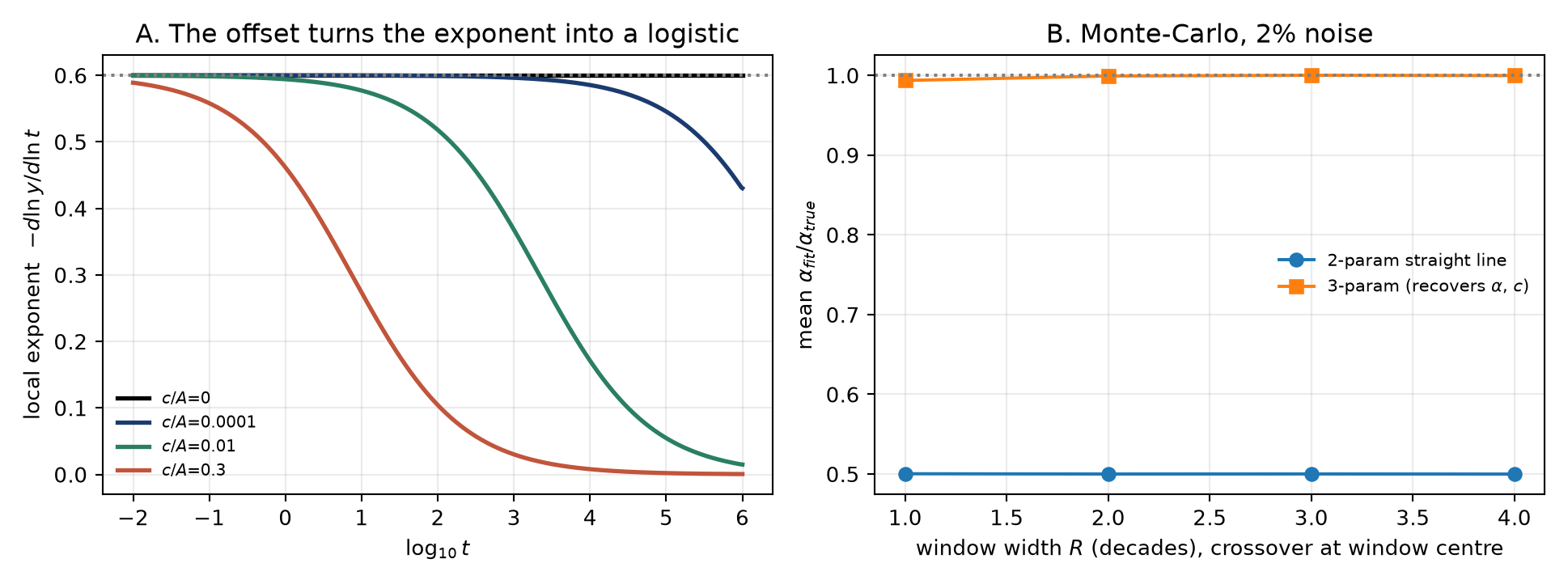
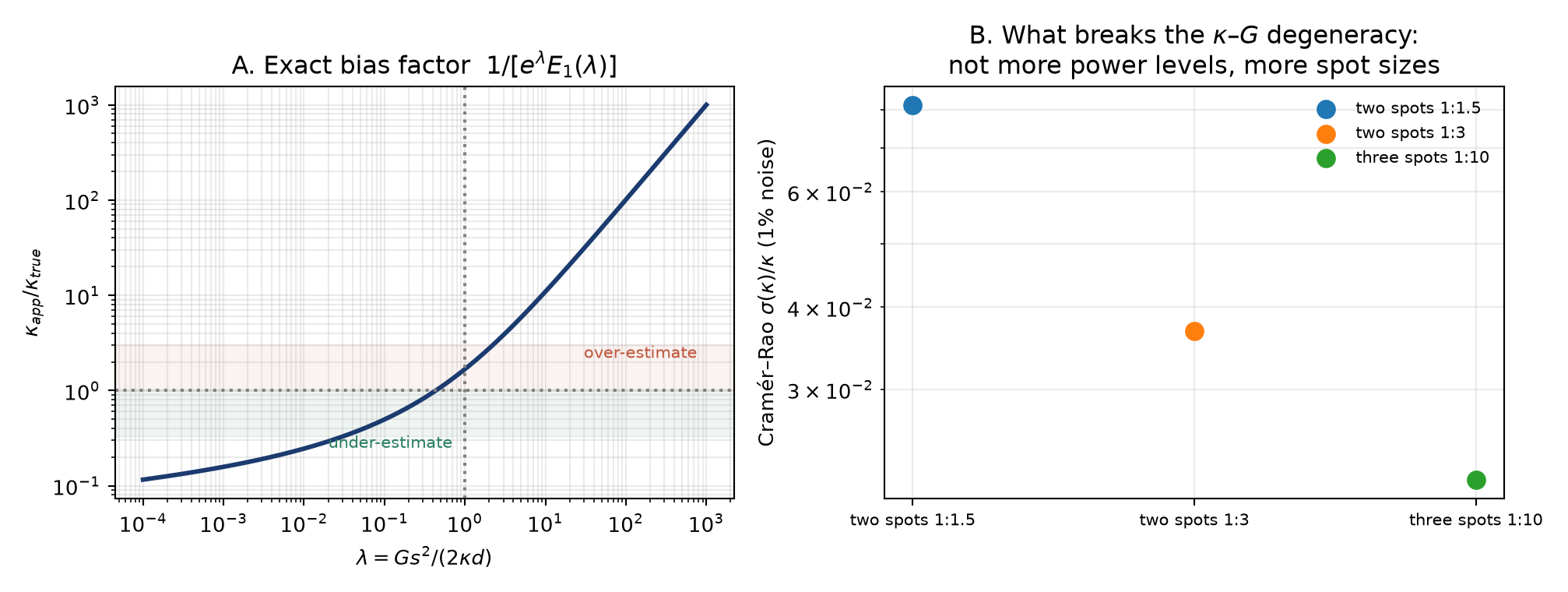
In I1 the initial framing assumed that a broad distribution of relaxation times would be indistinguishable from a power law over a short window. Direct evaluation of the log-normal Laplace transform showed the opposite: a log-normal spectrum produces a strongly curved decay, and a 0.5-decade window is enough to reject a single power law at 1% noise when the window sits on the spectral knee. The investigation was rebuilt around the offset term instead, where the degeneracy is genuine and the Cramér–Rao bound actually diverges. The discarded framing is recorded here rather than deleted.
6. Numerical errors caught during development
- I2, Hankel quadrature. The first version of the validation integral was missing a factor of two and disagreed with the closed form by exactly 0.5 at every λ. The closed form was correct; the check was fixed. Agreement is now 2×10⁻¹³.
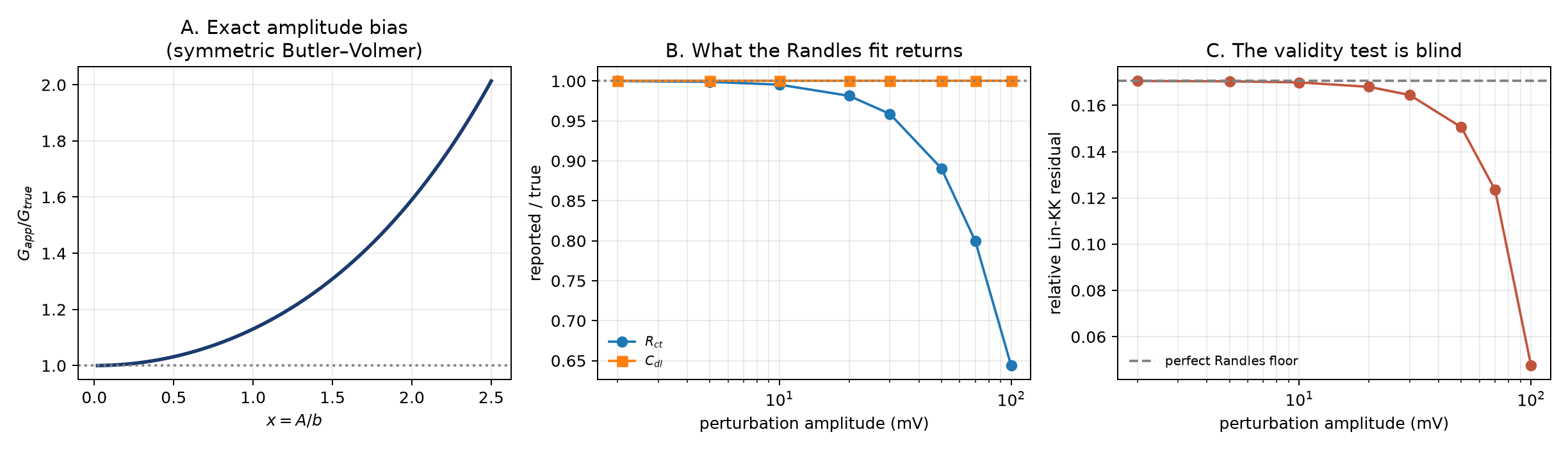
- I3, spectral derivative. The first harmonic-balance implementation divided the derivative of η by N, making the capacitive current 128× too small. The symptom was a fitted C_dl of 0.156 µF against a true 20 µF. Fixed by using the exact rfft/irfft derivative.
- I3, Bessel comparison. The first comparison used the thermal voltage RT/F where the Tafel parameter RT/(αF) was required, so the analytic and numerical curves differed by a factor of two in x. The identity was right; the comparison was wrong.
- I3, Lin–KK. The first Lin–KK implementation used an unbounded least-squares Voigt fit and reported a residual of 0.17 even for an exactly linear spectrum. Rather than use a fragile test, the final version compares the measured spectrum directly against the exact Debye form, which gives 10⁻⁷ and is unambiguous.
- R1, DSC lag. The first version double-converted scan rate and produced onset shifts of 12–200 K. Replaced with a time-constant formulation giving 0.4–6.7 K.
- R1, TDTR. The first sensitivity model was two series resistances, which is trivially degenerate at all frequencies. Replaced with a thermal-quadrupole multilayer model that includes the film’s heat capacity and reproduces the expected frequency dependence.
7. Things that were not done
- No experiment was performed. No apparatus was built. No sample was measured.
- No published dataset was reanalysed directly. The reanalysis predictions in I2 and R03 are stated as tests, not as results.
- The arXiv records cited were retrieved through the arXiv API and their abstract pages returned HTTP 200 on 1 November 2026. Their content was read at abstract level; no claim in this collection depends on a number taken from a paper without saying so.
- The 300 hypotheses were checked against 358 prior Incoprea hypothesis titles with a string-similarity screen. Two overlaps were found and replaced (section 1). The similarity screen cannot catch semantic overlap with different wording, so residual overlap remains possible.
Methodology and source-assessment depth
Methodology, scales, and limits
What was built
- A source base. A programmatic harvest of 817 arXiv
records submitted between January 2024 and December 2026, drawn from 49
queries aimed at measurement systematics rather than at subject matter:
“systematic error”, “measurement bias”, “unobservable”, “blind spot”,
“cannot be distinguished”, “degeneracy”, “identifiability”, “hidden
variable”, “nuisance parameter”, “model discrepancy”, “interlaboratory”,
“boundary condition”, “contact resistance”, “nonlinear impedance”,
“third harmonic”, “small-signal approximation”, “Kramers–Kronig”,
“instrument response”, “deconvolution”, “drift”, “aging”, “hysteresis”,
“model misspecification”, and 26 others. The harvester is
src/harvest_arxiv.py; the raw pack isdata/arxiv_pack.json. - A prior-art screen. 358 unique prior Incoprea
hypothesis titles were extracted from the existing export bundles, and
every new title was compared against them by string similarity. Two
substantive overlaps were found and replaced (see
CORRECTIONS.md). - Hypothesis construction. 300 hypotheses were
written directly, in six domain batches: physics and astronomy (50),
chemistry and electrochemistry (50), materials (50), biology and
medicine (50), engineering and Earth science (50), cross-cutting
methodology (50). Each was required to have a named baseline, a
mechanism, a discriminating observation, an available test, prior art,
and an explicit refutation. The parser
src/parse_hyp.pyenforces the schema and rejects missing fields. - Selection and refinement. 30 were selected for development on three criteria: the mechanism had to be expressible quantitatively; the blind spot had to be invisible to the instrument or test that is normally used as a check; and the refutation had to be cheap. Refinement required labelling each part of the claim as an identity, an artefact, or a genuine prediction.
- Investigation. Three were taken to full
mathematical treatment with validated code: finite-window decay
identifiability (I1), spot-size bias in thermal metrology (I2), and
Kramers–Kronig blindness (I3). Every number quoted in the refined set is
regenerated by
investigations/R1_refinement_numbers.py.
What “readiness” means
| Score | Meaning |
|---|---|
| 5 | A reanalysis of published data, or a two-point change to an existing measurement, would settle it |
| 4 | Existing public data or an existing apparatus can confirm or kill it |
| 3 | Needs a dedicated measurement campaign or a new analysis pipeline |
| 2 | Needs new instrumentation |
| 1 | Needs the idea made precise before it needs an experiment |
Readiness is a judgement about cost, not importance. Of the 300: 45 are scored 5, 201 are scored 4, and 54 are scored 3.
What “novelty” means
| Score | Meaning |
|---|---|
| 5 | A mechanism not present in the literature as far as the source base shows, with a new observable |
| 4 | A known mechanism applied where it is not currently applied, with a quantitative prediction |
| 3 | A known mechanism given a specific, testable form in a new domain |
| 2 | A known effect quantified for a domain that has not quantified it |
| 1 | A restatement or a small extension |
Novelty 4–5 is claimed for 61 hypotheses; the rest are mostly 3. This is deliberate: most real progress in measurement science comes from taking a known mechanism seriously in a place it has not been taken seriously, not from inventing a new mechanism.
The three labels used in the refined set
- Identity. True by construction. The logistic slope law in R01, the Bessel conductance ratio in R02, the closed-form temperature rise in R03, and the series-resistance formula in R25 are identities. They are useful and they are not discoveries. Presenting them as discoveries is the most common way this kind of work goes wrong.
- Model artefact. A property of the analysis rather than of the world. R07 (spurious ratio correlation), R09 (log-space bias), R21 (weighting), and R20 (error-bar deflation) are artefacts in this sense: they are real effects on reported numbers, produced entirely by the analysis.
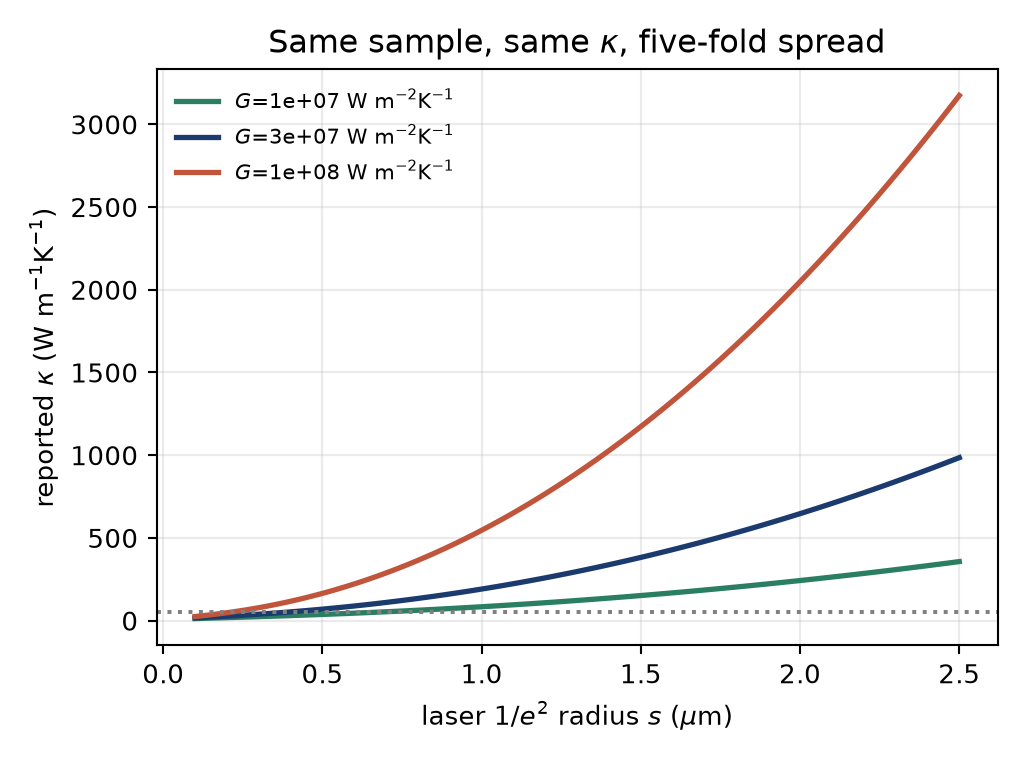
- Genuine prediction. A statement that could be false. R01’s claim that the offset is recoverable from curvature, R02’s claim that the KK test cannot detect the bias, R03’s claim that κ_app ∝ s² at large spot size, R11’s frequency-dependence ratio, and R26’s area-scaling collapse are all of this kind.
Limits
- No experiment was performed. Every result is analytic or numerical. The collection contains no new measurement, and nothing here should be cited as evidence that a proposed effect was observed.
- The source base is arXiv-weighted. arXiv covers physics, mathematics, materials, and quantitative biology well and clinical medicine poorly. Hypotheses in the medical entries rest on general methodological literature rather than on a dedicated source harvest.
- The prior-art screen is lexical. String similarity catches phrasing overlap, not conceptual overlap. Two overlaps were found; others may remain.
- Quantitative predictions are model-dependent. The numbers in the refined set are computed from stated models with stated parameters. They are illustrations of magnitude and scaling, not predictions for named materials or systems. Where a number depends on an assumed parameter (for instance the substrate conductance G in I2), the assumption is stated.
- The readiness scores are optimistic by design. A 4 means someone could test it soon, not that the test is easy or cheap.
- Adversarial reading. Several entries take the contrarian side of a live dispute (P11 on the neutron lifetime, P20 on clock self-gravity, P36 on the proton radius). They are marked, and each carries the observation that would show it is wrong.
Reproducing the collection
cd blindspot-2026-11-01
../.venv-research/bin/python src/parse_hyp.py            # rebuild CSV/JSON, validate schema
../.venv-research/bin/python investigations/I1_offset_window_bias.py
../.venv-research/bin/python investigations/I2_boundary_bias.py
../.venv-research/bin/python investigations/I3_kk_blindspot.py
../.venv-research/bin/python investigations/R1_refinement_numbers.py
python3 build/build_doc.py                                # assemble and typeset
The arXiv harvest is not required to rebuild the document;
data/arxiv_pack.json is included. Re-running
src/harvest_arxiv.py will produce a different pack because
arXiv grows, so the pack shipped here is the one this collection was
built from.
File inventory
- 00-START-HERE.md · 5521 bytes
- Blind-Spots.docx · 717970 bytes
- Blind-Spots.md · 360534 bytes
- Blind-Spots.pdf · 3712556 bytes
- CORRECTIONS.md · 7676 bytes
- MANIFEST.json · 2871 bytes
- METHODOLOGY.md · 6579 bytes
- README.md · 2595 bytes
- figs/i1_biasmap.png · 128535 bytes
- figs/i1_frontier.png · 112650 bytes
- figs/i1_localslope.png · 55560 bytes
- figs/i1_logistic.png · 129674 bytes
- figs/i2_bias.png · 130303 bytes
- figs/i2_spread.png · 77055 bytes
- figs/i3_kk.png · 130553 bytes
- hypotheses_300.csv · 238359 bytes
- hypotheses_300.json · 311226 bytes
- investigations/I1_offset_window_bias.py · 7503 bytes
- investigations/I2_boundary_bias.py · 8196 bytes
- investigations/I3_kk_blindspot.py · 10171 bytes
- investigations/R1_refinement_numbers.py · 6593 bytes
- investigations/README.md · 8996 bytes
- investigations/i1_mc.csv · 1817 bytes
- investigations/i2_R_of_lambda.csv · 7472 bytes
- investigations/i3_summary.json · 1744 bytes
- r1_refinement_numbers.json · 3280 bytes
- sources.csv · 2858 bytes
Bibliographic identifiers and HTTP checks are source-reported. Abstract-level reading is not a full-text assessment of support for the exact hypothesis. Novelty, outside review and physical validation remain separate questions.