052 / 75 · Sweet things worth the space
Pear–Rosemary Polenta Turnouts
12 small upside-down pear cakes; one cake per portion · Active 30 min · Cook 30 min · Total 2 hr 55 min
Print recipe · PDFA small piece of pear belongs at the top of each cake, rather than disappearing into the batter. Fine cornmeal gives the crumb a sandy tenderness, and a little rosemary makes the pear taste less predictable. Turn the cakes out before leaving home.
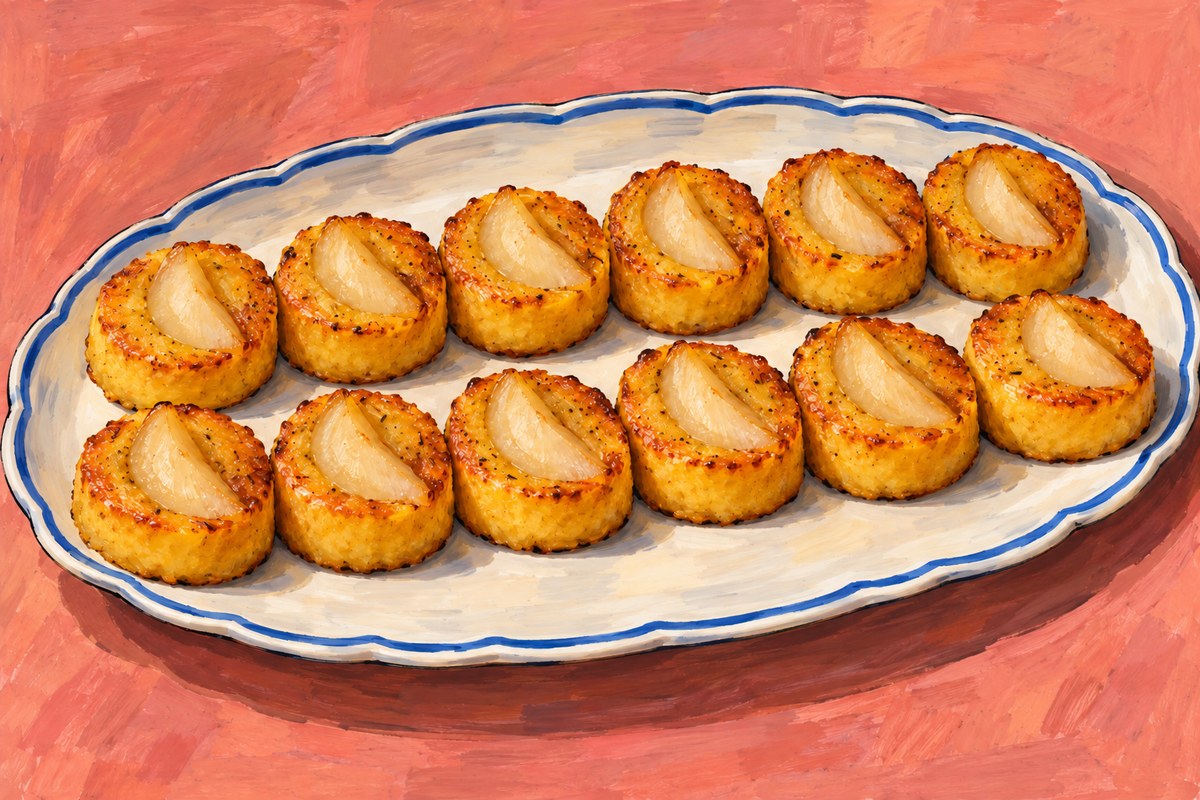
Choose a pear that has already softened
Ready-to-eat canned pear gives a more predictable small cake than a hard fresh pear. Drain and blot the fruit before weighing the prepared amount. Extra canning liquid would thin the batter around the fruit and make the turnouts difficult to release.
Twelve individual fruit tops
Line the muffin wells with small paper circles and use the measured butter on their sides. That small preparation is useful: the fruit sits on the bottom during baking but becomes the visible top after turning out. Do not carry the cakes still trapped in the pan.
Ingredients
- 240 g ready-to-eat canned pear halves, drained, blotted and cut into twelve equal pieces
- 100 g unsalted butter, softened: 10 g for the pan and 90 g for the batter
- 100 g fine sugar
- 100 g beaten egg without shell, about 2 large eggs
- 120 g all-purpose flour
- 50 g fine yellow cornmeal
- 6 g baking powder
- 2 g fine salt
- 1 g fresh rosemary leaves, very finely chopped
- 100 g plain yogurt made with pasteurized milk
- 40 ml milk
Set out
Oven, 12-well muffin pan with measured cavities at least 150 ml each, Baking paper cut into twelve base circles, Digital scales, Fine grater and knife, Two mixing bowls and whisk, Small brush, Thin knife or spatula, Food thermometer, Rack and shallow rigid lidded transport box, Ice-packed cooler
Allergens
Milk, Egg, Wheat. Check labels and substitutions.
Make it
- Heat the oven to 350°F (180°C). Brush the twelve wells with the reserved 10 g butter and add a paper base circle to each. Put one 20 g piece of drained pear on each base. Keep the other 90 g butter for the batter.
- Beat the 90 g butter and sugar until light, about 3 minutes. Beat in the egg in three additions. In a second bowl mix flour, cornmeal, baking powder, salt and chopped rosemary.
- Fold the dry ingredients into the butter mixture in two additions, alternating with the yogurt and milk. Stop when no dry flour remains; do not taste the raw batter. Divide all the batter evenly among the twelve pear-topped wells, about 59 g each. Each well should be no more than two-thirds full overall.
- Bake for 25–30 minutes, until the cake tops spring back and a skewer pushed into cake beside the fruit has no wet batter. Check a representative cake center reaches at least 160°F (71°C); continue until both the texture and temperature checks pass.
- Stand in the pan for 10 minutes. Loosen the edges and turn the cakes onto a rack, fruit upward; remove all paper circles. Cool for another 20 minutes, then refrigerate in a single layer for at least 90 minutes, until 40°F (4°C) or colder.
Bring it
Carry the turned-out cakes fruit-side up in one shallow rigid container; dividers stop the pear tops sticking to the next cake. Chill them fully before putting the box into the cooler. Keep at 40°F (4°C) or colder in an ice-packed cooler and at the gathering. Count all time out of cold control during packing, transport and display together: no more than 2 hours, or 1 hour above 90°F (32°C).
Finish at the gathering
Ready to serve. The host needs a plate and small forks; no warm oven is required. Set out six cakes first and replace the plate with the remaining cold cakes when needed.
Make it yours
For a winter brunch, serve one cake at each place. For a spring housewarming, use the same small portions on a shared dessert plate; the rosemary and pear remain the complete finish.
Ingredient labels
Check canned fruit, yogurt and baking powder labels for additional ingredients or cross-contact. Cornmeal is not a substitute for the wheat flour already present.
A useful detail
The 175-minute allowance includes 25 minutes of preparation, up to 30 baking, 30 cooling and 90 chilling. Active work is about 30 minutes because loosening and packing occur after the bake. Twelve 150 ml wells provide room for roughly 20 g fruit and 59 g batter apiece; do not use miniature muffin wells.
Another way
- Use 240 g drained ready-to-eat canned peach pieces instead of pear, still one 20 g portion per cake.
- Replace the rosemary with 2 g finely grated zest from a washed lemon; keep the remaining formula unchanged.
Keep it well
Refrigerate the fruit-topped cakes in a shallow covered container at 40°F (4°C) or below for up to 3 days. Get them into refrigeration within 2 hours of leaving the oven, or 1 hour above 90°F (32°C). Allow a small serving batch to lose its chill briefly; keep the rest cold. Freezing is not recommended for the appearance of the fruit tops.