051 / 75 · Sweet things worth the space
Clementine–Coriander Shortbread Tiles with Chocolate Corners
12 rectangular tiles, about 5×6.5 cm each; 1 tile per dessert portion · Active 35 min · Cook 40 min · Total 2 hr 40 min
Print recipe · PDFCoriander brings a quiet citrus note to a short, buttery biscuit; it does not turn it into a savory cracker. A dark chocolate corner gives each tile a different first and last bite. The uncovered part stays clean enough to hold.
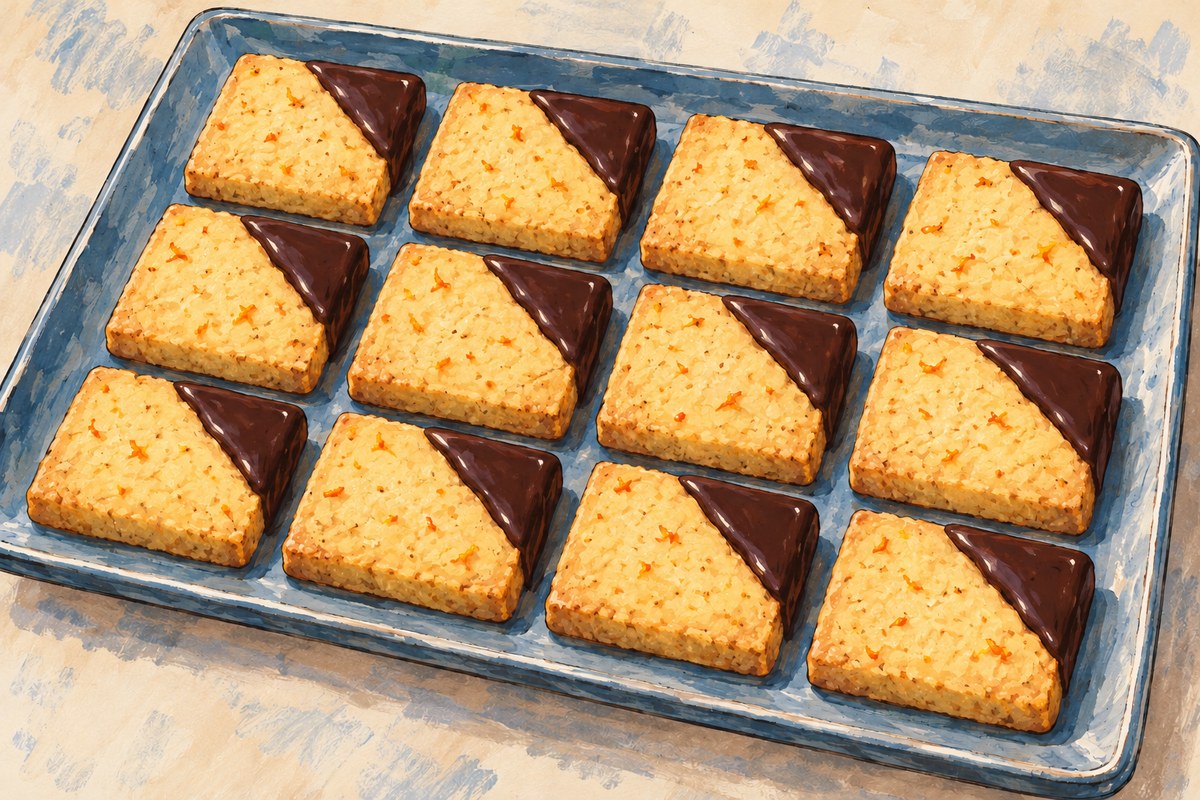
A corner is enough
Covering only one corner keeps the biscuit crisp and lets the clementine come through. Divide the chocolate into twelve small portions before dipping so the last tile receives the same finish as the first. There is no fresh cream in this coating.
Cut while it is still yielding
Warm shortbread cuts more neatly than completely cold shortbread. Let the baked slab stand for twenty minutes, then follow the scored lines with a sharp knife. Leave the pieces in the pan until firm enough to move; rushing that stage makes crumbly gifts.
Ingredients
- 180 g all-purpose flour
- 30 g cornstarch
- 110 g unsalted butter, softened
- 70 g fine sugar
- 6 g finely grated zest from washed clementines, with no white pith
- 2 g ground coriander
- 2 g fine salt
- 90 g dark chocolate, finely chopped
Set out
Oven, 20×20 cm square metal pan, at least 3 cm deep, Baking paper, Digital scales and a small measuring spoon, Mixing bowl and spatula, Fine grater, Sharp knife, Wire rack, Small heatproof bowl over a saucepan of barely simmering water, Rigid lidded transport box, Fork for pricking the tiles
Allergens
Milk, Wheat. Check labels and substitutions.
Make it
- Line the pan with paper extending over two sides. Beat the butter, sugar, zest, coriander and salt together until smooth, about 2 minutes; do not whip it fluffy. Fold in the flour and cornstarch until a soft dough forms. Do not taste uncooked dough.
- Press all the dough evenly into the pan, including the corners. It will be roughly 8 mm deep. Lightly score a 4-by-3 grid for twelve tiles and prick each tile several times with a fork. Chill for 20 minutes. Heat the oven to 340°F (170°C) during the final 10 minutes.
- Bake on the middle shelf for 30–35 minutes, until the surface is set and the edges and underside are pale gold. The center must look baked rather than damp or floury; extend the bake a few minutes if needed.
- Cool in the pan for 20 minutes. Cut along the scored lines into exactly twelve tiles. Leave them in place for another 10 minutes, then lift onto a rack and cool for about 15 minutes more.
- Melt the chocolate gently in the heatproof bowl, keeping steam and water out. Allow about 5 minutes; remove from the heat when smooth. Divide it visually into twelve equal uses, about 7.5 g per tile, and coat one corner of each tile. Scrape any remaining chocolate onto those same corners.
- Set on clean paper and let the coating firm for about 30 minutes in a cool room, or briefly refrigerate only if the room is too warm. Pack only once the biscuits and coating are completely cool and firm.
Bring it
Pack the twelve completely cooled tiles flat in a rigid box with paper between layers. Keep the chocolate corners away from direct sun and do not put the box against a hot dish. These dry, unfilled biscuits do not require a refrigerated buffet.
Finish at the gathering
Ready to serve. Bring a small set of tongs and a plate; the host needs no oven or preparation space. Unbox shortly before serving so the chocolate is not rubbed by passing dishes.
Make it yours
Use a dark plate for a winter film night or place the same twelve tiles in paper sleeves for an all-year birthday picnic. The changed occasion needs no extra topping, decoration or food ingredient.
Ingredient labels
Butter supplies milk and flour supplies wheat. Check chocolate for soy, milk and nut cross-contact; a particular chocolate label can add allergens to the batch.
A useful detail
The 160-minute schedule allows 20 minutes to mix and press, 20 to chill, up to 35 to bake, 45 to cool, 10 to coat and 30 to set. Melt the chocolate during the last part of cooling; that 5-minute heating task is included in the 40-minute cook figure and does not add another wait.
Another way
- Replace the 6 g clementine zest with 6 g washed orange zest; retain the coriander and chocolate amounts.
- For a more toasted flavor, replace 30 g of the all-purpose flour with 30 g whole-wheat flour. Keep the same pan and cut count; the edges may color sooner.
Keep it well
Store fully cooled, unfilled tiles airtight at a cool room temperature for up to 3 days for best texture. Separate layers with paper and keep away from heat. Freeze airtight for up to 1 month for quality, then thaw inside the closed container. This is a short home-baked quality window, not a validated shelf-stable mailing product.