046 / 75 · Build-at-the-table moments
Smoked Trout and Grape Endive Boats
24 small endive boats; 2 boats per buffet portion · Active 30 min · Cook 0 min · Total 2 hr (cold service and transport)
Cold-travel planning: 2 hr; follow the stated cooling endpoint and finishing route.
Print recipe · PDFSweet grape pieces soften the smoky note of canned trout, while endive gives each small spoonful a crisp, slightly bitter carrier. A little celery and mustard yogurt keep the filling lively without making it runny. Pack the leaves dry and the fish mixture cold, then fill only the batch being served.
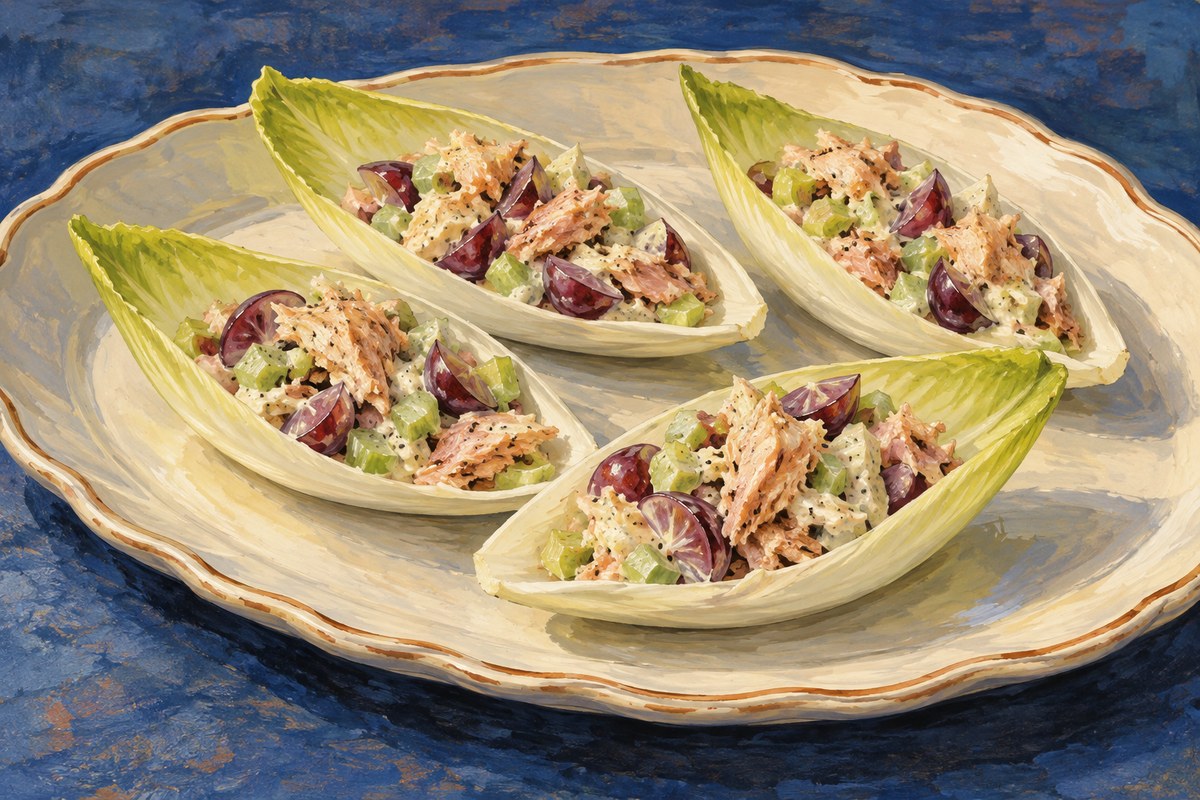
Use a ready-to-eat pantry fish
Commercially canned smoked trout is already cooked and gives a convenient flaky filling. Drain it before weighing, then check for and remove any hard bones. The recipe does not use raw fish, home curing or a raw marinade. Break the flesh into small pieces rather than blending it into a paste; the grapes should be small enough that each leaf receives a few, and finely diced celery adds a second kind of crunch.
The leaf is the serving shape
Broad outer endive leaves hold a modest filling better than narrow center leaves. Wash them before separating the final selection, dry gently and keep them cold in a rigid box. The cores and unused small leaves are reserved for another salad, outside this yield. About eighteen grams of filling sits comfortably along each selected leaf; it should not be heaped into a tall mound. A sample two-boat plate makes the intended small buffet portion clear.
Ingredients
- 24 broad usable Belgian endive leaves, each about 3½–4 in/9–10 cm long and at least 1¼ in/3 cm wide, about 4¼ oz/120 g selected prepared weight; buy about 4–6 heads and reserve cores and smaller leaves separately
- 2–3 cans commercially prepared ready-to-eat smoked trout, drained to give 6⅓ oz/180 g, checked for hard bones
- ¾ cup (120 g) seedless grapes, washed whole, dried and cut into small quarters
- ½ small celery stalk, finely diced, 1½ oz/40 g prepared weight
- ¼ cup (60 g) thick plain yogurt made with pasteurized milk
- 2 tsp (10 g) Dijon mustard
- 2 tsp (10 ml) lemon juice
- 2 tsp (10 ml/9 g) olive oil
- ¼ tsp (0.5 g) black pepper
Set out
Knife and board, Colander, Mixing bowl with lid, Digital scale, Small bowl and whisk for dressing, Clean towels or salad spinner for drying endive, Rigid shallow tray and cover, Small filling spoon, Cooler with ice packs, Food thermometer for checking cold transport
Allergens
Fish (trout), Milk, Mustard, Celery. Check labels and substitutions.
Make it
- Wash and dry endive and grapes before opening the fish. Select 24 broad intact leaves of the stated size, trimming only a tough base if needed; reserve all other endive separately. Refrigerate the leaves flat in a covered rigid box. Quarter the grapes finely and dice the celery.
- Drain and weigh 180 g ready-to-eat canned smoked trout. Check for any hard bones and flake into small pieces with a clean fork. Whisk yogurt, mustard, lemon juice, olive oil and pepper in the small bowl. Fold all dressing into the trout with the grapes and celery, keeping the flakes recognizable.
- Transfer filling to a shallow covered container and refrigerate to 40°F (4°C) or below. Plan about 60–90 minutes of chilling after preparation if the fish or grapes began at room temperature; allow longer until the actual cold endpoint is reached. Keep the leaves cold separately.
- At the gathering, divide the complete filling among the 24 leaves, about 18 g per leaf, using a small spoon along the hollow rather than a tall mound. Fill the first twelve only, with reserve leaves and filling held at 40°F (4°C) or below until replenishing. Serve 2 boats per small buffet portion.
Bring it
Carry fully chilled filling and dry endive leaves separately in a cooler at 40°F (4°C) or below, with a rigid tray and filling spoon. During packing, travel and display, allow no more than 2 hours combined outside cold control, or 1 hour above 90°F (32°C). Discard food beyond that limit.
Finish at the gathering
No host appliances are needed. Allow 5–8 minutes to fill the first twelve leaves. Nest the fish bowl in ice or keep it in the cooler between small refills; reserve leaves remain cold and dry until used.
Make it yours
The smoke-and-grape pairing fits an anniversary drinks table or an all-year housewarming. Use a simple sample two-boat plate and a clear fish, milk, mustard and celery label rather than hiding the filling under decorative herbs.
Ingredient labels
Check canned fish, yogurt and mustard labels for additional ingredients. The salmon variation still contains fish; no allergen-free or religious dietary certification is implied.
A useful detail
The 120-minute cold-ready planning estimate includes 30 minutes preparation and up to 90 minutes refrigerator chilling. No cooking is required because the fish is commercially canned and ready to eat. Actual temperature, not elapsed time, establishes readiness for cold transport. This method is not for raw or home-cured fish.
Another way
- Use 180 g drained ready-to-eat canned salmon instead of smoked trout for a milder filling; check for hard bones and retain all cold handling.
- Replace the grapes with 120 g crisp apple, cored and finely diced, folding it immediately into the measured lemon dressing.
Keep it well
Keep fish filling and dry endive separately at 40°F (4°C) or below and use within 2 days, or the earliest opened-fish/yogurt deadline. Filled leaves are best served immediately for crispness. Do not freeze the assembled boats. Respect the combined travel-and-display limit in “Bring it.”