045 / 75 · Build-at-the-table moments
Tuna and Cucumber Nori Wrap Station
24 small rice-free nori wraps; 2 wraps per buffet portion · Active 30 min · Cook 0 min · Total 1 hr 35 min (cold service and transport)
Cold-travel planning: 1 hr 35 min; follow the stated cooling endpoint and finishing route.
Print recipe · PDFNori becomes the crisp wrapper for a rice-free tuna filling and fine raw vegetable strips. It is assembled only when someone is ready to eat, because seaweed softens quickly against a wet filling. Everything needed is measured: the tuna mixture, dry wrappers, cucumber and carrot.
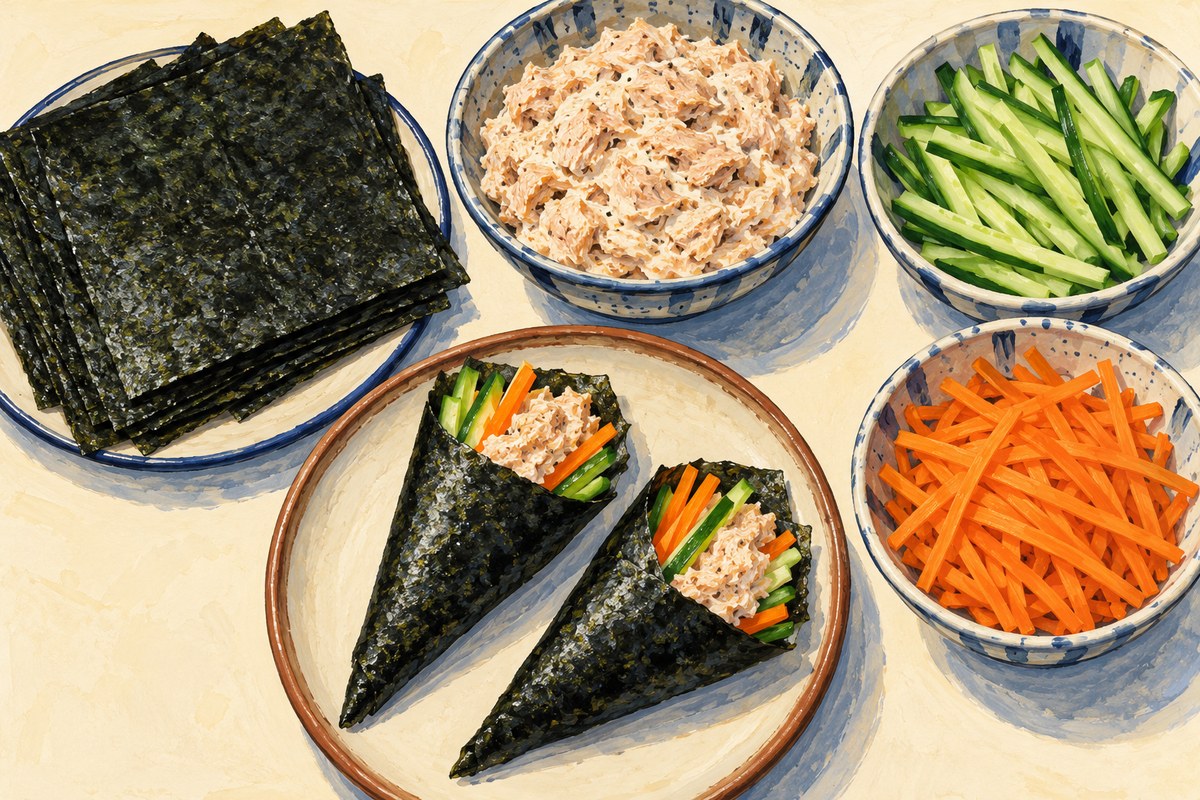
Keep the wrapper out of the cooler
Ready-to-eat nori is dry and brittle. Cut it with clean scissors, then close it in a dry box away from the chilled containers. Condensation turns a crisp sheet chewy before anyone starts. The tuna mixture is thick rather than loose, and the cucumber is seeded and blotted. Those small preparations buy enough time to form and eat a wrap; they do not make it suitable for an afternoon assembled on a platter.
A quarter sheet makes a small bite
Each quarter is about ten centimeters square, large enough for a modest spoonful and a few thin vegetable strips. Lay the filling diagonally and fold the seaweed around it into a loose cone or open roll. Do not promise a tightly sealed sushi roll: this is a simple modern table wrap, without cooked rice or raw fish. Two wraps make a small buffet portion, and guests can build another only while the chilled components remain safely controlled.
Ingredients
- 3 small cans ready-to-eat tuna, drained to give 12¾ oz (360 g)
- ½ cup (120 g) thick plain yogurt made with pasteurized milk
- 1 tbsp (15 ml) lemon juice
- 1 tbsp (15 ml) soy sauce
- 2 tsp (10 ml/9 g) toasted sesame oil
- ¼ tsp (0.5 g) black pepper
- 1 cucumber, seeded and cut into fine 2 in/5 cm strips, 200 g prepared weight, blotted dry
- 2 carrots, cut into fine 2 in/5 cm strips, 150 g prepared weight
- 6 ready-to-eat toasted nori sheets, about 8 in/20 cm square, about ⅔ oz/18 g total
Set out
Mixing bowl with lid, Colander, Knife and board, Paper towels or clean cloth for blotting cucumber, Clean scissors, Dry airtight nori box, Three small cold serving containers, Three clean serving utensils, Cooler with ice packs
Allergens
Fish (tuna), Milk, Soy, Wheat, Sesame. Check labels and substitutions.
Make it
- Drain the tuna well and break into small flakes. Mix with yogurt, lemon juice, soy sauce, sesame oil and pepper. Cover and refrigerate to 40°F (4°C) or below, allowing 1 hour if the cans started at room temperature.
- Prepare and blot the cucumber strips. Cut carrot strips thinly enough to bite comfortably, about ⅛ in/3 mm thick. Refrigerate vegetables in separate covered containers. With clean dry scissors cut each nori sheet into four squares, 24 total; close in a dry airtight box.
- At the table, place one nori square dry on a small plate. Add one twenty-fourth of the tuna mixture, about 1 heaped tbsp/22 g, diagonally across it. Add a few cucumber and carrot strips, dividing all vegetables across the 24 wraps. Fold loosely into a cone or open roll and eat immediately. Keep the remaining tuna and vegetables cold, and the nori dry.
Bring it
Carry tuna and cut vegetables at 40°F (4°C) or below in a cooler. Keep the sealed dry nori box outside the wet cooler space, protected from heat and moisture. Bring small plates and three clean utensils. During packing, travel and display, keep cold food at 40°F (4°C) or below and hot food at 140°F (60°C) or above. Allow no more than 2 hours combined outside those controls, or 1 hour above 90°F (32°C). Discard food beyond that limit.
Finish at the gathering
No host appliances are needed. Allow 3 minutes to set the tuna and vegetable bowls into ice and open the nori box. Assemble one sample wrap, then let each guest make a fresh one; do not prefill all 24.
Make it yours
The station suits a birthday table, graduation or summer gathering. Use small bowls and replenish from the cooler; a neat dry wrapper is more useful than a large decorative platter that leaves all the fish filling warm.
Ingredient labels
Check nori for flavoring ingredients and cross-contact warnings, and soy sauce for wheat. The recipe is rice-free but not represented as gluten-free.
A useful detail
No cooking is required. The 95-minute total includes vegetable cutting, mixing, a cold-chilling allowance and arranging the station. This is not a substitute for sushi-rice instructions, and no raw fish is used.
Another way
- Use 360 g drained canned salmon instead of tuna; check for large hard bones before mixing.
- Replace carrot with 150 g fine radish strips for a sharper bite. Keep cucumber and all cold-handling directions unchanged.
Keep it well
Refrigerate tuna mixture and vegetables separately at 40°F (4°C) or below and use within 2 days, respecting any earlier yogurt deadline. Keep nori dry according to its package. Do not save assembled wraps for later; quality deteriorates quickly and their time outside cold control still counts. Respect the combined travel-and-display limit in “Bring it.”