075 / 75 · Cupboard Rescue Meals
Savory Mackerel Oats with Peas and Horseradish
2 savory porridge bowls, with toast · Active 10 min · Total 25 min
Print recipe · PDFOats can make a savory bowl as readily as a sweet breakfast. Here they cook in stock, with peas and flakes of canned mackerel added near the end. A little prepared horseradish and lemon sharpen the finish without turning the porridge into a strong sauce. Toast provides a crisp contrast. This is a quick home meal for a nearly empty refrigerator, using a can of fish, a bag of frozen peas and ordinary rolled oats.
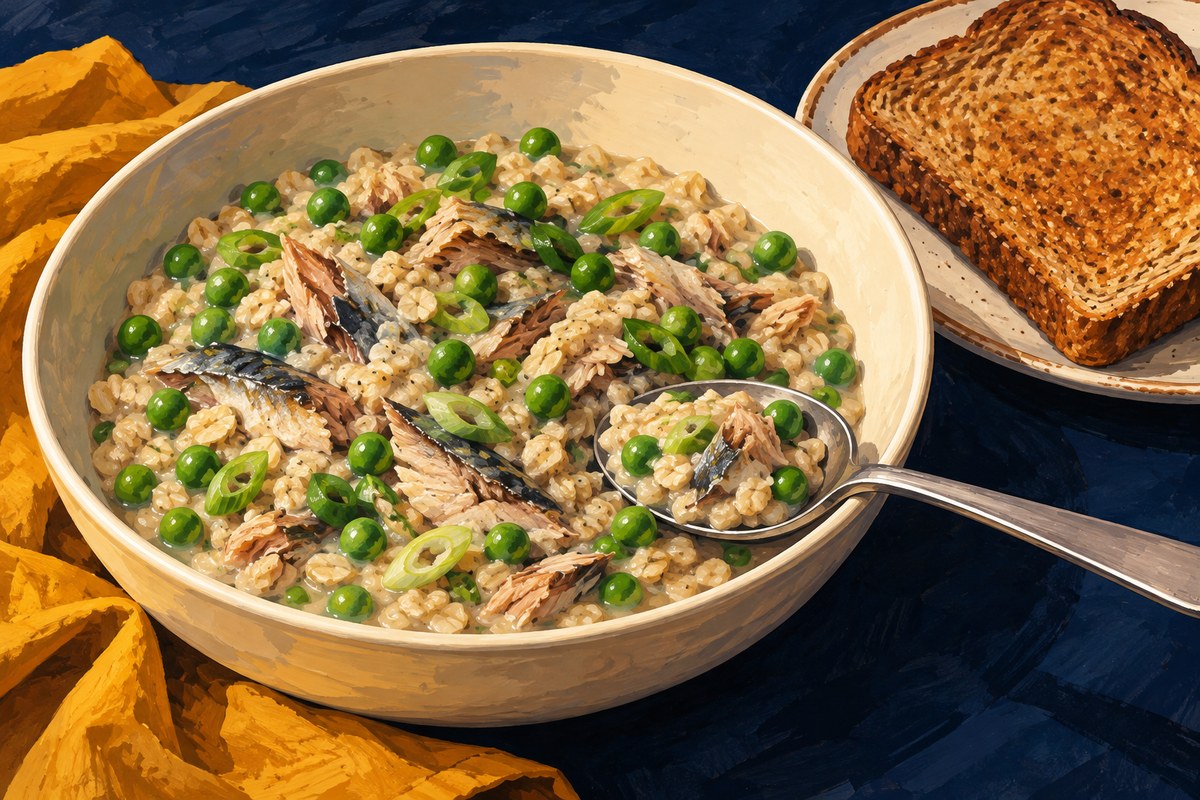
Use rolled oats and enough liquid
The starting mixture looks quite loose, but rolled oats continue to thicken as they stand. Keep the heat low and stir across the bottom so the stock does not catch under a stiff layer. Steel-cut oats need a much longer method and are not a quick substitute. Have a little hot water ready near the end: the finished bowl should be spoonable rather than something you can cut into slices.
Fold the fish in at the end
Canned mackerel is already cooked. Drain it, lift the pieces out and check for any hard bones before gently flaking it. Add the fish only after the oats are tender so it warms through without being stirred into a uniform paste. A few distinct pieces make the bowl more pleasant to eat. Use mackerel in brine or spring water for the stated result; heavily sauced fish would change the seasoning completely.
Start small with horseradish
Prepared horseradish varies in strength and may contain vinegar, cream or other additions. The small measured amount gives a background bite. You can add more to your own served bowl, but it is hard to take it out of the pot. Lemon and green onion bring a fresh edge without a long list of finishing ingredients. Eat this meal at home while the oats are loose; it is not designed to remain appealing lukewarm in a food flask.
Ingredients
- 1 cup rolled oats (100 g)
- 2 1/2 cups low-sodium vegetable stock (600 ml)
- 1 cup frozen peas (140 g)
- 1 can mackerel in brine or spring water, drained to yield about 4 1/2 oz (125 g)
- 1 teaspoon prepared grated horseradish (5 g)
- 1 tablespoon lemon juice (15 ml)
- 2 green onions, thinly sliced (25 g)
- 1 teaspoon olive oil (5 ml)
- 1/4 teaspoon black pepper (0.5 g)
- 2 slices whole-wheat bread (80 g total), to toast
Set out
Medium saucepan, Toaster, Fork, Instant-read thermometer
Allergens
Fish (mackerel), Wheat in bread; oats may have wheat cross-contact, Prepared horseradish may contain milk, mustard or sulfites—check label. Check labels and substitutions.
Make it
- Put the oats and stock in the saucepan. Bring to a gentle simmer, then cook over low heat for 5–7 minutes, stirring often, until the oats are almost tender.
- Add the frozen peas and cook for 3 minutes, stirring. Add a little hot water if the mixture becomes stiff.
- Meanwhile, drain and gently flake the mackerel, removing any hard bones you find. Toast the bread.
- Fold the mackerel into the oats and cook gently for 2–3 minutes, until the peas are tender and the whole mixture reaches 165°F/74°C. Remove from the heat and stir in the horseradish, lemon juice, olive oil, black pepper and half the green onion.
- Divide between two bowls and scatter the remaining green onion over them. Serve immediately with one slice of toast per person.
Check the can before the shift begins
Keep a suitable can of plain fish in the cupboard rather than relying on a flavored version whose sauce may not suit this dish. Refrigerate any opened remainder promptly in a covered container.
A useful detail
Use ordinary rolled oats. Steel-cut oats and instant flavored oatmeal are not suitable for this timing or seasoning.
Another way
- Use canned salmon at the same drained weight for a different fish flavor, checking for hard bones before flaking.
- Replace horseradish with 1 teaspoon (5 g) Dijon mustard for a gentler sharpness; this adds mustard.
Keep it well
Best served immediately. Refrigerate shallow leftovers within 2 hours, or 1 hour above 90°F/32°C, at 40°F/4°C or below and use within 2 days. Reheat with a little water, stirring until 165°F/74°C throughout. Keep toast separate. If transporting leftovers, chill fully, use two cold sources and refrigerate at work before reheating.