001 / 75 · Savory Garden Molds
Tomato Celery Aspic Ring
One 1-liter ring holding about 3¼ cups (780 ml); 8 small vegetable side portions · Active 25 min · Total 9 hr 30 min
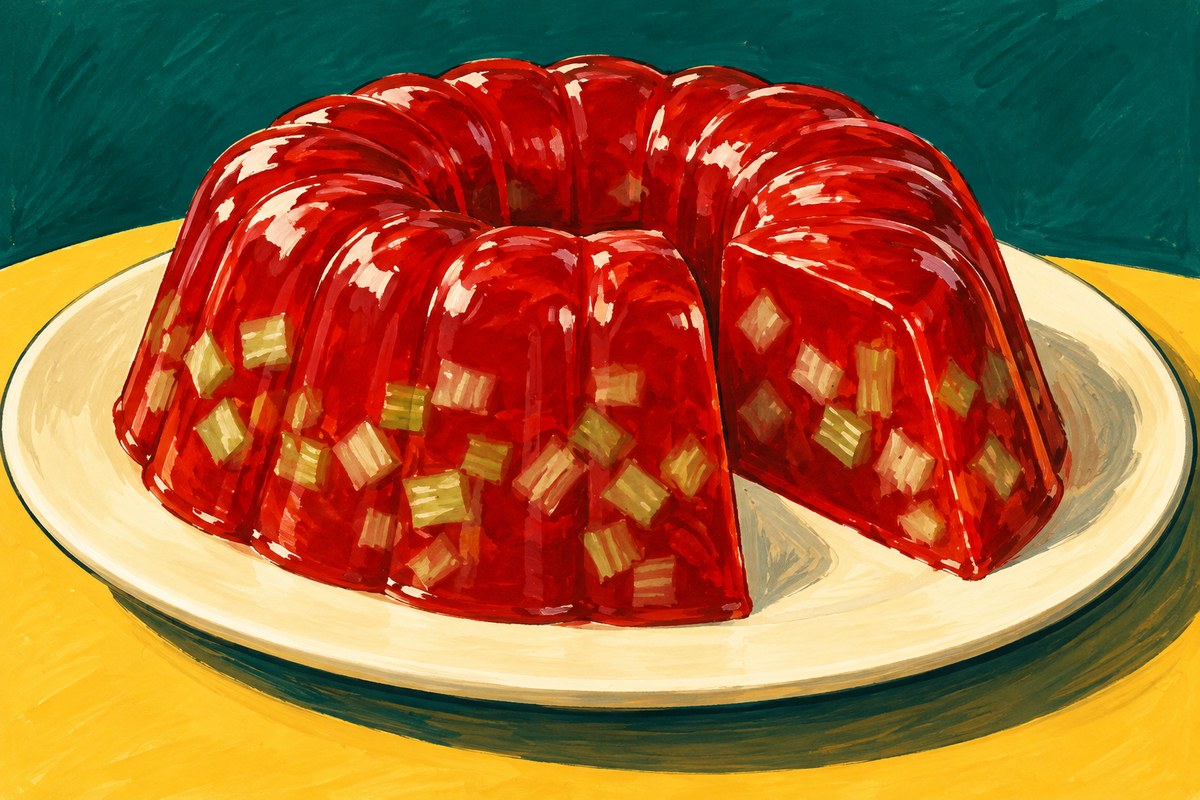
Print recipe · PDFTomato juice makes a deep red savory ring with finely cut celery suspended through it. The seasoning is closer to a chilled tomato course than a sweet dessert salad. Give the juice time to become lightly syrupy in the refrigerator before folding in the celery, then leave the filled mold undisturbed overnight.
A ring with a clear purpose
Serve a small wedge beside a sandwich, an egg dish or cooked fish; those accompaniments are separate. This vegetable aspic is a side, not eight complete lunches. Unsweetened tomato juice already has a settled flavor and salt level, so read its label before adding the measured salt. The small sugar quantity softens the sharpness without turning the ring into a sweet tomato jelly.
Cut celery for the slice, not the garnish
Remove tough strings before cutting the celery into dice no larger than a small pea. Large crescents can tear a thin slice when a fork presses against them. Dry the washed stalks before weighing and chopping; rinse water is additional liquid the formula has not counted. The celery goes inside the aspic, with no unlisted frond or parsley crown added later.
Watch the bowl instead of the minute hand
Chilling the base before adding celery is a suspension stage. Stir gently every ten minutes until a spoon leaves a faint track and the juice flows like a thin syrup. If the celery sinks immediately, give the bowl another short refrigerator pause. If the base has set into lumps, warm the bowl gently over warm water just until fluid, then repeat the cooling stage. Do not rescue it with an unmeasured splash of water. The eight-hour final chill starts after filling, and a warm kitchen or slower refrigerator can lengthen the earlier stage.
Ingredients
- 2 standard ¼-ounce envelopes unflavored powdered gelatin (14 g total), of the specified setting strength
- 6 tablespoons cold drinking water (90 ml), for blooming
- 2½ cups unsweetened tomato juice (600 ml), divided
- 1 tablespoon lemon juice (15 ml), seeds removed
- 2 teaspoons granulated sugar (8 g)
- ⅛ teaspoon fine salt (0.75 g), or omit if juice is already salty
- ⅛ teaspoon black pepper
- ½ cup very finely diced celery (60 g prepared), washed and thoroughly dried
- ¼ teaspoon neutral oil (1.25 ml), for wiping the mold
Set out
Small saucepan, Mixing bowl and whisk, Kitchen scale and measuring jug, Food thermometer, Metal ring mold of at least 1-liter usable capacity, Paper towel, Larger bowl for an external cool-water bath, Cold serving plate, Reliable refrigerator
Allergens
No major US allergen identified in the base ingredients. Check labels and substitutions.
Make it
- Check mold capacity with water before starting, then empty and dry it. Wipe its inside with the oil using paper towel, leaving a fine film rather than a pool. Make level space in the refrigerator. Sprinkle gelatin over the 90 ml cold water in the mixing bowl and bloom 5–10 minutes, following its packet.
- Warm 1 cup (240 ml) tomato juice with sugar, salt and pepper to about 140–150°F (60–65°C), stirring until sugar dissolves. Take off heat. Add to bloomed gelatin and stir until every granule dissolves; do not boil gelatin. Stir in the remaining 360 ml tomato juice and lemon juice.
- Stand the bowl briefly in an external cool-water bath, keeping bath water out, then refrigerate. Stir gently every 10 minutes until lightly syrupy, commonly 20–40 minutes. Fold in dry celery. Pour into the mold, leaving at least ½ inch (1.25 cm) below its rim; put any excess in a small separate refrigerated cup rather than overfill.
- Cover without touching the surface and refrigerate at 40°F (4°C) or below for at least 8 hours, preferably overnight, until firm throughout. The 9½-hour estimate includes preparation and the suspension pause.
- For unmolding, set a cold plate beside the refrigerator. Dip only the outside of the metal mold in warm, not hot, water, about 100°F (38°C), for 5–8 seconds without letting water touch food. Dry the outside, loosen just the upper edge with a clean fingertip and invert onto the plate. If stuck, repeat a brief dip rather than shaking violently. Refrigerate again immediately if not serving now. Cut into 8 small side wedges with a clean thin knife.
Gelatin starting strength
Use food-grade unflavored powdered gelatin with a manufacturer benchmark of 7 g for about 2 cups (500 ml) plain liquid. Weigh the stated grams: envelope sizes and powder density vary. A flavored dessert packet, collagen peptides, sheet gelatin or agar is not an equal substitute.
Cold service
This is an original retro-inspired recipe, not a recovered 1960s formula. Gelatin is animal-derived; the vegetable ingredients do not make the dish vegetarian. A reliable refrigerator and the stated earlier ingredient deadlines are essential.
Ingredient labels
Celery can cause allergy although it is not one of the nine major US allergen categories. Check tomato juice, gelatin and other labels.
A useful detail
The measured free liquid is 705 ml: 90 ml bloom water +600 ml tomato juice +15 ml lemon juice. The celery adds about 60 g moist solids. Fourteen grams gelatin gives a firmer acidic ring than a plain spoon jelly. Do not dilute a strongly flavored juice after measuring; choose another juice before starting instead.
Another way
- Replace celery with 60 g well-drained, blotted canned green beans cut into tiny pieces for an explicitly different vegetable inclusion; retain all liquid and gelatin measures.
- Omit black pepper for a plainer tomato side.
Keep it well
Keep covered at 40°F (4°C) or below. Use within 2 days of assembly or the earliest ingredient deadline, whichever comes first. Include the overnight setting period in that limit. Keep total unrefrigerated preparation and serving below 2 hours, or 1 hour above 90°F (32°C). Chill slices promptly after service; discard food exceeding those limits. Do not freeze; freezing damages the gel and releases water.