012 / 100 · Soups with Something to Say
Chicken, Barley, and Dill Soup
About 8 cups soup Active 25 min Total 1 hr 15 min
Barley gives chicken soup a pleasant chew and enough body to stand as a meal. Carrots and celery soften into the broth while a final handful of dill keeps the pot from tasting heavy. Chicken thighs simmer gently until cooked, then return in small shreds that are easy to gather on a spoon. The barley continues drinking broth after cooking, so this is intentionally a little loose at first. Keep some water nearby when reheating the next day.
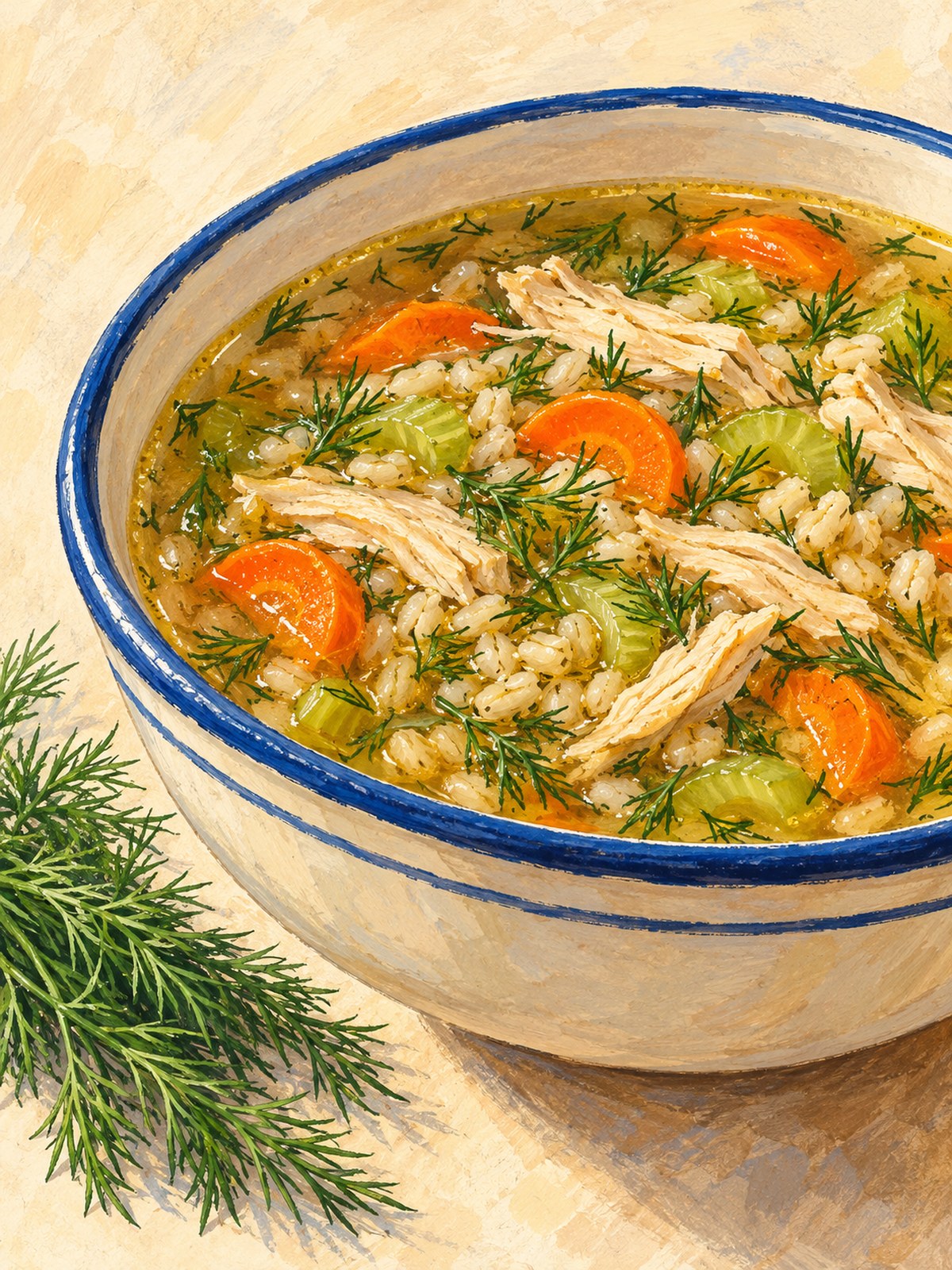
Choose pearl barley for this timing
Pearl barley has some of its outer layer removed and cooks more quickly than hulled barley. The two are not interchangeable on the same schedule. Rinse the pearl barley and let it simmer until pleasantly tender, not hard at the center. Because brands differ, taste a few grains before finishing the soup. If the barley needs longer, remove the cooked chicken first and let the grain continue so the meat does not spend unnecessary time in the pot.
Dill is a finishing herb here
A small amount of dill stirred into a hot bowl smells brighter than a large amount boiled for half an hour. Chop the tender stems with the leaves, saving any coarse stalks for another use. Lemon juice sharpens the broth gently at the end rather than turning it into a lemon soup. The chicken should reach 165°F/74°C before shredding; clear-looking juices alone are not a dependable check. Shred on a clean board after the thermometer confirms doneness.
Make tomorrow’s soup a little looser
Barley absorbs broth while cooling as well as while cooking. If you expect leftovers, do not keep reducing the pot until the first serving is very thick. Divide it into shallow containers while still warm and refrigerate promptly. Add water during reheating, then check the salt only after the soup has loosened. Fresh dill can be added again, but the original measured amount already seasons the stored broth.
Ingredients
- 1 tablespoon olive oil
- 1 medium yellow onion, diced
- 3 medium carrots (225 g), cut into 1/4-inch half-moons
- 2 celery stalks, diced
- 1/2 teaspoon fine salt
- 3/4 cup (150 g) pearl barley, rinsed
- 6 cups (1.4 liters) low-sodium chicken broth, labeled pepper-free and chili-free
- 1 pound (450 g) boneless skinless chicken thighs
- 1 bay leaf
- 1/4 cup chopped fresh dill
- 1 tablespoon lemon juice
Set out
Large soup pot with lid, Fine-mesh sieve, Tongs, Instant-read thermometer
Allergens
Check ingredient labels and substitutions.
Make it
- Heat the oil in a large soup pot over medium heat. Add onion, carrots, celery, and salt. Cook for 7 minutes, stirring occasionally, until the onion softens.
- Add the barley, broth, chicken thighs, and bay leaf. Bring just to a simmer, then reduce to medium-low and partly cover.
- Simmer gently for 25–30 minutes, stirring occasionally. Check the thickest chicken thigh with a thermometer; when it reaches 165°F/74°C, transfer all cooked thighs to a clean plate.
- Continue simmering the barley and vegetables for another 10–15 minutes, or until the barley is tender. Add water in 1/4-cup amounts if needed to keep a soup consistency.
- Shred the chicken into bite-size pieces with two forks. Discard the bay leaf.
- Return the chicken and any collected juices to the soup. Simmer for 2 minutes, then stir in the dill and lemon juice. Serve hot.
A useful detail
The total time allows for pearl barley that takes about 45 minutes to soften. Follow a longer package timing if needed, checking the grain rather than stopping at a fixed minute. Barley contains gluten, although it is not wheat and is not one of the major US food allergens.
Make it your own
- Replace the dill with 2 tablespoons parsley and 1 teaspoon fresh thyme leaves.
- Use boneless skinless chicken breast instead of thighs, checking its temperature early to avoid overcooking.
Keep it well
Divide into shallow containers and refrigerate within 2 hours at 40°F/4°C or below for up to 4 days. Reheat with extra water as needed to 165°F/74°C. Freeze for up to 2 months; barley will be softer after thawing.