002 / 100 · Slow Morning Comforts
Soft Scrambled Eggs with Chive Butter
2 generous portions Active 10 min Total 15 min
Chives and butter make a small breakfast feel finished. The chives go in twice: first into softened butter, then across the cooked eggs, so their mild onion flavor stays fresh. A flexible spatula and a low burner are more useful here than any special pan. Fold the eggs slowly into broad, tender curds and serve them as soon as they are fully set. This is a simple plate, but the contrast between creamy yellow eggs and bright green chives gives it plenty of character.
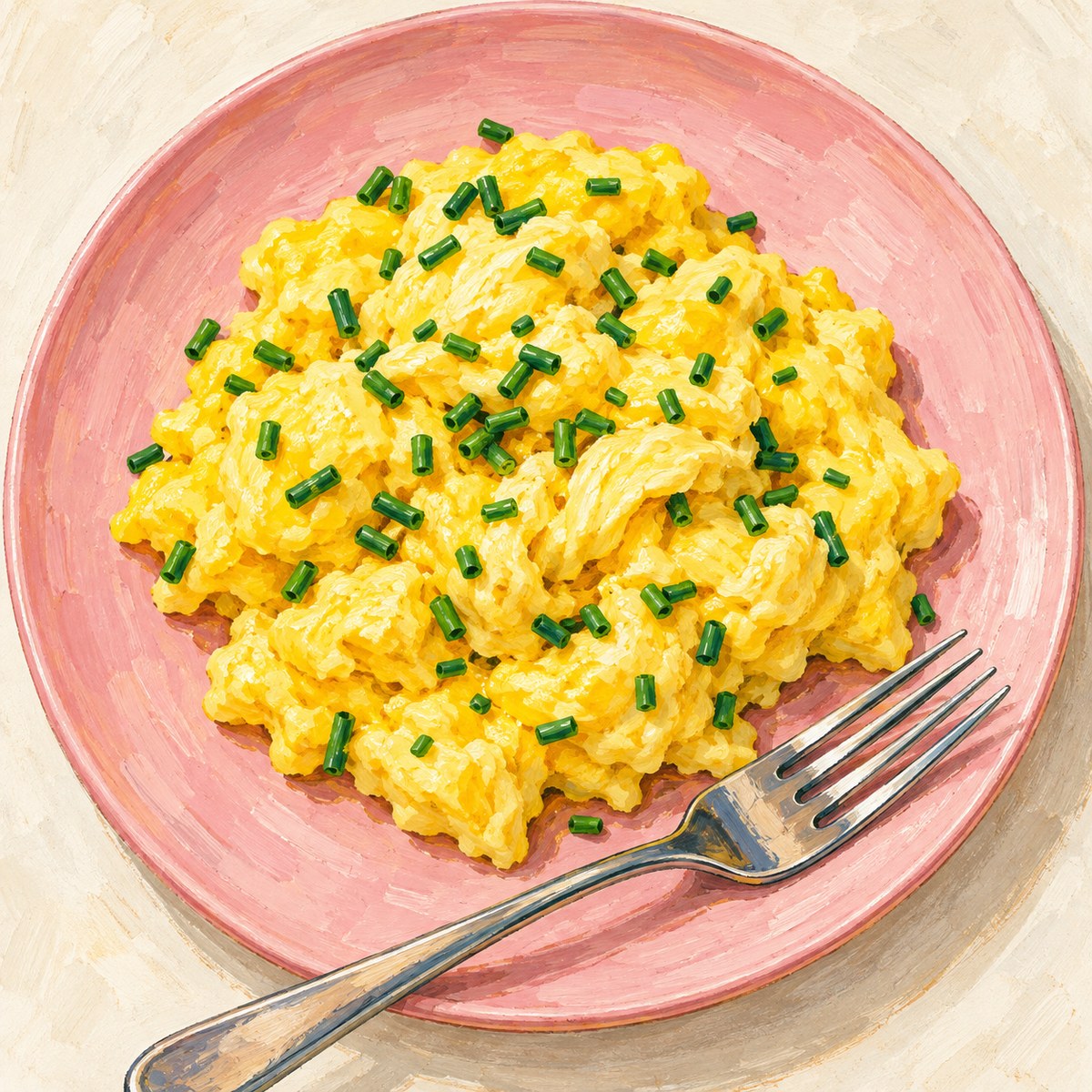
Broad folds, gentle heat
Finely cut chives distribute more evenly than long hollow pieces. Mix most into softened butter so their flavor reaches the eggs without clumping. Once the eggs enter the skillet, sweep the spatula across the bottom, then pause to let another thin layer set. Reduce the burner if you hear sizzling. The finished curds should be moist-looking but have no pools of uncooked liquid; verify 160°F/71°C in a gathered mound. Warm plates help you serve promptly without holding the eggs in the hot pan. More milk will not make the eggs more tender: gentle cooking does that work. A measured amount loosens the mixture without leaving water around the curds.
Ingredients
- 4 large eggs
- 2 tablespoons milk
- 1/4 teaspoon fine salt
- 2 tablespoons unsalted butter, softened
- 2 tablespoons finely snipped fresh chives, divided
Set out
10-inch nonstick skillet, Flexible silicone spatula, Mixing bowl, Instant-read thermometer
Allergens
Egg, milk. Check ingredient labels and substitutions.
Make it
- Mix the softened butter with 1 tablespoon of the chives in a small bowl. Set aside 1 teaspoon of this chive butter for the finish.
- Whisk the eggs, milk, and salt in a bowl until the yolks and whites are fully combined.
- Put the remaining chive butter in a 10-inch nonstick skillet over low heat. When it melts and begins to foam gently, pour in the eggs.
- Let a thin layer set for about 20 seconds, then sweep the spatula slowly across the base to form broad folds. Repeat, pausing briefly between sweeps.
- Cook for about 5–8 minutes, adjusting the burner to avoid sizzling. Fold until there is no free liquid and the eggs reach 160°F/71°C in a gathered mound.
- Take the pan off the heat. Fold in the reserved teaspoon of chive butter, divide between two plates, and scatter with the remaining tablespoon of chives. Serve at once.
A useful detail
For an accurate reading, gather the eggs into a mound and insert a thin thermometer probe sideways without touching the pan.
Make it your own
- Use finely chopped dill in place of half the chives.
- For four servings, double the ingredients and use a 12-inch skillet; allow a few extra minutes over the same gentle heat.
Keep it well
Best served freshly cooked. Refrigerate any leftovers within 2 hours at 40°F/4°C or below for up to 3 days. Reheat gently to 165°F/74°C; the curds will become firmer.