044 / 75 · Cook Once, Keep It Interesting
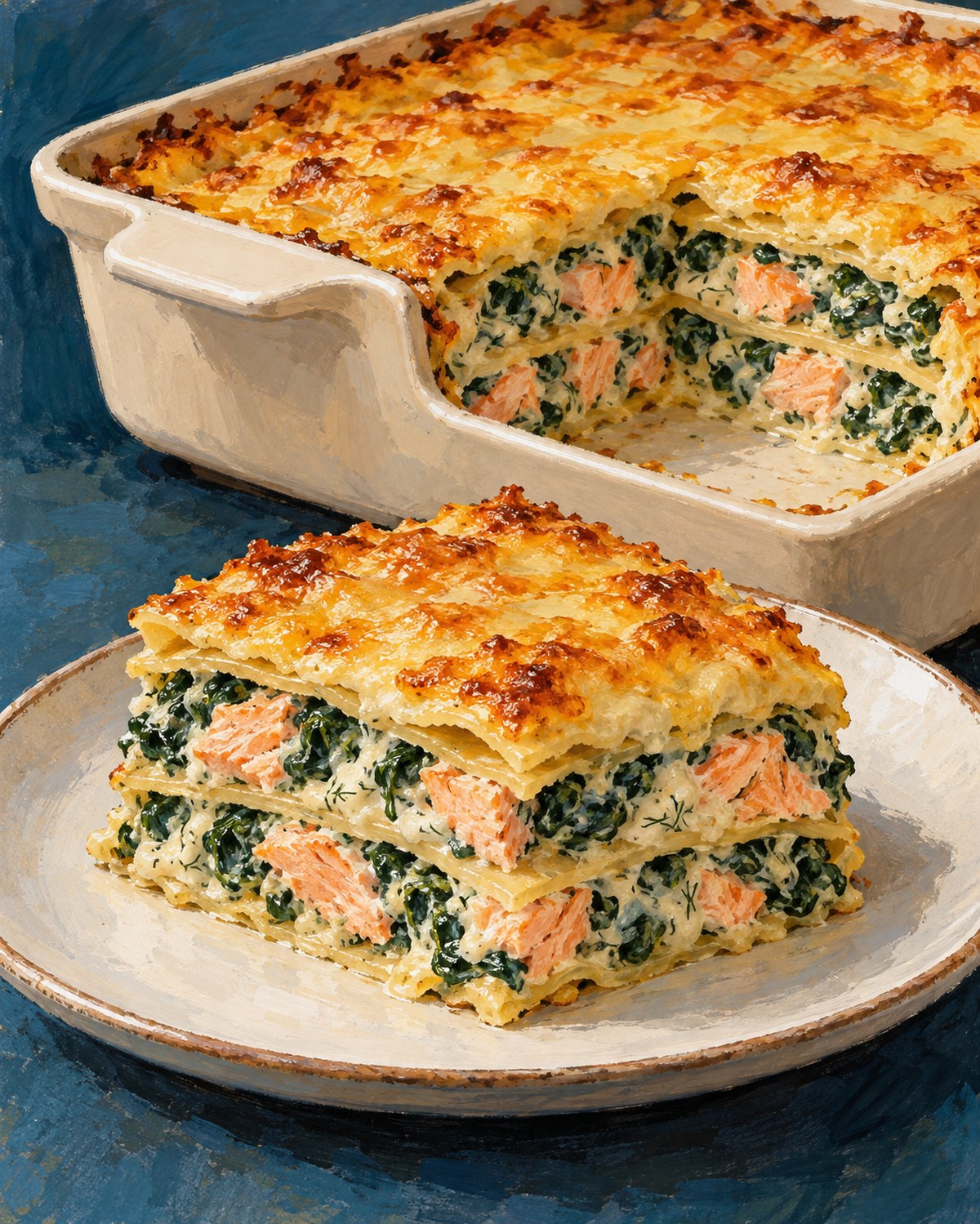
Salmon and Spinach Lasagne with Lemon White Sauce
4 portions of three-layer salmon-spinach lasagne, including all pasta, sauce and cheese · Active 45 min · Cook 1 hr · Total 1 hr 45 min
Print recipe · PDFA light-colored milk sauce carries raw salmon pieces and wilted spinach between layers of boiled lasagne sheets. Lemon zest and dill season the dish without a sharp juice curdling the sauce. The fish cooks during the covered oven stage, so it is not first seared and then baked dry. This is a full batch recipe with measured pasta and a real sauce-making step.
Remove spinach water before making layers
Fresh spinach shrinks dramatically in a warm pan. Add it in handfuls with the measured small amount of oil, then stir until its loose water has evaporated. There is no hidden bag of thawed spinach in this method. Chop the wilted leaves after they cool enough to handle, keeping any tiny edible leaf pieces with the batch. A wet layer makes it hard for the white sauce to hold the lasagne together. This is why the spinach cooks separately rather than being tucked in raw as a thick cushion around the fish.
A smooth white sauce begins with measured flour
Melt the butter gently and stir in all the flour. Cook the paste briefly without browning, then add milk gradually while whisking. The first additions look thick; keep working them smooth before pouring in more. Once all the milk is in, simmer gently until the sauce coats the back of a spoon. It is meant to flow across the pasta, not stand in lumps. Add lemon zest and dill off the heat. Lemon juice would change the balance of this milk sauce and is not an unmeasured finishing squeeze.
Fit the sheets before assembling
Use dried lasagne sheets that require boiling, then follow their packet timing and lay the cooked sheets separately on clean plates. Oven-ready sheets absorb liquid differently and are not a direct substitute. Three sheets form each layer; trim and reuse offcuts to cover the declared square dish rather than throwing part of the weighed pasta away. Distribute the salmon evenly through two filling layers so the middle portions receive fish as well as sauce. Rest after baking before cutting four portions, and cool any saved pieces in shallow containers instead of leaving the whole hot dish on the counter.
Ingredients
- 9 dried enriched-wheat lasagne sheets that require boiling (240 g total), each about 3×8 inches/7.5×20 cm
- 14 oz raw Atlantic farmed salmon, skin and pin bones removed, cut into 3/4-inch/2 cm pieces (400 g edible fish)
- 10 1/2 oz fresh spinach, washed and dried (300 g)
- 1 teaspoon olive oil (5 ml/4.5 g)
- 2 1/2 tablespoons unsalted butter (35 g)
- 1 3/4 oz all-purpose flour (50 g)
- About 3 cups 2% milk (700 ml; use 700 g for the estimate)
- 1 teaspoon finely grated lemon zest (2 g)
- A small handful fresh dill, chopped (8 g)
- 1/2 teaspoon fine salt (3 g)
- 1/2 teaspoon ground black pepper (1 g)
- 2 1/8 oz mature Cheddar, grated (60 g)
Set out
Kitchen scale, large pot and colander for pasta, Wide skillet and clean plates for cooked sheets, Heavy 2 qt/2 liter saucepan, whisk and spatula, Deep square baking dish, usable base about 9×9 inches/23×23 cm and at least 2 1/2 inches/6 cm deep, capacity at least 3 qt/3 liters, Foil or an oven-safe lid and food thermometer
Allergens
Wheat, Milk, Fish (salmon), Check the actual lasagne sheets for egg or other declared allergens.. Check labels and substitutions.
Make it
- Heat oven to 375°F/190°C. Cook the weighed lasagne sheets in plain boiling water according to their packet for sheets that require boiling. Drain and lay separately on clean plates so they do not stick together. Do not use oven-ready sheets for the stated liquid balance.
- Heat oil in the skillet over medium heat. Add spinach in handfuls and cook for 4–6 minutes, stirring, until wilted and loose water has evaporated. Cool briefly, chop and keep all the leaves for the layers. Cut raw salmon on a separate board, then wash hands and clean raw-fish equipment.
- Melt butter gently in the saucepan. Stir in flour and cook for 1 minute without browning. Gradually whisk in the measured milk, smoothing each addition before adding more. Bring to a gentle simmer and cook for 4–5 minutes, stirring along the base, until it coats a spoon. Remove from heat and stir in zest, dill, salt and pepper.
- Spread a small spoonful of sauce over the base of the deep dish. Fit three sheets over it, trimming and reusing any offcuts. Add half the raw salmon, half the spinach and one third of the remaining sauce. Repeat with three sheets, all remaining salmon and spinach and another third of the sauce. Finish with the last three sheets and all remaining sauce. Scatter all Cheddar over the top. Use every weighed sheet and keep at least 1/2 inch/1.5 cm headroom.
- Cover and bake for 30 minutes. Uncover and bake for another 10–15 minutes, until gently golden, bubbling and at least 165°F/74°C in the center of the assembled casserole, including a central fish piece. If needed, continue until that endpoint. Rest for 10 minutes and cut into four equal portions.
A dinner portion that reheats as one piece
The sauce and layered pasta protect the fish better than a dry tray of leftovers, although reheated salmon will still be firmer. Pack one quarter of the complete dish into each container while the portions are easy to identify, and warm only the meal needed.
A useful detail
The salmon is weighed raw and cooks only once in the lasagne. All milk, butter and flour become the sauce. The estimate counts the complete raw spinach weight and full oil, with water removed by evaporation. The timing includes boiling the sheets and making the sauce before the oven stage.
Another way
- Replace the 400 g salmon with 400 g raw boneless cod pieces, keeping the assembled casserole endpoint of 165°F/74°C.
- Replace the 60 g Cheddar with 60 g low-moisture part-skim mozzarella. The base estimate covers salmon and Cheddar.
Keep it well
After the short serving rest, transfer saved portions into shallow containers and refrigerate within 2 hours of baking, or 1 hour above 90°F/32°C. Keep at 40°F/4°C or below for up to 2 days. Reheat the portion needed, covered, until its center reaches 165°F/74°C. Freeze promptly for up to 2 months and thaw in the refrigerator. Keep chilled portions cold during transport with two cold sources.