043 / 75 · Cook Once, Keep It Interesting
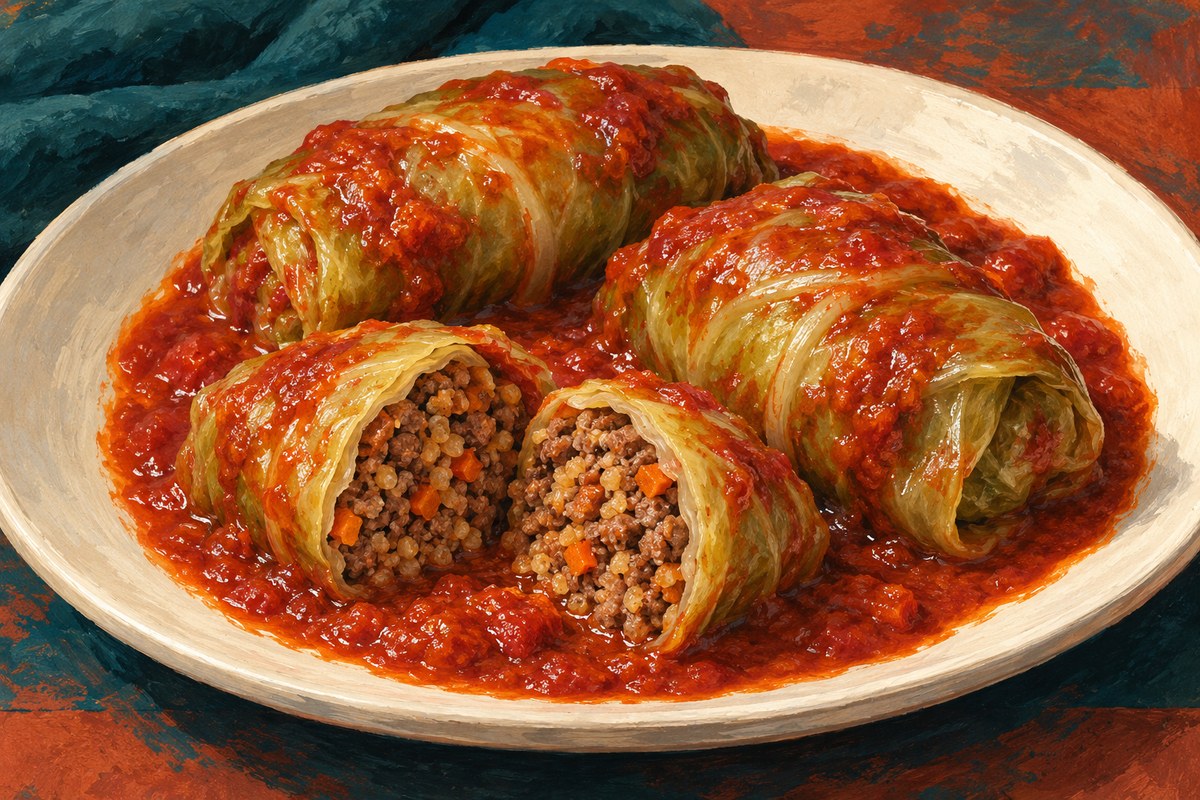
Beef-Stuffed Cabbage Rolls with Tomato Gravy
12 cabbage rolls; 3 per serving with one quarter of all tomato gravy · Active 55 min · Cook 1 hr 40 min · Total 2 hr 30 min
Print recipe · PDFTender cabbage leaves wrap a filling of beef and bulgur, then braise in a mild tomato gravy. Bulgur is cooked before it meets the raw beef, so the filling does not depend on an uncertain grain-to-sauce ratio inside a closed roll. Twelve modest rolls fit a single layer in the declared deep dish. The real preparation and baking time belongs in the plan for this meal.
Choose leaves that will fold, not fight
Broad outer cabbage leaves are easier to roll than small thick inner ones. Separate twelve usable leaves and weigh the edible leaves before blanching; the unused head can be saved for another dish and is not part of this recipe. A short dip in boiling water makes each leaf flexible. Cool it enough to handle, then shave the thick raised rib level with the leaf using a small knife. Do not cut all the way through. The goal is a broad wrapper that bends around filling without a hard ridge cracking the seam.
Measure the filling before making the first roll
Cook the bulgur according to its own packet and let steam escape before mixing with raw meat. A very hot grain can partly cook egg and make a lumpy filling. Divide the complete mixture into twelve equal portions before rolling; this avoids a huge first roll followed by small empty ones. Fold in the sides and roll loosely into parcels about 3 1/2 inches/9 cm long and 2 inches/5 cm wide. The filling needs space to stay tender. This is a raw-beef filling, so clean the board and hands before moving on to serving utensils.
Braise until the middle is genuinely ready
Arrange the rolls seam-side down in one layer and share the sauce above and below them. Covering the dish keeps the exposed cabbage from drying before its thick center softens. The sauce should bubble gently during baking. Check a middle roll with a thermometer, not only one at the hot outer edge, and keep cooking until its center reaches 165°F/74°C and the cabbage is tender. Let the covered dish settle briefly before serving. The full tomato gravy is divided between the four portions, making leftovers easier to reheat without drying their cut sides.
Ingredients
- 12 broad green cabbage leaves, tough ends trimmed (600 g raw edible leaves; save unused cabbage separately)
- 4 1/4 oz medium bulgur (120 g dry)
- 1 cup water for bulgur (240 ml/240 g), or the packet amount
- 14 oz 90%-lean ground beef (400 g raw)
- 1 small onion, finely grated (100 g)
- 1 medium carrot, finely grated (100 g)
- 1 large egg, without shell (50 g)
- 2 garlic cloves, minced (6 g)
- 1 teaspoon sweet paprika (2 g)
- 1/2 teaspoon caraway seeds (1 g)
- 1/2 teaspoon fine salt (3 g), divided
- 1/4 teaspoon ground black pepper (0.5 g)
- 1 can crushed tomatoes with liquid (about 21 oz/600 g)
- 1 tablespoon tomato paste (16 g)
- 3/4 cup plus 1 tablespoon and 1 teaspoon water for gravy (200 ml/200 g)
Set out
Kitchen scale, large pot for blanching and tongs, Lidded saucepan for bulgur and a clean cooling plate, Mixing bowl, small knife and clean raw-meat board, Deep baking dish, at least 4 qt/4 liters, usable base 12×9 inches/30×23 cm and sides at least 2 1/2 inches/6 cm, Foil or an oven-safe fitted lid, ladle and food thermometer
Allergens
Wheat, Egg. Check labels and substitutions.
Make it
- Cook bulgur with the stated 240 ml water, or its packet amount, according to the packet, usually 12–15 minutes covered on low after boiling. Spread on a clean plate and cool for 10 minutes while preparing leaves; it should no longer be hot before meeting the raw egg and beef. Use freshly cooked bulgur for this recipe, not an old leftover portion.
- Bring a large pot of plain water to a boil. Blanch the cabbage leaves in manageable batches for 3–4 minutes per batch until flexible, then drain. Once safe to handle, shave the thick raised rib from each leaf without cutting through. Heat oven to 375°F/190°C.
- Mix all cooked bulgur with raw beef, grated onion, carrot, egg, garlic, paprika, caraway, half the salt and all black pepper just until evenly combined. Weigh and divide into twelve equal filling portions, about 80–85 g each. Keep unused filling covered in the refrigerator while working if rolling is slow.
- Whisk crushed tomatoes and all their liquid with tomato paste, the 200 ml gravy water and remaining salt. Spread one third in the deep baking dish. Put a filling portion near the base of each leaf, fold in the sides and roll loosely into a parcel about 3 1/2×2 inches/9×5 cm. Arrange seam-side down in one layer, three across and four along the declared base. Divide all filling among the twelve leaves. Wash hands and raw-meat tools.
- Pour all remaining tomato gravy over and between the rolls. Cover tightly with an oven-safe lid or foil. Bake for 75–85 minutes, until gravy bubbles, cabbage is tender and centers of middle rolls reach at least 165°F/74°C. Continue cooking if needed. Rest covered for 10 minutes. Serve three rolls per person with one quarter of all the gravy.
A long bake can make several orderly dinners
Keep three rolls and one quarter of the sauce together in each container. That count makes the batch simple to divide after a weekend cook, while the sauce protects the cabbage and filling during safe reheating. There is no need to reheat the entire batch for one meal.
A useful detail
The ingredient weight for cabbage is the raw leaves actually used, not the whole head. Plain blanching water is discarded and has no energy. Bulgur is weighed dry; all cooked grain and measured gravy stay in the batch. The filling should make twelve modest, not giant, rolls.
Another way
- Use 400 g 93%-lean ground turkey instead of beef and keep the same 165°F/74°C center endpoint.
- Replace 1 g caraway with 1 g ground cumin for a different aromatic direction. Recalculate for substitutions.
Keep it well
Move saved rolls and their gravy into shallow containers and refrigerate within 2 hours, or 1 hour above 90°F/32°C. Keep at 40°F/4°C or below for up to 3 days. Reheat the needed portion, covered with its gravy, until every roll center reaches 165°F/74°C. Freeze promptly for up to 2 months and thaw in the refrigerator.