013 / 75 · Breakfasts with Staying Power
Savory Salmon and Leek Oats
2 substantial bowls; each contains half the salmon and half the oat-and-leek porridge · Active 20 min · Cook 25 min · Total 40 min
Print recipe · PDFSoft oats make a gentle base for salmon and sweet, buttery-tasting leeks without needing a separate pan of rice. The fish cooks in the porridge at the end, so its juices stay in the pot. Lemon and fresh dill lift the finish. This is a warm, substantial breakfast for two, with an ordinary saucepan doing the work.
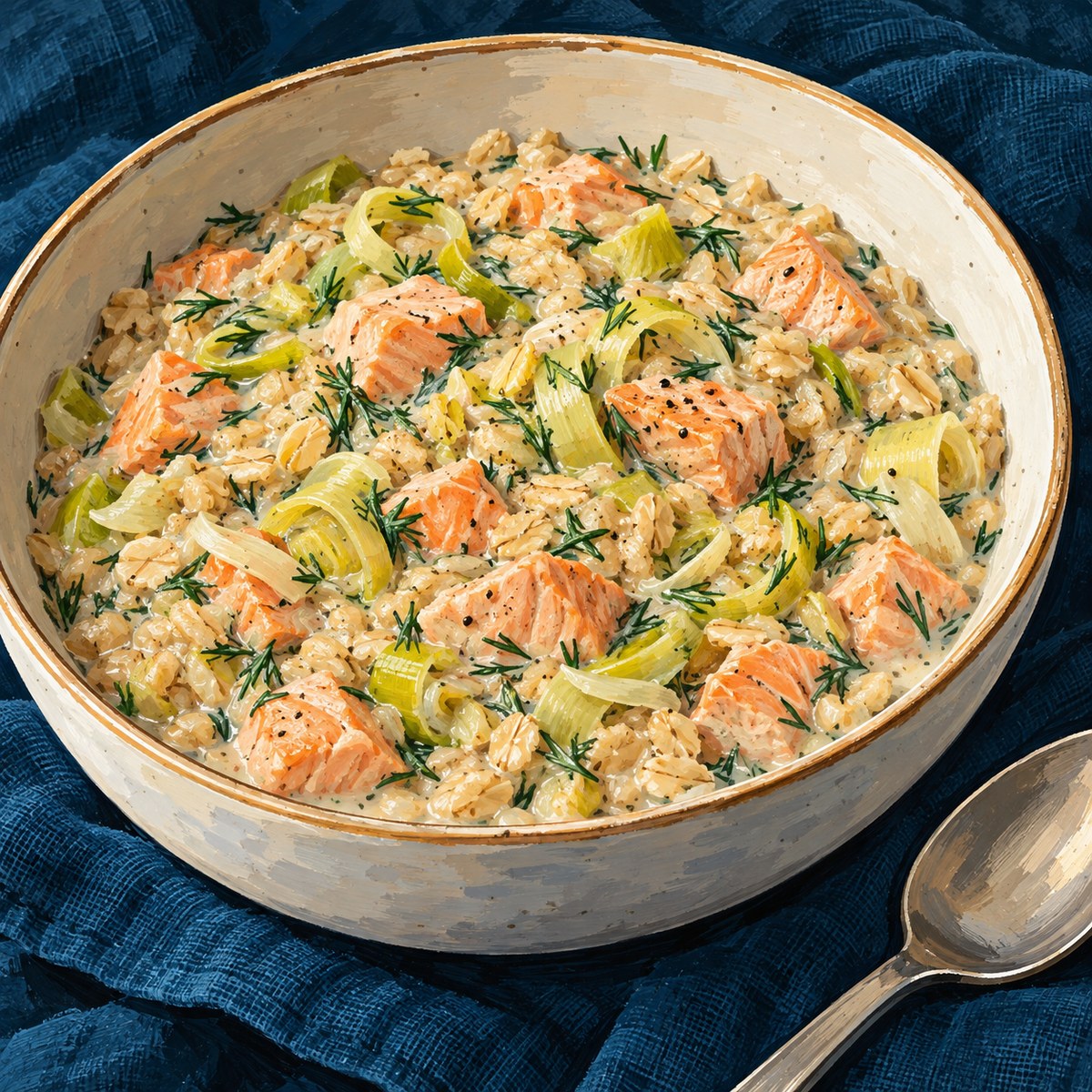
A clean leek is worth the extra minute
Trim away the tough dark leaves and root before weighing the leek. Split the pale portion lengthwise, rinse between the layers and slice thinly. Grit hides inside those layers and will not disappear during cooking. Cook the sliced leek slowly in the measured oil, stirring so the edges soften without darkening. There is no need to chase a deep brown color here: pale, tender ribbons are easier to mix through a spoonable bowl. Add the oats only when the leek has lost its raw firmness.
Keep the porridge moving and the fish still
Milk and oats can catch on the bottom of a pan if the heat is too high. Bring the liquids to a gentle simmer, then lower the heat and stir along the base. The oats get a short head start before the fish goes in. Cut the salmon into even cubes and nestle them into the porridge, rather than stirring raw fish vigorously through it. After the covered cooking, check a thick cube with a thermometer. Turn the cubes gently once if needed; repeated stirring breaks them into flakes before they cook evenly.
Finish loose, then take it to the table
The porridge thickens as it stands. With the stated water and milk it should settle into a soft mound that still moves when the pan is tilted, not a dry oat cake. The lemon and dill go in after cooking so the dill keeps its fresh scent. Divide both the fish and the porridge evenly between two bowls. This is best eaten straight away, which makes it useful on a morning when there is time to sit down after training or before a later start. It is a meal choice, not a prescribed recovery formula.
Ingredients
- 8 1/2 oz raw Atlantic salmon fillet, skin and pin bones removed (240 g edible weight)
- 3 1/4 oz rolled oats (90 g)
- 1 cup 2% milk (240 ml; use 240 g for the estimate)
- 1 1/4 cups water (300 ml/300 g)
- 1 large leek, pale portion trimmed, thoroughly washed and thinly sliced (150 g)
- 2 teaspoons olive oil (10 ml/9 g)
- 1 tablespoon lemon juice (15 ml/15 g)
- A small handful fresh dill, chopped (6 g)
- 1/4 teaspoon fine salt (1.5 g)
- 1/4 teaspoon ground black pepper (0.5 g)
Set out
Kitchen scale and measuring jug, 8-inch/20 cm wide saucepan, at least 2 qt/2 liters, with lid, Separate clean board and knife for raw fish, Wooden spoon or silicone spatula, Thin-tip food thermometer
Allergens
Fish (salmon), Milk, Check oats for allergen or cross-contact statements.. Check labels and substitutions.
Make it
- Trim, split and rinse the leek between its layers, then slice and weigh 150 g. On a separate board cut the salmon into roughly 1-inch/2.5 cm cubes. Wash hands and clean surfaces and utensils after handling raw fish.
- Heat the oil in the saucepan over medium-low heat. Cook the leek with the salt for 7–8 minutes, stirring, until soft without browning. Stir in the oats for 1 minute. Pour in milk and water and add black pepper.
- Bring to a gentle simmer, taking about 3 minutes, then lower the heat. Stir along the pan base and cook for 3–4 minutes, until the oats begin to soften but the mixture is still loose.
- Nestle the salmon cubes into the porridge in one layer, cover and maintain a very gentle simmer for 5–7 minutes. Check a thick cube: the center must reach 145°F/63°C. If needed, turn the pieces gently, cover and cook a little longer. Avoid a hard boil or frequent stirring, which can scorch the milk and break up the fish.
- Remove from the heat, gently fold in the lemon juice and dill, and stand for 2 minutes. Divide all the salmon and all the porridge equally between two bowls. Serve warm.
One pot, one proper pause
The breakfast needs attention at the stove for about 25 minutes, rather than a long list of separate components. Keep it for a morning when a warm bowl fits the schedule; it does not need to be eaten at a particular interval after exercise.
A useful detail
The 240 g salmon is weighed raw after skin and bones are removed. The estimate uses raw Atlantic farmed salmon, counts all oil and liquids, and divides the entire cooked pan between two servings. Other salmon types change the estimate.
Another way
- Replace the 6 g dill with 6 g chopped fresh chives.
- For a different grain texture, use 90 g quick oats rather than rolled oats, but check their packet timing and add the fish as soon as the porridge begins to thicken. The resulting texture will be smoother.
Keep it well
Best just cooked. If saving a portion, transfer it promptly to a shallow container and refrigerate within 2 hours, or 1 hour above 90°F/32°C. Keep at 40°F/4°C or below for up to 2 days, within the fish's original storage window. Reheat only the portion needed to 165°F/74°C throughout, stirring gently and adding a little water to loosen it; the fish will become firmer. Carry chilled portions with two cold sources.