042 / 75 · Canned Fish, Chicken and Eggs
Salmon Oat Cakes with Yogurt Dip
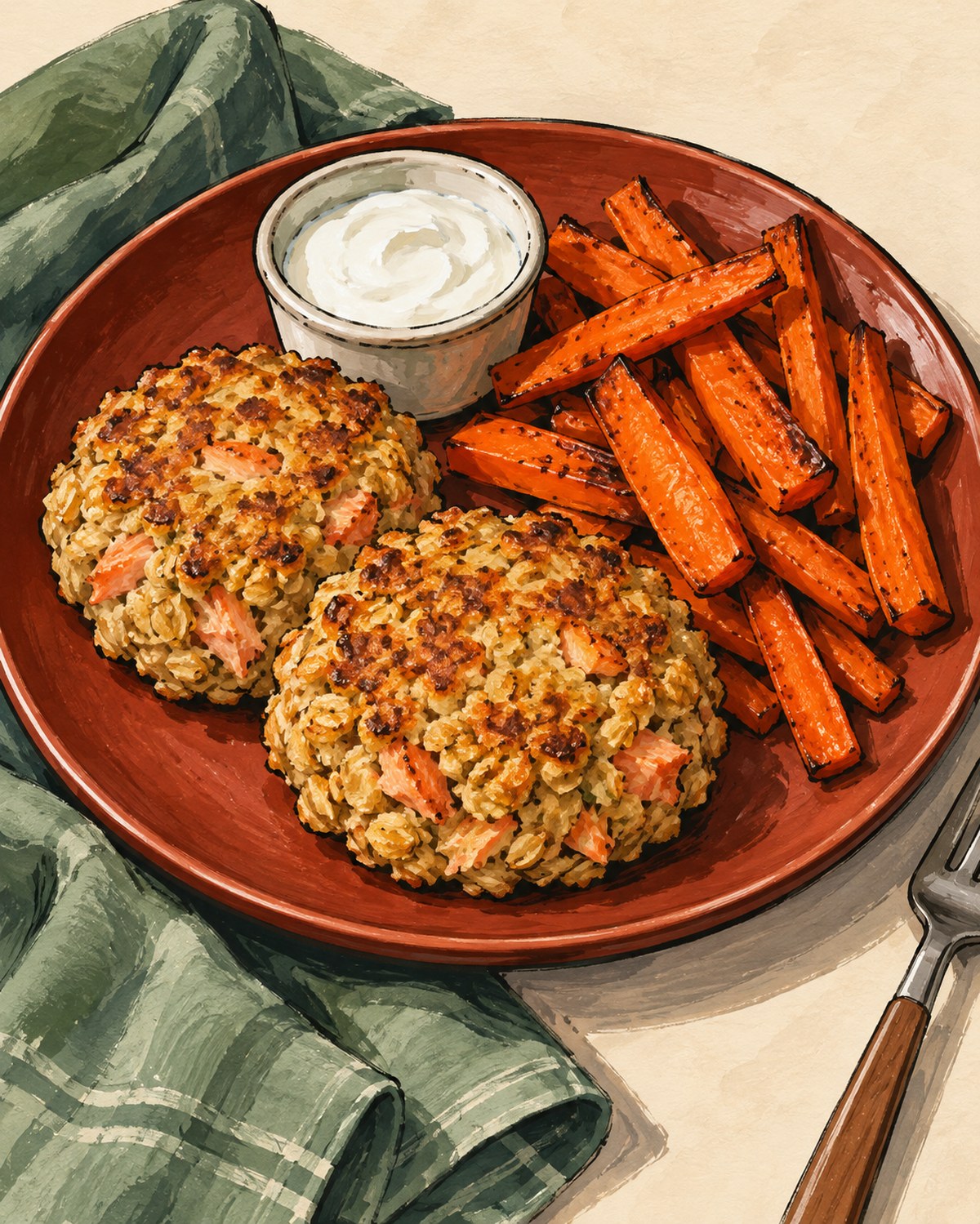
Eight salmon oat cakes, two per light meal with carrots and yogurt dip · Active 35 min · Total 1 hr 10 min
Print recipe · PDFRolled oats absorb a little water before they are mixed with canned salmon and eggs. The cakes are baked rather than fried, with a plain yogurt-vinegar dip and roasted carrots on the same meal plan. These are not potato fishcakes: their texture stays visibly oaty.
Give the oats their short soak
Plain old-fashioned rolled oats need a few minutes in warm water to soften. This is a brief preparation step, not an overnight room-temperature soak. Drain and check the salmon while they stand, removing any unwanted hard fragments and measuring usable fish. Instant flavored oatmeal and steel-cut oats do not match the same binder or hydration time.
Shape before the tray goes in
Mix softened oats with egg, onion and fish, then divide into eight equal portions. Flatten them into broad shallow cakes on an oiled sheet. Thick balls can remain soft inside after the outside colors. The carrots go on a second tray so their released moisture does not sit under the oat cakes, and both trays can be rotated once if the oven has a hot corner.
A cold dip and a hot center
The yogurt dressing needs only vinegar and a little of the measured pepper. Keep it refrigerated while the egg-bound cakes bake. Check a cake’s thickest center from the side rather than judging only its browned oats. Serve two cakes with one-quarter of the carrots and dip. Use the dip in small spoonfuls beside the cakes, keeping it cold until serving. It should provide a cool contrast to the hot oats and carrots without soaking their surfaces.
Ingredients
- 1 cup plain old-fashioned rolled oats (80 g)
- 1/3 cup warm water (80 ml)
- Canned salmon, drained and checked (8 oz/230 g usable fish)
- 2 large eggs
- 1/2 small onion, very finely chopped (50 g)
- 1/4 teaspoon fine salt (1.5 g)
- 1/4 teaspoon black pepper (0.5 g), divided
- 1 1/2 tablespoons neutral oil (22 ml), divided: 2 teaspoons/10 ml for cake sheet, remainder for carrots
- 1 1/3 lb carrots (600 g trimmed weight), cut into 1/2-inch/1 cm thick sticks
- 3/4 cup plain yogurt (180 g)
- 1 tablespoon cider vinegar (15 ml)
Set out
Two baking sheets, Mixing bowl and fork, Small dip bowl, Broad turner, Food thermometer
Allergens
fish, egg, milk. Check labels and substitutions.
Make it
- Heat oven to 425°F/220°C. Mix oats and warm water in the bowl and let stand for 10 minutes. Toss carrot sticks with their share of oil on one sheet, spread in one layer and roast for 25–30 minutes, turning once, until tender.
- Meanwhile check and measure drained salmon. Add fish, eggs, finely chopped onion, salt and half the pepper to the softened oats. Mix well without crushing every fish flake.
- Oil the second sheet with the measured 2 teaspoons/10 ml oil. Divide cake mixture into eight equal portions and flatten to about 3 inches/8 cm across and 1/2 inch/1 cm thick. Bake for 18–22 minutes, carefully turning after 12 minutes, until golden and at least 160°F/71°C in the centers. Rotate trays if needed.
- Mix yogurt, vinegar and remaining pepper in the small bowl and refrigerate until serving. Serve two cakes per person with one-quarter of the carrots and dip.
No potato binder
The oats and eggs hold these cakes. Their visible oat texture distinguishes them from the collection’s mashed-potato salmon patties.
Ingredient labels
Salmon supplies fish, eggs bind cakes and yogurt supplies milk. Oats may have wheat/barley cross-contact; check all actual labels rather than assuming gluten-free status.
A useful detail
The oat soak, carrot roast and cake preparation overlap. Two separate sheets are intentional; a crowded single tray makes the cakes wetter and carrots less evenly cooked.
Another way
- Use 230 g well-drained canned tuna instead of salmon.
- Use 600 g peeled parsnips cut into the same thin sticks instead of carrots, checking tenderness during roasting.
Keep it well
Refrigerate cooked cakes, carrots and yogurt dip separately within 2 hours, or 1 hour above 90°F/32°C, at 40°F/4°C or below. Use cakes and carrots within 3 days and dip within 2 days. Reheat hot components to 165°F/74°C. Freeze promptly cooled cakes for up to 1 month, thaw in the refrigerator; do not freeze the yogurt dip.