
Famous Last Meals / Illustrated food history

Ted Bundy: The Breakfast He Refused

Florida, 24 January 1989

Evidence: Contemporary reporting distinguishes the breakfast arranged from the breakfast refused.

Breakfast is easy to picture. It is harder to notice when the person did not eat it. On 24 January 1989, United Press International reported that Ted Bundy had refused a final breakfast of steak and eggs. The report attributed the refusal to a Florida corrections spokesman. Behind a familiar food list lay a night of prayer with a minister, unsuccessful appeals and a case whose victims had already spent years inside the public story. Contemporary UPI report.

Imagined illustration of an untouched breakfast place setting. The arrangement is editorial, not a record of Bundy’s actual tray.

Before the breakfast, a missing schoolgirl

The Florida Supreme Court’s 1985 opinion begins with Kimberly Leach. She was 12 when she disappeared from her junior high school in Lake City on 9 February 1978. A large search followed. Her body was found two months later. That opening restores a child and a place to a case so often organized around the killer’s name. Florida Supreme Court, printed page 1.

The opinion then follows the investigation through Bundy’s arrest in Pensacola on 15 February. He initially gave a different name before his identity emerged during interviews. Later that year came an indictment for Leach’s kidnapping and murder. The trial was moved to Orlando, where he was convicted and sentenced. The court upheld the judgment in the decision used here. These dated steps lead toward the final morning without making a breakfast menu carry the whole history.

A meal planned, then declined

Contemporary Los Angeles Times reporting named steak, eggs, orange juice, hash browns and coffee as the planned breakfast. The newspaper’s prison-spokesman account.

UPI’s later account reports refusal. It names the minister as Fred Lawrence of Gainesville and says Bundy spent part of the night praying. A kitchen’s provision and a prisoner’s consumption are different events. Here that difference changes the title of the scene: this is a breakfast refused, rather than a favorite dish chosen and enjoyed. The source provides no reason for the refusal that needs to be supplied by imagination. UPI.

The noise outside, the people left behind

The same dispatch describes a crowd outside Florida State Prison celebrating the execution, with opponents of the death penalty nearby. The meal occupies only a few sentences between reports of public spectacle and the last legal decisions. That placement is a reminder of how quickly a person’s case can become an event watched by others.

Kimberly Leach’s name remains the more necessary detail. A short chapter cannot contain every person harmed by Bundy, but it can resist letting an easily repeated menu replace them. The refusal matters because it corrects the scene; it does not explain the crimes or settle the larger arguments surrounding the sentence.

One ordinary cooking task

For the kitchen, choose a single component: potatoes. This modern version cuts them into small cubes, simmers them briefly and gives them room to brown. The pleasure of the dish is practical—soft centers against crisp edges—and depends on patient heat rather than an elaborate ingredient list.

The complete recipe below is useful on its own. Its connection is to a reported component of the arranged breakfast. It makes no claim about a historical potato variety, prison recipe or plate actually eaten.

Cook the recipe

An original modern home recipe, with its historical connection and adaptations explained below.

Famous Last Meals / Modern companion recipe

Golden Skillet Hash Browns

Small potato cubes are simmered until nearly tender, dried, then browned in a wide skillet. Hash browns appear in the reported breakfast arranged for Bundy; the diced cut, portion size and cooking method here are modern choices. This is a recipe for one breakfast component, not a reconstruction of the whole tray.

2 side-dish portions of crisp, tender diced potatoesActive 20 minCooking 30 minTotal 55 min

Read Ted Bundy: The Breakfast He Refused →

Print recipe · PDF
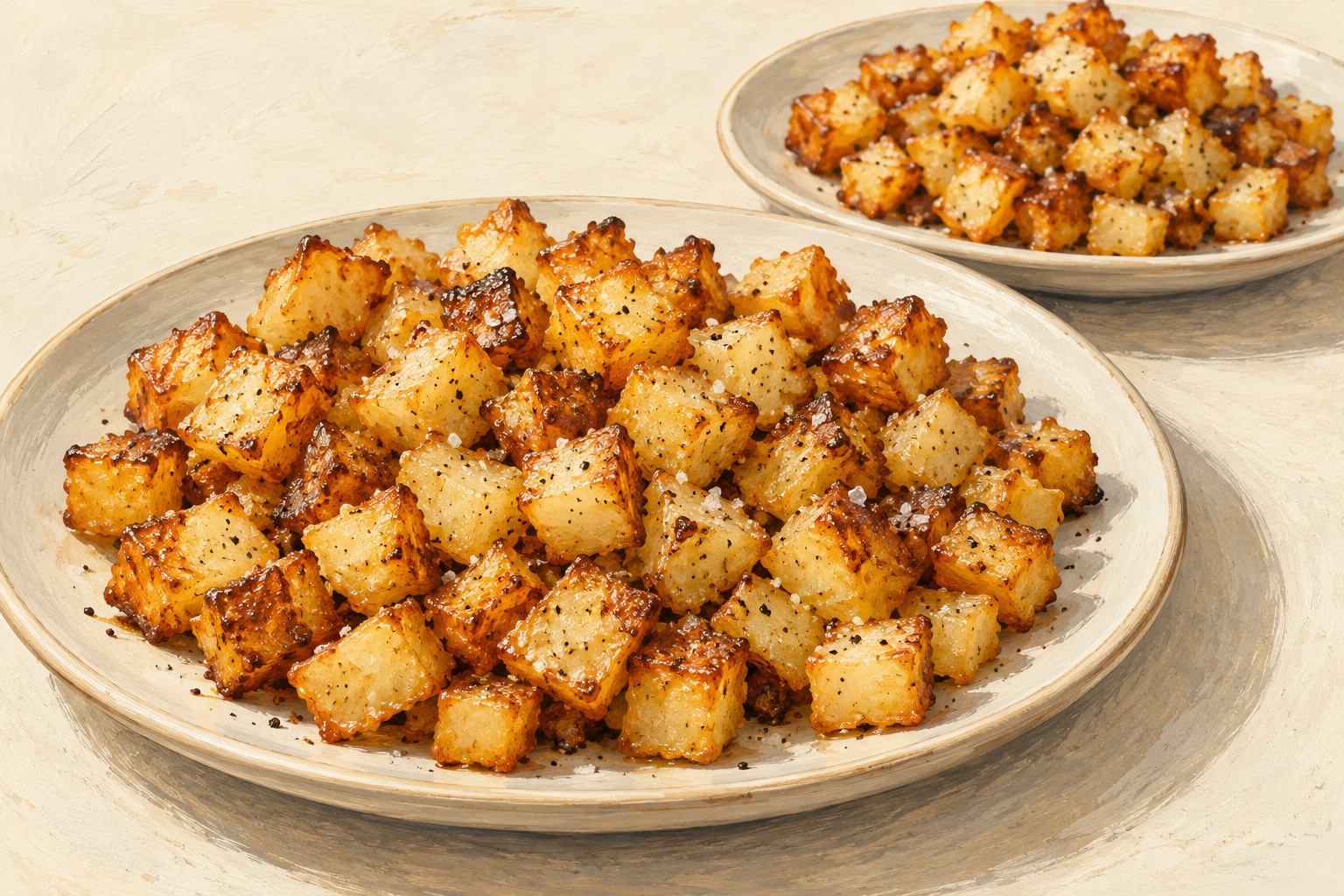
Two plain small cream plates, each with half a batch of crisp golden 1-cm potato cubes, light black-pepper flecks and irregular lightly browned edges. Cooked tender inside, no shredded cakes, eggs, steak, onions, herbs, ketchup, drink or other food. One plate dominant in a close three-quarter view.
Original modern recipe illustration: Golden Skillet Hash Browns. See the measured recipe for portions and cooking instructions.

Ingredients

  • About 3 medium floury potatoes, scrubbed and peeled to give 14 oz/400 g prepared flesh
  • 4 cups drinking water (1 liter), for simmering, drained away
  • 1 tablespoon plus 1 teaspoon neutral cooking oil (20 ml)
  • ⅓ teaspoon fine salt (2 g)
  • ¼ teaspoon ground black pepper (0.5 g)
Set out

Stovetop with 1 burner, Saucepan of at least 2 qt/2 L and colander, Heavy nonstick or well-seasoned skillet with usable flat base at least 10 in/25 cm across, Knife, vegetable board, kitchen scale and measuring spoons, Heatproof spatula, clean tray and serving plates, Food thermometer for checking reheated leftovers

Allergens

No major US allergen is intentionally included in the base recipe. Check the cooking oil and any substitutions for additional ingredients or cross-contact.

Make it

  1. Cut the prepared potatoes into even ⅜-in/1-cm cubes. Put in the saucepan with the 1 liter water. Bring to a simmer, then cook gently for about 6–8 minutes, checking early: the outside should soften while the cubes still hold their shape. A fork should enter with slight resistance. Do not reduce them to mash.
  2. Drain in the colander. Spread on the clean tray for about 5 minutes so visible steam and surface moisture escape. This short drying stage is part of continuous preparation, not a storage method.
  3. Heat all 20 ml oil in the skillet over medium heat. Add the potatoes in a shallow, uncrowded layer. If the stated flat base cannot hold them without crowding, use two batches and extend the clock rather than stacking them.
  4. Cook about 5 minutes undisturbed, until the undersides begin to brown. Turn with the spatula, then continue 10–15 minutes, turning a few times and reducing heat if the outside darkens before the centers soften.
  5. Add all the salt and pepper in the last 2 minutes. Split and taste a cooked cube to check that its center is fully tender, with no hard raw core; continue over gentler heat if needed. Divide all the potatoes between 2 plates and serve promptly. No onion, eggs, meat, sauce or garnish is included.

A useful detail

The 55-minute estimate allows 20 minutes for preparation and bringing water to a simmer, up to 8 minutes simmering, 5 minutes drying and up to 20 minutes browning. The cook clock rounds the simmering and browning stages to 30 minutes. Pan fit and the potato variety can extend cooking. Tender centers and browned surfaces are both required.

Keep it well

Refrigerate leftovers promptly in a shallow covered container within 2 hours, or 1 hour above 90°F/32°C, at 40°F/4°C or below. Use within 2 days. Reheat only the portion needed in a covered skillet until it reaches 165°F/74°C throughout, then uncover briefly to dry the surface. Discard food left beyond the stated room-temperature limits.

How this recipe relates to the story

Contemporary Los Angeles Times reporting identifies hash browns among the breakfast components to be supplied. UPI’s later report says Bundy refused breakfast. Diced potatoes, quantities, oil and this simmer-then-skillet method are new home-kitchen decisions; the recipe does not imply he ate them.

Another way

  • Use scrubbed thin-skinned potatoes without peeling, retaining 400 g prepared potato and the same 1-cm cut. Check tenderness rather than shortening the clock automatically.
  • Omit the black pepper for plain salted potatoes; no seasoning choice is established by the historical breakfast report.

Cooking and storage references

Sources for this story

  1. Urgent, 24 January 1989 ·
  2. High Court Refuses 3 Times to Block Bundy Execution, 24 January 1989 ·
  3. Bundy v.State, Supreme Court of Florida, 9 May 1985 ·