Famous Last Meals / Illustrated food history

Napoleon: Small Cups at Longwood

A surgeon’s notebook, a household diary, and the food recorded before 5 May 1821

Evidence: Food and drink recorded during the last days; no certain final meal identified

On the afternoon of 4 May 1821, Henri-Gatien Bertrand’s account places cold broth among the small quantities offered to Napoleon at Longwood. Later came more sips, then half a cup around nine. These entries are a long way from the image of an emperor presiding over a banquet. They belong to a household keeping watch through an illness, with attendants recording hours, visits and what could be taken. Bertrand’s dated account, as edited by the Fondation Napoléon.

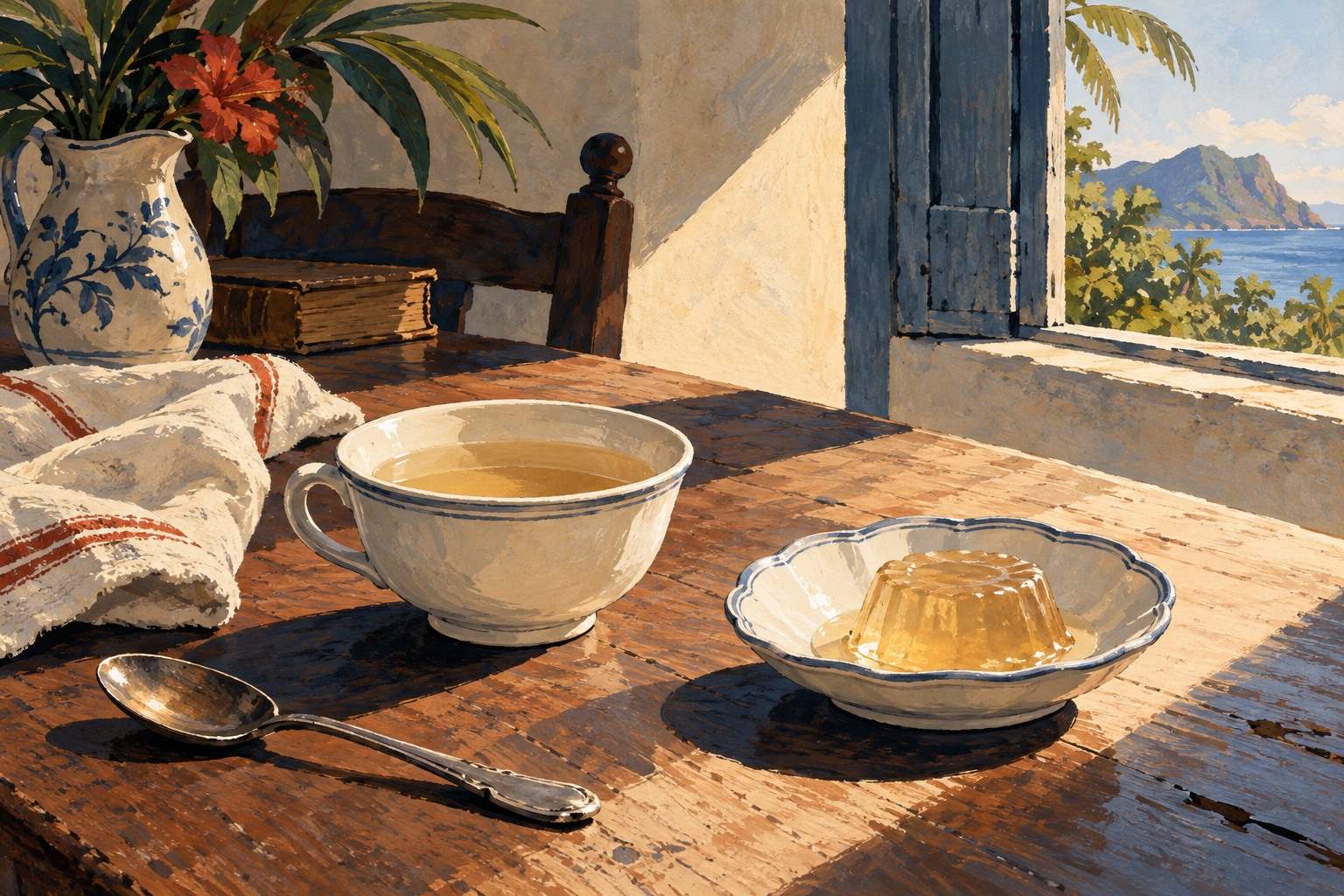
An imagined Longwood-era table with a small cup of pale broth and a separate plain jelly dish, kept restrained and unoccupied. It evokes dated bedside provisions, not a verified final tray or the exact furnishings of Napoleon’s room.

A doctor called after dark

Archibald Arnott, a British surgeon of the 20th Regiment, had first been consulted by Napoleon’s doctor, Antommarchi, on 25 March. On the night of 1 April, Antommarchi came to fetch him. Arnott’s subsequent book describes the route through Longwood’s dim passages and the introduction at the bedside by Count Montholon. The room itself was dark, and Arnott could not make a visual examination that night. He agreed to continue attending with Antommarchi.

Arnott wrote that he made daily notes for his own use. Published in 1822, his account retained the day-by-day form. The doctor’s visits became one record of the household’s final weeks, alongside the observations of the French attendants. Arnott, preface and printed pages 1–4.

A request for pheasant

The food entries do not move in a straight line from full meals to none. On 17 April, Arnott recorded a brief improvement and a request for minced pheasant. Napoleon received it, followed by a small amount of diluted claret. The next day’s entry names vermicelli soup, but also records that it could not be retained. On the morning of 19 April, Antommarchi told Arnott about potatoes eaten around midnight and a little more vermicelli soup.

The details place cooks, attendants and doctors in the same sequence of work. A request could be answered, a bowl brought, and the next report could still be very different. The dates matter more than a menu assembled by collecting every named dish into one extravagant final dinner. Arnott, printed pages 12–14.

Papers for a future he would not see

While the household managed these immediate needs, Napoleon was also arranging his papers and possessions. The Musée de l’Armée’s presentation of his surviving will dates the start of his final wishes to 11 April and the first handwritten copy to 15 April, followed by further texts. The documents are held by the French Archives Nationales.

This was another kind of household task, carried on alongside the bedside watch: deciding what would be written down and preserved. The will and codicils survive as objects with their own dates, not as a legend supplied after an unnamed last meal. The museum’s guide, item 055.

What was taken on 4 May

Arnott’s entry covering 4 May says that Napoleon took a little jelly and wine at intervals. Milk was recommended, but the suggestion was objected to; the doctor does not report it as consumed. He left at nine that evening.

Bertrand’s account gives the broth its closer timing: cold broth and orange-flower water in the afternoon, more sips during the evening and half a cup of broth at nine. Its early-hours entry for 5 May mentions further drinking without naming the liquid. A confident label for a final sip would go beyond those words.

Arnott returned the next morning. His book records Napoleon’s death at 5:49 that afternoon, 5 May. What remains for this food story is modest and specific: a few dated dishes earlier in April, then jelly, wine and small cups near the end. The record closes around the people keeping watch, not a ceremonially ordered last supper. Arnott, printed pages 23–24; Bertrand’s 4–5 May entries.

Cook the recipe

An original modern home recipe, with its historical connection and adaptations explained below.

Famous Last Meals / Modern companion recipe

Chicken and Fine-Noodle Broth

Simmer carrot and leek in a light seasoned broth, gently cook the chicken, then add fine noodles at the end. The chicken, vegetables, pasta and quantities are modern choices. This is a practical small soup, not Napoleon’s broth and not a diet for illness.

2 light soup portions, each half of all broth, chicken, vegetables and noodles; add other food separately if serving as a full mealActive 20 minCooking 35 minTotal 55 min

Read Napoleon: Small Cups at Longwood →

Print recipe · PDF
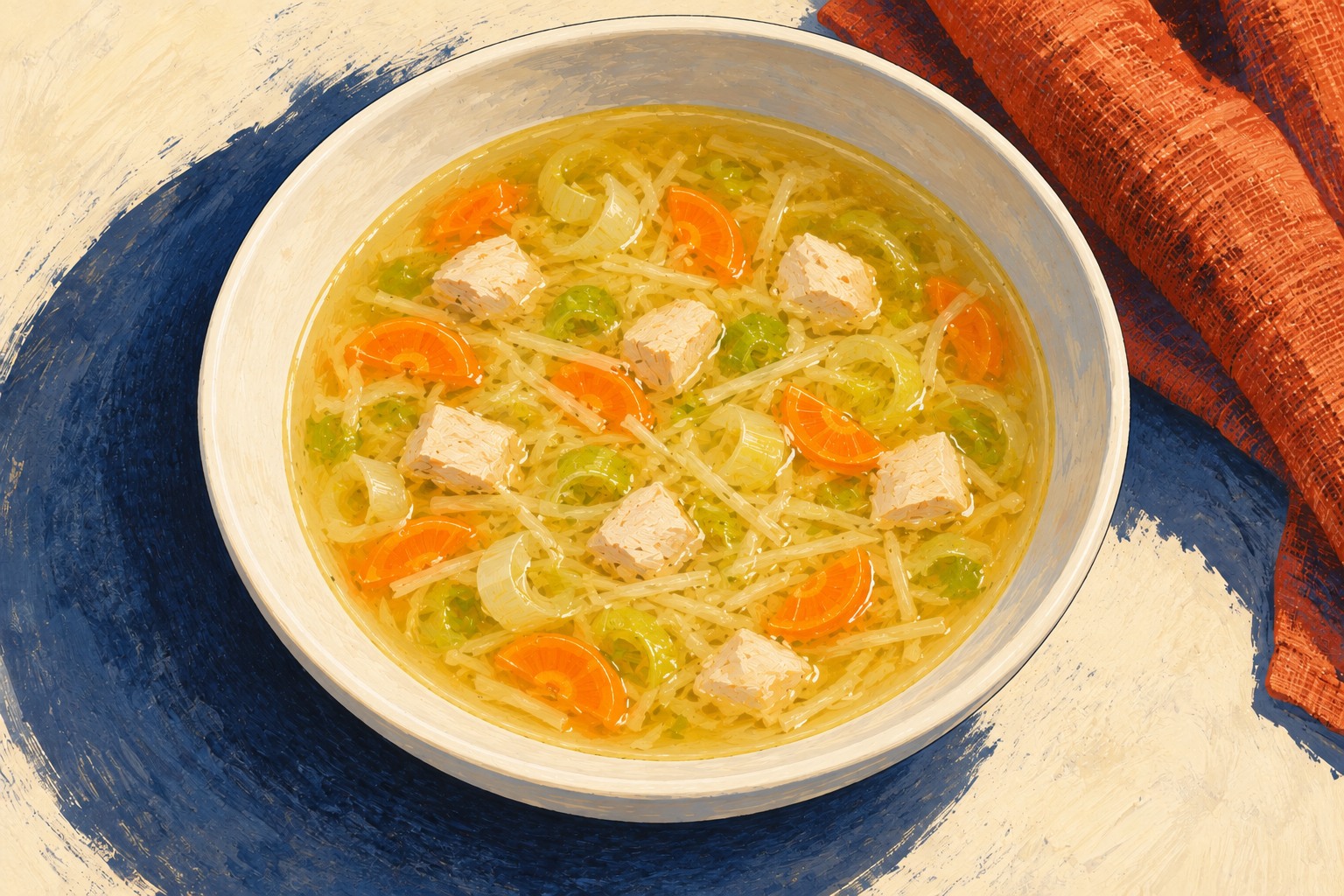
One modern light soup bowl, one of two portions, with pale fully cooked chicken pieces, fine short soft noodle strands, thin orange carrot half-moons and pale softened leek in clear golden broth.
Original modern recipe illustration: Chicken and Fine-Noodle Broth. See the measured recipe for portions and cooking instructions.

Look between the leek’s layers

Cut through the white and pale-green portion lengthwise before washing. Soil can remain deep between the layers even when the outside looks clean. Loosen the slices in a bowl of water, lift them out and rinse again; do not pour the grit back onto them. Weigh the prepared leek after trimming and cleaning.

Gentle heat leaves the chicken in pieces

Small chicken pieces do not need a furious boil. Bring the soup back to a controlled simmer after adding them, then check their centers with a thermometer. The tender vegetables have already had a head start. Cook the chicken fully before adding the pasta, so noodle timing never becomes a reason to stop the protein stage early.

Fine noodles finish quickly

Choose the pasta by its actual package time. Short broken strands are easier to divide and eat than a tangle of long vermicelli. They keep absorbing broth after cooking, so serve the soup promptly; leftovers will be thicker. When reheating, loosen with a little water rather than treating a thicker bowl as a failed broth.

Ingredients

  • 5⅔ oz raw skinless boneless chicken breast, fully thawed and cut into ¾ in/2 cm pieces (160 g edible meat)
  • 1 small carrot, scrubbed or peeled and cut into very thin half-moons (100 g prepared)
  • 2 oz white and pale-green leek, thinly sliced and thoroughly washed (60 g prepared)
  • 1¾ oz dry fine wheat vermicelli, broken into short 2 in/5 cm lengths (50 g); choose a product with a 3–5-minute simmer instruction
  • 3¾ cups drinking water (900 ml)
  • 1 small dried bay leaf
  • ½ teaspoon dried thyme leaves (about 0.5 g)
  • ⅓ teaspoon fine salt (2 g)
  • ⅛ teaspoon black pepper (about 0.25 g)
  • 1 teaspoon lemon juice (5 ml)
Set out

Stovetop, 2-liter/about 2-quart saucepan with lid, Knife and separate boards for raw chicken and produce, Colander and bowl for washing leek, Kitchen scale, measuring jug and spoons, Spoon, clean tongs and ladle, Food thermometer, Two soup bowls, Refrigerator and shallow containers for planned leftovers

Allergens

Wheat/gluten. Wheat vermicelli contains wheat/gluten; some products also contain egg. Check pasta and seasoning labels for every intended allergen. The egg-noodle variation adds egg. No commercial stock is hidden in the base recipe.

Make it

  1. Prepare the vegetables before handling raw chicken. Split and rinse the leek’s layers until no grit remains, then slice and weigh 60 g. Cut and weigh the carrot. On a separate board, cut the fully thawed chicken; do not wash raw chicken. Wash hands and clean its board and knife, keeping raw juices away from prepared vegetables and serving dishes.
  2. Put water, carrot, leek, bay, thyme, salt and pepper in the saucepan. Bring to a boil over medium-high heat, about 5–7 minutes. Lower to a gentle simmer, partly cover and cook 8–10 minutes until the carrot is almost tender.
  3. Add the raw chicken pieces, stir to separate and return to a gentle simmer. Partly cover and cook about 8–10 minutes, until the thickest pieces reach 165°F/74°C measured with a clean thermometer. Extend cooking if needed; color alone is not the safety test.
  4. Remove the bay. Add all the broken vermicelli and stir. Simmer uncovered for the full package time, usually 3–5 minutes for the specified fine pasta, until no hard center remains. Stir along the base so strands do not clump. If a different product requires longer, cook it fully and extend the total; add small splashes of boiling drinking water if necessary.
  5. Turn off the heat and stir in the measured lemon juice. Divide the entire pan into two bowls, sharing chicken and noodles as well as liquid. Serve promptly. There is no additional butter, bread, cream or garnish in the stated recipe.

A useful detail

The 55-minute total allows 20 minutes to wash leek and prepare the ingredients, plus approximately 35 minutes for heating, vegetables, chicken and short-cooking noodles. All required food fits below roughly two-thirds of a 2-liter pan before simmering. The recipe uses raw fully thawed chicken, not an unspecified older cooked batch.

Keep it well

Promptly divide planned soup leftovers into shallow containers and refrigerate at 40°F/4°C or below within 2 hours, or 1 hour above 90°F/32°C. Use within 3 days. For quality, freeze promptly chilled portions at 0°F/−18°C for up to 2 months; the noodles will soften. Thaw in the refrigerator. Reheat only what is needed to 165°F/74°C throughout, stirring and adding a little water to loosen the noodles.

How this recipe relates to the story

Broth appears in Bertrand’s dated 4 May account. The chicken, leek, carrot, noodles, lemon, seasonings and method are new home-recipe choices. This neither reconstructs that broth nor recommends historical or modern medical feeding.

Another way

  • Replace the leek with the same prepared weight of thinly sliced onion; simmer until tender before adding the chicken. This is another modern flavor choice.
  • Use 50 g fine egg noodles with the same 3–5-minute package route instead of wheat vermicelli. Cook for their full labeled time and add egg to the allergen list. Do not substitute uncooked rice on the same timing.

Cooking and storage references

Sources for this story

  1. An Account of the Last Illness, Decease, and Post Mortem Appearances of Napoleon Bonaparte · 1822 John Murray edition, University of Glasgow Library scan via Internet Archive
  2. Napoleon’s last days, March–May 1821, as seen through the eyes of the Grand Marshal Bertrand · Fondation Napoléon, attributed edited timeline based on Bertrand’s Cahiers de Sainte-Hélène; commentaries François Houdecek
  3. Napoléon n’est plus: English exhibition discovery guide, item 055 · Musée de l’Armée; exhibited Archives Nationales will AE/I/13/21