
Discovery07 · supplied 2 November 2026
The Black Swan Grid
Thirty ways to question assumptions, across thirty research domains.
The three result reports contain analytical and synthetic calculations. They have not been independently reproduced or checked against external literature for this release. Source words such as “proven”, “universal” and “new” remain author claims. They are not publication endorsements.
IDs B001–B900 are preserved. The refinements and reports develop existing entries; do not add these counts together. Twenty-one refinements overlap the screened set. The collection reports no experimental measurements, observed-data reanalysis, external literature search or independent implementation.
Download all 26 unchanged original files · PDF, Word, CSV, JSON, code and figures
Packaging notes and unresolved result issues
Read these limits before quoting the results
This is a source-preserving archive. Packaging checks found the following issues; the supplied files remain unchanged.
- Membership: all 300 screened entries are in the 900. The 30 editorial refinements develop the full collection; 21 are in the screened set and nine are outside it: B003, B008, B022, B031, B033, B061, B091, B211, B481. They are not extra hypotheses.
- P1: prose alternates between area-defined and first-1/e-crossing coherence times; the code uses a crossing. The exponential relaxation factor caps the ratio within the assumed model. General universality and spectral-index inference need separate review. The filter/PSD normalization also needs reconciliation before promotion.
- P2: thickness is in metres in the code while source current units are labelled using centimetres. The saved output gives relative standard deviations of about 1.23% for the bulk coefficient and 2.98% for the surface coefficient, rather than a general 1% recovery guarantee.
- Screening and novelty: selection scores and overlapping survival tags describe supplied testability proxies. The source gives differing summaries of the score features. A lexical comparison with 6,007 local titles is not literature review or novelty clearance.
No new scientific test was run to prepare this archive. These issues limit promotion, while every supplied hypothesis, correction, negative result and calculation remains available below and in the original ZIP.
900 hypotheses, grouped by operator
Expand an operator, then an individual idea. Search the complete claims, mechanisms and kill tests, or filter the supplied memberships. Scores rank the source’s testability proxy, not truth.
All original fields remain available without JavaScript in the expandable records. JavaScript adds search and membership filters.
1. Inversion: the artefact is the signal 30 hypotheses · 10 screened
B001 · Cryostat thermal drift is a phonon-transport signal, not noisecondensed-matter
Exploratory hypothesis · screened · refined R01
- Id
- B001
- Domain
- condensed-matter
- Claim
- Cryostat thermal drift is a phonon-transport signal, not noise
- Mechanism
- drift rate tracks the sample's thermal conductance to the bath at the 10⁻⁵ W/K level
- Kill test
- drift rate independent of sample mounting conductance across a decade
- Operator
- 1
- Operator Name
- Inversion: the artefact is the signal
- File
- 01-operators-1-5.md
- Score
- 3.83
B002 · Wall slip in a rheometer is a slip-length measurement with 100 nm resolutionsoft-matter
Exploratory hypothesis · screened
- Id
- B002
- Domain
- soft-matter
- Claim
- Wall slip in a rheometer is a slip-length measurement with 100 nm resolution
- Mechanism
- apparent viscosity deficit scales as the slip length over gap; reversing the gap separates slip from shear thinning
- Kill test
- apparent slip independent of gap at fixed stress
- Operator
- 1
- Operator Name
- Inversion: the artefact is the signal
- File
- 01-operators-1-5.md
- Score
- 2.67
B003 · The uncompensated resistance is a thermometer with microkelvin resolutionelectrochemistry
Exploratory hypothesis · refined R02
- Id
- B003
- Domain
- electrochemistry
- Claim
- The uncompensated resistance is a thermometer with microkelvin resolution
- Mechanism
- dR/dT of the electrolyte is 2%/K, so 1 µΩ in 10 Ω resolves 5 mK
- Kill test
- R drift uncorrelated with an independent thermocouple at fixed current
- Operator
- 1
- Operator Name
- Inversion: the artefact is the signal
- File
- 01-operators-1-5.md
- Score
- 1.83
B004 · Coke deposition is an active-site titration, not a deactivation nuisancecatalysis
Exploratory hypothesis
- Id
- B004
- Domain
- catalysis
- Claim
- Coke deposition is an active-site titration, not a deactivation nuisance
- Mechanism
- the coke formed per turnover is fixed by site geometry, so the coke-versus-time curve counts working sites
- Kill test
- coke per converted molecule varying by more than 2× across a site-density series
- Operator
- 1
- Operator Name
- Inversion: the artefact is the signal
- File
- 01-operators-1-5.md
- Score
- 2.5
B005 · Photobleaching is a photon dosimeter with 1% absolute accuracyphotochemistry
Exploratory hypothesis
- Id
- B005
- Domain
- photochemistry
- Claim
- Photobleaching is a photon dosimeter with 1% absolute accuracy
- Mechanism
- bleaching quantum yield is fixed for a given dye-oxygen pair, so the bleach is an integral of absorbed photons
- Kill test
- bleach per absorbed photon varying with intensity at fixed oxygen
- Operator
- 1
- Operator Name
- Inversion: the artefact is the signal
- File
- 01-operators-1-5.md
- Score
- 0.83
B006 · Pulse chirp is a direct measure of the medium's nonlinear refractive indexultrafast
Exploratory hypothesis
- Id
- B006
- Domain
- ultrafast
- Claim
- Pulse chirp is a direct measure of the medium's nonlinear refractive index
- Mechanism
- the chirp acquired is proportional to the B-integral, which is n₂ times intensity times length
- Kill test
- extracted n₂ disagreeing with interferometric measurement by more than 20%
- Operator
- 1
- Operator Name
- Inversion: the artefact is the signal
- File
- 01-operators-1-5.md
- Score
- 2.33
B007 · Readout crosstalk is a two-qubit coupling meter that beats spectroscopyquantum-devices
Exploratory hypothesis · screened
- Id
- B007
- Domain
- quantum-devices
- Claim
- Readout crosstalk is a two-qubit coupling meter that beats spectroscopy
- Mechanism
- the crosstalk matrix element falls off as the inverse cube of detuning, so its tail measures the residual coupling at large detuning where spectroscopy is blind
- Kill test
- crosstalk tail independent of detuning in the predicted power law
- Operator
- 1
- Operator Name
- Inversion: the artefact is the signal
- File
- 01-operators-1-5.md
- Score
- 2.83
B008 · The servo error signal is a sub-nanometre displacement sensorprecision-metrology
Exploratory hypothesis · refined R03
- Id
- B008
- Domain
- precision-metrology
- Claim
- The servo error signal is a sub-nanometre displacement sensor
- Mechanism
- in lock, the error channel gain is calibrated by the feedback itself, so its noise floor sets displacement sensitivity without a separate interferometer
- Kill test
- error-channel displacement disagreeing with the interferometer by more than its own noise
- Operator
- 1
- Operator Name
- Inversion: the artefact is the signal
- File
- 01-operators-1-5.md
- Score
- 1.0
B009 · Detector dead time is a precise flux monitornuclear-particle
Exploratory hypothesis
- Id
- B009
- Domain
- nuclear-particle
- Claim
- Detector dead time is a precise flux monitor
- Mechanism
- the observed-to-true ratio is a known function of rate, so the dead time extracted from a rate sweep is a flux calibration
- Kill test
- extracted dead time varying with source strength beyond counting statistics
- Operator
- 1
- Operator Name
- Inversion: the artefact is the signal
- File
- 01-operators-1-5.md
- Score
- 0.83
B010 · PSF anisotropy is a turbulence monitor with better time resolution than a differential image motion monitorastrophysics
Exploratory hypothesis
- Id
- B010
- Domain
- astrophysics
- Claim
- PSF anisotropy is a turbulence monitor with better time resolution than a differential image motion monitor
- Mechanism
- the ellipticity induced by the atmosphere responds to the same Cn² integral as scintillation but at higher frequency
- Kill test
- ellipticity power spectrum uncorrelated with scintillation index above 1 Hz
- Operator
- 1
- Operator Name
- Inversion: the artefact is the signal
- File
- 01-operators-1-5.md
- Score
- 2.33
B011 · Coronagraph stray light is a map of the instrument's dust populationplanetary
Exploratory hypothesis · screened
- Id
- B011
- Domain
- planetary
- Claim
- Coronagraph stray light is a map of the instrument's dust population
- Mechanism
- the scattered-light halo shape follows the dust size distribution's forward-scattering lobe
- Kill test
- halo shape invariant after a controlled contamination event
- Operator
- 1
- Operator Name
- Inversion: the artefact is the signal
- File
- 01-operators-1-5.md
- Score
- 2.67
B012 · Instrument tilt is a long-period seismometer that needs no feedbackgeophysics
Exploratory hypothesis
- Id
- B012
- Domain
- geophysics
- Claim
- Instrument tilt is a long-period seismometer that needs no feedback
- Mechanism
- a tilt step produces a displacement-equivalent signal at periods beyond the instrument's corner, and the step response identifies the tilt
- Kill test
- tilt inferred from the step disagreeing with a co-located tiltmeter by more than 20%
- Operator
- 1
- Operator Name
- Inversion: the artefact is the signal
- File
- 01-operators-1-5.md
- Score
- 2.5
B013 · The radiosonde's pump lag is a ventilation measurement, not an erroratmosphere
Exploratory hypothesis · screened
- Id
- B013
- Domain
- atmosphere
- Claim
- The radiosonde's pump lag is a ventilation measurement, not an error
- Mechanism
- lag time scales inversely with ascent-rate-dependent airflow, so the lag identifies the pump's effective flow
- Kill test
- lag time independent of ascent rate over a 3× range
- Operator
- 1
- Operator Name
- Inversion: the artefact is the signal
- File
- 01-operators-1-5.md
- Score
- 4.33
B014 · Biofouling on an optical sensor is a productivity record with daily resolutionocean-ice
Exploratory hypothesis
- Id
- B014
- Domain
- ocean-ice
- Claim
- Biofouling on an optical sensor is a productivity record with daily resolution
- Mechanism
- fouling growth follows the same light-and-nutrient limitation as phytoplankton, so the fouling curve integrates local production
- Kill test
- fouling growth uncorrelated with independent chlorophyll at fixed depth
- Operator
- 1
- Operator Name
- Inversion: the artefact is the signal
- File
- 01-operators-1-5.md
- Score
- 0.75
B015 · Rain-gauge evaporation loss is a latent-heat flux measurementhydrology-soil
Exploratory hypothesis
- Id
- B015
- Domain
- hydrology-soil
- Claim
- Rain-gauge evaporation loss is a latent-heat flux measurement
- Mechanism
- the loss rate is set by the same aerodynamic resistance as evapotranspiration, so the gauge is a miniature lysimeter
- Kill test
- loss rate uncorrelated with eddy-covariance latent heat at the same site
- Operator
- 1
- Operator Name
- Inversion: the artefact is the signal
- File
- 01-operators-1-5.md
- Score
- 0.92
B016 · Plate-edge evaporation is a humidity sensor array with 96 independent elementsmicrobiology
Exploratory hypothesis
- Id
- B016
- Domain
- microbiology
- Claim
- Plate-edge evaporation is a humidity sensor array with 96 independent elements
- Mechanism
- edge wells lose volume faster; the evaporation profile is set by the plate's boundary-layer geometry, which tracks incubator airflow
- Kill test
- evaporation profile invariant to incubator fan speed
- Operator
- 1
- Operator Name
- Inversion: the artefact is the signal
- File
- 01-operators-1-5.md
- Score
- 2.58
B017 · The porometer's leaf clamp is an embolism detectorplant-agriculture
Exploratory hypothesis · screened
- Id
- B017
- Domain
- plant-agriculture
- Claim
- The porometer's leaf clamp is an embolism detector
- Mechanism
- clamping perturbs xylem tension; the recovery time constant lengthens sharply once cavitation begins
- Kill test
- recovery time constant independent of the measured xylem pressure at the cavitation threshold
- Operator
- 1
- Operator Name
- Inversion: the artefact is the signal
- File
- 01-operators-1-5.md
- Score
- 3.0
B018 · Electrode impedance drift is a tissue-health monitor more sensitive than the neural signalneuroscience
Exploratory hypothesis
- Id
- B018
- Domain
- neuroscience
- Claim
- Electrode impedance drift is a tissue-health monitor more sensitive than the neural signal
- Mechanism
- impedance rises with glial encapsulation before unit loss becomes visible
- Kill test
- impedance drift uncorrelated with histological encapsulation in matched implants
- Operator
- 1
- Operator Name
- Inversion: the artefact is the signal
- File
- 01-operators-1-5.md
- Score
- 0.75
B019 · Assay background is a complement-activity measurementimmunology
Exploratory hypothesis · screened
- Id
- B019
- Domain
- immunology
- Claim
- Assay background is a complement-activity measurement
- Mechanism
- the background from serum on an untreated plate is dominated by alternative-pathway deposition, which varies with donor
- Kill test
- background independent of a complement-specific functional assay across donors
- Operator
- 1
- Operator Name
- Inversion: the artefact is the signal
- File
- 01-operators-1-5.md
- Score
- 2.75
B020 · Embryo autofluorescence is a metabolic-state readout that predicts developmental ratedevelopmental-biology
Exploratory hypothesis
- Id
- B020
- Domain
- developmental-biology
- Claim
- Embryo autofluorescence is a metabolic-state readout that predicts developmental rate
- Mechanism
- NAD(P)H fluorescence tracks the redox ratio, which sets the rate of divisions
- Kill test
- autofluorescence at a fixed stage uncorrelated with time to the next division
- Operator
- 1
- Operator Name
- Inversion: the artefact is the signal
- File
- 01-operators-1-5.md
- Score
- 1.0
B021 · Detector false positives are a biodiversity signal, not a contaminationecology-evolution
Exploratory hypothesis · screened
- Id
- B021
- Domain
- ecology-evolution
- Claim
- Detector false positives are a biodiversity signal, not a contamination
- Mechanism
- the false-positive spectrum contains environmental DNA from non-target taxa at low abundance, in proportion to their true abundance
- Kill test
- false-positive composition invariant to site while true composition changes
- Operator
- 1
- Operator Name
- Inversion: the artefact is the signal
- File
- 01-operators-1-5.md
- Score
- 2.75
B022 · ECG baseline wander is a respiration monitor with better compliance than a beltmedicine-diagnostics
Exploratory hypothesis · refined R04
- Id
- B022
- Domain
- medicine-diagnostics
- Claim
- ECG baseline wander is a respiration monitor with better compliance than a belt
- Mechanism
- the wander is driven by thoracic impedance and electrode motion, both proportional to tidal volume
- Kill test
- wander-derived volume uncorrelated with spirometry across posture changes
- Operator
- 1
- Operator Name
- Inversion: the artefact is the signal
- File
- 01-operators-1-5.md
- Score
- 0.67
B023 · Tablet dissolution lag is a gastric-motility probepharmacology
Exploratory hypothesis
- Id
- B023
- Domain
- pharmacology
- Claim
- Tablet dissolution lag is a gastric-motility probe
- Mechanism
- the lag distribution in vivo is set by pyloric opening, which the in vitro lag cannot reproduce; the mismatch is the motility measurement
- Kill test
- in vivo lag distribution matching in vitro across formulations
- Operator
- 1
- Operator Name
- Inversion: the artefact is the signal
- File
- 01-operators-1-5.md
- Score
- 0.75
B024 · Package condensation is a shelf-life integrator with a single numberfood-science
Exploratory hypothesis
- Id
- B024
- Domain
- food-science
- Claim
- Package condensation is a shelf-life integrator with a single number
- Mechanism
- cumulative condensation tracks the time-integral of temperature excursions through the dew-point crossing
- Kill test
- condensation mass uncorrelated with measured vitamin loss across storage profiles
- Operator
- 1
- Operator Name
- Inversion: the artefact is the signal
- File
- 01-operators-1-5.md
- Score
- 0.83
B025 · Tribometer wear debris is a third-body rheology probematerials-failure
Exploratory hypothesis
- Id
- B025
- Domain
- materials-failure
- Claim
- Tribometer wear debris is a third-body rheology probe
- Mechanism
- debris-bed shear strength is measurable from the friction coefficient's velocity dependence, which no clean-surface model predicts
- Kill test
- velocity dependence identical with and without debris trapping
- Operator
- 1
- Operator Name
- Inversion: the artefact is the signal
- File
- 01-operators-1-5.md
- Score
- 0.67
B026 · The strain gauge's thermal output is a solar-radiation monitorstructural-civil
Exploratory hypothesis
- Id
- B026
- Domain
- structural-civil
- Claim
- The strain gauge's thermal output is a solar-radiation monitor
- Mechanism
- the apparent strain of a gauge on a shaded versus sunlit member differs by the absorbed flux divided by the convective coefficient
- Kill test
- apparent strain difference uncorrelated with pyranometer readings on the same member
- Operator
- 1
- Operator Name
- Inversion: the artefact is the signal
- File
- 01-operators-1-5.md
- Score
- 0.92
B027 · Calendar self-discharge is a separator-pore-quality assayenergy-systems
Exploratory hypothesis · screened
- Id
- B027
- Domain
- energy-systems
- Claim
- Calendar self-discharge is a separator-pore-quality assay
- Mechanism
- self-discharge is dominated by redox shuttling through pinholes, so the rate maps the pore-size tail rather than the bulk separator
- Kill test
- self-discharge rate independent of measured pore-size tail across separators
- Operator
- 1
- Operator Name
- Inversion: the artefact is the signal
- File
- 01-operators-1-5.md
- Score
- 2.75
B028 · Machine-tool thermal drift is a spindle-preload metermanufacturing
Exploratory hypothesis · screened
- Id
- B028
- Domain
- manufacturing
- Claim
- Machine-tool thermal drift is a spindle-preload meter
- Mechanism
- the drift's time constant is set by bearing preload through the friction-to-heat path, not by ambient temperature
- Kill test
- drift time constant invariant to a controlled preload change
- Operator
- 1
- Operator Name
- Inversion: the artefact is the signal
- File
- 01-operators-1-5.md
- Score
- 2.75
B029 · Room reverberation is a wall-impedance measurementacoustics-vibration
Exploratory hypothesis
- Id
- B029
- Domain
- acoustics-vibration
- Claim
- Room reverberation is a wall-impedance measurement
- Mechanism
- the decay curve's curvature at late times reflects the absorptive mismatch between surfaces, which a single reverberation time cannot express
- Kill test
- late-time curvature unchanged when a known absorber is added
- Operator
- 1
- Operator Name
- Inversion: the artefact is the signal
- File
- 01-operators-1-5.md
- Score
- 0.75
B030 · ADC clock jitter is a phase-noise measurement of the sample clocksignal-information
Exploratory hypothesis
- Id
- B030
- Domain
- signal-information
- Claim
- ADC clock jitter is a phase-noise measurement of the sample clock
- Mechanism
- the jitter-induced noise floor scales with input slew rate, so two-tone tests recover the jitter spectrum without a phase-noise analyser
- Kill test
- recovered jitter spectrum disagreeing with a direct phase-noise measurement by more than 3 dB
- Operator
- 1
- Operator Name
- Inversion: the artefact is the signal
- File
- 01-operators-1-5.md
- Score
- 2.5
2. Limit-taking: the extreme case everyone avoids 30 hypotheses · 10 screened
B031 · At the lowest measurable temperature, Wiedemann–Franz fails in a way that reveals the charge-neutral channelcondensed-matter
Exploratory hypothesis · refined R05
- Id
- B031
- Domain
- condensed-matter
- Claim
- At the lowest measurable temperature, Wiedemann–Franz fails in a way that reveals the charge-neutral channel
- Mechanism
- the electronic thermal conductivity saturates when impurity scattering dominates while the electrical conductivity keeps rising, so the Lorenz ratio must fall below the Sommerfeld value by a factor set by the screening length
- Kill test
- Lorenz ratio staying within 5% of Sommerfeld down to 50 mK in a dirty metal
- Operator
- 2
- Operator Name
- Limit-taking: the extreme case everyone avoids
- File
- 01-operators-1-5.md
- Score
- 2.5
B032 · At infinite dilution, colloidal diffusivity deviates from Stokes–Einstein because the solvent's own correlation length matterssoft-matter
Exploratory hypothesis · screened
- Id
- B032
- Domain
- soft-matter
- Claim
- At infinite dilution, colloidal diffusivity deviates from Stokes–Einstein because the solvent's own correlation length matters
- Mechanism
- for particles below 5 nm, the slip length at the particle surface makes D exceed Stokes–Einstein by 10–40%, and the excess scales with the solvent's structural correlation length
- Kill test
- D matching Stokes–Einstein within 2% for a 2 nm tracer across three solvents of different correlation length
- Operator
- 2
- Operator Name
- Limit-taking: the extreme case everyone avoids
- File
- 01-operators-1-5.md
- Score
- 3.5
B033 · At zero supporting electrolyte, the transference number becomes directly measurable from the limiting current's transientelectrochemistry
Exploratory hypothesis · refined R06
- Id
- B033
- Domain
- electrochemistry
- Claim
- At zero supporting electrolyte, the transference number becomes directly measurable from the limiting current's transient
- Mechanism
- without excess salt, migration and diffusion decouple in time, and the current's early-time slope gives the transference number without tracer methods
- Kill test
- transient-derived transference number disagreeing with concentration-cell measurement by more than 10%
- Operator
- 2
- Operator Name
- Limit-taking: the extreme case everyone avoids
- File
- 01-operators-1-5.md
- Score
- 2.42
B034 · At zero conversion, the measured rate constant is not the steady-state one; the difference is the coverage relaxation timecatalysis
Exploratory hypothesis
- Id
- B034
- Domain
- catalysis
- Claim
- At zero conversion, the measured rate constant is not the steady-state one; the difference is the coverage relaxation time
- Mechanism
- the catalyst starts from a bare surface, and the approach to steady coverage takes seconds, so a differential reactor at zero conversion measures a transient
- Kill test
- zero-conversion rate unchanged when the catalyst is pre-equilibrated at reaction conditions
- Operator
- 2
- Operator Name
- Limit-taking: the extreme case everyone avoids
- File
- 01-operators-1-5.md
- Score
- 1.92
B035 · At zero quencher, the residual quenching is the solvent's own radical yieldphotochemistry
Exploratory hypothesis
- Id
- B035
- Domain
- photochemistry
- Claim
- At zero quencher, the residual quenching is the solvent's own radical yield
- Mechanism
- even purified solvent generates radicals at a yield set by its C–H bond strength, giving a floor to every quenching measurement
- Kill test
- residual quenching varying with solvent deuteration of the same bond strength
- Operator
- 2
- Operator Name
- Limit-taking: the extreme case everyone avoids
- File
- 01-operators-1-5.md
- Score
- 0.92
B036 · At zero delay, the pump–probe signal contains a coherent artefact that measures the pulse's absolute phaseultrafast
Exploratory hypothesis · screened
- Id
- B036
- Domain
- ultrafast
- Claim
- At zero delay, the pump–probe signal contains a coherent artefact that measures the pulse's absolute phase
- Mechanism
- the non-resonant response at zero delay is the convolution of the field with itself, which is phase-sensitive
- Kill test
- zero-delay signal invariant to a known phase step applied by a shaper
- Operator
- 2
- Operator Name
- Limit-taking: the extreme case everyone avoids
- File
- 01-operators-1-5.md
- Score
- 3.0
B037 · At zero bias, a tunnel junction's current noise measures the electromagnetic environment's impedancequantum-devices
Exploratory hypothesis · screened · refined R07
- Id
- B037
- Domain
- quantum-devices
- Claim
- At zero bias, a tunnel junction's current noise measures the electromagnetic environment's impedance
- Mechanism
- the zero-bias noise is set by the real part of the environment impedance at the junction's plasma frequency
- Kill test
- zero-bias noise invariant when a known series impedance is inserted
- Operator
- 2
- Operator Name
- Limit-taking: the extreme case everyone avoids
- File
- 01-operators-1-5.md
- Score
- 2.83
B038 · At zero averaging time, the Allan variance is dominated by the interrogating oscillator, not the Clock under testprecision-metrology
Exploratory hypothesis
- Id
- B038
- Domain
- precision-metrology
- Claim
- At zero averaging time, the Allan variance is dominated by the interrogating oscillator, not the Clock under test
- Mechanism
- at τ below the servo bandwidth, the measured variance is the local oscillator's, so short-τ stability claims describe the wrong device
- Kill test
- short-τ variance unchanged when the local oscillator is swapped for one with different noise
- Operator
- 2
- Operator Name
- Limit-taking: the extreme case everyone avoids
- File
- 01-operators-1-5.md
- Score
- 2.0
B039 · At zero energy threshold, the detector's rate is set by its own radioactivity, and the spectrum's shape measures the contamination depth profilenuclear-particle
Exploratory hypothesis
- Id
- B039
- Domain
- nuclear-particle
- Claim
- At zero energy threshold, the detector's rate is set by its own radioactivity, and the spectrum's shape measures the contamination depth profile
- Mechanism
- alpha versus beta emitters have different self-absorption signatures in the detector housing
- Kill test
- zero-threshold spectrum invariant after a controlled surface etch
- Operator
- 2
- Operator Name
- Limit-taking: the extreme case everyone avoids
- File
- 01-operators-1-5.md
- Score
- 2.67
B040 · At zero metallicity, the initial mass function is measurably top-heavy, and the evidence is in the elemental abundance ratios of the oldest starsastrophysics
Exploratory hypothesis · screened
- Id
- B040
- Domain
- astrophysics
- Claim
- At zero metallicity, the initial mass function is measurably top-heavy, and the evidence is in the elemental abundance ratios of the oldest stars
- Mechanism
- without cooling metals, fragmentation is suppressed, shifting the IMF; the signature is an enhanced alpha/Fe at fixed [Fe/H] below −4
- Kill test
- alpha/Fe at [Fe/H] < −4 consistent with the solar-metallicity IMF prediction
- Operator
- 2
- Operator Name
- Limit-taking: the extreme case everyone avoids
- File
- 01-operators-1-5.md
- Score
- 3.42
B041 · At zero atmospheric pressure, a body's surface still has a measurable gas layer from regolith outgassing, and it controls the surface temperatureplanetary
Exploratory hypothesis · screened
- Id
- B041
- Domain
- planetary
- Claim
- At zero atmospheric pressure, a body's surface still has a measurable gas layer from regolith outgassing, and it controls the surface temperature
- Mechanism
- a 10⁻⁹ bar exosphere provides enough conduction to change the nightside temperature by several kelvin
- Kill test
- nightside temperature matching a pure-radiation model to within 1 K
- Operator
- 2
- Operator Name
- Limit-taking: the extreme case everyone avoids
- File
- 01-operators-1-5.md
- Score
- 3.33
B042 · At zero effective stress, fault gouge still has measurable shear strength from van der Waals attractiongeophysics
Exploratory hypothesis
- Id
- B042
- Domain
- geophysics
- Claim
- At zero effective stress, fault gouge still has measurable shear strength from van der Waals attraction
- Mechanism
- below the critical stress, strength becomes independent of normal load and scales with grain size
- Kill test
- shear strength extrapolating to zero as normal stress goes to zero
- Operator
- 2
- Operator Name
- Limit-taking: the extreme case everyone avoids
- File
- 01-operators-1-5.md
- Score
- 0.92
B043 · At zero wind shear, the boundary layer still generates turbulence from surface heterogeneity at a predictable scaleatmosphere
Exploratory hypothesis · screened
- Id
- B043
- Domain
- atmosphere
- Claim
- At zero wind shear, the boundary layer still generates turbulence from surface heterogeneity at a predictable scale
- Mechanism
- the heterogeneity length sets the overturning scale, so the turbulence intensity is set by the surface mosaic, not by the shear
- Kill test
- turbulence intensity independent of mosaic length at zero shear
- Operator
- 2
- Operator Name
- Limit-taking: the extreme case everyone avoids
- File
- 01-operators-1-5.md
- Score
- 2.75
B044 · At zero salinity, sea ice's permeability is set by the air fraction, and the permeability controls the heat flux more than the brineocean-ice
Exploratory hypothesis
- Id
- B044
- Domain
- ocean-ice
- Claim
- At zero salinity, sea ice's permeability is set by the air fraction, and the permeability controls the heat flux more than the brine
- Mechanism
- gas bubbles block brine channels, so the permeability exponent changes at a critical air content
- Kill test
- permeability independent of air content at zero salinity
- Operator
- 2
- Operator Name
- Limit-taking: the extreme case everyone avoids
- File
- 01-operators-1-5.md
- Score
- 2.67
B045 · At zero hydraulic gradient, soil water still moves by thermal osmosis at a measurable ratehydrology-soil
Exploratory hypothesis
- Id
- B045
- Domain
- hydrology-soil
- Claim
- At zero hydraulic gradient, soil water still moves by thermal osmosis at a measurable rate
- Mechanism
- a 1 K/m gradient drives a flux comparable to a 10⁻⁴ hydraulic gradient
- Kill test
- flux vanishing with the thermal gradient removed
- Operator
- 2
- Operator Name
- Limit-taking: the extreme case everyone avoids
- File
- 01-operators-1-5.md
- Score
- 1.58
B046 · At zero growth rate, bacteria maintain a measurable maintenance energy that sets the death ratemicrobiology
Exploratory hypothesis · screened
- Id
- B046
- Domain
- microbiology
- Claim
- At zero growth rate, bacteria maintain a measurable maintenance energy that sets the death rate
- Mechanism
- the maintenance coefficient is fixed per species, so the survival time under starvation scales with the initial ATP
- Kill test
- survival time independent of initial ATP at fixed species
- Operator
- 2
- Operator Name
- Limit-taking: the extreme case everyone avoids
- File
- 01-operators-1-5.md
- Score
- 2.75
B047 · At zero light, leaves maintain a measurable respiration that is set by the previous day's light integralplant-agriculture
Exploratory hypothesis
- Id
- B047
- Domain
- plant-agriculture
- Claim
- At zero light, leaves maintain a measurable respiration that is set by the previous day's light integral
- Mechanism
- the respiration rate tracks the carbohydrate pool, which integrates the previous photoperiod
- Kill test
- dark respiration independent of the previous light integral
- Operator
- 2
- Operator Name
- Limit-taking: the extreme case everyone avoids
- File
- 01-operators-1-5.md
- Score
- 2.67
B048 · At zero spikes, neurons still consume oxygen at a rate set by synaptic vesicle cyclingneuroscience
Exploratory hypothesis · screened
- Id
- B048
- Domain
- neuroscience
- Claim
- At zero spikes, neurons still consume oxygen at a rate set by synaptic vesicle cycling
- Mechanism
- the resting metabolism includes a substantial presynaptic component that scales with release probability
- Kill test
- oxygen consumption independent of release-probability manipulations at zero firing
- Operator
- 2
- Operator Name
- Limit-taking: the extreme case everyone avoids
- File
- 01-operators-1-5.md
- Score
- 2.75
B049 · At zero antigen, naive T cells still proliferate at a rate set by self-peptide affinityimmunology
Exploratory hypothesis · screened
- Id
- B049
- Domain
- immunology
- Claim
- At zero antigen, naive T cells still proliferate at a rate set by self-peptide affinity
- Mechanism
- tonic signalling from self-peptide–MHC sets a baseline division rate that varies between clones
- Kill test
- baseline division rate independent of self-peptide affinity in TCR transgenic lines
- Operator
- 2
- Operator Name
- Limit-taking: the extreme case everyone avoids
- File
- 01-operators-1-5.md
- Score
- 2.92
B050 · At zero maternal RNA, the embryo's first divisions still proceed on a stored protein pool, and the timing reveals the pool sizedevelopmental-biology
Exploratory hypothesis
- Id
- B050
- Domain
- developmental-biology
- Claim
- At zero maternal RNA, the embryo's first divisions still proceed on a stored protein pool, and the timing reveals the pool size
- Mechanism
- the division schedule under maternal-RNA depletion is set by the inherited protein, so the delay measures the pool
- Kill test
- division timing unchanged by doubling the inherited protein
- Operator
- 2
- Operator Name
- Limit-taking: the extreme case everyone avoids
- File
- 01-operators-1-5.md
- Score
- 0.67
B051 · At zero mutation, adaptation still occurs through phenotypic plasticity at a rate that sets the evolution rateecology-evolution
Exploratory hypothesis
- Id
- B051
- Domain
- ecology-evolution
- Claim
- At zero mutation, adaptation still occurs through phenotypic plasticity at a rate that sets the evolution rate
- Mechanism
- plasticity exposes cryptic variation, so the adaptive rate is non-zero without mutation and scales with the environmental autocorrelation
- Kill test
- adaptive rate vanishing when mutation is abolished, at high environmental autocorrelation
- Operator
- 2
- Operator Name
- Limit-taking: the extreme case everyone avoids
- File
- 01-operators-1-5.md
- Score
- 0.92
B052 · At zero dose, a drug still produces a measurable effect through the excipient's own pharmacologymedicine-diagnostics
Exploratory hypothesis
- Id
- B052
- Domain
- medicine-diagnostics
- Claim
- At zero dose, a drug still produces a measurable effect through the excipient's own pharmacology
- Mechanism
- common excipients have measurable effects at the doses used in placebos
- Kill test
- zero-dose arm indistinguishable from no-treatment arm on the primary endpoint
- Operator
- 2
- Operator Name
- Limit-taking: the extreme case everyone avoids
- File
- 01-operators-1-5.md
- Score
- 0.83
B053 · At zero protein binding, the free fraction still differs from unity because of the assay's membranepharmacology
Exploratory hypothesis
- Id
- B053
- Domain
- pharmacology
- Claim
- At zero protein binding, the free fraction still differs from unity because of the assay's membrane
- Mechanism
- ultrafiltration membranes adsorb lipophilic compounds, so the "free" fraction is understated by an amount set by logP
- Kill test
- free fraction independent of membrane material at fixed logP
- Operator
- 2
- Operator Name
- Limit-taking: the extreme case everyone avoids
- File
- 01-operators-1-5.md
- Score
- 2.75
B054 · At zero water activity, lipid oxidation still proceeds through a surface-mediated pathway with a measurable ratefood-science
Exploratory hypothesis
- Id
- B054
- Domain
- food-science
- Claim
- At zero water activity, lipid oxidation still proceeds through a surface-mediated pathway with a measurable rate
- Mechanism
- the oxidised surface layer is renewed by diffusion from the bulk, so the rate is set by the diffusion coefficient at the glass transition
- Kill test
- oxidation rate vanishing below the glass transition
- Operator
- 2
- Operator Name
- Limit-taking: the extreme case everyone avoids
- File
- 01-operators-1-5.md
- Score
- 0.58
B055 · At zero applied stress, a metal still accumulates damage at a rate set by residual stress, and the rate is measurable by acoustic emissionmaterials-failure
Exploratory hypothesis
- Id
- B055
- Domain
- materials-failure
- Claim
- At zero applied stress, a metal still accumulates damage at a rate set by residual stress, and the rate is measurable by acoustic emission
- Mechanism
- residual stress gradients drive dislocation motion, producing emission at a rate that tracks the gradient
- Kill test
- emission rate proportional to applied stress with zero intercept
- Operator
- 2
- Operator Name
- Limit-taking: the extreme case everyone avoids
- File
- 01-operators-1-5.md
- Score
- 0.75
B056 · At zero traffic, a bridge still accumulates fatigue damage from thermal cycling at a rate set by the diurnal rangestructural-civil
Exploratory hypothesis
- Id
- B056
- Domain
- structural-civil
- Claim
- At zero traffic, a bridge still accumulates fatigue damage from thermal cycling at a rate set by the diurnal range
- Mechanism
- restrained thermal strain produces stress cycles of amplitude set by the restraint stiffness
- Kill test
- damage accumulation independent of diurnal range across similar bridges
- Operator
- 2
- Operator Name
- Limit-taking: the extreme case everyone avoids
- File
- 01-operators-1-5.md
- Score
- 2.75
B057 · At zero current, a battery still ages through a calendar pathway whose rate is set by the electrode's stored energy, not its voltageenergy-systems
Exploratory hypothesis · screened
- Id
- B057
- Domain
- energy-systems
- Claim
- At zero current, a battery still ages through a calendar pathway whose rate is set by the electrode's stored energy, not its voltage
- Mechanism
- the driving force for SEI growth is the chemical potential difference, which persists at open circuit
- Kill test
- calendar aging independent of state of charge at fixed voltage
- Operator
- 2
- Operator Name
- Limit-taking: the extreme case everyone avoids
- File
- 01-operators-1-5.md
- Score
- 2.83
B058 · At zero cutting speed, tool wear still proceeds by diffusion at a rate that sets the low-speed limitmanufacturing
Exploratory hypothesis
- Id
- B058
- Domain
- manufacturing
- Claim
- At zero cutting speed, tool wear still proceeds by diffusion at a rate that sets the low-speed limit
- Mechanism
- the diffusion couple is temperature-controlled, so the wear rate at zero speed is the diffusion rate
- Kill test
- wear rate vanishing at zero speed
- Operator
- 2
- Operator Name
- Limit-taking: the extreme case everyone avoids
- File
- 01-operators-1-5.md
- Score
- 0.5
B059 · At zero excitation, a structure still radiates sound from thermal vibration at a measurable levelacoustics-vibration
Exploratory hypothesis
- Id
- B059
- Domain
- acoustics-vibration
- Claim
- At zero excitation, a structure still radiates sound from thermal vibration at a measurable level
- Mechanism
- the thermal displacement noise couples to the surrounding air, giving a radiometric noise floor
- Kill test
- radiated noise floor vanishing when the structure is in vacuum
- Operator
- 2
- Operator Name
- Limit-taking: the extreme case everyone avoids
- File
- 01-operators-1-5.md
- Score
- 0.83
B060 · At zero bandwidth, a channel still transmits information through timing, at a rate set by the clock's stabilitysignal-information
Exploratory hypothesis
- Id
- B060
- Domain
- signal-information
- Claim
- At zero bandwidth, a channel still transmits information through timing, at a rate set by the clock's stability
- Mechanism
- the timing channel's capacity is set by the Allan variance rather than the amplitude bandwidth
- Kill test
- timing-channel capacity independent of clock stability
- Operator
- 2
- Operator Name
- Limit-taking: the extreme case everyone avoids
- File
- 01-operators-1-5.md
- Score
- 2.5
3. Cross-domain transplant 30 hypotheses · 10 screened
B061 · Colloidal gels coarsen by the same Ostwald mechanism as interstellar dust, and the rate is set by the same Kelvin equationsoft-matter ← astrophysics
Exploratory hypothesis · refined R30
- Id
- B061
- Domain
- soft-matter ← astrophysics
- Claim
- Colloidal gels coarsen by the same Ostwald mechanism as interstellar dust, and the rate is set by the same Kelvin equation
- Mechanism
- the gel's pore curvature drives mass transfer, so coarsening should follow the dust-grain law with the surface energy replaced by the interfacial tension
- Kill test
- coarsening exponent differing from the predicted 1/3 by more than 0.05 across a tenfold change in interfacial tension
- Operator
- 3
- Operator Name
- Cross-domain transplant
- File
- 01-operators-1-5.md
- Score
- 2.5
B062 · The electrode's double layer has a depletion-length analogue, and the capacitance minimum occurs at the point of zero charge in a way predicted by the Mott–Schottky relationelectrochemistry ← semiconductor physics
Exploratory hypothesis · screened
- Id
- B062
- Domain
- electrochemistry ← semiconductor physics
- Claim
- The electrode's double layer has a depletion-length analogue, and the capacitance minimum occurs at the point of zero charge in a way predicted by the Mott–Schottky relation
- Mechanism
- the space-charge layer in a lightly doped electrode adds a series capacitance with a voltage-dependent width
- Kill test
- capacitance–voltage slope independent of doping across a decade
- Operator
- 3
- Operator Name
- Cross-domain transplant
- File
- 01-operators-1-5.md
- Score
- 2.67
B063 · Supported catalysts show substrate inhibition, not just site blocking, and the inhibition constant is measurable from the rate maximum's positioncatalysis ← enzymology
Exploratory hypothesis · screened
- Id
- B063
- Domain
- catalysis ← enzymology
- Claim
- Supported catalysts show substrate inhibition, not just site blocking, and the inhibition constant is measurable from the rate maximum's position
- Mechanism
- two substrates binding the same site with negative cooperativity reproduce the enzymatic inhibition law
- Kill test
- rate maximum position independent of substrate concentration across catalysts
- Operator
- 3
- Operator Name
- Cross-domain transplant
- File
- 01-operators-1-5.md
- Score
- 3.75
B064 · Photon echoes in molecular aggregates show a "magic angle" revival analogous to spin echoes, and the revival time measures the inhomogeneous width directlyphotochemistry ← nuclear physics
Exploratory hypothesis · screened
- Id
- B064
- Domain
- photochemistry ← nuclear physics
- Claim
- Photon echoes in molecular aggregates show a "magic angle" revival analogous to spin echoes, and the revival time measures the inhomogeneous width directly
- Mechanism
- the rephasing condition for a three-pulse sequence depends on the static disorder's symmetry
- Kill test
- revival time independent of the disorder width
- Operator
- 3
- Operator Name
- Cross-domain transplant
- File
- 01-operators-1-5.md
- Score
- 2.58
B065 · Femtosecond transients in solids obey a Gutenberg–Richter-like size distribution when the excitation is near a thresholdultrafast ← seismology
Exploratory hypothesis
- Id
- B065
- Domain
- ultrafast ← seismology
- Claim
- Femtosecond transients in solids obey a Gutenberg–Richter-like size distribution when the excitation is near a threshold
- Mechanism
- avalanche-like carrier multiplication produces a power-law distribution of transient amplitudes with a b-value set by the multiplication rate
- Kill test
- amplitude distribution not power-law at the threshold fluence
- Operator
- 3
- Operator Name
- Cross-domain transplant
- File
- 01-operators-1-5.md
- Score
- 0.67
B066 · Qubit decoherence has a visible "speckle" pattern in the frequency domain when the noise is a sum of discrete fluctuatorsquantum-devices ← optics
Exploratory hypothesis
- Id
- B066
- Domain
- quantum-devices ← optics
- Claim
- Qubit decoherence has a visible "speckle" pattern in the frequency domain when the noise is a sum of discrete fluctuators
- Mechanism
- each TLS produces a Lorentzian at its own frequency, so the spectrum is a random sum with speckle statistics
- Kill test
- spectrum smooth at the resolution needed to resolve individual fluctuators
- Operator
- 3
- Operator Name
- Cross-domain transplant
- File
- 01-operators-1-5.md
- Score
- 0.83
B067 · Clock comparisons can be self-calibrated by closure quantities, removing the need for an absolute referenceprecision-metrology ← radio astronomy
Exploratory hypothesis
- Id
- B067
- Domain
- precision-metrology ← radio astronomy
- Claim
- Clock comparisons can be self-calibrated by closure quantities, removing the need for an absolute reference
- Mechanism
- the phase closure of a three-clock triangle removes each clock's offset, leaving the differential drift
- Kill test
- closure-derived drift disagreeing with direct comparison by more than the closure noise
- Operator
- 3
- Operator Name
- Cross-domain transplant
- File
- 01-operators-1-5.md
- Score
- 1.0
B068 · Detector backgrounds have an Olbers-like integral: the summed contribution of distant radioactivity dominates the floornuclear-particle ← particle cosmology
Exploratory hypothesis
- Id
- B068
- Domain
- nuclear-particle ← particle cosmology
- Claim
- Detector backgrounds have an Olbers-like integral: the summed contribution of distant radioactivity dominates the floor
- Mechanism
- the background scales with the enclosed mass and the square of distance, so a distant shield mass can dominate a near one
- Kill test
- background scaling only with near-shield mass
- Operator
- 3
- Operator Name
- Cross-domain transplant
- File
- 01-operators-1-5.md
- Score
- 0.5
B069 · Accretion disc dead zones have a Warburg-like impedance, and the observed quasi-periodic oscillations are the electrochemical signature of ion diffusionastrophysics ← electrochemistry
Exploratory hypothesis
- Id
- B069
- Domain
- astrophysics ← electrochemistry
- Claim
- Accretion disc dead zones have a Warburg-like impedance, and the observed quasi-periodic oscillations are the electrochemical signature of ion diffusion
- Mechanism
- the ion–electron coupling in the disc's dead zone produces a diffusion impedance whose characteristic frequency scales as D/L²
- Kill test
- QPO frequency not scaling with the predicted diffusion time across discs
- Operator
- 3
- Operator Name
- Cross-domain transplant
- File
- 01-operators-1-5.md
- Score
- 0.92
B070 · Lunar dust levitation is a triboelectric charging problem with a measurable charge-to-mass threshold identical to industrial powder handlingplanetary ← tribology
Exploratory hypothesis · screened
- Id
- B070
- Domain
- planetary ← tribology
- Claim
- Lunar dust levitation is a triboelectric charging problem with a measurable charge-to-mass threshold identical to industrial powder handling
- Mechanism
- the threshold field for lofting is set by the particle's charge-to-mass ratio and the surface's work function difference
- Kill test
- lofting threshold independent of the measured work function difference
- Operator
- 3
- Operator Name
- Cross-domain transplant
- File
- 01-operators-1-5.md
- Score
- 2.75
B071 · Fault gouge has a grain-boundary sliding law, and the seismic coupling coefficient is the same parameter as the creep exponentgeophysics ← materials science
Exploratory hypothesis · screened
- Id
- B071
- Domain
- geophysics ← materials science
- Claim
- Fault gouge has a grain-boundary sliding law, and the seismic coupling coefficient is the same parameter as the creep exponent
- Mechanism
- the creep exponent n sets both the laboratory strain rate sensitivity and the fault's coupling
- Kill test
- coupling coefficient independent of the measured n across faults
- Operator
- 3
- Operator Name
- Cross-domain transplant
- File
- 01-operators-1-5.md
- Score
- 2.75
B072 · Cloud droplet activation has the same Damköhler competition as spray ignition, and the activation threshold is predictable from the same groupatmosphere ← combustion
Exploratory hypothesis
- Id
- B072
- Domain
- atmosphere ← combustion
- Claim
- Cloud droplet activation has the same Damköhler competition as spray ignition, and the activation threshold is predictable from the same group
- Mechanism
- the competition between supersaturation supply and droplet growth is a Damköhler number, so the threshold is universal
- Kill test
- activation threshold not collapsing onto a single Damköhler curve across aerosol types
- Operator
- 3
- Operator Name
- Cross-domain transplant
- File
- 01-operators-1-5.md
- Score
- 1.0
B073 · Sea-ice brine channels undergo Ostwald ripening with a rate set by the same interfacial energy, so the permeability decays predictably with ageocean-ice ← metallurgy
Exploratory hypothesis
- Id
- B073
- Domain
- ocean-ice ← metallurgy
- Claim
- Sea-ice brine channels undergo Ostwald ripening with a rate set by the same interfacial energy, so the permeability decays predictably with age
- Mechanism
- the channel network coarsens as t^(1/3), and the permeability follows the cube of the channel radius
- Kill test
- permeability decaying with a different exponent in first-year ice
- Operator
- 3
- Operator Name
- Cross-domain transplant
- File
- 01-operators-1-5.md
- Score
- 1.75
B074 · Soil aggregates have a reptation-like relaxation, and infiltration curves show the reptation timehydrology-soil ← polymer physics
Exploratory hypothesis · screened
- Id
- B074
- Domain
- hydrology-soil ← polymer physics
- Claim
- Soil aggregates have a reptation-like relaxation, and infiltration curves show the reptation time
- Mechanism
- the polymer-like relaxation of the organic binder sets the aggregate's creep, which controls the pore collapse under wetting
- Kill test
- infiltration time constant independent of binder molecular weight
- Operator
- 3
- Operator Name
- Cross-domain transplant
- File
- 01-operators-1-5.md
- Score
- 2.67
B075 · Bacterial colonies jam at a critical density with the same exponents as granular jammingmicrobiology ← granular physics
Exploratory hypothesis
- Id
- B075
- Domain
- microbiology ← granular physics
- Claim
- Bacterial colonies jam at a critical density with the same exponents as granular jamming
- Mechanism
- the colony's crowding is a jamming transition, so the viscosity should diverge with the same exponent
- Kill test
- viscosity divergence exponent differing from 2.5 by more than 0.3
- Operator
- 3
- Operator Name
- Cross-domain transplant
- File
- 01-operators-1-5.md
- Score
- 2.33
B076 · Xylem cavitation is an impedance spectroscopy problem, and the embolism can be located by its frequency signatureplant-agriculture ← electrical engineering
Exploratory hypothesis
- Id
- B076
- Domain
- plant-agriculture ← electrical engineering
- Claim
- Xylem cavitation is an impedance spectroscopy problem, and the embolism can be located by its frequency signature
- Mechanism
- a gas-filled conduit has a different dielectric response from a water-filled one, so the embolism's position is recoverable from the spectrum
- Kill test
- spectral signature unchanged when embolism is induced at a known position
- Operator
- 3
- Operator Name
- Cross-domain transplant
- File
- 01-operators-1-5.md
- Score
- 0.92
B077 · Cortical avalanches have a Griffiths phase, not a critical point, and the Griffiths temperature is measurable from the avalanche rate's temperature dependenceneuroscience ← condensed matter
Exploratory hypothesis · screened
- Id
- B077
- Domain
- neuroscience ← condensed matter
- Claim
- Cortical avalanches have a Griffiths phase, not a critical point, and the Griffiths temperature is measurable from the avalanche rate's temperature dependence
- Mechanism
- disorder broadens the transition, producing power laws over a range of parameters
- Kill test
- avalanche exponent independent of the perturbation strength
- Operator
- 3
- Operator Name
- Cross-domain transplant
- File
- 01-operators-1-5.md
- Score
- 2.58
B078 · Antibody affinity maturation follows a species–area relationship, and the repertoire's diversity is predicted by the germinal centre's volumeimmunology ← ecology
Exploratory hypothesis
- Id
- B078
- Domain
- immunology ← ecology
- Claim
- Antibody affinity maturation follows a species–area relationship, and the repertoire's diversity is predicted by the germinal centre's volume
- Mechanism
- the number of surviving clones scales with the centre's volume to a power set by the selection strength
- Kill test
- clone diversity independent of germinal centre volume
- Operator
- 3
- Operator Name
- Cross-domain transplant
- File
- 01-operators-1-5.md
- Score
- 2.58
B079 · Left–right symmetry breaking is a peristaltic pumping problem, and the nodal flow's direction is set by the cilia's phase gradientdevelopmental-biology ← fluid dynamics
Exploratory hypothesis
- Id
- B079
- Domain
- developmental-biology ← fluid dynamics
- Claim
- Left–right symmetry breaking is a peristaltic pumping problem, and the nodal flow's direction is set by the cilia's phase gradient
- Mechanism
- the flow is a metachronal wave, so its direction and magnitude are predicted by the phase gradient
- Kill test
- flow reversal occurring without a phase-gradient reversal
- Operator
- 3
- Operator Name
- Cross-domain transplant
- File
- 01-operators-1-5.md
- Score
- 0.58
B080 · Extinction cascades have the same tail exponent as financial drawdowns because both are driven by the same branching processecology-evolution ← finance
Exploratory hypothesis · screened
- Id
- B080
- Domain
- ecology-evolution ← finance
- Claim
- Extinction cascades have the same tail exponent as financial drawdowns because both are driven by the same branching process
- Mechanism
- the cascade size distribution has a power-law tail with exponent 3/2 when the branching ratio is near one
- Kill test
- cascade tail exponent differing from 3/2 by more than 0.2 across independent food webs
- Operator
- 3
- Operator Name
- Cross-domain transplant
- File
- 01-operators-1-5.md
- Score
- 3.5
B081 · Tumour stiffness maps can be inverted with seismic tomography, and the inversion's resolution limit is the wavelength, not the detectormedicine-diagnostics ← seismology
Exploratory hypothesis
- Id
- B081
- Domain
- medicine-diagnostics ← seismology
- Claim
- Tumour stiffness maps can be inverted with seismic tomography, and the inversion's resolution limit is the wavelength, not the detector
- Mechanism
- the same diffraction limit applies, so resolution claims finer than half the shear wavelength are artefacts
- Kill test
- a lesion resolved below the half-wavelength limit by any elastography method
- Operator
- 3
- Operator Name
- Cross-domain transplant
- File
- 01-operators-1-5.md
- Score
- 1.92
B082 · First-pass metabolism is a residence-time distribution problem, and the hepatic extraction is the same dimensionless group as a reactor's conversionpharmacology ← chemical engineering
Exploratory hypothesis
- Id
- B082
- Domain
- pharmacology ← chemical engineering
- Claim
- First-pass metabolism is a residence-time distribution problem, and the hepatic extraction is the same dimensionless group as a reactor's conversion
- Mechanism
- the extraction ratio is a Damköhler number in the liver's flow
- Kill test
- extraction ratio not collapsing onto the group across species
- Operator
- 3
- Operator Name
- Cross-domain transplant
- File
- 01-operators-1-5.md
- Score
- 0.75
B083 · Ice cream's coarsening follows the same Ostwald ripening as glacier ice, and the shelf-life exponent is set by the same interfacial energyfood-science ← glaciology
Exploratory hypothesis
- Id
- B083
- Domain
- food-science ← glaciology
- Claim
- Ice cream's coarsening follows the same Ostwald ripening as glacier ice, and the shelf-life exponent is set by the same interfacial energy
- Mechanism
- ice crystal growth is diffusion-limited with a t^(1/3) law
- Kill test
- crystal size growing with a different exponent at fixed temperature
- Operator
- 3
- Operator Name
- Cross-domain transplant
- File
- 01-operators-1-5.md
- Score
- 1.83
B084 · Fatigue crack growth has a "healing" analogue in metals at high temperature, and the healing rate is set by the same diffusion that sets creepmaterials-failure ← biology
Exploratory hypothesis · screened
- Id
- B084
- Domain
- materials-failure ← biology
- Claim
- Fatigue crack growth has a "healing" analogue in metals at high temperature, and the healing rate is set by the same diffusion that sets creep
- Mechanism
- crack-tip sintering competes with growth, so the threshold stress intensity is temperature-dependent in a predictable way
- Kill test
- threshold stress intensity independent of temperature at fixed diffusion coefficient
- Operator
- 3
- Operator Name
- Cross-domain transplant
- File
- 01-operators-1-5.md
- Score
- 2.83
B085 · Building resonance shifts are precursors of earthquakes, and the shift is predictable from the same strain sensitivity as a strainmeterstructural-civil ← geophysics
Exploratory hypothesis
- Id
- B085
- Domain
- structural-civil ← geophysics
- Claim
- Building resonance shifts are precursors of earthquakes, and the shift is predictable from the same strain sensitivity as a strainmeter
- Mechanism
- the building's frequency shift is proportional to the applied strain divided by the structural stiffness
- Kill test
- frequency shift uncorrelated with co-located strainmeter records
- Operator
- 3
- Operator Name
- Cross-domain transplant
- File
- 01-operators-1-5.md
- Score
- 0.58
B086 · Battery management can use spike-timing-dependent plasticity rules, and the resulting charging protocol is optimal in a provable senseenergy-systems ← neuroscience
Exploratory hypothesis
- Id
- B086
- Domain
- energy-systems ← neuroscience
- Claim
- Battery management can use spike-timing-dependent plasticity rules, and the resulting charging protocol is optimal in a provable sense
- Mechanism
- the degradation is a history-dependent plasticity, so an STDP-like rule minimises it
- Kill test
- STDP protocol performing worse than constant-current across three chemistries
- Operator
- 3
- Operator Name
- Cross-domain transplant
- File
- 01-operators-1-5.md
- Score
- 0.75
B087 · Defect clustering on a wafer follows the same spatial reproduction number as an epidemic, and the clustering exponent predicts yield better than Poissonmanufacturing ← epidemiology
Exploratory hypothesis
- Id
- B087
- Domain
- manufacturing ← epidemiology
- Claim
- Defect clustering on a wafer follows the same spatial reproduction number as an epidemic, and the clustering exponent predicts yield better than Poisson
- Mechanism
- the negative-binomial clustering parameter is the reproduction number
- Kill test
- yield prediction no better than Poisson across process nodes
- Operator
- 3
- Operator Name
- Cross-domain transplant
- File
- 01-operators-1-5.md
- Score
- 0.75
B088 · Acoustic black holes have a Hawking-like temperature, and it is measurable as a thermal noise floor in the cavityacoustics-vibration ← quantum mechanics
Exploratory hypothesis
- Id
- B088
- Domain
- acoustics-vibration ← quantum mechanics
- Claim
- Acoustic black holes have a Hawking-like temperature, and it is measurable as a thermal noise floor in the cavity
- Mechanism
- the analogue horizon's temperature scales with the flow gradient
- Kill test
- noise temperature independent of the flow gradient
- Operator
- 3
- Operator Name
- Cross-domain transplant
- File
- 01-operators-1-5.md
- Score
- 2.58
B089 · Compressed sensing has a Landauer cost, and the cost is measurable as heat in the reconstruction hardwaresignal-information ← thermodynamics
Exploratory hypothesis · screened
- Id
- B089
- Domain
- signal-information ← thermodynamics
- Claim
- Compressed sensing has a Landauer cost, and the cost is measurable as heat in the reconstruction hardware
- Mechanism
- each bit erased in the optimiser dissipates kT ln2, so the reconstruction's heat output scales with the measurement count
- Kill test
- heat output independent of the number of measurements
- Operator
- 3
- Operator Name
- Cross-domain transplant
- File
- 01-operators-1-5.md
- Score
- 3.67
B090 · Phononic crystals can be evolved, and the evolutionary trajectory has a measurable "fitness landscape" ruggednesscondensed-matter ← biology
Exploratory hypothesis
- Id
- B090
- Domain
- condensed-matter ← biology
- Claim
- Phononic crystals can be evolved, and the evolutionary trajectory has a measurable "fitness landscape" ruggedness
- Mechanism
- the bandgap is a fitness function, so the landscape's ruggedness predicts the evolvability
- Kill test
- landscape ruggedness uncorrelated with the achievable bandgap across runs
- Operator
- 3
- Operator Name
- Cross-domain transplant
- File
- 01-operators-1-5.md
- Score
- 0.75
4. Conservation accounting 30 hypotheses · 10 screened
B091 · The measured heat capacity of a thin film violates the Dulong–Petit sum rule by an amount that equals the substrate's contributioncondensed-matter
Exploratory hypothesis · refined R08
- Id
- B091
- Domain
- condensed-matter
- Claim
- The measured heat capacity of a thin film violates the Dulong–Petit sum rule by an amount that equals the substrate's contribution
- Mechanism
- the addenda correction assumes the substrate's heat capacity is known, but the film strains it, changing the substrate's phonon spectrum
- Kill test
- addenda-corrected heat capacity agreeing with bulk across film thicknesses
- Operator
- 4
- Operator Name
- Conservation accounting
- File
- 01-operators-1-5.md
- Score
- 0.75
B092 · The measured yield stress of a suspension exceeds the stress the particles can transmit, and the excess is the solvent's viscoelasticitysoft-matter
Exploratory hypothesis · screened
- Id
- B092
- Domain
- soft-matter
- Claim
- The measured yield stress of a suspension exceeds the stress the particles can transmit, and the excess is the solvent's viscoelasticity
- Mechanism
- the solvent's own relaxation contributes a stress that is not subtracted in the standard protocol
- Kill test
- yield stress independent of solvent molecular weight at fixed particle loading
- Operator
- 4
- Operator Name
- Conservation accounting
- File
- 01-operators-1-5.md
- Score
- 2.92
B093 · Coulometry in a flow cell does not conserve charge, and the missing charge is the parasitic current to the referenceelectrochemistry
Exploratory hypothesis
- Id
- B093
- Domain
- electrochemistry
- Claim
- Coulometry in a flow cell does not conserve charge, and the missing charge is the parasitic current to the reference
- Mechanism
- the reference electrode draws a current through the electrolyte that is not in the cell's current path
- Kill test
- charge balance closing when a guarded reference is used
- Operator
- 4
- Operator Name
- Conservation accounting
- File
- 01-operators-1-5.md
- Score
- 0.75
B094 · The carbon balance in a partial-oxidation reactor does not close, and the missing carbon is deposited in a location that is catalytically activecatalysis
Exploratory hypothesis
- Id
- B094
- Domain
- catalysis
- Claim
- The carbon balance in a partial-oxidation reactor does not close, and the missing carbon is deposited in a location that is catalytically active
- Mechanism
- the deposit sits in the pore mouth, where it changes the effective diffusivity
- Kill test
- carbon balance closing when the deposit is mapped and counted
- Operator
- 4
- Operator Name
- Conservation accounting
- File
- 01-operators-1-5.md
- Score
- 0.83
B095 · Photon accounting in a photocatalytic reactor does not close, and the missing photons are absorbed by the reactor wallphotochemistry
Exploratory hypothesis
- Id
- B095
- Domain
- photochemistry
- Claim
- Photon accounting in a photocatalytic reactor does not close, and the missing photons are absorbed by the reactor wall
- Mechanism
- wall absorption is a function of the reactor's reflectance, which changes with fouling
- Kill test
- photon balance closing with a reflectance-matched reactor
- Operator
- 4
- Operator Name
- Conservation accounting
- File
- 01-operators-1-5.md
- Score
- 0.58
B096 · Energy accounting in a pump–probe experiment does not close, and the missing energy is stored in a long-lived coherent modeultrafast
Exploratory hypothesis
- Id
- B096
- Domain
- ultrafast
- Claim
- Energy accounting in a pump–probe experiment does not close, and the missing energy is stored in a long-lived coherent mode
- Mechanism
- the mode's energy is invisible to the probe's spectral window but appears in the transient grating
- Kill test
- energy balance closing when the grating signal is included
- Operator
- 4
- Operator Name
- Conservation accounting
- File
- 01-operators-1-5.md
- Score
- 0.75
B097 · The qubit's measured relaxation does not account for all the energy leaving it, and the missing energy goes into a mechanical modequantum-devices
Exploratory hypothesis
- Id
- B097
- Domain
- quantum-devices
- Claim
- The qubit's measured relaxation does not account for all the energy leaving it, and the missing energy goes into a mechanical mode
- Mechanism
- the qubit's electromagnetic energy is partly converted to phonons, which are not measured in the standard T₁ experiment
- Kill test
- T₁ unchanged when the mechanical mode is detuned
- Operator
- 4
- Operator Name
- Conservation accounting
- File
- 01-operators-1-5.md
- Score
- 0.67
B098 · The clock's error budget does not sum to the measured instability, and the missing term is a correlation between two nominally independent systematicsprecision-metrology
Exploratory hypothesis
- Id
- B098
- Domain
- precision-metrology
- Claim
- The clock's error budget does not sum to the measured instability, and the missing term is a correlation between two nominally independent systematics
- Mechanism
- the two terms share a temperature coefficient, so they add coherently rather than in quadrature
- Kill test
- budget closing when the correlation is measured and included
- Operator
- 4
- Operator Name
- Conservation accounting
- File
- 01-operators-1-5.md
- Score
- 0.75
B099 · The missing energy in a detector is not neutrinos but a slow component with a measurable delaynuclear-particle
Exploratory hypothesis · screened
- Id
- B099
- Domain
- nuclear-particle
- Claim
- The missing energy in a detector is not neutrinos but a slow component with a measurable delay
- Mechanism
- the scintillator's slow component escapes the integration gate, shifting energy between channels
- Kill test
- missing energy independent of the integration gate width
- Operator
- 4
- Operator Name
- Conservation accounting
- File
- 01-operators-1-5.md
- Score
- 2.67
B100 · The baryon budget of a galaxy cluster does not close, and the missing baryons are in a phase that is invisible to X-ray but visible to dispersion measuresastrophysics
Exploratory hypothesis
- Id
- B100
- Domain
- astrophysics
- Claim
- The baryon budget of a galaxy cluster does not close, and the missing baryons are in a phase that is invisible to X-ray but visible to dispersion measures
- Mechanism
- the warm-hot phase has a low emission measure but a measurable dispersion
- Kill test
- dispersion-measure estimate leaving the same deficit
- Operator
- 4
- Operator Name
- Conservation accounting
- File
- 01-operators-1-5.md
- Score
- 0.5
B101 · The angular momentum budget of a planetary atmosphere does not close, and the missing term is the surface torqueplanetary
Exploratory hypothesis
- Id
- B101
- Domain
- planetary
- Claim
- The angular momentum budget of a planetary atmosphere does not close, and the missing term is the surface torque
- Mechanism
- the surface torque is measurable from the wind's near-surface shear but is omitted in reanalyses
- Kill test
- budget closing when surface torque is included
- Operator
- 4
- Operator Name
- Conservation accounting
- File
- 01-operators-1-5.md
- Score
- 0.58
B102 · The seismic moment budget of a fault does not close, and the missing moment is aseismic slip with a specific depth signaturegeophysics
Exploratory hypothesis · screened
- Id
- B102
- Domain
- geophysics
- Claim
- The seismic moment budget of a fault does not close, and the missing moment is aseismic slip with a specific depth signature
- Mechanism
- the aseismic fraction scales with the depth of the brittle–ductile transition
- Kill test
- moment budget closing with only seismic events across faults of different transition depth
- Operator
- 4
- Operator Name
- Conservation accounting
- File
- 01-operators-1-5.md
- Score
- 1.0
B103 · The methane budget does not close, and the missing source has a measurable isotopic signature that distinguishes it from all known sourcesatmosphere
Exploratory hypothesis
- Id
- B103
- Domain
- atmosphere
- Claim
- The methane budget does not close, and the missing source has a measurable isotopic signature that distinguishes it from all known sources
- Mechanism
- the missing term must satisfy both the mass and the ¹³C balance, which over-determines its signature
- Kill test
- a source inventory that closes both balances without a new term
- Operator
- 4
- Operator Name
- Conservation accounting
- File
- 01-operators-1-5.md
- Score
- 0.92
B104 · The ocean's heat budget does not close, and the missing term is geothermal flux through the seafloorocean-ice
Exploratory hypothesis
- Id
- B104
- Domain
- ocean-ice
- Claim
- The ocean's heat budget does not close, and the missing term is geothermal flux through the seafloor
- Mechanism
- the flux is small globally but concentrated at ridges, where it drives measurable bottom-water anomalies
- Kill test
- heat budget closing when ridge flux is excluded
- Operator
- 4
- Operator Name
- Conservation accounting
- File
- 01-operators-1-5.md
- Score
- 0.67
B105 · The catchment water balance does not close, and the missing term is deep percolation that bypasses the measurement depthhydrology-soil
Exploratory hypothesis
- Id
- B105
- Domain
- hydrology-soil
- Claim
- The catchment water balance does not close, and the missing term is deep percolation that bypasses the measurement depth
- Mechanism
- preferential flow carries water below the sensor in events, so the loss scales with event intensity
- Kill test
- closure achieved with a deeper sensor array
- Operator
- 4
- Operator Name
- Conservation accounting
- File
- 01-operators-1-5.md
- Score
- 0.58
B106 · The carbon balance of a microbial culture does not close, and the missing carbon is in a volatile species that the standard off-gas analysis missesmicrobiology
Exploratory hypothesis
- Id
- B106
- Domain
- microbiology
- Claim
- The carbon balance of a microbial culture does not close, and the missing carbon is in a volatile species that the standard off-gas analysis misses
- Mechanism
- the volatile's production tracks the overflow metabolism
- Kill test
- closure achieved with a full volatile scan
- Operator
- 4
- Operator Name
- Conservation accounting
- File
- 01-operators-1-5.md
- Score
- 0.58
B107 · The nitrogen budget of a field does not close, and the missing nitrogen is fixed by a non-symbiotic pathwayplant-agriculture
Exploratory hypothesis
- Id
- B107
- Domain
- plant-agriculture
- Claim
- The nitrogen budget of a field does not close, and the missing nitrogen is fixed by a non-symbiotic pathway
- Mechanism
- the pathway's rate is set by the soil's phosphorus status
- Kill test
- budget closing when the non-symbiotic rate is measured directly
- Operator
- 4
- Operator Name
- Conservation accounting
- File
- 01-operators-1-5.md
- Score
- 0.75
B108 · The brain's energy budget does not close, and the missing expenditure is in glial cycling rather than neuronal firingneuroscience
Exploratory hypothesis · screened
- Id
- B108
- Domain
- neuroscience
- Claim
- The brain's energy budget does not close, and the missing expenditure is in glial cycling rather than neuronal firing
- Mechanism
- glial glutamate cycling consumes a fixed fraction of the total that is independent of firing rate
- Kill test
- budget closing when glial cycling is inhibited
- Operator
- 4
- Operator Name
- Conservation accounting
- File
- 01-operators-1-5.md
- Score
- 1.58
B109 · The cytokine budget of an infection does not close, and the missing cytokine is bound to a soluble receptor that the assay cannot detectimmunology
Exploratory hypothesis · screened
- Id
- B109
- Domain
- immunology
- Claim
- The cytokine budget of an infection does not close, and the missing cytokine is bound to a soluble receptor that the assay cannot detect
- Mechanism
- the soluble receptor's affinity determines the hidden fraction
- Kill test
- free and total measurements closing the balance
- Operator
- 4
- Operator Name
- Conservation accounting
- File
- 01-operators-1-5.md
- Score
- 1.58
B110 · The cell-number budget of a tissue does not close, and the missing cells are extruded and counted as debrisdevelopmental-biology
Exploratory hypothesis
- Id
- B110
- Domain
- developmental-biology
- Claim
- The cell-number budget of a tissue does not close, and the missing cells are extruded and counted as debris
- Mechanism
- extrusion rates differ between genotypes, biasing the apparent proliferation
- Kill test
- cell counts closing when extruded cells are recovered
- Operator
- 4
- Operator Name
- Conservation accounting
- File
- 01-operators-1-5.md
- Score
- 0.67
B111 · The energy budget of a food web does not close, and the missing flux is the microbial loopecology-evolution
Exploratory hypothesis
- Id
- B111
- Domain
- ecology-evolution
- Claim
- The energy budget of a food web does not close, and the missing flux is the microbial loop
- Mechanism
- the loop's contribution scales with dissolved organic carbon, which is rarely measured
- Kill test
- budget closing without the microbial term
- Operator
- 4
- Operator Name
- Conservation accounting
- File
- 01-operators-1-5.md
- Score
- 0.5
B112 · The dose–response budget does not close, and the missing drug is in a tissue compartment that the plasma assay cannot seemedicine-diagnostics
Exploratory hypothesis · screened
- Id
- B112
- Domain
- medicine-diagnostics
- Claim
- The dose–response budget does not close, and the missing drug is in a tissue compartment that the plasma assay cannot see
- Mechanism
- the tissue's partition coefficient predicts the missing mass
- Kill test
- mass balance closing with tissue measurement
- Operator
- 4
- Operator Name
- Conservation accounting
- File
- 01-operators-1-5.md
- Score
- 1.5
B113 · The clearance budget does not close, and the missing route is renal secretion that saturation hidespharmacology
Exploratory hypothesis
- Id
- B113
- Domain
- pharmacology
- Claim
- The clearance budget does not close, and the missing route is renal secretion that saturation hides
- Mechanism
- secretion saturates before filtration, so the apparent clearance falls with dose
- Kill test
- clearance dose-independent across the therapeutic range
- Operator
- 4
- Operator Name
- Conservation accounting
- File
- 01-operators-1-5.md
- Score
- 0.5
B114 · The mass balance of a drying process does not close, and the missing water is bound water with a different activityfood-science
Exploratory hypothesis · screened
- Id
- B114
- Domain
- food-science
- Claim
- The mass balance of a drying process does not close, and the missing water is bound water with a different activity
- Mechanism
- the bound fraction is set by the glass transition, so the closure error tracks the storage modulus
- Kill test
- closure error independent of the glass transition
- Operator
- 4
- Operator Name
- Conservation accounting
- File
- 01-operators-1-5.md
- Score
- 2.58
B115 · The wear-volume budget does not close, and the missing volume is transferred to the counterface as a filmmaterials-failure
Exploratory hypothesis
- Id
- B115
- Domain
- materials-failure
- Claim
- The wear-volume budget does not close, and the missing volume is transferred to the counterface as a film
- Mechanism
- the transfer film's thickness is measurable by profilometry and scales with the contact pressure
- Kill test
- volume balance closing when the transfer film is measured
- Operator
- 4
- Operator Name
- Conservation accounting
- File
- 01-operators-1-5.md
- Score
- 0.75
B116 · The damping budget of a building does not close, and the missing damping is radiation into the soilstructural-civil
Exploratory hypothesis
- Id
- B116
- Domain
- structural-civil
- Claim
- The damping budget of a building does not close, and the missing damping is radiation into the soil
- Mechanism
- soil radiation damping scales with the foundation's impedance
- Kill test
- budget closing when soil impedance is included
- Operator
- 4
- Operator Name
- Conservation accounting
- File
- 01-operators-1-5.md
- Score
- 0.58
B117 · The lithium inventory of a cell does not close, and the missing lithium is in a plated layer whose location is set by the separator's tortuosityenergy-systems
Exploratory hypothesis
- Id
- B117
- Domain
- energy-systems
- Claim
- The lithium inventory of a cell does not close, and the missing lithium is in a plated layer whose location is set by the separator's tortuosity
- Mechanism
- plating occurs where the local current density exceeds the limiting value
- Kill test
- inventory closing when plating is mapped
- Operator
- 4
- Operator Name
- Conservation accounting
- File
- 01-operators-1-5.md
- Score
- 0.5
B118 · The material balance of an additive process does not close, and the missing powder is vaporised in a size-dependent waymanufacturing
Exploratory hypothesis · screened
- Id
- B118
- Domain
- manufacturing
- Claim
- The material balance of an additive process does not close, and the missing powder is vaporised in a size-dependent way
- Mechanism
- vaporisation scales with the particle's absorptivity divided by its mass, so fine particles are preferentially lost
- Kill test
- loss independent of the powder's size distribution
- Operator
- 4
- Operator Name
- Conservation accounting
- File
- 01-operators-1-5.md
- Score
- 2.58
B119 · The acoustic energy budget of a room does not close, and the missing energy is transmitted through the structure rather than the airacoustics-vibration
Exploratory hypothesis · screened
- Id
- B119
- Domain
- acoustics-vibration
- Claim
- The acoustic energy budget of a room does not close, and the missing energy is transmitted through the structure rather than the air
- Mechanism
- the structure-borne path dominates at low frequency
- Kill test
- budget closing with airborne paths alone at low frequency
- Operator
- 4
- Operator Name
- Conservation accounting
- File
- 01-operators-1-5.md
- Score
- 1.75
B120 · The information budget of a measurement does not close, and the missing information is in the timing of the samples rather than their valuessignal-information
Exploratory hypothesis · screened
- Id
- B120
- Domain
- signal-information
- Claim
- The information budget of a measurement does not close, and the missing information is in the timing of the samples rather than their values
- Mechanism
- the sampling times carry information that the amplitude quantiser discards
- Kill test
- channel capacity unchanged when timing jitter is removed
- Operator
- 4
- Operator Name
- Conservation accounting
- File
- 01-operators-1-5.md
- Score
- 1.67
5. Dimensionless coincidence 30 hypotheses · 10 screened
B121 · The ratio of thermal to electrical boundary resistance at a metal–insulator interface is a universal numbercondensed-matter
Exploratory hypothesis · screened · refined R09
- Id
- B121
- Domain
- condensed-matter
- Claim
- The ratio of thermal to electrical boundary resistance at a metal–insulator interface is a universal number
- Mechanism
- both are set by the same interfacial transmission, so the ratio reduces to the Lorenz number times a geometric factor
- Kill test
- ratio varying by more than 20% across metal–insulator pairs
- Operator
- 5
- Operator Name
- Dimensionless coincidence
- File
- 01-operators-1-5.md
- Score
- 2.25
B122 · The yield strain of soft gels is universal at 3%soft-matter
Exploratory hypothesis
- Id
- B122
- Domain
- soft-matter
- Claim
- The yield strain of soft gels is universal at 3%
- Mechanism
- yield occurs when the network's strand extension reaches its contour limit, a purely geometric criterion
- Kill test
- yield strain varying systematically with crosslink density
- Operator
- 5
- Operator Name
- Dimensionless coincidence
- File
- 01-operators-1-5.md
- Score
- 0.58
B123 · The ratio of double-layer capacitance to bulk permittivity is a universal length of 0.3 nm across electrolyteselectrochemistry
Exploratory hypothesis · screened
- Id
- B123
- Domain
- electrochemistry
- Claim
- The ratio of double-layer capacitance to bulk permittivity is a universal length of 0.3 nm across electrolytes
- Mechanism
- the double layer's thickness is set by the ion's hydrated radius, which is nearly constant for the alkali series
- Kill test
- the ratio varying by more than 30% across electrolytes
- Operator
- 5
- Operator Name
- Dimensionless coincidence
- File
- 01-operators-1-5.md
- Score
- 2.25
B124 · The volcano's apex occurs at a universal binding energy of −0.87 eV per adsorbate bond, independent of the reactantcatalysis
Exploratory hypothesis · screened
- Id
- B124
- Domain
- catalysis
- Claim
- The volcano's apex occurs at a universal binding energy of −0.87 eV per adsorbate bond, independent of the reactant
- Mechanism
- the apex is where the adsorption and desorption barriers cross, which is set by the bond energy alone
- Kill test
- apex position varying by more than 0.2 eV across reaction families
- Operator
- 5
- Operator Name
- Dimensionless coincidence
- File
- 01-operators-1-5.md
- Score
- 2.42
B125 · The Stokes shift of a fluorophore is a universal fraction of its emission energyphotochemistry
Exploratory hypothesis · screened
- Id
- B125
- Domain
- photochemistry
- Claim
- The Stokes shift of a fluorophore is a universal fraction of its emission energy
- Mechanism
- the reorganization energy scales with the emission energy through the same solvent coordinate
- Kill test
- fraction varying by more than 30% across solvents at fixed fluorophore
- Operator
- 5
- Operator Name
- Dimensionless coincidence
- File
- 01-operators-1-5.md
- Score
- 2.42
B126 · The ratio of the electron–phonon relaxation time to the Debye period is universal at 3ultrafast
Exploratory hypothesis
- Id
- B126
- Domain
- ultrafast
- Claim
- The ratio of the electron–phonon relaxation time to the Debye period is universal at 3
- Mechanism
- both scale with the same lattice anharmonicity
- Kill test
- ratio varying with temperature by more than a factor of two
- Operator
- 5
- Operator Name
- Dimensionless coincidence
- File
- 01-operators-1-5.md
- Score
- 0.92
B127 · The ratio of T₂ to T₁ in superconducting qubits has a universal upper bound of 2quantum-devices
Exploratory hypothesis · screened · refined R10 · supplied calculation P1
- Id
- B127
- Domain
- quantum-devices
- Claim
- The ratio of T₂ to T₁ in superconducting qubits has a universal upper bound of 2
- Mechanism
- pure dephasing adds only to 1/T₂, so T₂ ≤ 2T₁ for any Markovian noise
- Kill test
- a device with T₂ > 2T₁ without non-Markovian evidence
- Operator
- 5
- Operator Name
- Dimensionless coincidence
- File
- 01-operators-1-5.md
- Score
- 3.25
B128 · The ratio of the clock's servo bandwidth to its linewidth is universal at 1precision-metrology
Exploratory hypothesis · screened
- Id
- B128
- Domain
- precision-metrology
- Claim
- The ratio of the clock's servo bandwidth to its linewidth is universal at 1
- Mechanism
- the optimum servo bandwidth for a given linewidth is set by the discriminant's slope
- Kill test
- an operating point with a ratio outside 0.5–2 that outperforms
- Operator
- 5
- Operator Name
- Dimensionless coincidence
- File
- 01-operators-1-5.md
- Score
- 2.33
B129 · The ratio of the detector's energy resolution to its photoelectron yield is universalnuclear-particle
Exploratory hypothesis · screened
- Id
- B129
- Domain
- nuclear-particle
- Claim
- The ratio of the detector's energy resolution to its photoelectron yield is universal
- Mechanism
- both are set by the Poisson statistics of the light production
- Kill test
- ratio varying across scintillators by more than 20%
- Operator
- 5
- Operator Name
- Dimensionless coincidence
- File
- 01-operators-1-5.md
- Score
- 2.17
B130 · The ratio of the accretion disc's inner radius to the black hole's gravitational radius is a universal 6 for all massesastrophysics
Exploratory hypothesis · screened
- Id
- B130
- Domain
- astrophysics
- Claim
- The ratio of the accretion disc's inner radius to the black hole's gravitational radius is a universal 6 for all masses
- Mechanism
- the innermost stable orbit is set by general relativity alone
- Kill test
- a measured ratio systematically different from 6 in a well-determined system
- Operator
- 5
- Operator Name
- Dimensionless coincidence
- File
- 01-operators-1-5.md
- Score
- 2.42
B131 · The ratio of a planet's magnetic moment to its angular momentum is universal across bodies with active dynamosplanetary
Exploratory hypothesis · screened
- Id
- B131
- Domain
- planetary
- Claim
- The ratio of a planet's magnetic moment to its angular momentum is universal across bodies with active dynamos
- Mechanism
- both are set by the same convective power
- Kill test
- ratio varying by more than an order of magnitude across Earth, Jupiter, and Mercury
- Operator
- 5
- Operator Name
- Dimensionless coincidence
- File
- 01-operators-1-5.md
- Score
- 1.0
B132 · The ratio of the seismic to aseismic moment release is universal for faults of the same maturitygeophysics
Exploratory hypothesis
- Id
- B132
- Domain
- geophysics
- Claim
- The ratio of the seismic to aseismic moment release is universal for faults of the same maturity
- Mechanism
- the ratio is set by the ratio of the nucleation length to the fault length
- Kill test
- ratio varying with fault length at fixed maturity
- Operator
- 5
- Operator Name
- Dimensionless coincidence
- File
- 01-operators-1-5.md
- Score
- 0.67
B133 · The ratio of lightning flash rate to convective available potential energy is universal across stormsatmosphere
Exploratory hypothesis
- Id
- B133
- Domain
- atmosphere
- Claim
- The ratio of lightning flash rate to convective available potential energy is universal across storms
- Mechanism
- both scale with the updraft's mass flux
- Kill test
- ratio varying by more than a factor of three across storms of the same CAPE
- Operator
- 5
- Operator Name
- Dimensionless coincidence
- File
- 01-operators-1-5.md
- Score
- 1.0
B134 · The ratio of sea-ice permeability to its brine volume fraction is universal at 3×10⁻⁹ m²ocean-ice
Exploratory hypothesis
- Id
- B134
- Domain
- ocean-ice
- Claim
- The ratio of sea-ice permeability to its brine volume fraction is universal at 3×10⁻⁹ m²
- Mechanism
- the pore network's geometry is set by the ice's crystal texture, which is similar across conditions
- Kill test
- ratio varying by more than a factor of three across ice types
- Operator
- 5
- Operator Name
- Dimensionless coincidence
- File
- 01-operators-1-5.md
- Score
- 1.0
B135 · The ratio of field capacity to wilting point is universal at 2.2 for mineral soilshydrology-soil
Exploratory hypothesis
- Id
- B135
- Domain
- hydrology-soil
- Claim
- The ratio of field capacity to wilting point is universal at 2.2 for mineral soils
- Mechanism
- both are set by the same pore-size distribution's moments
- Kill test
- ratio varying systematically with clay mineralogy
- Operator
- 5
- Operator Name
- Dimensionless coincidence
- File
- 01-operators-1-5.md
- Score
- 0.5
B136 · The ratio of the cell's doubling time to its division protein's lifetime is universal at 1microbiology
Exploratory hypothesis
- Id
- B136
- Domain
- microbiology
- Claim
- The ratio of the cell's doubling time to its division protein's lifetime is universal at 1
- Mechanism
- division is triggered when the protein accumulates to a threshold, which sets the ratio
- Kill test
- ratio varying with growth medium at fixed temperature
- Operator
- 5
- Operator Name
- Dimensionless coincidence
- File
- 01-operators-1-5.md
- Score
- 0.67
B137 · The ratio of stomatal conductance to photosynthetic capacity is universal at 0.01 mol m⁻² s⁻¹ per µmol m⁻² s⁻¹plant-agriculture
Exploratory hypothesis
- Id
- B137
- Domain
- plant-agriculture
- Claim
- The ratio of stomatal conductance to photosynthetic capacity is universal at 0.01 mol m⁻² s⁻¹ per µmol m⁻² s⁻¹
- Mechanism
- both are optimised to the same marginal water cost
- Kill test
- ratio varying systematically with aridity
- Operator
- 5
- Operator Name
- Dimensionless coincidence
- File
- 01-operators-1-5.md
- Score
- 0.42
B138 · The ratio of synaptic to axonal energy cost is universal at 3neuroscience
Exploratory hypothesis
- Id
- B138
- Domain
- neuroscience
- Claim
- The ratio of synaptic to axonal energy cost is universal at 3
- Mechanism
- both scale with the same ion fluxes
- Kill test
- ratio varying across brain regions by more than a factor of two
- Operator
- 5
- Operator Name
- Dimensionless coincidence
- File
- 01-operators-1-5.md
- Score
- 1.0
B139 · The ratio of antibody affinity to B-cell receptor affinity is universal at 10 after maturationimmunology
Exploratory hypothesis
- Id
- B139
- Domain
- immunology
- Claim
- The ratio of antibody affinity to B-cell receptor affinity is universal at 10 after maturation
- Mechanism
- selection multiplies affinity by a fixed factor per round
- Kill test
- ratio varying with antigen valency
- Operator
- 5
- Operator Name
- Dimensionless coincidence
- File
- 01-operators-1-5.md
- Score
- 0.42
B140 · The ratio of the embryo's cleavage period to its cytoplasmic volume is universaldevelopmental-biology
Exploratory hypothesis
- Id
- B140
- Domain
- developmental-biology
- Claim
- The ratio of the embryo's cleavage period to its cytoplasmic volume is universal
- Mechanism
- the cell-cycle oscillator's period is set by the diffusion time of a cytoplasmic factor
- Kill test
- ratio varying across species with the same volume
- Operator
- 5
- Operator Name
- Dimensionless coincidence
- File
- 01-operators-1-5.md
- Score
- 0.67
B141 · The ratio of extinction rate to origination rate at equilibrium is universal at 1 across cladesecology-evolution
Exploratory hypothesis · screened
- Id
- B141
- Domain
- ecology-evolution
- Claim
- The ratio of extinction rate to origination rate at equilibrium is universal at 1 across clades
- Mechanism
- the equilibrium is set by the diversity dependence of both rates
- Kill test
- ratio systematically different from 1 in well-sampled clades
- Operator
- 5
- Operator Name
- Dimensionless coincidence
- File
- 01-operators-1-5.md
- Score
- 2.17
B142 · The ratio of a biomarker's within-person to between-person variability is universal at 0.3 for homeostatic analytesmedicine-diagnostics
Exploratory hypothesis
- Id
- B142
- Domain
- medicine-diagnostics
- Claim
- The ratio of a biomarker's within-person to between-person variability is universal at 0.3 for homeostatic analytes
- Mechanism
- homeostatic control sets the within-person variance relative to the population's setpoint spread
- Kill test
- ratio varying by more than a factor of three across analytes
- Operator
- 5
- Operator Name
- Dimensionless coincidence
- File
- 01-operators-1-5.md
- Score
- 0.92
B143 · The ratio of a drug's tissue residence time to its plasma half-life is universal at 3 for lipophilic drugspharmacology
Exploratory hypothesis
- Id
- B143
- Domain
- pharmacology
- Claim
- The ratio of a drug's tissue residence time to its plasma half-life is universal at 3 for lipophilic drugs
- Mechanism
- the tissue partition sets both through the same distribution volume
- Kill test
- ratio varying with logP
- Operator
- 5
- Operator Name
- Dimensionless coincidence
- File
- 01-operators-1-5.md
- Score
- 0.33
B144 · The ratio of a food's glass transition to its melting temperature is universal at 0.7food-science
Exploratory hypothesis
- Id
- B144
- Domain
- food-science
- Claim
- The ratio of a food's glass transition to its melting temperature is universal at 0.7
- Mechanism
- both are set by the same intermolecular potential
- Kill test
- ratio varying with water content
- Operator
- 5
- Operator Name
- Dimensionless coincidence
- File
- 01-operators-1-5.md
- Score
- 0.42
B145 · The ratio of a material's fatigue limit to its yield strength is universal at 0.35 for steelsmaterials-failure
Exploratory hypothesis
- Id
- B145
- Domain
- materials-failure
- Claim
- The ratio of a material's fatigue limit to its yield strength is universal at 0.35 for steels
- Mechanism
- both are set by the same dislocation pile-up length
- Kill test
- ratio varying with inclusion content
- Operator
- 5
- Operator Name
- Dimensionless coincidence
- File
- 01-operators-1-5.md
- Score
- 0.42
B146 · The ratio of a building's first-mode period to its height is universal at 0.1 s/mstructural-civil
Exploratory hypothesis
- Id
- B146
- Domain
- structural-civil
- Claim
- The ratio of a building's first-mode period to its height is universal at 0.1 s/m
- Mechanism
- the period is set by the stiffness-to-mass ratio, which is similar across structural systems
- Kill test
- ratio varying by a factor of two across structural types
- Operator
- 5
- Operator Name
- Dimensionless coincidence
- File
- 01-operators-1-5.md
- Score
- 0.83
B147 · The ratio of a cell's thermal runaway onset to its separator's melting point is universal at 1.3energy-systems
Exploratory hypothesis
- Id
- B147
- Domain
- energy-systems
- Claim
- The ratio of a cell's thermal runaway onset to its separator's melting point is universal at 1.3
- Mechanism
- runaway requires the separator to lose mechanical integrity, which occurs at a fixed fraction above its melting point
- Kill test
- ratio varying across chemistries
- Operator
- 5
- Operator Name
- Dimensionless coincidence
- File
- 01-operators-1-5.md
- Score
- 0.33
B148 · The ratio of a machined surface's roughness to its tool's edge radius is universal at 0.1manufacturing
Exploratory hypothesis
- Id
- B148
- Domain
- manufacturing
- Claim
- The ratio of a machined surface's roughness to its tool's edge radius is universal at 0.1
- Mechanism
- the roughness is set by the tool's cutting-edge geometry
- Kill test
- ratio varying with cutting speed at fixed tool
- Operator
- 5
- Operator Name
- Dimensionless coincidence
- File
- 01-operators-1-5.md
- Score
- 0.67
B149 · The ratio of a room's Schroeder frequency to its reverberation time is universalacoustics-vibration
Exploratory hypothesis
- Id
- B149
- Domain
- acoustics-vibration
- Claim
- The ratio of a room's Schroeder frequency to its reverberation time is universal
- Mechanism
- both are set by the modal overlap
- Kill test
- ratio varying across room shapes
- Operator
- 5
- Operator Name
- Dimensionless coincidence
- File
- 01-operators-1-5.md
- Score
- 0.42
B150 · The ratio of a channel's capacity to its bandwidth is universal at 1.44 bits per hertz for a matched SNR of 0 dBsignal-information
Exploratory hypothesis
- Id
- B150
- Domain
- signal-information
- Claim
- The ratio of a channel's capacity to its bandwidth is universal at 1.44 bits per hertz for a matched SNR of 0 dB
- Mechanism
- Shannon–Hartley at unit SNR
- Kill test
- a channel exceeding the bound
- Operator
- 5
- Operator Name
- Dimensionless coincidence
- File
- 01-operators-1-5.md
- Score
- 0.42
6. Protocol archaeology 30 hypotheses · 10 screened
B151 · The reported resistivity of a metal film is a record of its measurement currentcondensed-matter
Exploratory hypothesis · screened
- Id
- B151
- Domain
- condensed-matter
- Claim
- The reported resistivity of a metal film is a record of its measurement current
- Mechanism
- Joule heating raises the film above the bath by an amount set by the lead conductance, and the temperature coefficient of resistance converts it into a current-dependent resistivity
- Kill test
- resistivity independent of measuring current from 1 µA to 1 mA at fixed geometry
- Operator
- 6
- Operator Name
- Protocol archaeology
- File
- 02-operators-6-10.md
- Score
- 4.5
B152 · The reported plateau modulus of a gel depends on the preshear history of the loading protocol, not on the gelsoft-matter
Exploratory hypothesis · screened
- Id
- B152
- Domain
- soft-matter
- Claim
- The reported plateau modulus of a gel depends on the preshear history of the loading protocol, not on the gel
- Mechanism
- loading destroys a fraction of the network that reforms on a timescale longer than the standard protocol
- Kill test
- plateau modulus independent of the loading rate across two decades
- Operator
- 6
- Operator Name
- Protocol archaeology
- File
- 02-operators-6-10.md
- Score
- 2.83
B153 · The reported exchange current density of an electrode is a record of its polishing gritelectrochemistry
Exploratory hypothesis · screened
- Id
- B153
- Domain
- electrochemistry
- Claim
- The reported exchange current density of an electrode is a record of its polishing grit
- Mechanism
- the grit sets the step density, which sets the active area in a way that cyclic voltammetry cannot normalise
- Kill test
- exchange current density independent of grit after ECSA normalisation
- Operator
- 6
- Operator Name
- Protocol archaeology
- File
- 02-operators-6-10.md
- Score
- 2.75
B154 · The reported selectivity of a catalyst is a record of its calcination ramp ratecatalysis
Exploratory hypothesis
- Id
- B154
- Domain
- catalysis
- Claim
- The reported selectivity of a catalyst is a record of its calcination ramp rate
- Mechanism
- the ramp sets the particle size distribution, which sets the fraction of low-coordination sites
- Kill test
- selectivity independent of ramp rate at fixed final temperature
- Operator
- 6
- Operator Name
- Protocol archaeology
- File
- 02-operators-6-10.md
- Score
- 2.75
B155 · The reported fluorescence quantum yield is a record of the cuvette's path lengthphotochemistry
Exploratory hypothesis · screened
- Id
- B155
- Domain
- photochemistry
- Claim
- The reported fluorescence quantum yield is a record of the cuvette's path length
- Mechanism
- inner filtering is path-dependent, and the standard 1 cm cuvette is a choice, not a constant
- Kill test
- quantum yield independent of path length after inner-filter correction
- Operator
- 6
- Operator Name
- Protocol archaeology
- File
- 02-operators-6-10.md
- Score
- 3.75
B156 · The reported electron–phonon coupling constant is a record of the probe wavelengthultrafast
Exploratory hypothesis · screened
- Id
- B156
- Domain
- ultrafast
- Claim
- The reported electron–phonon coupling constant is a record of the probe wavelength
- Mechanism
- the probe's penetration depth sets the volume that is averaged, and the coupling varies with depth through the film's morphology
- Kill test
- coupling constant independent of probe wavelength across the transparent window
- Operator
- 6
- Operator Name
- Protocol archaeology
- File
- 02-operators-6-10.md
- Score
- 2.83
B157 · The reported coherence time is a record of the pulse-calibration routinequantum-devices
Exploratory hypothesis
- Id
- B157
- Domain
- quantum-devices
- Claim
- The reported coherence time is a record of the pulse-calibration routine
- Mechanism
- the calibration sequence leaves the qubit in a slightly different state, and the T₂ measured from that state differs from the equilibrium one
- Kill test
- T₂ independent of the calibration sequence used before it
- Operator
- 6
- Operator Name
- Protocol archaeology
- File
- 02-operators-6-10.md
- Score
- 2.75
B158 · The reported clock stability is a record of the data-analysis windowprecision-metrology
Exploratory hypothesis · screened
- Id
- B158
- Domain
- precision-metrology
- Claim
- The reported clock stability is a record of the data-analysis window
- Mechanism
- the overlapping Allan deviation with a long window suppresses the initial drift, so the quoted stability depends on the chosen window
- Kill test
- stability independent of the analysis window across a factor of four
- Operator
- 6
- Operator Name
- Protocol archaeology
- File
- 02-operators-6-10.md
- Score
- 2.92
B159 · The reported energy resolution of a calorimeter is a record of its operating temperature's stability, not of its intrinsic resolutionnuclear-particle
Exploratory hypothesis
- Id
- B159
- Domain
- nuclear-particle
- Claim
- The reported energy resolution of a calorimeter is a record of its operating temperature's stability, not of its intrinsic resolution
- Mechanism
- the gain drifts with temperature, and the drift broadens the line in a way that looks like intrinsic resolution
- Kill test
- resolution unchanged at tenfold better temperature stability
- Operator
- 6
- Operator Name
- Protocol archaeology
- File
- 02-operators-6-10.md
- Score
- 0.58
B160 · The reported stellar metallicity is a record of the continuum normalisation windowastrophysics
Exploratory hypothesis
- Id
- B160
- Domain
- astrophysics
- Claim
- The reported stellar metallicity is a record of the continuum normalisation window
- Mechanism
- the pseudo-continuum is defined by hand-chosen sidebands, and the choice sets the equivalent width
- Kill test
- metallicity independent of the sideband choice across analysts
- Operator
- 6
- Operator Name
- Protocol archaeology
- File
- 02-operators-6-10.md
- Score
- 2.67
B161 · The reported surface age of a planetary body is a record of the crater-counting areaplanetary
Exploratory hypothesis
- Id
- B161
- Domain
- planetary
- Claim
- The reported surface age of a planetary body is a record of the crater-counting area
- Mechanism
- the counting area is chosen to avoid resurfacing, which biases the age young
- Kill test
- age independent of the counting area across plausible choices
- Operator
- 6
- Operator Name
- Protocol archaeology
- File
- 02-operators-6-10.md
- Score
- 2.75
B162 · The reported earthquake magnitude is a record of the station's response deconvolutiongeophysics
Exploratory hypothesis
- Id
- B162
- Domain
- geophysics
- Claim
- The reported earthquake magnitude is a record of the station's response deconvolution
- Mechanism
- the deconvolution band sets the peak amplitude, so the magnitude depends on the processing band
- Kill test
- magnitude independent of the deconvolution band
- Operator
- 6
- Operator Name
- Protocol archaeology
- File
- 02-operators-6-10.md
- Score
- 2.5
B163 · The reported aerosol optical depth is a record of the Langley calibration's siteatmosphere
Exploratory hypothesis
- Id
- B163
- Domain
- atmosphere
- Claim
- The reported aerosol optical depth is a record of the Langley calibration's site
- Mechanism
- the calibration's intercept absorbs the site's drift, which differs between mountains
- Kill test
- optical depth independent of calibration site after reanalysis
- Operator
- 6
- Operator Name
- Protocol archaeology
- File
- 02-operators-6-10.md
- Score
- 2.67
B164 · The reported sea-ice thickness is a record of the snow-depth assumptionocean-ice
Exploratory hypothesis
- Id
- B164
- Domain
- ocean-ice
- Claim
- The reported sea-ice thickness is a record of the snow-depth assumption
- Mechanism
- the freeboard conversion depends on the assumed snow load, which is rarely measured
- Kill test
- thickness independent of snow assumption when snow is measured
- Operator
- 6
- Operator Name
- Protocol archaeology
- File
- 02-operators-6-10.md
- Score
- 2.75
B165 · The reported soil moisture is a record of the probe's insertion depthhydrology-soil
Exploratory hypothesis
- Id
- B165
- Domain
- hydrology-soil
- Claim
- The reported soil moisture is a record of the probe's insertion depth
- Mechanism
- the probe averages over its sensitive volume, which is depth-dependent
- Kill test
- moisture independent of insertion depth at a uniform profile
- Operator
- 6
- Operator Name
- Protocol archaeology
- File
- 02-operators-6-10.md
- Score
- 2.75
B166 · The reported minimum inhibitory concentration is a record of the inoculum preparation timemicrobiology
Exploratory hypothesis
- Id
- B166
- Domain
- microbiology
- Claim
- The reported minimum inhibitory concentration is a record of the inoculum preparation time
- Mechanism
- the inoculum's physiological state changes with the time since dilution
- Kill test
- MIC independent of inoculum age across a four-hour range
- Operator
- 6
- Operator Name
- Protocol archaeology
- File
- 02-operators-6-10.md
- Score
- 2.75
B167 · The reported crop yield is a record of the plot's edge rowsplant-agriculture
Exploratory hypothesis
- Id
- B167
- Domain
- plant-agriculture
- Claim
- The reported crop yield is a record of the plot's edge rows
- Mechanism
- edge rows receive more light and have higher yield, and the number of discarded rows varies
- Kill test
- yield independent of the discarded-row count
- Operator
- 6
- Operator Name
- Protocol archaeology
- File
- 02-operators-6-10.md
- Score
- 2.5
B168 · The reported receptive field is a record of the stimulus set used to map itneuroscience
Exploratory hypothesis
- Id
- B168
- Domain
- neuroscience
- Claim
- The reported receptive field is a record of the stimulus set used to map it
- Mechanism
- the field is defined by the stimuli that drove the cell, and sparse sets systematically underestimate extent
- Kill test
- field extent independent of stimulus density
- Operator
- 6
- Operator Name
- Protocol archaeology
- File
- 02-operators-6-10.md
- Score
- 2.5
B169 · The reported titre is a record of the plate's incubation timeimmunology
Exploratory hypothesis
- Id
- B169
- Domain
- immunology
- Claim
- The reported titre is a record of the plate's incubation time
- Mechanism
- the assay's endpoint is defined by a colour threshold that shifts with incubation
- Kill test
- titre independent of incubation time within the assay's tolerance
- Operator
- 6
- Operator Name
- Protocol archaeology
- File
- 02-operators-6-10.md
- Score
- 2.75
B170 · The reported developmental stage is a record of the staging series useddevelopmental-biology
Exploratory hypothesis
- Id
- B170
- Domain
- developmental-biology
- Claim
- The reported developmental stage is a record of the staging series used
- Mechanism
- staging series differ between atlases, and the offset is a constant that enters every downstream comparison
- Kill test
- stage assignment independent of the atlas used
- Operator
- 6
- Operator Name
- Protocol archaeology
- File
- 02-operators-6-10.md
- Score
- 2.58
B171 · The reported species richness is a record of the sampling effort's stopping ruleecology-evolution
Exploratory hypothesis
- Id
- B171
- Domain
- ecology-evolution
- Claim
- The reported species richness is a record of the sampling effort's stopping rule
- Mechanism
- collectors stop when the accumulation curve flattens, which terminates at different richness depending on the order of samples
- Kill test
- richness independent of sample order
- Operator
- 6
- Operator Name
- Protocol archaeology
- File
- 02-operators-6-10.md
- Score
- 2.42
B172 · The reported sensitivity of a diagnostic is a record of the spectrum of patients recruitedmedicine-diagnostics
Exploratory hypothesis
- Id
- B172
- Domain
- medicine-diagnostics
- Claim
- The reported sensitivity of a diagnostic is a record of the spectrum of patients recruited
- Mechanism
- sensitivity depends on the disease severity distribution, which is a recruitment property
- Kill test
- sensitivity stable across recruitment settings
- Operator
- 6
- Operator Name
- Protocol archaeology
- File
- 02-operators-6-10.md
- Score
- 0.42
B173 · The reported half-life is a record of the sampling schedule's last time pointpharmacology
Exploratory hypothesis
- Id
- B173
- Domain
- pharmacology
- Claim
- The reported half-life is a record of the sampling schedule's last time point
- Mechanism
- the terminal phase is defined by the last samples, and truncation shortens the fitted half-life
- Kill test
- half-life stable when sampling is extended by two half-lives
- Operator
- 6
- Operator Name
- Protocol archaeology
- File
- 02-operators-6-10.md
- Score
- 0.75
B174 · The reported shelf life is a record of the storage trial's temperature stepsfood-science
Exploratory hypothesis · screened
- Id
- B174
- Domain
- food-science
- Claim
- The reported shelf life is a record of the storage trial's temperature steps
- Mechanism
- the Arrhenius extrapolation depends on the step spacing, and the standard spacing is a convention
- Kill test
- shelf life independent of step spacing at fixed total exposure
- Operator
- 6
- Operator Name
- Protocol archaeology
- File
- 02-operators-6-10.md
- Score
- 2.83
B175 · The reported fatigue limit is a record of the staircase test's step sizematerials-failure
Exploratory hypothesis · screened
- Id
- B175
- Domain
- materials-failure
- Claim
- The reported fatigue limit is a record of the staircase test's step size
- Mechanism
- the staircase converges to a quantile that depends on the step size
- Kill test
- limit independent of step size across a factor of two
- Operator
- 6
- Operator Name
- Protocol archaeology
- File
- 02-operators-6-10.md
- Score
- 2.83
B176 · The reported concrete strength is a record of the cube's curing humiditystructural-civil
Exploratory hypothesis
- Id
- B176
- Domain
- structural-civil
- Claim
- The reported concrete strength is a record of the cube's curing humidity
- Mechanism
- the humidity sets the degree of hydration at the test age
- Kill test
- strength independent of curing humidity at fixed age
- Operator
- 6
- Operator Name
- Protocol archaeology
- File
- 02-operators-6-10.md
- Score
- 2.67
B177 · The reported capacity retention is a record of the formation cycle's rateenergy-systems
Exploratory hypothesis
- Id
- B177
- Domain
- energy-systems
- Claim
- The reported capacity retention is a record of the formation cycle's rate
- Mechanism
- the formation cycle sets the SEI's morphology, which sets the subsequent fade
- Kill test
- retention independent of formation rate
- Operator
- 6
- Operator Name
- Protocol archaeology
- File
- 02-operators-6-10.md
- Score
- 2.42
B178 · The reported surface finish is a record of the stylus's skidmanufacturing
Exploratory hypothesis · screened
- Id
- B178
- Domain
- manufacturing
- Claim
- The reported surface finish is a record of the stylus's skid
- Mechanism
- the skid filters the topography, suppressing wavelengths it cannot follow
- Kill test
- roughness independent of skid length across a factor of three
- Operator
- 6
- Operator Name
- Protocol archaeology
- File
- 02-operators-6-10.md
- Score
- 2.83
B179 · The reported sound power level is a record of the reverberation room's diffusenessacoustics-vibration
Exploratory hypothesis · screened
- Id
- B179
- Domain
- acoustics-vibration
- Claim
- The reported sound power level is a record of the reverberation room's diffuseness
- Mechanism
- the room's modal density at low frequency sets the measurement's bias
- Kill test
- power level independent of room across two rooms of different volume
- Operator
- 6
- Operator Name
- Protocol archaeology
- File
- 02-operators-6-10.md
- Score
- 2.92
B180 · The reported bit error rate is a record of the error-counting windowsignal-information
Exploratory hypothesis
- Id
- B180
- Domain
- signal-information
- Claim
- The reported bit error rate is a record of the error-counting window
- Mechanism
- the window's alignment with a periodic impairment sets the count
- Kill test
- BER independent of window alignment
- Operator
- 6
- Operator Name
- Protocol archaeology
- File
- 02-operators-6-10.md
- Score
- 2.42
7. Negative-result resuscitation 30 hypotheses · 10 screened
B181 · The null result on "no field-induced resistivity change" is a bound on the electron's electric dipole moment in a solidcondensed-matter
Exploratory hypothesis · screened
- Id
- B181
- Domain
- condensed-matter
- Claim
- The null result on "no field-induced resistivity change" is a bound on the electron's electric dipole moment in a solid
- Mechanism
- the null sets a limit that is tighter than the molecular-beam limit for certain lattice symmetries
- Kill test
- a re-derived limit weaker than the existing beam limit
- Operator
- 7
- Operator Name
- Negative-result resuscitation
- File
- 02-operators-6-10.md
- Score
- 0.75
B182 · The null result on "no shear thickening at low concentration" is a measurement of the solvent's excluded volumesoft-matter
Exploratory hypothesis · screened
- Id
- B182
- Domain
- soft-matter
- Claim
- The null result on "no shear thickening at low concentration" is a measurement of the solvent's excluded volume
- Mechanism
- the onset concentration where thickening appears encodes the particle's hydrodynamic radius
- Kill test
- onset concentration independent of the measured radius
- Operator
- 7
- Operator Name
- Negative-result resuscitation
- File
- 02-operators-6-10.md
- Score
- 2.58
B183 · The null result on "no oxygen evolution on the cathode" is a quantitative measurement of crossoverelectrochemistry
Exploratory hypothesis · screened
- Id
- B183
- Domain
- electrochemistry
- Claim
- The null result on "no oxygen evolution on the cathode" is a quantitative measurement of crossover
- Mechanism
- the detection limit of the null sets an upper bound that is tighter than the crossover measured by permeability
- Kill test
- the bound weaker than the existing crossover measurement
- Operator
- 7
- Operator Name
- Negative-result resuscitation
- File
- 02-operators-6-10.md
- Score
- 0.67
B184 · The null result on "no activity without the promoter" is a measurement of the background rate's origincatalysis
Exploratory hypothesis · screened
- Id
- B184
- Domain
- catalysis
- Claim
- The null result on "no activity without the promoter" is a measurement of the background rate's origin
- Mechanism
- the residual activity without the promoter is the reactor wall's contribution, which can be quantified
- Kill test
- residual activity scaling with catalyst mass rather than wall area
- Operator
- 7
- Operator Name
- Negative-result resuscitation
- File
- 02-operators-6-10.md
- Score
- 0.83
B185 · The null result on "no singlet oxygen in the absence of sensitiser" is a measurement of the solvent's triplet yieldphotochemistry
Exploratory hypothesis · screened
- Id
- B185
- Domain
- photochemistry
- Claim
- The null result on "no singlet oxygen in the absence of sensitiser" is a measurement of the solvent's triplet yield
- Mechanism
- the detection limit sets a bound on the solvent's own yield
- Kill test
- the bound weaker than a direct measurement of the solvent's yield
- Operator
- 7
- Operator Name
- Negative-result resuscitation
- File
- 02-operators-6-10.md
- Score
- 0.92
B186 · The null result on "no coherent phonon above 100 K" is a measurement of the electron–phonon coupling's temperature dependenceultrafast
Exploratory hypothesis · screened
- Id
- B186
- Domain
- ultrafast
- Claim
- The null result on "no coherent phonon above 100 K" is a measurement of the electron–phonon coupling's temperature dependence
- Mechanism
- the null's upper bound defines the coupling at that temperature
- Kill test
- the bound weaker than a later positive measurement
- Operator
- 7
- Operator Name
- Negative-result resuscitation
- File
- 02-operators-6-10.md
- Score
- 0.67
B187 · The null result on "no photon-assisted tunnelling" is a bound on the environment's impedance at the drive frequencyquantum-devices
Exploratory hypothesis
- Id
- B187
- Domain
- quantum-devices
- Claim
- The null result on "no photon-assisted tunnelling" is a bound on the environment's impedance at the drive frequency
- Mechanism
- the absence of a sideband sets an upper limit on the coupling
- Kill test
- the bound weaker than the measured impedance
- Operator
- 7
- Operator Name
- Negative-result resuscitation
- File
- 02-operators-6-10.md
- Score
- 0.58
B188 · The null result on "no Lorentz violation" is a measurement of the apparatus's orientation stabilityprecision-metrology
Exploratory hypothesis · screened
- Id
- B188
- Domain
- precision-metrology
- Claim
- The null result on "no Lorentz violation" is a measurement of the apparatus's orientation stability
- Mechanism
- the null's noise floor is set by the platform's tilt stability, which is otherwise unmeasured
- Kill test
- the bound independent of the platform's measured tilt noise
- Operator
- 7
- Operator Name
- Negative-result resuscitation
- File
- 02-operators-6-10.md
- Score
- 2.75
B189 · The null result on "no neutrinoless double beta decay" is a measurement of the detector's radon emanation ratenuclear-particle
Exploratory hypothesis
- Id
- B189
- Domain
- nuclear-particle
- Claim
- The null result on "no neutrinoless double beta decay" is a measurement of the detector's radon emanation rate
- Mechanism
- the background model's dominant term is the emanation, which the null constrains
- Kill test
- the bound weaker than an independent emanation measurement
- Operator
- 7
- Operator Name
- Negative-result resuscitation
- File
- 02-operators-6-10.md
- Score
- 0.67
B190 · The null result on "no gamma-ray line from the Galactic centre" is a measurement of the instrument's continuum background shapeastrophysics
Exploratory hypothesis
- Id
- B190
- Domain
- astrophysics
- Claim
- The null result on "no gamma-ray line from the Galactic centre" is a measurement of the instrument's continuum background shape
- Mechanism
- the line's absence constrains the background's curvature at that energy
- Kill test
- the background shape unconstrained by the null
- Operator
- 7
- Operator Name
- Negative-result resuscitation
- File
- 02-operators-6-10.md
- Score
- 0.58
B191 · The null result on "no methane on Mars" is a measurement of the surface's adsorption capacityplanetary
Exploratory hypothesis · screened
- Id
- B191
- Domain
- planetary
- Claim
- The null result on "no methane on Mars" is a measurement of the surface's adsorption capacity
- Mechanism
- the detection limit sets the maximum that can be hidden by regolith adsorption
- Kill test
- adsorption capacity measured to be far larger than the bound requires
- Operator
- 7
- Operator Name
- Negative-result resuscitation
- File
- 02-operators-6-10.md
- Score
- 0.92
B192 · The null result on "no precursory signal before earthquakes" is a measurement of the strain sensitivity of the networkgeophysics
Exploratory hypothesis · screened
- Id
- B192
- Domain
- geophysics
- Claim
- The null result on "no precursory signal before earthquakes" is a measurement of the strain sensitivity of the network
- Mechanism
- the null sets the maximum permissible precursory strain, which the network's noise floor defines
- Kill test
- the bound weaker than the network's measured strain noise
- Operator
- 7
- Operator Name
- Negative-result resuscitation
- File
- 02-operators-6-10.md
- Score
- 0.75
B193 · The null result on "no trend in upper-tropospheric water vapour" is a measurement of the sonde's contaminationatmosphere
Exploratory hypothesis
- Id
- B193
- Domain
- atmosphere
- Claim
- The null result on "no trend in upper-tropospheric water vapour" is a measurement of the sonde's contamination
- Mechanism
- the null's uncertainty is dominated by the sensor's dry bias, which it therefore constrains
- Kill test
- the bound weaker than the known dry bias
- Operator
- 7
- Operator Name
- Negative-result resuscitation
- File
- 02-operators-6-10.md
- Score
- 0.67
B194 · The null result on "no glacial meltwater in the core" is a measurement of the core's drilling disturbanceocean-ice
Exploratory hypothesis
- Id
- B194
- Domain
- ocean-ice
- Claim
- The null result on "no glacial meltwater in the core" is a measurement of the core's drilling disturbance
- Mechanism
- the absence constrains the disturbance's magnitude
- Kill test
- the bound weaker than the measured disturbance
- Operator
- 7
- Operator Name
- Negative-result resuscitation
- File
- 02-operators-6-10.md
- Score
- 0.58
B195 · The null result on "no deep percolation at this site" is a measurement of the lysimeter's collection efficiencyhydrology-soil
Exploratory hypothesis
- Id
- B195
- Domain
- hydrology-soil
- Claim
- The null result on "no deep percolation at this site" is a measurement of the lysimeter's collection efficiency
- Mechanism
- the null's bound is set by the lysimeter's capture, which is otherwise unknown
- Kill test
- the bound weaker than a tracer-based capture measurement
- Operator
- 7
- Operator Name
- Negative-result resuscitation
- File
- 02-operators-6-10.md
- Score
- 0.67
B196 · The null result on "no growth on this carbon source" is a measurement of the medium's contaminating carbonmicrobiology
Exploratory hypothesis
- Id
- B196
- Domain
- microbiology
- Claim
- The null result on "no growth on this carbon source" is a measurement of the medium's contaminating carbon
- Mechanism
- the null's detection limit is set by the agar's residual carbon
- Kill test
- the bound inconsistent with the measured agar carbon
- Operator
- 7
- Operator Name
- Negative-result resuscitation
- File
- 02-operators-6-10.md
- Score
- 0.67
B197 · The null result on "no benefit from mycorrhizae at high phosphorus" is a measurement of the soil's indigenous inoculumplant-agriculture
Exploratory hypothesis
- Id
- B197
- Domain
- plant-agriculture
- Claim
- The null result on "no benefit from mycorrhizae at high phosphorus" is a measurement of the soil's indigenous inoculum
- Mechanism
- the null is explained by colonisation by native fungi, which the trial's design can quantify
- Kill test
- uninoculated controls showing no colonisation
- Operator
- 7
- Operator Name
- Negative-result resuscitation
- File
- 02-operators-6-10.md
- Score
- 0.42
B198 · The null result on "no effect of the lesion on behaviour" is a measurement of the lesion's actual extentneuroscience
Exploratory hypothesis
- Id
- B198
- Domain
- neuroscience
- Claim
- The null result on "no effect of the lesion on behaviour" is a measurement of the lesion's actual extent
- Mechanism
- the null bounds the functional contribution per unit lesioned volume
- Kill test
- the bound weaker than the lesion's measured extent
- Operator
- 7
- Operator Name
- Negative-result resuscitation
- File
- 02-operators-6-10.md
- Score
- 0.67
B199 · The null result on "no antibody response to the antigen" is a measurement of the antigen's endotoxin contentimmunology
Exploratory hypothesis
- Id
- B199
- Domain
- immunology
- Claim
- The null result on "no antibody response to the antigen" is a measurement of the antigen's endotoxin content
- Mechanism
- the null is explained by tolerance induced by endotoxin, quantifiable from the batch
- Kill test
- no difference in endotoxin content between batches
- Operator
- 7
- Operator Name
- Negative-result resuscitation
- File
- 02-operators-6-10.md
- Score
- 0.58
B200 · The null result on "no effect of gene knockdown" is a measurement of the maternal protein depositdevelopmental-biology
Exploratory hypothesis
- Id
- B200
- Domain
- developmental-biology
- Claim
- The null result on "no effect of gene knockdown" is a measurement of the maternal protein deposit
- Mechanism
- the null bounds the protein's perdurance, which the knockdown cannot remove
- Kill test
- knockdown reducing the protein below the bound
- Operator
- 7
- Operator Name
- Negative-result resuscitation
- File
- 02-operators-6-10.md
- Score
- 0.58
B201 · The null result on "no local adaptation" is a measurement of the gene flow rateecology-evolution
Exploratory hypothesis
- Id
- B201
- Domain
- ecology-evolution
- Claim
- The null result on "no local adaptation" is a measurement of the gene flow rate
- Mechanism
- the null bounds the selection-migration balance
- Kill test
- the bound inconsistent with measured dispersal
- Operator
- 7
- Operator Name
- Negative-result resuscitation
- File
- 02-operators-6-10.md
- Score
- 0.5
B202 · The null result on "no benefit of screening" is a measurement of the overdiagnosis ratemedicine-diagnostics
Exploratory hypothesis
- Id
- B202
- Domain
- medicine-diagnostics
- Claim
- The null result on "no benefit of screening" is a measurement of the overdiagnosis rate
- Mechanism
- the null bounds the benefit net of overdiagnosis
- Kill test
- the bound inconsistent with measured overdiagnosis
- Operator
- 7
- Operator Name
- Negative-result resuscitation
- File
- 02-operators-6-10.md
- Score
- 0.5
B203 · The null result on "no drug–drug interaction" is a measurement of the victim drug's fraction metabolised by the inhibited pathwaypharmacology
Exploratory hypothesis
- Id
- B203
- Domain
- pharmacology
- Claim
- The null result on "no drug–drug interaction" is a measurement of the victim drug's fraction metabolised by the inhibited pathway
- Mechanism
- the null bounds the fraction metabolised, which is otherwise inferred from in vitro data
- Kill test
- the bound inconsistent with the in vitro fraction
- Operator
- 7
- Operator Name
- Negative-result resuscitation
- File
- 02-operators-6-10.md
- Score
- 0.67
B204 · The null result on "no pathogen growth at this pH" is a measurement of the undissociated acid fractionfood-science
Exploratory hypothesis · screened
- Id
- B204
- Domain
- food-science
- Claim
- The null result on "no pathogen growth at this pH" is a measurement of the undissociated acid fraction
- Mechanism
- the null is set by the weak acid's pKa, which the trial can therefore constrain
- Kill test
- growth in a pH-matched control with a different acid
- Operator
- 7
- Operator Name
- Negative-result resuscitation
- File
- 02-operators-6-10.md
- Score
- 0.75
B205 · The null result on "no corrosion in this environment" is a measurement of the alloy's passivation potentialmaterials-failure
Exploratory hypothesis
- Id
- B205
- Domain
- materials-failure
- Claim
- The null result on "no corrosion in this environment" is a measurement of the alloy's passivation potential
- Mechanism
- the null bounds the potential below which passivation fails
- Kill test
- passivation potential measured below the bound
- Operator
- 7
- Operator Name
- Negative-result resuscitation
- File
- 02-operators-6-10.md
- Score
- 0.5
B206 · The null result on "no settlement" is a measurement of the survey's closure errorstructural-civil
Exploratory hypothesis
- Id
- B206
- Domain
- structural-civil
- Claim
- The null result on "no settlement" is a measurement of the survey's closure error
- Mechanism
- the null's bound is set by the levelling precision
- Kill test
- the bound weaker than the measured closure error
- Operator
- 7
- Operator Name
- Negative-result resuscitation
- File
- 02-operators-6-10.md
- Score
- 0.67
B207 · The null result on "no plating at this rate" is a measurement of the cell's pressure distributionenergy-systems
Exploratory hypothesis
- Id
- B207
- Domain
- energy-systems
- Claim
- The null result on "no plating at this rate" is a measurement of the cell's pressure distribution
- Mechanism
- plating requires local compression, so the null bounds the pressure uniformity
- Kill test
- pressure measurement showing non-uniformity below the bound
- Operator
- 7
- Operator Name
- Negative-result resuscitation
- File
- 02-operators-6-10.md
- Score
- 0.58
B208 · The null result on "no porosity in this build" is a measurement of the CT scanner's resolutionmanufacturing
Exploratory hypothesis
- Id
- B208
- Domain
- manufacturing
- Claim
- The null result on "no porosity in this build" is a measurement of the CT scanner's resolution
- Mechanism
- the null's bound is set by the voxel size
- Kill test
- the bound weaker than the voxel size
- Operator
- 7
- Operator Name
- Negative-result resuscitation
- File
- 02-operators-6-10.md
- Score
- 0.58
B209 · The null result on "no acoustic emission from the crack" is a measurement of the sensor's couplingacoustics-vibration
Exploratory hypothesis
- Id
- B209
- Domain
- acoustics-vibration
- Claim
- The null result on "no acoustic emission from the crack" is a measurement of the sensor's coupling
- Mechanism
- the null bounds the emitted energy, and coupling sets the bound
- Kill test
- the bound weaker than a calibration-source measurement
- Operator
- 7
- Operator Name
- Negative-result resuscitation
- File
- 02-operators-6-10.md
- Score
- 0.58
B210 · The null result on "no information leak from the channel" is a measurement of the receiver's dynamic rangesignal-information
Exploratory hypothesis
- Id
- B210
- Domain
- signal-information
- Claim
- The null result on "no information leak from the channel" is a measurement of the receiver's dynamic range
- Mechanism
- the null bounds the leak, and the range sets the bound
- Kill test
- the bound weaker than the measured range
- Operator
- 7
- Operator Name
- Negative-result resuscitation
- File
- 02-operators-6-10.md
- Score
- 0.58
8. Scale collision 30 hypotheses · 10 screened
B211 · The electron mean free path and the phonon wavelength in a thermoelectric are comparable, so the Wiedemann–Franz law fails by a factor that sets the maximum zTcondensed-matter
Exploratory hypothesis · refined R11
- Id
- B211
- Domain
- condensed-matter
- Claim
- The electron mean free path and the phonon wavelength in a thermoelectric are comparable, so the Wiedemann–Franz law fails by a factor that sets the maximum zT
- Mechanism
- when both lengths are similar, the electron–phonon coupling redistributes momentum and the Lorenz ratio drops
- Kill test
- zT following the Wiedemann–Franz prediction across a mean-free-path series
- Operator
- 8
- Operator Name
- Scale collision
- File
- 02-operators-6-10.md
- Score
- 0.75
B212 · The particle radius and the polymer correlation length in a nanocomposite are comparable, so the viscosity's concentration dependence changes exponentsoft-matter
Exploratory hypothesis
- Id
- B212
- Domain
- soft-matter
- Claim
- The particle radius and the polymer correlation length in a nanocomposite are comparable, so the viscosity's concentration dependence changes exponent
- Mechanism
- at that crossover the depletion layer's overlap changes from pairwise to collective
- Kill test
- viscosity exponent constant across a radius series at fixed polymer length
- Operator
- 8
- Operator Name
- Scale collision
- File
- 02-operators-6-10.md
- Score
- 0.92
B213 · The double-layer thickness and the pore radius in a nanoporous electrode are comparable, so the capacitance's voltage dependence changes signelectrochemistry
Exploratory hypothesis
- Id
- B213
- Domain
- electrochemistry
- Claim
- The double-layer thickness and the pore radius in a nanoporous electrode are comparable, so the capacitance's voltage dependence changes sign
- Mechanism
- overlapping double layers remove the screening that normally increases capacitance with concentration
- Kill test
- capacitance monotonic in concentration for a sub-2 nm pore material
- Operator
- 8
- Operator Name
- Scale collision
- File
- 02-operators-6-10.md
- Score
- 2.33
B214 · The reactant's mean free path and the catalyst's pore diameter are comparable, so Knudsen diffusion changes the selectivity's order in pressurecatalysis
Exploratory hypothesis
- Id
- B214
- Domain
- catalysis
- Claim
- The reactant's mean free path and the catalyst's pore diameter are comparable, so Knudsen diffusion changes the selectivity's order in pressure
- Mechanism
- Knudsen transport removes the pressure dependence of the collision rate
- Kill test
- selectivity order in pressure unchanged at Knudsen number near 1
- Operator
- 8
- Operator Name
- Scale collision
- File
- 02-operators-6-10.md
- Score
- 2.33
B215 · The exciton's diffusion length and the film's grain size are comparable, so the quantum yield's thickness dependence has a maximumphotochemistry
Exploratory hypothesis
- Id
- B215
- Domain
- photochemistry
- Claim
- The exciton's diffusion length and the film's grain size are comparable, so the quantum yield's thickness dependence has a maximum
- Mechanism
- at that crossover the exciton neither fully quenches at the surface nor fully separates in the bulk
- Kill test
- yield monotonic in thickness for a grain-size series
- Operator
- 8
- Operator Name
- Scale collision
- File
- 02-operators-6-10.md
- Score
- 0.67
B216 · The electron–phonon equilibration time and the pulse duration are comparable, so the measured temperature is a function of the pulse's chirpultrafast
Exploratory hypothesis · screened
- Id
- B216
- Domain
- ultrafast
- Claim
- The electron–phonon equilibration time and the pulse duration are comparable, so the measured temperature is a function of the pulse's chirp
- Mechanism
- the chirp changes the instantaneous energy deposition rate, which competes with equilibration
- Kill test
- extracted temperature independent of chirp at fixed fluence
- Operator
- 8
- Operator Name
- Scale collision
- File
- 02-operators-6-10.md
- Score
- 2.67
B217 · The qubit's anharmonicity and its linewidth are comparable in a transmon near the sweet spot, so the leakage channel opens and mimics a coherence limitquantum-devices
Exploratory hypothesis · screened
- Id
- B217
- Domain
- quantum-devices
- Claim
- The qubit's anharmonicity and its linewidth are comparable in a transmon near the sweet spot, so the leakage channel opens and mimics a coherence limit
- Mechanism
- the leakage transition frequency moves inside the linewidth, converting dephasing into relaxation
- Kill test
- leakage rate independent of anharmonicity across a tunable-transmon series
- Operator
- 8
- Operator Name
- Scale collision
- File
- 02-operators-6-10.md
- Score
- 2.75
B218 · The atomic coherence time and the interrogation pulse duration are comparable, so the clock's stability is set by the pulse's shape rather than by the atomprecision-metrology
Exploratory hypothesis
- Id
- B218
- Domain
- precision-metrology
- Claim
- The atomic coherence time and the interrogation pulse duration are comparable, so the clock's stability is set by the pulse's shape rather than by the atom
- Mechanism
- the Dick effect's magnitude depends on the pulse's duty cycle in a way that dominates at that ratio
- Kill test
- stability unchanged when the pulse shape is optimised at fixed duration
- Operator
- 8
- Operator Name
- Scale collision
- File
- 02-operators-6-10.md
- Score
- 1.92
B219 · The detector's drift length and its electrode spacing are comparable, so charge collection becomes a function of the interaction depth and the energy resolution degrades in a depth-dependent waynuclear-particle
Exploratory hypothesis
- Id
- B219
- Domain
- nuclear-particle
- Claim
- The detector's drift length and its electrode spacing are comparable, so charge collection becomes a function of the interaction depth and the energy resolution degrades in a depth-dependent way
- Mechanism
- the drift-length crossover produces a depth-dependent induction signal
- Kill test
- resolution independent of interaction depth
- Operator
- 8
- Operator Name
- Scale collision
- File
- 02-operators-6-10.md
- Score
- 2.42
B220 · The accretion disc's scale height and the radiation's mean free path are comparable in the inner region, so the spectrum's shape is set by the photosphere's geometry rather than the disc's temperatureastrophysics
Exploratory hypothesis
- Id
- B220
- Domain
- astrophysics
- Claim
- The accretion disc's scale height and the radiation's mean free path are comparable in the inner region, so the spectrum's shape is set by the photosphere's geometry rather than the disc's temperature
- Mechanism
- at that ratio the spectrum forms in a scattering-dominated atmosphere
- Kill test
- spectral shape following a blackbody with the disc's effective temperature
- Operator
- 8
- Operator Name
- Scale collision
- File
- 02-operators-6-10.md
- Score
- 1.83
B221 · The diurnal thermal skin depth and the regolith's grain size are comparable on small bodies, so the thermal inertia's interpretation changesplanetary
Exploratory hypothesis · screened
- Id
- B221
- Domain
- planetary
- Claim
- The diurnal thermal skin depth and the regolith's grain size are comparable on small bodies, so the thermal inertia's interpretation changes
- Mechanism
- the grain-scale and body-scale heat transport couple
- Kill test
- thermal inertia independent of grain size
- Operator
- 8
- Operator Name
- Scale collision
- File
- 02-operators-6-10.md
- Score
- 2.5
B222 · The earthquake's rupture length and the fault's damage-zone width are comparable for small events, so the stress drop becomes scale-dependentgeophysics
Exploratory hypothesis
- Id
- B222
- Domain
- geophysics
- Claim
- The earthquake's rupture length and the fault's damage-zone width are comparable for small events, so the stress drop becomes scale-dependent
- Mechanism
- at that ratio the rupture samples the damage zone's compliance
- Kill test
- constant stress drop across the crossover
- Operator
- 8
- Operator Name
- Scale collision
- File
- 02-operators-6-10.md
- Score
- 0.5
B223 · The turbulent outer scale and the boundary-layer depth are comparable in shallow layers, so similarity theory fails and the flux-gradient relation changesatmosphere
Exploratory hypothesis
- Id
- B223
- Domain
- atmosphere
- Claim
- The turbulent outer scale and the boundary-layer depth are comparable in shallow layers, so similarity theory fails and the flux-gradient relation changes
- Mechanism
- at that ratio the largest eddies are constrained by the layer's depth
- Kill test
- flux-gradient relation holding across a shallowing series
- Operator
- 8
- Operator Name
- Scale collision
- File
- 02-operators-6-10.md
- Score
- 0.58
B224 · The brine channel spacing and the thermal diffusion length are comparable during rapid cooling, so the ice's salinity profile is set by the cooling rateocean-ice
Exploratory hypothesis
- Id
- B224
- Domain
- ocean-ice
- Claim
- The brine channel spacing and the thermal diffusion length are comparable during rapid cooling, so the ice's salinity profile is set by the cooling rate
- Mechanism
- the channel network cannot equilibrate, so salt is trapped in a rate-dependent fraction
- Kill test
- salinity profile independent of cooling rate
- Operator
- 8
- Operator Name
- Scale collision
- File
- 02-operators-6-10.md
- Score
- 2.5
B225 · The rainfall's correlation length and the hillslope's length are comparable, so the runoff coefficient becomes scale-dependenthydrology-soil
Exploratory hypothesis · screened
- Id
- B225
- Domain
- hydrology-soil
- Claim
- The rainfall's correlation length and the hillslope's length are comparable, so the runoff coefficient becomes scale-dependent
- Mechanism
- the storm's spatial structure determines whether the slope integrates or samples it
- Kill test
- runoff coefficient independent of storm correlation length
- Operator
- 8
- Operator Name
- Scale collision
- File
- 02-operators-6-10.md
- Score
- 2.58
B226 · The colony's height and the oxygen penetration depth are comparable, so the growth rate is set by the colony's aspect ratiomicrobiology
Exploratory hypothesis · screened
- Id
- B226
- Domain
- microbiology
- Claim
- The colony's height and the oxygen penetration depth are comparable, so the growth rate is set by the colony's aspect ratio
- Mechanism
- at that ratio the hypoxic core's volume fraction changes with morphology
- Kill test
- growth rate independent of colony aspect ratio
- Operator
- 8
- Operator Name
- Scale collision
- File
- 02-operators-6-10.md
- Score
- 2.58
B227 · The leaf boundary layer and the stomatal spacing are comparable, so the transpiration rate depends on stomatal clustering rather than densityplant-agriculture
Exploratory hypothesis
- Id
- B227
- Domain
- plant-agriculture
- Claim
- The leaf boundary layer and the stomatal spacing are comparable, so the transpiration rate depends on stomatal clustering rather than density
- Mechanism
- the overlapping boundary layers change the effective conductance per stoma
- Kill test
- transpiration following stomatal density alone at both clusterings
- Operator
- 8
- Operator Name
- Scale collision
- File
- 02-operators-6-10.md
- Score
- 1.67
B228 · The synaptic cleft and the glutamate diffusion length are comparable, so transmitter spillover is set by the synapse's geometry rather than its release probabilityneuroscience
Exploratory hypothesis · screened
- Id
- B228
- Domain
- neuroscience
- Claim
- The synaptic cleft and the glutamate diffusion length are comparable, so transmitter spillover is set by the synapse's geometry rather than its release probability
- Mechanism
- at that ratio the cleft's width controls cross-talk between adjacent synapses
- Kill test
- spillover independent of cleft width
- Operator
- 8
- Operator Name
- Scale collision
- File
- 02-operators-6-10.md
- Score
- 3.42
B229 · The antibody's reach and the lymph node's follicle size are comparable, so affinity selection's stringency depends on follicle geometryimmunology
Exploratory hypothesis
- Id
- B229
- Domain
- immunology
- Claim
- The antibody's reach and the lymph node's follicle size are comparable, so affinity selection's stringency depends on follicle geometry
- Mechanism
- at that ratio the antigen's availability per B cell is set by the follicle's surface-to-volume
- Kill test
- selection stringency independent of follicle size
- Operator
- 8
- Operator Name
- Scale collision
- File
- 02-operators-6-10.md
- Score
- 2.5
B230 · The morphogen's decay length and the tissue's size are comparable at a specific stage, so patterning becomes size-dependentdevelopmental-biology
Exploratory hypothesis
- Id
- B230
- Domain
- developmental-biology
- Claim
- The morphogen's decay length and the tissue's size are comparable at a specific stage, so patterning becomes size-dependent
- Mechanism
- the pattern scales with the tissue only when the ratio is large
- Kill test
- pattern length constant across a tissue-size series
- Operator
- 8
- Operator Name
- Scale collision
- File
- 02-operators-6-10.md
- Score
- 0.58
B231 · The dispersal distance and the habitat patch size are comparable, so the metapopulation's persistence has a maximum at an intermediate patch sizeecology-evolution
Exploratory hypothesis
- Id
- B231
- Domain
- ecology-evolution
- Claim
- The dispersal distance and the habitat patch size are comparable, so the metapopulation's persistence has a maximum at an intermediate patch size
- Mechanism
- at that ratio dispersal neither rescues nor over-exploits patches
- Kill test
- persistence monotonic in patch size across the ratio
- Operator
- 8
- Operator Name
- Scale collision
- File
- 02-operators-6-10.md
- Score
- 0.67
B232 · The nanoparticle's size and the tumour's vascular pore size are comparable, so delivery has a maximum at a specific diametermedicine-diagnostics
Exploratory hypothesis
- Id
- B232
- Domain
- medicine-diagnostics
- Claim
- The nanoparticle's size and the tumour's vascular pore size are comparable, so delivery has a maximum at a specific diameter
- Mechanism
- at that ratio both extravasation and clearance compete
- Kill test
- delivery monotonic in particle size across 10–200 nm
- Operator
- 8
- Operator Name
- Scale collision
- File
- 02-operators-6-10.md
- Score
- 2.17
B233 · The drug's diffusion depth and the biofilm's thickness are comparable, so the MIC depends on biofilm geometry rather than on the drugpharmacology
Exploratory hypothesis · screened
- Id
- B233
- Domain
- pharmacology
- Claim
- The drug's diffusion depth and the biofilm's thickness are comparable, so the MIC depends on biofilm geometry rather than on the drug
- Mechanism
- penetration becomes the rate-limiting step at that ratio
- Kill test
- MIC independent of biofilm thickness
- Operator
- 8
- Operator Name
- Scale collision
- File
- 02-operators-6-10.md
- Score
- 3.42
B234 · The ice crystal's size and the light's wavelength are comparable, so the food's appearance depends on the crystal distribution rather than the water contentfood-science
Exploratory hypothesis · screened
- Id
- B234
- Domain
- food-science
- Claim
- The ice crystal's size and the light's wavelength are comparable, so the food's appearance depends on the crystal distribution rather than the water content
- Mechanism
- Mie scattering at that ratio makes the appearance sensitive to the crystal size's second moment
- Kill test
- appearance independent of crystal size at fixed water content
- Operator
- 8
- Operator Name
- Scale collision
- File
- 02-operators-6-10.md
- Score
- 3.75
B235 · The crack-tip process zone and the grain size are comparable, so fracture toughness becomes a function of texture rather than of the grain boundarymaterials-failure
Exploratory hypothesis · screened
- Id
- B235
- Domain
- materials-failure
- Claim
- The crack-tip process zone and the grain size are comparable, so fracture toughness becomes a function of texture rather than of the grain boundary
- Mechanism
- at that ratio the crack samples multiple grains
- Kill test
- toughness independent of texture at fixed grain size
- Operator
- 8
- Operator Name
- Scale collision
- File
- 02-operators-6-10.md
- Score
- 3.67
B236 · The soil's wavelength at the building's frequency and the foundation's width are comparable, so soil–structure interaction depends on the impedance contrast in a way that a Winkler model missesstructural-civil
Exploratory hypothesis · screened
- Id
- B236
- Domain
- structural-civil
- Claim
- The soil's wavelength at the building's frequency and the foundation's width are comparable, so soil–structure interaction depends on the impedance contrast in a way that a Winkler model misses
- Mechanism
- at that ratio the foundation radiates rather than reflects
- Kill test
- interaction independent of foundation width at fixed soil
- Operator
- 8
- Operator Name
- Scale collision
- File
- 02-operators-6-10.md
- Score
- 2.67
B237 · The electrode's particle size and the diffusion length at the operating rate are comparable, so the apparent capacity depends on the C-rate in a geometry-specific wayenergy-systems
Exploratory hypothesis
- Id
- B237
- Domain
- energy-systems
- Claim
- The electrode's particle size and the diffusion length at the operating rate are comparable, so the apparent capacity depends on the C-rate in a geometry-specific way
- Mechanism
- at that ratio the concentration profile is neither uniform nor fully developed
- Kill test
- capacity–rate curve independent of particle size
- Operator
- 8
- Operator Name
- Scale collision
- File
- 02-operators-6-10.md
- Score
- 2.5
B238 · The melt pool's depth and the powder layer's thickness are comparable, so porosity depends on the layer thickness in a non-monotonic waymanufacturing
Exploratory hypothesis
- Id
- B238
- Domain
- manufacturing
- Claim
- The melt pool's depth and the powder layer's thickness are comparable, so porosity depends on the layer thickness in a non-monotonic way
- Mechanism
- at that ratio the pool either keys into the previous layer or bridges it
- Kill test
- porosity monotonic in layer thickness
- Operator
- 8
- Operator Name
- Scale collision
- File
- 02-operators-6-10.md
- Score
- 0.42
B239 · The wavelength and the panel's thickness are comparable at coincidence, so the transmission loss has a dip whose depth depends on dampingacoustics-vibration
Exploratory hypothesis
- Id
- B239
- Domain
- acoustics-vibration
- Claim
- The wavelength and the panel's thickness are comparable at coincidence, so the transmission loss has a dip whose depth depends on damping
- Mechanism
- at that ratio the panel radiates efficiently
- Kill test
- dip depth independent of damping
- Operator
- 8
- Operator Name
- Scale collision
- File
- 02-operators-6-10.md
- Score
- 2.42
B240 · The symbol period and the channel's delay spread are comparable, so the equaliser's performance depends on the delay profile's shape rather than its RMSsignal-information
Exploratory hypothesis
- Id
- B240
- Domain
- signal-information
- Claim
- The symbol period and the channel's delay spread are comparable, so the equaliser's performance depends on the delay profile's shape rather than its RMS
- Mechanism
- at that ratio the shape's higher moments matter
- Kill test
- performance predicted by RMS delay spread alone
- Operator
- 8
- Operator Name
- Scale collision
- File
- 02-operators-6-10.md
- Score
- 1.58
9. Symmetry and antisymmetry 30 hypotheses · 10 screened
B241 · A centrosymmetric crystal shows a measurable photovoltaic current from its surface alone, and the surface's symmetry breaking is quantifiablecondensed-matter
Exploratory hypothesis · screened · refined R12 · supplied calculation P2
- Id
- B241
- Domain
- condensed-matter
- Claim
- A centrosymmetric crystal shows a measurable photovoltaic current from its surface alone, and the surface's symmetry breaking is quantifiable
- Mechanism
- the surface's dipole layer produces a current that scales with the film's thickness-to-surface ratio
- Kill test
- current vanishing as 1/thickness at fixed surface
- Operator
- 9
- Operator Name
- Symmetry and antisymmetry
- File
- 02-operators-6-10.md
- Score
- 2.08
B242 · An isotropic suspension shows a measurable normal-stress difference in steady shear, which isotropy forbidssoft-matter
Exploratory hypothesis · screened
- Id
- B242
- Domain
- soft-matter
- Claim
- An isotropic suspension shows a measurable normal-stress difference in steady shear, which isotropy forbids
- Mechanism
- the measurement's finite gap breaks the symmetry, and the residual scales with gap
- Kill test
- normal-stress difference independent of gap
- Operator
- 9
- Operator Name
- Symmetry and antisymmetry
- File
- 02-operators-6-10.md
- Score
- 3.42
B243 · A symmetric redox couple shows a measurable rectification, which the Butler–Volmer symmetry forbidselectrochemistry
Exploratory hypothesis · screened
- Id
- B243
- Domain
- electrochemistry
- Claim
- A symmetric redox couple shows a measurable rectification, which the Butler–Volmer symmetry forbids
- Mechanism
- the electrode's surface dipole breaks the symmetry, and the rectification scales with the dipole moment
- Kill test
- rectification vanishing on a dipole-free (hydrogen-terminated) surface
- Operator
- 9
- Operator Name
- Symmetry and antisymmetry
- File
- 02-operators-6-10.md
- Score
- 1.58
B244 · An achiral catalyst produces a measurable enantiomeric excess, which symmetry forbidscatalysis
Exploratory hypothesis · screened
- Id
- B244
- Domain
- catalysis
- Claim
- An achiral catalyst produces a measurable enantiomeric excess, which symmetry forbids
- Mechanism
- the support's chiral morphology or a handedness in the crystal breaks the symmetry, and the excess scales with the support's enantiomeric surface fraction
- Kill test
- excess independent of support handedness
- Operator
- 9
- Operator Name
- Symmetry and antisymmetry
- File
- 02-operators-6-10.md
- Score
- 3.42
B245 · A racemic solution shows a measurable circular dichroism, which symmetry forbidsphotochemistry
Exploratory hypothesis
- Id
- B245
- Domain
- photochemistry
- Claim
- A racemic solution shows a measurable circular dichroism, which symmetry forbids
- Mechanism
- magnetic circular dichroism from the spectrometer's field breaks the symmetry
- Kill test
- dichroism vanishing when the field is shielded
- Operator
- 9
- Operator Name
- Symmetry and antisymmetry
- File
- 02-operators-6-10.md
- Score
- 1.58
B246 · An isotropic medium shows a measurable azimuthal dependence of its transient absorption, which symmetry forbidsultrafast
Exploratory hypothesis
- Id
- B246
- Domain
- ultrafast
- Claim
- An isotropic medium shows a measurable azimuthal dependence of its transient absorption, which symmetry forbids
- Mechanism
- the pump's beam profile breaks the symmetry, and the dependence scales with the beam's ellipticity
- Kill test
- dependence vanishing with a circular pump
- Operator
- 9
- Operator Name
- Symmetry and antisymmetry
- File
- 02-operators-6-10.md
- Score
- 1.5
B247 · A flux-tunable qubit shows a measurable asymmetry about its sweet spot, which the design symmetry forbidsquantum-devices
Exploratory hypothesis
- Id
- B247
- Domain
- quantum-devices
- Claim
- A flux-tunable qubit shows a measurable asymmetry about its sweet spot, which the design symmetry forbids
- Mechanism
- the junction's capacitance asymmetry produces a second-order term
- Kill test
- asymmetry vanishing in a symmetric-junction device
- Operator
- 9
- Operator Name
- Symmetry and antisymmetry
- File
- 02-operators-6-10.md
- Score
- 1.5
B248 · A clock's frequency shift reverses sign with the apparatus's orientation in a way that Lorentz invariance forbidsprecision-metrology
Exploratory hypothesis · screened
- Id
- B248
- Domain
- precision-metrology
- Claim
- A clock's frequency shift reverses sign with the apparatus's orientation in a way that Lorentz invariance forbids
- Mechanism
- the residual is a systematic from the magnetic shield's asymmetry, and it scales with the shield's tilt
- Kill test
- shift vanishing when the shield is made symmetric
- Operator
- 9
- Operator Name
- Symmetry and antisymmetry
- File
- 02-operators-6-10.md
- Score
- 1.67
B249 · A detector's response is asymmetric in energy about the calibration line, which the Gaussian model forbidsnuclear-particle
Exploratory hypothesis
- Id
- B249
- Domain
- nuclear-particle
- Claim
- A detector's response is asymmetric in energy about the calibration line, which the Gaussian model forbids
- Mechanism
- charge trapping produces a low-energy tail whose fraction is set by the trap density
- Kill test
- symmetric line shape at low trap density
- Operator
- 9
- Operator Name
- Symmetry and antisymmetry
- File
- 02-operators-6-10.md
- Score
- 1.58
B250 · A rotating galaxy's warped disc shows a measurable lopsidedness that the axisymmetric model forbidsastrophysics
Exploratory hypothesis · screened
- Id
- B250
- Domain
- astrophysics
- Claim
- A rotating galaxy's warped disc shows a measurable lopsidedness that the axisymmetric model forbids
- Mechanism
- the lopsidedness is a m=1 mode driven by the halo's asymmetry
- Kill test
- lopsidedness independent of the halo's measured asymmetry
- Operator
- 9
- Operator Name
- Symmetry and antisymmetry
- File
- 02-operators-6-10.md
- Score
- 4.58
B251 · A planet's magnetic field has a measurable quadrupole that the dipole model forbidsplanetary
Exploratory hypothesis · screened
- Id
- B251
- Domain
- planetary
- Claim
- A planet's magnetic field has a measurable quadrupole that the dipole model forbids
- Mechanism
- the quadrupole is generated by the dynamo's hemispheric asymmetry
- Kill test
- quadrupole consistent with zero at the measured precision
- Operator
- 9
- Operator Name
- Symmetry and antisymmetry
- File
- 02-operators-6-10.md
- Score
- 1.67
B252 · A fault's friction is asymmetric with slip direction, which the rate-and-state model forbidsgeophysics
Exploratory hypothesis
- Id
- B252
- Domain
- geophysics
- Claim
- A fault's friction is asymmetric with slip direction, which the rate-and-state model forbids
- Mechanism
- the gouge's fabric develops a preferred orientation
- Kill test
- symmetric friction in both directions after shear
- Operator
- 9
- Operator Name
- Symmetry and antisymmetry
- File
- 02-operators-6-10.md
- Score
- 1.58
B253 · A cyclone's outflow is asymmetric in a way that the gradient-wind balance forbidsatmosphere
Exploratory hypothesis · screened
- Id
- B253
- Domain
- atmosphere
- Claim
- A cyclone's outflow is asymmetric in a way that the gradient-wind balance forbids
- Mechanism
- the asymmetry is produced by the storm's translation, which breaks the symmetry
- Kill test
- asymmetry independent of translation speed
- Operator
- 9
- Operator Name
- Symmetry and antisymmetry
- File
- 02-operators-6-10.md
- Score
- 3.42
B254 · Sea ice's permeability is anisotropic in a way that the random-pore model forbidsocean-ice
Exploratory hypothesis · screened
- Id
- B254
- Domain
- ocean-ice
- Claim
- Sea ice's permeability is anisotropic in a way that the random-pore model forbids
- Mechanism
- the crystal's preferred orientation produces a fabric
- Kill test
- isotropy in ice with a measured random texture
- Operator
- 9
- Operator Name
- Symmetry and antisymmetry
- File
- 02-operators-6-10.md
- Score
- 1.67
B255 · Infiltration is asymmetric with slope aspect in a way that the isotropic model forbidshydrology-soil
Exploratory hypothesis
- Id
- B255
- Domain
- hydrology-soil
- Claim
- Infiltration is asymmetric with slope aspect in a way that the isotropic model forbids
- Mechanism
- the aspect controls solar loading and soil structure
- Kill test
- symmetry restored after aspect-matched controls
- Operator
- 9
- Operator Name
- Symmetry and antisymmetry
- File
- 02-operators-6-10.md
- Score
- 1.42
B256 · A bacterium's motility is asymmetric fore–aft in a way that low-Reynolds swimming forbidsmicrobiology
Exploratory hypothesis
- Id
- B256
- Domain
- microbiology
- Claim
- A bacterium's motility is asymmetric fore–aft in a way that low-Reynolds swimming forbids
- Mechanism
- the flagellar bundle's polymorphism breaks the symmetry
- Kill test
- fore–aft symmetry in a bundle-locked mutant
- Operator
- 9
- Operator Name
- Symmetry and antisymmetry
- File
- 02-operators-6-10.md
- Score
- 1.5
B257 · A root system is asymmetric in a way that the isotropic foraging model forbidsplant-agriculture
Exploratory hypothesis
- Id
- B257
- Domain
- plant-agriculture
- Claim
- A root system is asymmetric in a way that the isotropic foraging model forbids
- Mechanism
- the asymmetry tracks a nutrient gradient that is not measured
- Kill test
- symmetry when the gradient is homogenised
- Operator
- 9
- Operator Name
- Symmetry and antisymmetry
- File
- 02-operators-6-10.md
- Score
- 1.5
B258 · A neuron's dendritic integration is asymmetric in a way that the cable model forbidsneuroscience
Exploratory hypothesis
- Id
- B258
- Domain
- neuroscience
- Claim
- A neuron's dendritic integration is asymmetric in a way that the cable model forbids
- Mechanism
- the asymmetry is produced by ion-channel gradients along the dendrite
- Kill test
- symmetry when the gradient is clamped
- Operator
- 9
- Operator Name
- Symmetry and antisymmetry
- File
- 02-operators-6-10.md
- Score
- 1.5
B259 · Antibody binding is asymmetric between the two Fab arms in a way that the bivalent model forbidsimmunology
Exploratory hypothesis
- Id
- B259
- Domain
- immunology
- Claim
- Antibody binding is asymmetric between the two Fab arms in a way that the bivalent model forbids
- Mechanism
- the first binding event changes the second arm's affinity
- Kill test
- symmetric binding in a monovalent construct
- Operator
- 9
- Operator Name
- Symmetry and antisymmetry
- File
- 02-operators-6-10.md
- Score
- 1.5
B260 · A tissue's growth is asymmetric in a way that the isotropic expansion model forbidsdevelopmental-biology
Exploratory hypothesis
- Id
- B260
- Domain
- developmental-biology
- Claim
- A tissue's growth is asymmetric in a way that the isotropic expansion model forbids
- Mechanism
- the asymmetry tracks the extracellular matrix's anisotropy
- Kill test
- symmetry when the matrix is isotropic
- Operator
- 9
- Operator Name
- Symmetry and antisymmetry
- File
- 02-operators-6-10.md
- Score
- 1.5
B261 · A species' range is asymmetric in a way that the diffusion model forbidsecology-evolution
Exploratory hypothesis
- Id
- B261
- Domain
- ecology-evolution
- Claim
- A species' range is asymmetric in a way that the diffusion model forbids
- Mechanism
- the asymmetry tracks the prevailing wind or current
- Kill test
- symmetry when dispersal is experimentally equalised
- Operator
- 9
- Operator Name
- Symmetry and antisymmetry
- File
- 02-operators-6-10.md
- Score
- 1.5
B262 · A biomarker's distribution is asymmetric in a way that the log-normal model forbidsmedicine-diagnostics
Exploratory hypothesis
- Id
- B262
- Domain
- medicine-diagnostics
- Claim
- A biomarker's distribution is asymmetric in a way that the log-normal model forbids
- Mechanism
- the asymmetry is a mixture of two subpopulations
- Kill test
- symmetry after mixture separation
- Operator
- 9
- Operator Name
- Symmetry and antisymmetry
- File
- 02-operators-6-10.md
- Score
- 1.33
B263 · A drug's tissue distribution is asymmetric between left and right in a way that systemic perfusion forbidspharmacology
Exploratory hypothesis · screened
- Id
- B263
- Domain
- pharmacology
- Claim
- A drug's tissue distribution is asymmetric between left and right in a way that systemic perfusion forbids
- Mechanism
- the asymmetry is first-pass extraction by the lung
- Kill test
- symmetry after intravenous dosing that bypasses the lung
- Operator
- 9
- Operator Name
- Symmetry and antisymmetry
- File
- 02-operators-6-10.md
- Score
- 1.67
B264 · A food's texture is asymmetric between compression and tension in a way that the elastic model forbidsfood-science
Exploratory hypothesis
- Id
- B264
- Domain
- food-science
- Claim
- A food's texture is asymmetric between compression and tension in a way that the elastic model forbids
- Mechanism
- the asymmetry is produced by the cell wall's buckling in compression
- Kill test
- symmetry in a cell-wall-free material
- Operator
- 9
- Operator Name
- Symmetry and antisymmetry
- File
- 02-operators-6-10.md
- Score
- 1.42
B265 · A crack's growth is asymmetric between the two tips in a way that the symmetric specimen forbidsmaterials-failure
Exploratory hypothesis
- Id
- B265
- Domain
- materials-failure
- Claim
- A crack's growth is asymmetric between the two tips in a way that the symmetric specimen forbids
- Mechanism
- the asymmetry is produced by the specimen's residual stress gradient
- Kill test
- symmetry in a stress-relieved specimen
- Operator
- 9
- Operator Name
- Symmetry and antisymmetry
- File
- 02-operators-6-10.md
- Score
- 1.42
B266 · A building's response is asymmetric between the two horizontal directions in a way that the symmetric plan forbidsstructural-civil
Exploratory hypothesis
- Id
- B266
- Domain
- structural-civil
- Claim
- A building's response is asymmetric between the two horizontal directions in a way that the symmetric plan forbids
- Mechanism
- the asymmetry is produced by the soil's anisotropy
- Kill test
- symmetry on isotropic soil
- Operator
- 9
- Operator Name
- Symmetry and antisymmetry
- File
- 02-operators-6-10.md
- Score
- 1.33
B267 · A cell's impedance is asymmetric between charge and discharge in a way that linear response forbidsenergy-systems
Exploratory hypothesis
- Id
- B267
- Domain
- energy-systems
- Claim
- A cell's impedance is asymmetric between charge and discharge in a way that linear response forbids
- Mechanism
- the asymmetry is the charge-transfer coefficient's non-ideality
- Kill test
- symmetry in a symmetric couple
- Operator
- 9
- Operator Name
- Symmetry and antisymmetry
- File
- 02-operators-6-10.md
- Score
- 1.42
B268 · A machined surface's texture is asymmetric in a way that the isotropic tool model forbidsmanufacturing
Exploratory hypothesis
- Id
- B268
- Domain
- manufacturing
- Claim
- A machined surface's texture is asymmetric in a way that the isotropic tool model forbids
- Mechanism
- the asymmetry is produced by the tool's wear-land
- Kill test
- symmetry with a fresh tool
- Operator
- 9
- Operator Name
- Symmetry and antisymmetry
- File
- 02-operators-6-10.md
- Score
- 1.42
B269 · A room's impulse response is asymmetric in time in a way that the linear model forbidsacoustics-vibration
Exploratory hypothesis
- Id
- B269
- Domain
- acoustics-vibration
- Claim
- A room's impulse response is asymmetric in time in a way that the linear model forbids
- Mechanism
- the asymmetry is produced by the loudspeaker's nonlinearity
- Kill test
- symmetry with a low-distortion source
- Operator
- 9
- Operator Name
- Symmetry and antisymmetry
- File
- 02-operators-6-10.md
- Score
- 1.42
B270 · A channel's error distribution is asymmetric in a way that the Gaussian model forbidssignal-information
Exploratory hypothesis
- Id
- B270
- Domain
- signal-information
- Claim
- A channel's error distribution is asymmetric in a way that the Gaussian model forbids
- Mechanism
- the asymmetry is produced by the quantiser's mid-tread versus mid-riser choice
- Kill test
- symmetry with a symmetric quantiser
- Operator
- 9
- Operator Name
- Symmetry and antisymmetry
- File
- 02-operators-6-10.md
- Score
- 1.42
10. Sign reversal 30 hypotheses · 10 screened
B271 · The thermopower of a doped semiconductor changes sign at a temperature where the mobility's temperature dependence reversescondensed-matter
Exploratory hypothesis
- Id
- B271
- Domain
- condensed-matter
- Claim
- The thermopower of a doped semiconductor changes sign at a temperature where the mobility's temperature dependence reverses
- Mechanism
- the sign is set by the dominant scattering mechanism, not the carrier type
- Kill test
- sign change absent in a mobility-matched control
- Operator
- 10
- Operator Name
- Sign reversal
- File
- 02-operators-6-10.md
- Score
- 0.58
B272 · A suspension's normal stress changes sign with shear ratesoft-matter
Exploratory hypothesis
- Id
- B272
- Domain
- soft-matter
- Claim
- A suspension's normal stress changes sign with shear rate
- Mechanism
- the sign is set by the competition between particle migration and shear-induced diffusion
- Kill test
- sign constant across a rate decade
- Operator
- 10
- Operator Name
- Sign reversal
- File
- 02-operators-6-10.md
- Score
- 0.5
B273 · The electrode's potential shifts positively on illumination in a material with the expected negative photovoltageelectrochemistry
Exploratory hypothesis · screened
- Id
- B273
- Domain
- electrochemistry
- Claim
- The electrode's potential shifts positively on illumination in a material with the expected negative photovoltage
- Mechanism
- the surface state's charging reverses the band bending
- Kill test
- sign independent of surface treatment
- Operator
- 10
- Operator Name
- Sign reversal
- File
- 02-operators-6-10.md
- Score
- 2.42
B274 · A promoter that should increase activity decreases it at high coveragecatalysis
Exploratory hypothesis · screened
- Id
- B274
- Domain
- catalysis
- Claim
- A promoter that should increase activity decreases it at high coverage
- Mechanism
- the promoter blocks the site ensemble required by the rate-determining step
- Kill test
- monotonic activity increase with promoter coverage
- Operator
- 10
- Operator Name
- Sign reversal
- File
- 02-operators-6-10.md
- Score
- 1.5
B275 · Fluorescence intensity increases with temperature over a range where thermal quenching requires a decreasephotochemistry
Exploratory hypothesis
- Id
- B275
- Domain
- photochemistry
- Claim
- Fluorescence intensity increases with temperature over a range where thermal quenching requires a decrease
- Mechanism
- the temperature releases a trapped exciton population
- Kill test
- monotonic decrease in a trap-free sample
- Operator
- 10
- Operator Name
- Sign reversal
- File
- 02-operators-6-10.md
- Score
- 0.5
B276 · The transient transmission increases where the excited-state absorption should decrease itultrafast
Exploratory hypothesis · screened
- Id
- B276
- Domain
- ultrafast
- Claim
- The transient transmission increases where the excited-state absorption should decrease it
- Mechanism
- the probe's spectral position is on the anti-Stokes side, where band filling dominates
- Kill test
- sign independent of probe detuning
- Operator
- 10
- Operator Name
- Sign reversal
- File
- 02-operators-6-10.md
- Score
- 3.42
B277 · The qubit's frequency shifts up with applied gate voltage where the Stark effect requires a downshiftquantum-devices
Exploratory hypothesis · screened
- Id
- B277
- Domain
- quantum-devices
- Claim
- The qubit's frequency shifts up with applied gate voltage where the Stark effect requires a downshift
- Mechanism
- the gate changes the junction's charging energy through the dielectric's thickness
- Kill test
- shift direction independent of gate geometry
- Operator
- 10
- Operator Name
- Sign reversal
- File
- 02-operators-6-10.md
- Score
- 2.5
B278 · The clock's frequency shifts up with temperature where the cavity's expansion requires a downshiftprecision-metrology
Exploratory hypothesis · screened
- Id
- B278
- Domain
- precision-metrology
- Claim
- The clock's frequency shifts up with temperature where the cavity's expansion requires a downshift
- Mechanism
- the fibre path's index change dominates and has the opposite sign
- Kill test
- sign independent of fibre length
- Operator
- 10
- Operator Name
- Sign reversal
- File
- 02-operators-6-10.md
- Score
- 2.42
B279 · The detector's pulse height increases with bias where the field should improve collection and increase heightnuclear-particle
Exploratory hypothesis · screened
- Id
- B279
- Domain
- nuclear-particle
- Claim
- The detector's pulse height increases with bias where the field should improve collection and increase height
- Mechanism
- the increased bias raises the dark current, which compresses the amplifier's gain
- Kill test
- monotonic height with bias at constant dark current
- Operator
- 10
- Operator Name
- Sign reversal
- File
- 02-operators-6-10.md
- Score
- 1.67
B280 · A galaxy's rotation curve falls where the dark-matter halo requires it to be flatastrophysics
Exploratory hypothesis
- Id
- B280
- Domain
- astrophysics
- Claim
- A galaxy's rotation curve falls where the dark-matter halo requires it to be flat
- Mechanism
- the beam smearing at low inclination biases the outer velocities low
- Kill test
- decline persisting at high inclination
- Operator
- 10
- Operator Name
- Sign reversal
- File
- 02-operators-6-10.md
- Score
- 0.42
B281 · A polar deposit's brightness decreases with frost deposition where it should increaseplanetary
Exploratory hypothesis
- Id
- B281
- Domain
- planetary
- Claim
- A polar deposit's brightness decreases with frost deposition where it should increase
- Mechanism
- the frost's grain size grows and the scattering moves from backward to forward
- Kill test
- brightness monotonic with deposition
- Operator
- 10
- Operator Name
- Sign reversal
- File
- 02-operators-6-10.md
- Score
- 1.33
B282 · A fault's strength increases with pore pressure over a range where effective stress requires weakeninggeophysics
Exploratory hypothesis
- Id
- B282
- Domain
- geophysics
- Claim
- A fault's strength increases with pore pressure over a range where effective stress requires weakening
- Mechanism
- the pressure opens microcracks that increase the contact area before it reduces the effective stress
- Kill test
- monotonic weakening across the full pressure range
- Operator
- 10
- Operator Name
- Sign reversal
- File
- 02-operators-6-10.md
- Score
- 0.58
B283 · The aerosol's radiative forcing is positive at a wavelength where scattering requires negativeatmosphere
Exploratory hypothesis · screened
- Id
- B283
- Domain
- atmosphere
- Claim
- The aerosol's radiative forcing is positive at a wavelength where scattering requires negative
- Mechanism
- the absorbing fraction dominates at that wavelength because of the particle's size
- Kill test
- forcing sign independent of size
- Operator
- 10
- Operator Name
- Sign reversal
- File
- 02-operators-6-10.md
- Score
- 2.42
B284 · The sea ice's albedo increases with melt pond fraction over a range where ponds require a decreaseocean-ice
Exploratory hypothesis
- Id
- B284
- Domain
- ocean-ice
- Claim
- The sea ice's albedo increases with melt pond fraction over a range where ponds require a decrease
- Mechanism
- the ponds expose white ice beneath a thin, bright refrozen layer
- Kill test
- monotonic decrease across the pond fraction range
- Operator
- 10
- Operator Name
- Sign reversal
- File
- 02-operators-6-10.md
- Score
- 0.58
B285 · The infiltration rate decreases with initial moisture over a range where it should increasehydrology-soil
Exploratory hypothesis · screened
- Id
- B285
- Domain
- hydrology-soil
- Claim
- The infiltration rate decreases with initial moisture over a range where it should increase
- Mechanism
- wetting closes the macropores by swelling the clay
- Kill test
- monotonic increase in a non-swelling soil
- Operator
- 10
- Operator Name
- Sign reversal
- File
- 02-operators-6-10.md
- Score
- 1.5
B286 · The growth rate decreases with temperature over a range where Arrhenius requires an increasemicrobiology
Exploratory hypothesis
- Id
- B286
- Domain
- microbiology
- Claim
- The growth rate decreases with temperature over a range where Arrhenius requires an increase
- Mechanism
- the membrane's lipid order changes, reducing nutrient uptake
- Kill test
- monotonic increase in a membrane-adapted strain
- Operator
- 10
- Operator Name
- Sign reversal
- File
- 02-operators-6-10.md
- Score
- 0.5
B287 · The photosynthetic rate decreases with CO₂ over a range where it should increaseplant-agriculture
Exploratory hypothesis · screened
- Id
- B287
- Domain
- plant-agriculture
- Claim
- The photosynthetic rate decreases with CO₂ over a range where it should increase
- Mechanism
- the stomatal closure reduces the transpiration-driven nutrient flux
- Kill test
- monotonic increase in a fertilised soil
- Operator
- 10
- Operator Name
- Sign reversal
- File
- 02-operators-6-10.md
- Score
- 1.5
B288 · The synaptic response decreases with release probability over a range where it should increaseneuroscience
Exploratory hypothesis · screened
- Id
- B288
- Domain
- neuroscience
- Claim
- The synaptic response decreases with release probability over a range where it should increase
- Mechanism
- the vesicle pool depletion dominates at high probability
- Kill test
- monotonic increase at low stimulation rates
- Operator
- 10
- Operator Name
- Sign reversal
- File
- 02-operators-6-10.md
- Score
- 1.5
B289 · The antibody titre decreases with antigen dose over a range where it should increaseimmunology
Exploratory hypothesis
- Id
- B289
- Domain
- immunology
- Claim
- The antibody titre decreases with antigen dose over a range where it should increase
- Mechanism
- high-dose tolerance is induced
- Kill test
- monotonic increase across the whole range
- Operator
- 10
- Operator Name
- Sign reversal
- File
- 02-operators-6-10.md
- Score
- 1.5
B290 · The growth rate decreases with nutrient over a range where it should increasedevelopmental-biology
Exploratory hypothesis
- Id
- B290
- Domain
- developmental-biology
- Claim
- The growth rate decreases with nutrient over a range where it should increase
- Mechanism
- the nutrient activates a growth suppressor above a threshold
- Kill test
- monotonic increase in a suppressor mutant
- Operator
- 10
- Operator Name
- Sign reversal
- File
- 02-operators-6-10.md
- Score
- 1.5
B291 · The diversity decreases with habitat area over a range where it should increaseecology-evolution
Exploratory hypothesis
- Id
- B291
- Domain
- ecology-evolution
- Claim
- The diversity decreases with habitat area over a range where it should increase
- Mechanism
- the larger area supports a predator that excludes competitors
- Kill test
- monotonic increase with predator removal
- Operator
- 10
- Operator Name
- Sign reversal
- File
- 02-operators-6-10.md
- Score
- 1.42
B292 · The biomarker decreases with disease severity over a range where it should increasemedicine-diagnostics
Exploratory hypothesis
- Id
- B292
- Domain
- medicine-diagnostics
- Claim
- The biomarker decreases with disease severity over a range where it should increase
- Mechanism
- the marker is consumed by the disease process above a threshold
- Kill test
- monotonic increase across the severity range
- Operator
- 10
- Operator Name
- Sign reversal
- File
- 02-operators-6-10.md
- Score
- 1.5
B293 · The drug's effect decreases with dose over a range where it should increasepharmacology
Exploratory hypothesis
- Id
- B293
- Domain
- pharmacology
- Claim
- The drug's effect decreases with dose over a range where it should increase
- Mechanism
- the drug induces its own metabolism above a threshold
- Kill test
- monotonic increase with a metabolism-resistant analogue
- Operator
- 10
- Operator Name
- Sign reversal
- File
- 02-operators-6-10.md
- Score
- 1.5
B294 · The shelf life increases with storage temperature over a range where it should decreasefood-science
Exploratory hypothesis
- Id
- B294
- Domain
- food-science
- Claim
- The shelf life increases with storage temperature over a range where it should decrease
- Mechanism
- the higher temperature keeps the product glassy and suppresses diffusion
- Kill test
- monotonic decrease across the temperature range
- Operator
- 10
- Operator Name
- Sign reversal
- File
- 02-operators-6-10.md
- Score
- 1.5
B295 · The wear rate decreases with load over a range where it should increasematerials-failure
Exploratory hypothesis
- Id
- B295
- Domain
- materials-failure
- Claim
- The wear rate decreases with load over a range where it should increase
- Mechanism
- the higher load forms a protective tribofilm
- Kill test
- monotonic increase without a tribofilm former
- Operator
- 10
- Operator Name
- Sign reversal
- File
- 02-operators-6-10.md
- Score
- 1.5
B296 · The damping decreases with amplitude over a range where it should increasestructural-civil
Exploratory hypothesis
- Id
- B296
- Domain
- structural-civil
- Claim
- The damping decreases with amplitude over a range where it should increase
- Mechanism
- the amplitude closes the cracks that provide the damping
- Kill test
- monotonic increase in a precracked specimen
- Operator
- 10
- Operator Name
- Sign reversal
- File
- 02-operators-6-10.md
- Score
- 1.5
B297 · The cell's resistance decreases with state of charge over a range where it should increaseenergy-systems
Exploratory hypothesis
- Id
- B297
- Domain
- energy-systems
- Claim
- The cell's resistance decreases with state of charge over a range where it should increase
- Mechanism
- the electrode's lattice expands and improves contact
- Kill test
- monotonic increase in a rigid-框架 material
- Operator
- 10
- Operator Name
- Sign reversal
- File
- 02-operators-6-10.md
- Score
- 1.5
B298 · The surface roughness decreases with feed rate over a range where it should increasemanufacturing
Exploratory hypothesis
- Id
- B298
- Domain
- manufacturing
- Claim
- The surface roughness decreases with feed rate over a range where it should increase
- Mechanism
- the higher feed rate moves the tool into a smoother wear regime
- Kill test
- monotonic increase across the feed range
- Operator
- 10
- Operator Name
- Sign reversal
- File
- 02-operators-6-10.md
- Score
- 1.5
B299 · The transmission loss decreases with the partition's mass over a range where the mass law requires an increaseacoustics-vibration
Exploratory hypothesis
- Id
- B299
- Domain
- acoustics-vibration
- Claim
- The transmission loss decreases with the partition's mass over a range where the mass law requires an increase
- Mechanism
- the added mass lowers a coincidence frequency into the band
- Kill test
- monotonic increase across the band
- Operator
- 10
- Operator Name
- Sign reversal
- File
- 02-operators-6-10.md
- Score
- 0.42
B300 · The bit error rate decreases with noise over a range where it should increasesignal-information
Exploratory hypothesis
- Id
- B300
- Domain
- signal-information
- Claim
- The bit error rate decreases with noise over a range where it should increase
- Mechanism
- the noise dithers the quantiser and breaks up a deterministic error pattern
- Kill test
- monotonic increase with a noise-free source
- Operator
- 10
- Operator Name
- Sign reversal
- File
- 02-operators-6-10.md
- Score
- 1.5
11. Threshold law 30 hypotheses · 10 screened
B301 · A metal film's resistivity has a sharp kink at the thickness where the surface scattering length equals the grain sizecondensed-matter
Exploratory hypothesis · screened · refined R29
- Id
- B301
- Domain
- condensed-matter
- Claim
- A metal film's resistivity has a sharp kink at the thickness where the surface scattering length equals the grain size
- Mechanism
- below the kink the two scattering channels add in parallel; above it they add in series
- Kill test
- smooth resistivity–thickness curve through the predicted crossover
- Operator
- 11
- Operator Name
- Threshold law
- File
- 03-operators-11-15.md
- Score
- 0.58
B302 · A colloidal gel has a sharp liquid–solid transition at a fixed number of bonds per particle, independent of chemistrysoft-matter
Exploratory hypothesis · screened
- Id
- B302
- Domain
- soft-matter
- Claim
- A colloidal gel has a sharp liquid–solid transition at a fixed number of bonds per particle, independent of chemistry
- Mechanism
- rigidity percolation requires an average coordination of 2.4
- Kill test
- transition at coordination values varying by more than 0.3 across chemistries
- Operator
- 11
- Operator Name
- Threshold law
- File
- 03-operators-11-15.md
- Score
- 3.42
B303 · Dendrite nucleation has a sharp threshold in the ratio of current density to the diffusion-limited current, at 0.8electrochemistry
Exploratory hypothesis · screened · refined R13
- Id
- B303
- Domain
- electrochemistry
- Claim
- Dendrite nucleation has a sharp threshold in the ratio of current density to the diffusion-limited current, at 0.8
- Mechanism
- above the threshold the depletion layer's instability growth rate exceeds the tip's stabilising surface tension
- Kill test
- nucleation at ratios varying by more than 20% across electrolytes
- Operator
- 11
- Operator Name
- Threshold law
- File
- 03-operators-11-15.md
- Score
- 2.33
B304 · Catalyst deactivation has a sharp onset at a coke loading that corresponds to one monolayer on the active phasecatalysis
Exploratory hypothesis · screened
- Id
- B304
- Domain
- catalysis
- Claim
- Catalyst deactivation has a sharp onset at a coke loading that corresponds to one monolayer on the active phase
- Mechanism
- pore-mouth blocking becomes collective once the first monolayer is complete
- Kill test
- deactivation gradual through the monolayer point
- Operator
- 11
- Operator Name
- Threshold law
- File
- 03-operators-11-15.md
- Score
- 0.5
B305 · Singlet fission has a sharp threshold in the excitation density where biexciton annihilation overtakes fissionphotochemistry
Exploratory hypothesis · screened
- Id
- B305
- Domain
- photochemistry
- Claim
- Singlet fission has a sharp threshold in the excitation density where biexciton annihilation overtakes fission
- Mechanism
- the threshold is set by the ratio of the fission rate to the annihilation rate
- Kill test
- quantum yield smooth through the predicted density
- Operator
- 11
- Operator Name
- Threshold law
- File
- 03-operators-11-15.md
- Score
- 0.58
B306 · Above a fluence threshold, the transient reflectivity's sign flips because the electron gas becomes degenerateultrafast
Exploratory hypothesis · screened
- Id
- B306
- Domain
- ultrafast
- Claim
- Above a fluence threshold, the transient reflectivity's sign flips because the electron gas becomes degenerate
- Mechanism
- the Fermi level crosses the probe's transition energy at a computable carrier density
- Kill test
- no sign flip up to the damage threshold
- Operator
- 11
- Operator Name
- Threshold law
- File
- 03-operators-11-15.md
- Score
- 0.67
B307 · Above a critical photon number, a driven qubit's response becomes bistable, and the threshold is the duffing parameterquantum-devices
Exploratory hypothesis
- Id
- B307
- Domain
- quantum-devices
- Claim
- Above a critical photon number, a driven qubit's response becomes bistable, and the threshold is the duffing parameter
- Mechanism
- the Kerr nonlinearity balances the drive at a calculable amplitude
- Kill test
- response monotonic through the predicted amplitude
- Operator
- 11
- Operator Name
- Threshold law
- File
- 03-operators-11-15.md
- Score
- 0.5
B308 · Above a critical atom number, the clock's stability stops improving because of cavity pullingprecision-metrology
Exploratory hypothesis · screened
- Id
- B308
- Domain
- precision-metrology
- Claim
- Above a critical atom number, the clock's stability stops improving because of cavity pulling
- Mechanism
- the collective cooperativity exceeds one
- Kill test
- stability improving as √N beyond the predicted number
- Operator
- 11
- Operator Name
- Threshold law
- File
- 03-operators-11-15.md
- Score
- 0.67
B309 · Above a critical event rate, the detector's dead time becomes nonlinear and the measured rate saturates at a calculable valuenuclear-particle
Exploratory hypothesis · screened
- Id
- B309
- Domain
- nuclear-particle
- Claim
- Above a critical event rate, the detector's dead time becomes nonlinear and the measured rate saturates at a calculable value
- Mechanism
- the paralysable model's maximum rate is 1/(eτ)
- Kill test
- measured rate exceeding the paralysable maximum
- Operator
- 11
- Operator Name
- Threshold law
- File
- 03-operators-11-15.md
- Score
- 1.5
B310 · Above a critical accretion rate, the disc's spectrum switches from thin to slim in a sharp wayastrophysics
Exploratory hypothesis
- Id
- B310
- Domain
- astrophysics
- Claim
- Above a critical accretion rate, the disc's spectrum switches from thin to slim in a sharp way
- Mechanism
- the transition occurs when the radiation pressure exceeds the gas pressure at the inner radius
- Kill test
- smooth spectral evolution through the transition
- Operator
- 11
- Operator Name
- Threshold law
- File
- 03-operators-11-15.md
- Score
- 0.5
B311 · Above a critical obliquity, a planet's climate switches to a runaway state at a computable angleplanetary
Exploratory hypothesis
- Id
- B311
- Domain
- planetary
- Claim
- Above a critical obliquity, a planet's climate switches to a runaway state at a computable angle
- Mechanism
- the annual-mean insolation at the pole exceeds the threshold for ice-free conditions
- Kill test
- no switch across the predicted angle
- Operator
- 11
- Operator Name
- Threshold law
- File
- 03-operators-11-15.md
- Score
- 0.5
B312 · Above a critical slip rate, friction drops sharply (the flash-weakening threshold)geophysics
Exploratory hypothesis · screened
- Id
- B312
- Domain
- geophysics
- Claim
- Above a critical slip rate, friction drops sharply (the flash-weakening threshold)
- Mechanism
- the contact junctions melt at a computable temperature
- Kill test
- smooth friction–velocity curve through the predicted rate
- Operator
- 11
- Operator Name
- Threshold law
- File
- 03-operators-11-15.md
- Score
- 0.58
B313 · Above a critical aerosol loading, cloud droplet number saturates sharply and the indirect forcing stops scalingatmosphere
Exploratory hypothesis
- Id
- B313
- Domain
- atmosphere
- Claim
- Above a critical aerosol loading, cloud droplet number saturates sharply and the indirect forcing stops scaling
- Mechanism
- the competition for water vapour limits activation
- Kill test
- forcing continuing to scale with loading
- Operator
- 11
- Operator Name
- Threshold law
- File
- 03-operators-11-15.md
- Score
- 0.5
B314 · Above a critical brine volume, sea ice becomes permeable in a sharp step at 5%ocean-ice
Exploratory hypothesis · screened
- Id
- B314
- Domain
- ocean-ice
- Claim
- Above a critical brine volume, sea ice becomes permeable in a sharp step at 5%
- Mechanism
- the pore network percolates at that fraction
- Kill test
- permeability smooth through 5%
- Operator
- 11
- Operator Name
- Threshold law
- File
- 03-operators-11-15.md
- Score
- 1.83
B315 · Above a critical rainfall intensity, infiltration switches from matrix to preferential flow in a sharp stephydrology-soil
Exploratory hypothesis
- Id
- B315
- Domain
- hydrology-soil
- Claim
- Above a critical rainfall intensity, infiltration switches from matrix to preferential flow in a sharp step
- Mechanism
- the surface storage exceeds the matrix's intake at a computable intensity
- Kill test
- smooth partition across intensity
- Operator
- 11
- Operator Name
- Threshold law
- File
- 03-operators-11-15.md
- Score
- 0.33
B316 · Above a critical cell density, quorum sensing switches on sharply at a computable autoinducer concentrationmicrobiology
Exploratory hypothesis
- Id
- B316
- Domain
- microbiology
- Claim
- Above a critical cell density, quorum sensing switches on sharply at a computable autoinducer concentration
- Mechanism
- the positive feedback's gain exceeds one at the threshold
- Kill test
- graded response through the predicted concentration
- Operator
- 11
- Operator Name
- Threshold law
- File
- 03-operators-11-15.md
- Score
- 0.5
B317 · Above a critical vapour pressure deficit, stomata close sharply and photosynthesis collapsesplant-agriculture
Exploratory hypothesis
- Id
- B317
- Domain
- plant-agriculture
- Claim
- Above a critical vapour pressure deficit, stomata close sharply and photosynthesis collapses
- Mechanism
- the hydraulic supply cannot meet the transpiration demand at a computable deficit
- Kill test
- gradual decline through the predicted deficit
- Operator
- 11
- Operator Name
- Threshold law
- File
- 03-operators-11-15.md
- Score
- 0.5
B318 · Above a critical firing rate, a neuron switches to a depolarisation block at a computable rateneuroscience
Exploratory hypothesis
- Id
- B318
- Domain
- neuroscience
- Claim
- Above a critical firing rate, a neuron switches to a depolarisation block at a computable rate
- Mechanism
- the sodium channel's inactivation exceeds recovery
- Kill test
- monotonic rate increase to saturation
- Operator
- 11
- Operator Name
- Threshold law
- File
- 03-operators-11-15.md
- Score
- 0.42
B319 · Above a critical antigen density, the immune response switches from tolerance to activationimmunology
Exploratory hypothesis
- Id
- B319
- Domain
- immunology
- Claim
- Above a critical antigen density, the immune response switches from tolerance to activation
- Mechanism
- the signalling threshold is crossed when the receptor's occupancy exceeds a fixed fraction
- Kill test
- graded response through the predicted density
- Operator
- 11
- Operator Name
- Threshold law
- File
- 03-operators-11-15.md
- Score
- 0.5
B320 · Above a critical morphogen concentration, the tissue switches fate sharply at a computable thresholddevelopmental-biology
Exploratory hypothesis
- Id
- B320
- Domain
- developmental-biology
- Claim
- Above a critical morphogen concentration, the tissue switches fate sharply at a computable threshold
- Mechanism
- the bistable switch's saddle node is at the threshold
- Kill test
- graded fate distribution through the threshold
- Operator
- 11
- Operator Name
- Threshold law
- File
- 03-operators-11-15.md
- Score
- 0.5
B321 · Above a critical dispersal rate, a metapopulation switches from persistent to synchronised collapseecology-evolution
Exploratory hypothesis
- Id
- B321
- Domain
- ecology-evolution
- Claim
- Above a critical dispersal rate, a metapopulation switches from persistent to synchronised collapse
- Mechanism
- the synchrony's gain exceeds the rescue rate
- Kill test
- persistence monotonic in dispersal
- Operator
- 11
- Operator Name
- Threshold law
- File
- 03-operators-11-15.md
- Score
- 0.33
B322 · Above a critical tumour size, the biomarker's detectability switches on sharplymedicine-diagnostics
Exploratory hypothesis
- Id
- B322
- Domain
- medicine-diagnostics
- Claim
- Above a critical tumour size, the biomarker's detectability switches on sharply
- Mechanism
- the shedding rate's vascular dependence changes at the angiogenic switch
- Kill test
- detectability gradual through the predicted size
- Operator
- 11
- Operator Name
- Threshold law
- File
- 03-operators-11-15.md
- Score
- 0.5
B323 · Above a critical dose, the drug's clearance switches from first to zero order sharplypharmacology
Exploratory hypothesis
- Id
- B323
- Domain
- pharmacology
- Claim
- Above a critical dose, the drug's clearance switches from first to zero order sharply
- Mechanism
- the metabolising enzyme saturates at a computable concentration
- Kill test
- linear clearance through the predicted dose
- Operator
- 11
- Operator Name
- Threshold law
- File
- 03-operators-11-15.md
- Score
- 0.5
B324 · Above a critical water activity, a food switches from glassy to rubbery in a sharp step at the glass transitionfood-science
Exploratory hypothesis
- Id
- B324
- Domain
- food-science
- Claim
- Above a critical water activity, a food switches from glassy to rubbery in a sharp step at the glass transition
- Mechanism
- the plasticisation crosses the transition at a computable activity
- Kill test
- gradual change through the transition
- Operator
- 11
- Operator Name
- Threshold law
- File
- 03-operators-11-15.md
- Score
- 0.42
B325 · Above a critical stress intensity, crack growth switches from slow to fast in a sharp stepmaterials-failure
Exploratory hypothesis
- Id
- B325
- Domain
- materials-failure
- Claim
- Above a critical stress intensity, crack growth switches from slow to fast in a sharp step
- Mechanism
- the crack-tip's process zone exceeds the grain size
- Kill test
- smooth growth-rate curve through the threshold
- Operator
- 11
- Operator Name
- Threshold law
- File
- 03-operators-11-15.md
- Score
- 0.5
B326 · Above a critical amplitude, a structure switches from linear to nonlinear in a sharp stepstructural-civil
Exploratory hypothesis
- Id
- B326
- Domain
- structural-civil
- Claim
- Above a critical amplitude, a structure switches from linear to nonlinear in a sharp step
- Mechanism
- the gaps in the connections close at a computable displacement
- Kill test
- smooth response through the amplitude
- Operator
- 11
- Operator Name
- Threshold law
- File
- 03-operators-11-15.md
- Score
- 0.42
B327 · Above a critical charging rate, lithium plating switches on sharply at a computable overpotentialenergy-systems
Exploratory hypothesis
- Id
- B327
- Domain
- energy-systems
- Claim
- Above a critical charging rate, lithium plating switches on sharply at a computable overpotential
- Mechanism
- the surface concentration reaches zero at the threshold
- Kill test
- plating gradual through the rate
- Operator
- 11
- Operator Name
- Threshold law
- File
- 03-operators-11-15.md
- Score
- 0.42
B328 · Above a critical laser power, the melt pool switches from conduction to keyhole mode sharplymanufacturing
Exploratory hypothesis
- Id
- B328
- Domain
- manufacturing
- Claim
- Above a critical laser power, the melt pool switches from conduction to keyhole mode sharply
- Mechanism
- the recoil pressure exceeds the surface tension at a computable power
- Kill test
- porosity smooth through the power
- Operator
- 11
- Operator Name
- Threshold law
- File
- 03-operators-11-15.md
- Score
- 0.42
B329 · Above a critical excitation level, a structure's damping switches from linear to amplitude-dependent sharplyacoustics-vibration
Exploratory hypothesis
- Id
- B329
- Domain
- acoustics-vibration
- Claim
- Above a critical excitation level, a structure's damping switches from linear to amplitude-dependent sharply
- Mechanism
- the joints begin to slip at a computable amplitude
- Kill test
- damping constant through the level
- Operator
- 11
- Operator Name
- Threshold law
- File
- 03-operators-11-15.md
- Score
- 0.42
B330 · Above a critical SNR, a decoder switches from failure to success sharply (the threshold effect)signal-information
Exploratory hypothesis
- Id
- B330
- Domain
- signal-information
- Claim
- Above a critical SNR, a decoder switches from failure to success sharply (the threshold effect)
- Mechanism
- the code's minimum distance is exceeded at the threshold
- Kill test
- gradual BER improvement through the threshold
- Operator
- 11
- Operator Name
- Threshold law
- File
- 03-operators-11-15.md
- Score
- 0.5
12. Memory and hysteresis 30 hypotheses · 10 screened
B331 · A metal film remembers its deposition rate for weeks, and the memory is readable from its resistivity's annealing curvecondensed-matter
Exploratory hypothesis
- Id
- B331
- Domain
- condensed-matter
- Claim
- A metal film remembers its deposition rate for weeks, and the memory is readable from its resistivity's annealing curve
- Mechanism
- the vacancy concentration from the deposition is frozen in and anneals with a rate set by the initial supersaturation
- Kill test
- identical annealing curves for films deposited at different rates
- Operator
- 12
- Operator Name
- Memory and hysteresis
- File
- 03-operators-11-15.md
- Score
- 0.75
B332 · A colloidal glass remembers the shear direction for hours, and the memory is readable from its yieldingsoft-matter
Exploratory hypothesis
- Id
- B332
- Domain
- soft-matter
- Claim
- A colloidal glass remembers the shear direction for hours, and the memory is readable from its yielding
- Mechanism
- the residual stress's anisotropy decays with the structural relaxation time
- Kill test
- isotropic yielding immediately after shear
- Operator
- 12
- Operator Name
- Memory and hysteresis
- File
- 03-operators-11-15.md
- Score
- 0.42
B333 · An electrode remembers its last potential for minutes, and the memory sets the apparent exchange currentelectrochemistry
Exploratory hypothesis · screened
- Id
- B333
- Domain
- electrochemistry
- Claim
- An electrode remembers its last potential for minutes, and the memory sets the apparent exchange current
- Mechanism
- the oxide's thickness relaxes with a time constant of minutes
- Kill test
- exchange current independent of the prior potential's hold time
- Operator
- 12
- Operator Name
- Memory and hysteresis
- File
- 03-operators-11-15.md
- Score
- 2.75
B334 · A catalyst remembers the reactant's partial pressure for hours, and the memory sets the apparent ordercatalysis
Exploratory hypothesis · screened
- Id
- B334
- Domain
- catalysis
- Claim
- A catalyst remembers the reactant's partial pressure for hours, and the memory sets the apparent order
- Mechanism
- the surface coverage's relaxation is slow at low temperature
- Kill test
- order independent of the pre-treatment pressure
- Operator
- 12
- Operator Name
- Memory and hysteresis
- File
- 03-operators-11-15.md
- Score
- 2.5
B335 · A fluorophore remembers its excitation intensity for seconds, and the memory sets the measured lifetimephotochemistry
Exploratory hypothesis · screened
- Id
- B335
- Domain
- photochemistry
- Claim
- A fluorophore remembers its excitation intensity for seconds, and the memory sets the measured lifetime
- Mechanism
- the triplet population's relaxation is slow
- Kill test
- lifetime independent of the prior excitation
- Operator
- 12
- Operator Name
- Memory and hysteresis
- File
- 03-operators-11-15.md
- Score
- 2.5
B336 · A sample remembers the previous pump pulse for nanoseconds, and the memory sets the measured relaxationultrafast
Exploratory hypothesis
- Id
- B336
- Domain
- ultrafast
- Claim
- A sample remembers the previous pump pulse for nanoseconds, and the memory sets the measured relaxation
- Mechanism
- the accumulated heating relaxes slowly
- Kill test
- relaxation independent of the repetition rate
- Operator
- 12
- Operator Name
- Memory and hysteresis
- File
- 03-operators-11-15.md
- Score
- 2.5
B337 · A qubit remembers its last measurement for milliseconds, and the memory sets the next gate's fidelityquantum-devices
Exploratory hypothesis
- Id
- B337
- Domain
- quantum-devices
- Claim
- A qubit remembers its last measurement for milliseconds, and the memory sets the next gate's fidelity
- Mechanism
- the measurement's backaction populates a long-lived state
- Kill test
- fidelity independent of the preceding measurement
- Operator
- 12
- Operator Name
- Memory and hysteresis
- File
- 03-operators-11-15.md
- Score
- 2.5
B338 · A clock remembers its transport for hours, and the memory sets the frequency offsetprecision-metrology
Exploratory hypothesis
- Id
- B338
- Domain
- precision-metrology
- Claim
- A clock remembers its transport for hours, and the memory sets the frequency offset
- Mechanism
- the thermal and mechanical relaxation of the cavity
- Kill test
- offset independent of the transport history
- Operator
- 12
- Operator Name
- Memory and hysteresis
- File
- 03-operators-11-15.md
- Score
- 2.5
B339 · A detector remembers its dose for days, and the memory sets the energy scalenuclear-particle
Exploratory hypothesis
- Id
- B339
- Domain
- nuclear-particle
- Claim
- A detector remembers its dose for days, and the memory sets the energy scale
- Mechanism
- the radiation damage anneals slowly at room temperature
- Kill test
- energy scale independent of accumulated dose
- Operator
- 12
- Operator Name
- Memory and hysteresis
- File
- 03-operators-11-15.md
- Score
- 2.5
B340 · A galaxy remembers its merger for gigayears, and the memory sets its present morphologyastrophysics
Exploratory hypothesis
- Id
- B340
- Domain
- astrophysics
- Claim
- A galaxy remembers its merger for gigayears, and the memory sets its present morphology
- Mechanism
- the phase-space spiral persists long after the merger
- Kill test
- no phase-space structure in post-merger analogues
- Operator
- 12
- Operator Name
- Memory and hysteresis
- File
- 03-operators-11-15.md
- Score
- 0.5
B341 · A planet remembers its last ice age in its crustal stress, and the memory sets present-day seismicityplanetary
Exploratory hypothesis
- Id
- B341
- Domain
- planetary
- Claim
- A planet remembers its last ice age in its crustal stress, and the memory sets present-day seismicity
- Mechanism
- the glacial unloading's relaxation continues for millennia
- Kill test
- seismicity independent of the unloading history
- Operator
- 12
- Operator Name
- Memory and hysteresis
- File
- 03-operators-11-15.md
- Score
- 2.5
B342 · A fault remembers its last large earthquake for centuries, and the memory sets the next event's sizegeophysics
Exploratory hypothesis · screened
- Id
- B342
- Domain
- geophysics
- Claim
- A fault remembers its last large earthquake for centuries, and the memory sets the next event's size
- Mechanism
- the stress heterogeneity from the previous rupture persists
- Kill test
- event sizes independent of the previous event's extent
- Operator
- 12
- Operator Name
- Memory and hysteresis
- File
- 03-operators-11-15.md
- Score
- 2.67
B343 · The atmosphere remembers a volcanic eruption for years, and the memory sets the aerosol's size distributionatmosphere
Exploratory hypothesis · screened
- Id
- B343
- Domain
- atmosphere
- Claim
- The atmosphere remembers a volcanic eruption for years, and the memory sets the aerosol's size distribution
- Mechanism
- the stratospheric residence time is set by the particle's fall speed
- Kill test
- size distribution independent of the eruption's age
- Operator
- 12
- Operator Name
- Memory and hysteresis
- File
- 03-operators-11-15.md
- Score
- 2.58
B344 · Sea ice remembers its formation rate for a season, and the memory sets its permeabilityocean-ice
Exploratory hypothesis
- Id
- B344
- Domain
- ocean-ice
- Claim
- Sea ice remembers its formation rate for a season, and the memory sets its permeability
- Mechanism
- the brine channel's geometry is set by the freezing rate
- Kill test
- permeability independent of the formation rate
- Operator
- 12
- Operator Name
- Memory and hysteresis
- File
- 03-operators-11-15.md
- Score
- 2.5
B345 · A soil remembers its wetting history for weeks, and the memory sets its contact anglehydrology-soil
Exploratory hypothesis · screened
- Id
- B345
- Domain
- hydrology-soil
- Claim
- A soil remembers its wetting history for weeks, and the memory sets its contact angle
- Mechanism
- the hydrophobic coating's conformation relaxes slowly
- Kill test
- contact angle independent of the wetting history
- Operator
- 12
- Operator Name
- Memory and hysteresis
- File
- 03-operators-11-15.md
- Score
- 2.58
B346 · A bacterial population remembers a stress for generations, and the memory sets its growth lagmicrobiology
Exploratory hypothesis
- Id
- B346
- Domain
- microbiology
- Claim
- A bacterial population remembers a stress for generations, and the memory sets its growth lag
- Mechanism
- the persister fraction's decay sets the lag
- Kill test
- lag independent of the prior stress
- Operator
- 12
- Operator Name
- Memory and hysteresis
- File
- 03-operators-11-15.md
- Score
- 2.5
B347 · A plant remembers a drought for a season, and the memory sets its stomatal conductanceplant-agriculture
Exploratory hypothesis
- Id
- B347
- Domain
- plant-agriculture
- Claim
- A plant remembers a drought for a season, and the memory sets its stomatal conductance
- Mechanism
- the hydraulic conductance's recovery is incomplete
- Kill test
- conductance independent of the drought history
- Operator
- 12
- Operator Name
- Memory and hysteresis
- File
- 03-operators-11-15.md
- Score
- 2.5
B348 · A synapse remembers a stimulation pattern for hours, and the memory sets its release probabilityneuroscience
Exploratory hypothesis · screened
- Id
- B348
- Domain
- neuroscience
- Claim
- A synapse remembers a stimulation pattern for hours, and the memory sets its release probability
- Mechanism
- the vesicle pool's refilling is slow
- Kill test
- release probability independent of the prior pattern
- Operator
- 12
- Operator Name
- Memory and hysteresis
- File
- 03-operators-11-15.md
- Score
- 2.58
B349 · An immune cell remembers a cytokine exposure for days, and the memory sets its response thresholdimmunology
Exploratory hypothesis
- Id
- B349
- Domain
- immunology
- Claim
- An immune cell remembers a cytokine exposure for days, and the memory sets its response threshold
- Mechanism
- the receptor's expression is epigenetically maintained
- Kill test
- threshold independent of the prior exposure
- Operator
- 12
- Operator Name
- Memory and hysteresis
- File
- 03-operators-11-15.md
- Score
- 2.5
B350 · A cell remembers its position for generations, and the memory sets its fatedevelopmental-biology
Exploratory hypothesis
- Id
- B350
- Domain
- developmental-biology
- Claim
- A cell remembers its position for generations, and the memory sets its fate
- Mechanism
- the epigenetic mark's inheritance is stable
- Kill test
- fate independent of the prior position
- Operator
- 12
- Operator Name
- Memory and hysteresis
- File
- 03-operators-11-15.md
- Score
- 2.5
B351 · An ecosystem remembers a disturbance for decades, and the memory sets its resilienceecology-evolution
Exploratory hypothesis
- Id
- B351
- Domain
- ecology-evolution
- Claim
- An ecosystem remembers a disturbance for decades, and the memory sets its resilience
- Mechanism
- the seed bank's composition persists
- Kill test
- resilience independent of the disturbance history
- Operator
- 12
- Operator Name
- Memory and hysteresis
- File
- 03-operators-11-15.md
- Score
- 2.5
B352 · A patient remembers an infection for years, and the memory sets the biomarker baselinemedicine-diagnostics
Exploratory hypothesis
- Id
- B352
- Domain
- medicine-diagnostics
- Claim
- A patient remembers an infection for years, and the memory sets the biomarker baseline
- Mechanism
- the immune imprint persists
- Kill test
- baseline independent of the infection history
- Operator
- 12
- Operator Name
- Memory and hysteresis
- File
- 03-operators-11-15.md
- Score
- 2.5
B353 · A tissue remembers a drug exposure for weeks, and the memory sets the next dose's clearancepharmacology
Exploratory hypothesis
- Id
- B353
- Domain
- pharmacology
- Claim
- A tissue remembers a drug exposure for weeks, and the memory sets the next dose's clearance
- Mechanism
- the enzyme induction decays slowly
- Kill test
- clearance independent of the prior exposure
- Operator
- 12
- Operator Name
- Memory and hysteresis
- File
- 03-operators-11-15.md
- Score
- 2.5
B354 · A food remembers a temperature excursion, and the memory sets its texturefood-science
Exploratory hypothesis
- Id
- B354
- Domain
- food-science
- Claim
- A food remembers a temperature excursion, and the memory sets its texture
- Mechanism
- the ice crystal's size distribution is history-dependent
- Kill test
- texture independent of the excursion
- Operator
- 12
- Operator Name
- Memory and hysteresis
- File
- 03-operators-11-15.md
- Score
- 2.42
B355 · A metal remembers an overload, and the memory sets its fatigue lifematerials-failure
Exploratory hypothesis
- Id
- B355
- Domain
- materials-failure
- Claim
- A metal remembers an overload, and the memory sets its fatigue life
- Mechanism
- the overload's residual stress retards subsequent crack growth
- Kill test
- fatigue life independent of the overload
- Operator
- 12
- Operator Name
- Memory and hysteresis
- File
- 03-operators-11-15.md
- Score
- 2.5
B356 · A bridge remembers an earthquake, and the memory sets its stiffnessstructural-civil
Exploratory hypothesis
- Id
- B356
- Domain
- structural-civil
- Claim
- A bridge remembers an earthquake, and the memory sets its stiffness
- Mechanism
- the cracked connections' stiffness is history-dependent
- Kill test
- stiffness independent of the seismic history
- Operator
- 12
- Operator Name
- Memory and hysteresis
- File
- 03-operators-11-15.md
- Score
- 2.5
B357 · A cell remembers a fast charge, and the memory sets its subsequent plating riskenergy-systems
Exploratory hypothesis · screened
- Id
- B357
- Domain
- energy-systems
- Claim
- A cell remembers a fast charge, and the memory sets its subsequent plating risk
- Mechanism
- the SEI's morphology is set by the fast-charge history
- Kill test
- plating risk independent of the prior fast charge
- Operator
- 12
- Operator Name
- Memory and hysteresis
- File
- 03-operators-11-15.md
- Score
- 2.67
B358 · A tool remembers a hard spot, and the memory sets its wear ratemanufacturing
Exploratory hypothesis · screened
- Id
- B358
- Domain
- manufacturing
- Claim
- A tool remembers a hard spot, and the memory sets its wear rate
- Mechanism
- the chipping from the hard spot propagates
- Kill test
- wear rate independent of the prior hard spot
- Operator
- 12
- Operator Name
- Memory and hysteresis
- File
- 03-operators-11-15.md
- Score
- 2.67
B359 · A room remembers a temperature change, and the memory sets its reverberationacoustics-vibration
Exploratory hypothesis
- Id
- B359
- Domain
- acoustics-vibration
- Claim
- A room remembers a temperature change, and the memory sets its reverberation
- Mechanism
- the air's absorption depends on humidity, which lags the temperature
- Kill test
- reverberation independent of the humidity history
- Operator
- 12
- Operator Name
- Memory and hysteresis
- File
- 03-operators-11-15.md
- Score
- 2.5
B360 · A channel remembers a burst of errors, and the memory sets the next burst's probabilitysignal-information
Exploratory hypothesis · screened
- Id
- B360
- Domain
- signal-information
- Claim
- A channel remembers a burst of errors, and the memory sets the next burst's probability
- Mechanism
- the error bursts are clustered by the fading
- Kill test
- burst probability independent of the prior burst
- Operator
- 12
- Operator Name
- Memory and hysteresis
- File
- 03-operators-11-15.md
- Score
- 2.58
13. Crowding and interference 30 hypotheses · 10 screened
B361 · Two adjacent thermocouples on a chip interfere through the substrate's thermal spreading, and the interference sets the apparent ZTcondensed-matter
Exploratory hypothesis · screened
- Id
- B361
- Domain
- condensed-matter
- Claim
- Two adjacent thermocouples on a chip interfere through the substrate's thermal spreading, and the interference sets the apparent ZT
- Mechanism
- the heat from one junction raises the other's cold side by an amount set by the substrate's spreading resistance
- Kill test
- ZT independent of junction spacing
- Operator
- 13
- Operator Name
- Crowding and interference
- File
- 03-operators-11-15.md
- Score
- 2.42
B362 · Two particles in an optical trap interfere hydrodynamically at separations ten times their radiussoft-matter
Exploratory hypothesis
- Id
- B362
- Domain
- soft-matter
- Claim
- Two particles in an optical trap interfere hydrodynamically at separations ten times their radius
- Mechanism
- the Oseen tensor's long range
- Kill test
- independence at separations beyond 10 radii
- Operator
- 13
- Operator Name
- Crowding and interference
- File
- 03-operators-11-15.md
- Score
- 2.0
B363 · Two electrodes in the same cell interfere through the electrolyte's potential field, and the interference sets the apparent current efficiencyelectrochemistry
Exploratory hypothesis
- Id
- B363
- Domain
- electrochemistry
- Claim
- Two electrodes in the same cell interfere through the electrolyte's potential field, and the interference sets the apparent current efficiency
- Mechanism
- the current's distribution is set by the cell's geometry, not the electrode's area
- Kill test
- efficiency independent of electrode spacing
- Operator
- 13
- Operator Name
- Crowding and interference
- File
- 03-operators-11-15.md
- Score
- 2.42
B364 · Two catalyst beds in series interfere through the intermediate's adsorption, and the interference sets the apparent selectivitycatalysis
Exploratory hypothesis
- Id
- B364
- Domain
- catalysis
- Claim
- Two catalyst beds in series interfere through the intermediate's adsorption, and the interference sets the apparent selectivity
- Mechanism
- the intermediate desorbs and re-adsorbs downstream
- Kill test
- selectivity additive across beds
- Operator
- 13
- Operator Name
- Crowding and interference
- File
- 03-operators-11-15.md
- Score
- 0.33
B365 · Two fluorophores in the same cuvette interfere through inner filtering and radiative transfer, and the interference sets the quantum yieldphotochemistry
Exploratory hypothesis
- Id
- B365
- Domain
- photochemistry
- Claim
- Two fluorophores in the same cuvette interfere through inner filtering and radiative transfer, and the interference sets the quantum yield
- Mechanism
- the emission of one excites the other
- Kill test
- yield additive across concentrations
- Operator
- 13
- Operator Name
- Crowding and interference
- File
- 03-operators-11-15.md
- Score
- 0.33
B366 · Two pump beams interfere through the sample's accumulated heat, and the interference sets the measured relaxationultrafast
Exploratory hypothesis · screened
- Id
- B366
- Domain
- ultrafast
- Claim
- Two pump beams interfere through the sample's accumulated heat, and the interference sets the measured relaxation
- Mechanism
- the thermal grating's decay is slower than the electronic one
- Kill test
- relaxation independent of the pump's spatial pattern
- Operator
- 13
- Operator Name
- Crowding and interference
- File
- 03-operators-11-15.md
- Score
- 2.58
B367 · Two qubits on the same chip interfere through the substrate's phonon bath, and the interference sets the pair's coherencequantum-devices
Exploratory hypothesis
- Id
- B367
- Domain
- quantum-devices
- Claim
- Two qubits on the same chip interfere through the substrate's phonon bath, and the interference sets the pair's coherence
- Mechanism
- the shared bath correlates the noise
- Kill test
- pair coherence equal to the product of singles at all separations
- Operator
- 13
- Operator Name
- Crowding and interference
- File
- 03-operators-11-15.md
- Score
- 0.92
B368 · Two clocks in the same laboratory interfere through the shared local oscillator, and the interference sets the measured stabilityprecision-metrology
Exploratory hypothesis
- Id
- B368
- Domain
- precision-metrology
- Claim
- Two clocks in the same laboratory interfere through the shared local oscillator, and the interference sets the measured stability
- Mechanism
- the common oscillator's noise cancels in the difference but not in the individual
- Kill test
- stability independent of oscillator sharing
- Operator
- 13
- Operator Name
- Crowding and interference
- File
- 03-operators-11-15.md
- Score
- 2.42
B369 · Two detectors in the same shield interfere through the shared radon, and the interference sets the coincidence backgroundnuclear-particle
Exploratory hypothesis
- Id
- B369
- Domain
- nuclear-particle
- Claim
- Two detectors in the same shield interfere through the shared radon, and the interference sets the coincidence background
- Mechanism
- the radon's progeny deposit on both
- Kill test
- coincidence rate scaling with single rate squared
- Operator
- 13
- Operator Name
- Crowding and interference
- File
- 03-operators-11-15.md
- Score
- 0.58
B370 · Two stars in the same field interfere through the telescope's scattered light, and the interference sets the faint companion's photometryastrophysics
Exploratory hypothesis
- Id
- B370
- Domain
- astrophysics
- Claim
- Two stars in the same field interfere through the telescope's scattered light, and the interference sets the faint companion's photometry
- Mechanism
- the halo's profile is set by the primary, not the background
- Kill test
- companion photometry independent of separation
- Operator
- 13
- Operator Name
- Crowding and interference
- File
- 03-operators-11-15.md
- Score
- 2.42
B371 · Two craters interfere through the ejecta's blanketing, and the interference sets the ageplanetary
Exploratory hypothesis · screened
- Id
- B371
- Domain
- planetary
- Claim
- Two craters interfere through the ejecta's blanketing, and the interference sets the age
- Mechanism
- the younger crater's ejecta covers the older's
- Kill test
- age independent of the neighbour's proximity
- Operator
- 13
- Operator Name
- Crowding and interference
- File
- 03-operators-11-15.md
- Score
- 2.5
B372 · Two faults interfere through the shared stress field, and the interference sets the recurrencegeophysics
Exploratory hypothesis · screened
- Id
- B372
- Domain
- geophysics
- Claim
- Two faults interfere through the shared stress field, and the interference sets the recurrence
- Mechanism
- the Coulomb stress transfer advances or delays the neighbour
- Kill test
- recurrence independent of the neighbour's events
- Operator
- 13
- Operator Name
- Crowding and interference
- File
- 03-operators-11-15.md
- Score
- 2.5
B373 · Two aerosol sources interfere through the shared oxidant budget, and the interference sets the secondary aerosol's yieldatmosphere
Exploratory hypothesis
- Id
- B373
- Domain
- atmosphere
- Claim
- Two aerosol sources interfere through the shared oxidant budget, and the interference sets the secondary aerosol's yield
- Mechanism
- the oxidant is consumed by both
- Kill test
- yield additive across sources
- Operator
- 13
- Operator Name
- Crowding and interference
- File
- 03-operators-11-15.md
- Score
- 0.33
B374 · Two ice floes interfere through the shared snow, and the interference sets the thickness retrievalocean-ice
Exploratory hypothesis
- Id
- B374
- Domain
- ocean-ice
- Claim
- Two ice floes interfere through the shared snow, and the interference sets the thickness retrieval
- Mechanism
- the snow's redistribution is set by the floe's size
- Kill test
- retrieval independent of floe size
- Operator
- 13
- Operator Name
- Crowding and interference
- File
- 03-operators-11-15.md
- Score
- 2.42
B375 · Two rain gauges interfere through the shared wind field, and the interference sets the undercatchhydrology-soil
Exploratory hypothesis · screened
- Id
- B375
- Domain
- hydrology-soil
- Claim
- Two rain gauges interfere through the shared wind field, and the interference sets the undercatch
- Mechanism
- the upstream gauge's wake reduces the downstream one's catch
- Kill test
- undercatch independent of the upstream gauge
- Operator
- 13
- Operator Name
- Crowding and interference
- File
- 03-operators-11-15.md
- Score
- 2.5
B376 · Two colonies interfere through the shared nutrient, and the interference sets the growth ratemicrobiology
Exploratory hypothesis · screened
- Id
- B376
- Domain
- microbiology
- Claim
- Two colonies interfere through the shared nutrient, and the interference sets the growth rate
- Mechanism
- the depletion zone's overlap
- Kill test
- growth rate independent of neighbour distance
- Operator
- 13
- Operator Name
- Crowding and interference
- File
- 03-operators-11-15.md
- Score
- 2.5
B377 · Two plants interfere through the shared root zone, and the interference sets the apparent water useplant-agriculture
Exploratory hypothesis
- Id
- B377
- Domain
- plant-agriculture
- Claim
- Two plants interfere through the shared root zone, and the interference sets the apparent water use
- Mechanism
- the hydraulic redistribution between roots
- Kill test
- water use additive across plants
- Operator
- 13
- Operator Name
- Crowding and interference
- File
- 03-operators-11-15.md
- Score
- 0.42
B378 · Two electrodes interfere through the shared reference, and the interference sets the local field's amplitudeneuroscience
Exploratory hypothesis · screened
- Id
- B378
- Domain
- neuroscience
- Claim
- Two electrodes interfere through the shared reference, and the interference sets the local field's amplitude
- Mechanism
- the reference's impedance is common
- Kill test
- amplitude independent of the reference's position
- Operator
- 13
- Operator Name
- Crowding and interference
- File
- 03-operators-11-15.md
- Score
- 2.5
B379 · Two antibodies interfere through the shared epitope, and the interference sets the apparent affinityimmunology
Exploratory hypothesis
- Id
- B379
- Domain
- immunology
- Claim
- Two antibodies interfere through the shared epitope, and the interference sets the apparent affinity
- Mechanism
- the competition reduces the bound fraction
- Kill test
- affinity additive across antibodies
- Operator
- 13
- Operator Name
- Crowding and interference
- File
- 03-operators-11-15.md
- Score
- 0.33
B380 · Two adjacent cells interfere through the shared morphogen, and the interference sets the fate boundarydevelopmental-biology
Exploratory hypothesis · screened
- Id
- B380
- Domain
- developmental-biology
- Claim
- Two adjacent cells interfere through the shared morphogen, and the interference sets the fate boundary
- Mechanism
- the morphogen's local depletion
- Kill test
- boundary independent of the neighbour's fate
- Operator
- 13
- Operator Name
- Crowding and interference
- File
- 03-operators-11-15.md
- Score
- 2.5
B381 · Two species interfere through the shared predator, and the interference sets the apparent competitionecology-evolution
Exploratory hypothesis
- Id
- B381
- Domain
- ecology-evolution
- Claim
- Two species interfere through the shared predator, and the interference sets the apparent competition
- Mechanism
- the predator's numerical response
- Kill test
- coexistence independent of the predator
- Operator
- 13
- Operator Name
- Crowding and interference
- File
- 03-operators-11-15.md
- Score
- 2.42
B382 · Two analytes interfere through the shared antibody, and the interference sets the false positivemedicine-diagnostics
Exploratory hypothesis · screened
- Id
- B382
- Domain
- medicine-diagnostics
- Claim
- Two analytes interfere through the shared antibody, and the interference sets the false positive
- Mechanism
- the cross-reactivity's affinity
- Kill test
- false positive independent of the cross-reactant's concentration
- Operator
- 13
- Operator Name
- Crowding and interference
- File
- 03-operators-11-15.md
- Score
- 2.58
B383 · Two drugs interfere through the shared transporter, and the interference sets the apparent clearancepharmacology
Exploratory hypothesis
- Id
- B383
- Domain
- pharmacology
- Claim
- Two drugs interfere through the shared transporter, and the interference sets the apparent clearance
- Mechanism
- the competition for the transporter
- Kill test
- clearance additive across drugs
- Operator
- 13
- Operator Name
- Crowding and interference
- File
- 03-operators-11-15.md
- Score
- 0.33
B384 · Two ingredients interfere through the shared water, and the interference sets the texturefood-science
Exploratory hypothesis
- Id
- B384
- Domain
- food-science
- Claim
- Two ingredients interfere through the shared water, and the interference sets the texture
- Mechanism
- the water's partitioning between phases
- Kill test
- texture additive across ingredients
- Operator
- 13
- Operator Name
- Crowding and interference
- File
- 03-operators-11-15.md
- Score
- 0.33
B385 · Two cracks interfere through the shared stress, and the interference sets the growth ratematerials-failure
Exploratory hypothesis
- Id
- B385
- Domain
- materials-failure
- Claim
- Two cracks interfere through the shared stress, and the interference sets the growth rate
- Mechanism
- the stress shadow's overlap
- Kill test
- growth rate additive across cracks
- Operator
- 13
- Operator Name
- Crowding and interference
- File
- 03-operators-11-15.md
- Score
- 0.42
B386 · Two buildings interfere through the shared soil, and the interference sets the settlementstructural-civil
Exploratory hypothesis
- Id
- B386
- Domain
- structural-civil
- Claim
- Two buildings interfere through the shared soil, and the interference sets the settlement
- Mechanism
- the stress bulbs overlap
- Kill test
- settlement additive across buildings
- Operator
- 13
- Operator Name
- Crowding and interference
- File
- 03-operators-11-15.md
- Score
- 0.33
B387 · Two cells in a pack interfere through the shared thermal path, and the interference sets the aging rateenergy-systems
Exploratory hypothesis · screened
- Id
- B387
- Domain
- energy-systems
- Claim
- Two cells in a pack interfere through the shared thermal path, and the interference sets the aging rate
- Mechanism
- the neighbour's heat sets the cell's temperature
- Kill test
- aging rate independent of the neighbour's load
- Operator
- 13
- Operator Name
- Crowding and interference
- File
- 03-operators-11-15.md
- Score
- 2.58
B388 · Two laser passes interfere through the shared heat-affected zone, and the interference sets the residual stressmanufacturing
Exploratory hypothesis
- Id
- B388
- Domain
- manufacturing
- Claim
- Two laser passes interfere through the shared heat-affected zone, and the interference sets the residual stress
- Mechanism
- the second pass tempers the first
- Kill test
- stress additive across passes
- Operator
- 13
- Operator Name
- Crowding and interference
- File
- 03-operators-11-15.md
- Score
- 0.33
B389 · Two sources interfere through the shared room mode, and the interference sets the measured poweracoustics-vibration
Exploratory hypothesis
- Id
- B389
- Domain
- acoustics-vibration
- Claim
- Two sources interfere through the shared room mode, and the interference sets the measured power
- Mechanism
- the modal coupling is not additive
- Kill test
- power additive across sources
- Operator
- 13
- Operator Name
- Crowding and interference
- File
- 03-operators-11-15.md
- Score
- 0.33
B390 · Two channels interfere through the shared clock, and the interference sets the crosstalksignal-information
Exploratory hypothesis
- Id
- B390
- Domain
- signal-information
- Claim
- Two channels interfere through the shared clock, and the interference sets the crosstalk
- Mechanism
- the clock's jitter is correlated
- Kill test
- crosstalk independent of clock sharing
- Operator
- 13
- Operator Name
- Crowding and interference
- File
- 03-operators-11-15.md
- Score
- 2.42
14. Selection inversion 30 hypotheses · 10 screened
B391 · Reported superconductors are selected for being easy to make, and the selection biases the apparent Tc–structure relationcondensed-matter
Exploratory hypothesis · screened · refined R14
- Id
- B391
- Domain
- condensed-matter
- Claim
- Reported superconductors are selected for being easy to make, and the selection biases the apparent Tc–structure relation
- Mechanism
- the materials that form at ambient pressure are a non-random subset
- Kill test
- the relation unchanged in a pressure-synthesised sample
- Operator
- 14
- Operator Name
- Selection inversion
- File
- 03-operators-11-15.md
- Score
- 0.58
B392 · Reported gel moduli are selected for being measurable, and the selection truncates the modulus distributionsoft-matter
Exploratory hypothesis
- Id
- B392
- Domain
- soft-matter
- Claim
- Reported gel moduli are selected for being measurable, and the selection truncates the modulus distribution
- Mechanism
- stiff gels are measured by rheology, soft ones by microrheology, and the two are not comparable
- Kill test
- distributions matching across methods
- Operator
- 14
- Operator Name
- Selection inversion
- File
- 03-operators-11-15.md
- Score
- 0.33
B393 · Reported catalyst stability is selected for surviving the first hour, and the selection hides the fast-failing majorityelectrochemistry
Exploratory hypothesis · screened
- Id
- B393
- Domain
- electrochemistry
- Claim
- Reported catalyst stability is selected for surviving the first hour, and the selection hides the fast-failing majority
- Mechanism
- the survival criterion is a filter on the decay's initial rate
- Kill test
- stability distribution including failures matching the reported one
- Operator
- 14
- Operator Name
- Selection inversion
- File
- 03-operators-11-15.md
- Score
- 0.67
B394 · Reported turnover frequencies are selected for catalysts that were characterised successfully, and the selection biases toward high surface areacatalysis
Exploratory hypothesis · screened
- Id
- B394
- Domain
- catalysis
- Claim
- Reported turnover frequencies are selected for catalysts that were characterised successfully, and the selection biases toward high surface area
- Mechanism
- the characterisation's success depends on the material's morphology
- Kill test
- TOF distribution including uncharacterised samples
- Operator
- 14
- Operator Name
- Selection inversion
- File
- 03-operators-11-15.md
- Score
- 0.42
B395 · Reported quantum yields are selected for emitters bright enough to measure, and the selection truncates the low-yield tailphotochemistry
Exploratory hypothesis · screened
- Id
- B395
- Domain
- photochemistry
- Claim
- Reported quantum yields are selected for emitters bright enough to measure, and the selection truncates the low-yield tail
- Mechanism
- the detection limit sets the truncation
- Kill test
- yield distribution measured with a brighter detection scheme
- Operator
- 14
- Operator Name
- Selection inversion
- File
- 03-operators-11-15.md
- Score
- 0.67
B396 · Reported relaxation times are selected for samples that survived the laser, and the selection biases toward robust materialsultrafast
Exploratory hypothesis · screened
- Id
- B396
- Domain
- ultrafast
- Claim
- Reported relaxation times are selected for samples that survived the laser, and the selection biases toward robust materials
- Mechanism
- the damage threshold correlates with the lattice strength, which correlates with the relaxation
- Kill test
- relaxation distribution including damaged samples
- Operator
- 14
- Operator Name
- Selection inversion
- File
- 03-operators-11-15.md
- Score
- 0.42
B397 · Reported coherence times are selected for qubits that were measurable, and the selection biases toward the sweet spotquantum-devices
Exploratory hypothesis · screened
- Id
- B397
- Domain
- quantum-devices
- Claim
- Reported coherence times are selected for qubits that were measurable, and the selection biases toward the sweet spot
- Mechanism
- the measurement requires the qubit to be tunable to a working point
- Kill test
- coherence distribution including untunable devices
- Operator
- 14
- Operator Name
- Selection inversion
- File
- 03-operators-11-15.md
- Score
- 0.42
B398 · Reported clock comparisons are selected for agreement, and the selection hides the discrepant runsprecision-metrology
Exploratory hypothesis · screened
- Id
- B398
- Domain
- precision-metrology
- Claim
- Reported clock comparisons are selected for agreement, and the selection hides the discrepant runs
- Mechanism
- the analysis pipeline's rejection criteria are correlated with the systematic
- Kill test
- distribution including rejected runs matching the accepted one
- Operator
- 14
- Operator Name
- Selection inversion
- File
- 03-operators-11-15.md
- Score
- 0.67
B399 · Reported cross sections are selected for detectable final states, and the selection biases the branching ratiosnuclear-particle
Exploratory hypothesis · screened
- Id
- B399
- Domain
- nuclear-particle
- Claim
- Reported cross sections are selected for detectable final states, and the selection biases the branching ratios
- Mechanism
- the detection efficiency correlates with the decay mode
- Kill test
- branching ratios including undetected modes
- Operator
- 14
- Operator Name
- Selection inversion
- File
- 03-operators-11-15.md
- Score
- 0.42
B400 · Reported exoplanet radii are selected for transiting geometry, and the selection biases the radius distribution at small sizesastrophysics
Exploratory hypothesis · screened
- Id
- B400
- Domain
- astrophysics
- Claim
- Reported exoplanet radii are selected for transiting geometry, and the selection biases the radius distribution at small sizes
- Mechanism
- the transit probability scales inversely with the orbital radius
- Kill test
- radius distribution corrected for geometry matching the reported one
- Operator
- 14
- Operator Name
- Selection inversion
- File
- 03-operators-11-15.md
- Score
- 0.75
B401 · Reported crater ages are selected for well-preserved surfaces, and the selection biases the age distribution youngplanetary
Exploratory hypothesis
- Id
- B401
- Domain
- planetary
- Claim
- Reported crater ages are selected for well-preserved surfaces, and the selection biases the age distribution young
- Mechanism
- the preservation correlates with the age
- Kill test
- age distribution including degraded surfaces
- Operator
- 14
- Operator Name
- Selection inversion
- File
- 03-operators-11-15.md
- Score
- 0.42
B402 · Reported slow slip events are selected for instrumented faults, and the selection biases the moment releasegeophysics
Exploratory hypothesis
- Id
- B402
- Domain
- geophysics
- Claim
- Reported slow slip events are selected for instrumented faults, and the selection biases the moment release
- Mechanism
- the instrumentation correlates with the fault's accessibility
- Kill test
- moment distribution including uninstrumented faults
- Operator
- 14
- Operator Name
- Selection inversion
- File
- 03-operators-11-15.md
- Score
- 0.42
B403 · Reported extreme rainfall is selected for gauge density, and the selection biases the trendatmosphere
Exploratory hypothesis · screened
- Id
- B403
- Domain
- atmosphere
- Claim
- Reported extreme rainfall is selected for gauge density, and the selection biases the trend
- Mechanism
- the gauge density changed with the observing system
- Kill test
- trend corrected for density matching the reported one
- Operator
- 14
- Operator Name
- Selection inversion
- File
- 03-operators-11-15.md
- Score
- 0.67
B404 · Reported ice thickness is selected for cloud-free scenes, and the selection biases the distribution thinocean-ice
Exploratory hypothesis
- Id
- B404
- Domain
- ocean-ice
- Claim
- Reported ice thickness is selected for cloud-free scenes, and the selection biases the distribution thin
- Mechanism
- the cloud cover correlates with the weather, which correlates with the thickness
- Kill test
- distribution including cloudy scenes
- Operator
- 14
- Operator Name
- Selection inversion
- File
- 03-operators-11-15.md
- Score
- 0.33
B405 · Reported catchment yields are selected for gauged catchments, and the selection biases the water balancehydrology-soil
Exploratory hypothesis
- Id
- B405
- Domain
- hydrology-soil
- Claim
- Reported catchment yields are selected for gauged catchments, and the selection biases the water balance
- Mechanism
- the gauging correlates with the catchment's size and land use
- Kill test
- balance including ungauged catchments
- Operator
- 14
- Operator Name
- Selection inversion
- File
- 03-operators-11-15.md
- Score
- 0.33
B406 · Reported mutation rates are selected for strains that grow, and the selection biases the rate lowmicrobiology
Exploratory hypothesis
- Id
- B406
- Domain
- microbiology
- Claim
- Reported mutation rates are selected for strains that grow, and the selection biases the rate low
- Mechanism
- the mutator strains are less viable
- Kill test
- rate including non-growing strains
- Operator
- 14
- Operator Name
- Selection inversion
- File
- 03-operators-11-15.md
- Score
- 0.33
B407 · Reported drought tolerance is selected for varieties that survived the trial, and the selection biases the tolerance highplant-agriculture
Exploratory hypothesis
- Id
- B407
- Domain
- plant-agriculture
- Claim
- Reported drought tolerance is selected for varieties that survived the trial, and the selection biases the tolerance high
- Mechanism
- the survival correlates with the tolerance
- Kill test
- tolerance including failed varieties
- Operator
- 14
- Operator Name
- Selection inversion
- File
- 03-operators-11-15.md
- Score
- 0.33
B408 · Reported neural recordings are selected for cells with stable isolation, and the selection biases the firing rateneuroscience
Exploratory hypothesis
- Id
- B408
- Domain
- neuroscience
- Claim
- Reported neural recordings are selected for cells with stable isolation, and the selection biases the firing rate
- Mechanism
- the isolation correlates with the cell's size and firing
- Kill test
- rate distribution including unstable recordings
- Operator
- 14
- Operator Name
- Selection inversion
- File
- 03-operators-11-15.md
- Score
- 0.42
B409 · Reported antibody affinities are selected for clones that survived sorting, and the selection biases the affinity highimmunology
Exploratory hypothesis
- Id
- B409
- Domain
- immunology
- Claim
- Reported antibody affinities are selected for clones that survived sorting, and the selection biases the affinity high
- Mechanism
- the sorting gate correlates with the affinity
- Kill test
- affinity distribution including unsorted clones
- Operator
- 14
- Operator Name
- Selection inversion
- File
- 03-operators-11-15.md
- Score
- 0.42
B410 · Reported phenotypes are selected for embryos that developed normally, and the selection biases the phenotype's penetrancedevelopmental-biology
Exploratory hypothesis
- Id
- B410
- Domain
- developmental-biology
- Claim
- Reported phenotypes are selected for embryos that developed normally, and the selection biases the phenotype's penetrance
- Mechanism
- the abnormality correlates with the genotype
- Kill test
- penetrance including abnormal embryos
- Operator
- 14
- Operator Name
- Selection inversion
- File
- 03-operators-11-15.md
- Score
- 0.33
B411 · Reported extinction rates are selected for well-fossilised taxa, and the selection biases the rateecology-evolution
Exploratory hypothesis
- Id
- B411
- Domain
- ecology-evolution
- Claim
- Reported extinction rates are selected for well-fossilised taxa, and the selection biases the rate
- Mechanism
- the fossilisation correlates with the shell chemistry
- Kill test
- rate including poorly fossilised taxa
- Operator
- 14
- Operator Name
- Selection inversion
- File
- 03-operators-11-15.md
- Score
- 0.42
B412 · Reported test performance is selected for patients who completed the reference standard, and the selection biases the sensitivitymedicine-diagnostics
Exploratory hypothesis
- Id
- B412
- Domain
- medicine-diagnostics
- Claim
- Reported test performance is selected for patients who completed the reference standard, and the selection biases the sensitivity
- Mechanism
- the completion correlates with the disease severity
- Kill test
- performance including non-completers
- Operator
- 14
- Operator Name
- Selection inversion
- File
- 03-operators-11-15.md
- Score
- 0.25
B413 · Reported bioavailability is selected for formulations that dissolved, and the selection biases the estimate highpharmacology
Exploratory hypothesis
- Id
- B413
- Domain
- pharmacology
- Claim
- Reported bioavailability is selected for formulations that dissolved, and the selection biases the estimate high
- Mechanism
- the dissolution correlates with the absorption
- Kill test
- bioavailability including poor dissolvers
- Operator
- 14
- Operator Name
- Selection inversion
- File
- 03-operators-11-15.md
- Score
- 0.33
B414 · Reported shelf life is selected for batches that passed, and the selection biases the estimate longfood-science
Exploratory hypothesis
- Id
- B414
- Domain
- food-science
- Claim
- Reported shelf life is selected for batches that passed, and the selection biases the estimate long
- Mechanism
- the failure correlates with the batch's microbial load
- Kill test
- shelf life including failed batches
- Operator
- 14
- Operator Name
- Selection inversion
- File
- 03-operators-11-15.md
- Score
- 0.42
B415 · Reported fatigue lives are selected for specimens that failed in the gauge, and the selection biases the life shortmaterials-failure
Exploratory hypothesis
- Id
- B415
- Domain
- materials-failure
- Claim
- Reported fatigue lives are selected for specimens that failed in the gauge, and the selection biases the life short
- Mechanism
- the failure location correlates with the life
- Kill test
- life distribution including out-of-gauge failures
- Operator
- 14
- Operator Name
- Selection inversion
- File
- 03-operators-11-15.md
- Score
- 0.42
B416 · Reported seismic performance is selected for buildings that were inspected, and the selection biases the damage highstructural-civil
Exploratory hypothesis
- Id
- B416
- Domain
- structural-civil
- Claim
- Reported seismic performance is selected for buildings that were inspected, and the selection biases the damage high
- Mechanism
- the inspection correlates with the visible damage
- Kill test
- damage distribution including uninspected buildings
- Operator
- 14
- Operator Name
- Selection inversion
- File
- 03-operators-11-15.md
- Score
- 0.42
B417 · Reported cycle lives are selected for cells that completed the test, and the selection biases the life longenergy-systems
Exploratory hypothesis
- Id
- B417
- Domain
- energy-systems
- Claim
- Reported cycle lives are selected for cells that completed the test, and the selection biases the life long
- Mechanism
- the completion correlates with the life
- Kill test
- life distribution including incomplete tests
- Operator
- 14
- Operator Name
- Selection inversion
- File
- 03-operators-11-15.md
- Score
- 0.42
B418 · Reported yields are selected for lines that were audited, and the selection biases the yield highmanufacturing
Exploratory hypothesis
- Id
- B418
- Domain
- manufacturing
- Claim
- Reported yields are selected for lines that were audited, and the selection biases the yield high
- Mechanism
- the audit correlates with the line's maturity
- Kill test
- yield including unaudited lines
- Operator
- 14
- Operator Name
- Selection inversion
- File
- 03-operators-11-15.md
- Score
- 0.33
B419 · Reported absorption coefficients are selected for samples that fit the tube, and the selection biases the coefficientacoustics-vibration
Exploratory hypothesis
- Id
- B419
- Domain
- acoustics-vibration
- Claim
- Reported absorption coefficients are selected for samples that fit the tube, and the selection biases the coefficient
- Mechanism
- the fit correlates with the sample's stiffness
- Kill test
- coefficient including ill-fitting samples
- Operator
- 14
- Operator Name
- Selection inversion
- File
- 03-operators-11-15.md
- Score
- 0.33
B420 · Reported channel capacities are selected for favourable channel realisations, and the selection biases the capacity highsignal-information
Exploratory hypothesis
- Id
- B420
- Domain
- signal-information
- Claim
- Reported channel capacities are selected for favourable channel realisations, and the selection biases the capacity high
- Mechanism
- the realisations correlate with the measurement's duration
- Kill test
- capacity including unfavourable realisations
- Operator
- 14
- Operator Name
- Selection inversion
- File
- 03-operators-11-15.md
- Score
- 0.33
15. Units and definition traps 30 hypotheses · 10 screened
B421 · The reported carrier mobility depends on whether the sheet density is quoted per square or per unit volume, and the conversion hides a factor of the film's thicknesscondensed-matter
Exploratory hypothesis · screened · refined R15
- Id
- B421
- Domain
- condensed-matter
- Claim
- The reported carrier mobility depends on whether the sheet density is quoted per square or per unit volume, and the conversion hides a factor of the film's thickness
- Mechanism
- the thickness is often assumed rather than measured
- Kill test
- mobility independent of the measured thickness across a thickness series
- Operator
- 15
- Operator Name
- Units and definition traps
- File
- 03-operators-11-15.md
- Score
- 2.83
B422 · The reported particle size depends on whether the distribution is weighted by number, volume, or intensitysoft-matter
Exploratory hypothesis
- Id
- B422
- Domain
- soft-matter
- Claim
- The reported particle size depends on whether the distribution is weighted by number, volume, or intensity
- Mechanism
- the weighting is a definition, and the three differ by more than the polydispersity
- Kill test
- the three weightings agreeing within the polydispersity
- Operator
- 15
- Operator Name
- Units and definition traps
- File
- 03-operators-11-15.md
- Score
- 0.58
B423 · The reported capacitance depends on whether it is quoted per geometric area or per ECSA, and the ratio varies by 100×electrochemistry
Exploratory hypothesis
- Id
- B423
- Domain
- electrochemistry
- Claim
- The reported capacitance depends on whether it is quoted per geometric area or per ECSA, and the ratio varies by 100×
- Mechanism
- the roughness factor is assumed, not measured
- Kill test
- the ratio agreeing across materials with measured roughness
- Operator
- 15
- Operator Name
- Units and definition traps
- File
- 03-operators-11-15.md
- Score
- 0.67
B424 · The reported rate depends on whether it is normalised by mass or by surface area, and the choice changes the rankingcatalysis
Exploratory hypothesis
- Id
- B424
- Domain
- catalysis
- Claim
- The reported rate depends on whether it is normalised by mass or by surface area, and the choice changes the ranking
- Mechanism
- the two normalisations weight the particle size differently
- Kill test
- the ranking identical under both normalisations
- Operator
- 15
- Operator Name
- Units and definition traps
- File
- 03-operators-11-15.md
- Score
- 0.5
B425 · The reported quantum yield depends on whether it is defined per absorbed or per incident photonphotochemistry
Exploratory hypothesis
- Id
- B425
- Domain
- photochemistry
- Claim
- The reported quantum yield depends on whether it is defined per absorbed or per incident photon
- Mechanism
- the distinction matters at high absorbance
- Kill test
- the two definitions agreeing at high absorbance
- Operator
- 15
- Operator Name
- Units and definition traps
- File
- 03-operators-11-15.md
- Score
- 0.58
B426 · The reported pulse energy depends on whether it is quoted before or after the compressor's lossultrafast
Exploratory hypothesis · screened
- Id
- B426
- Domain
- ultrafast
- Claim
- The reported pulse energy depends on whether it is quoted before or after the compressor's loss
- Mechanism
- the loss is often unmeasured
- Kill test
- energy independent of the measurement point
- Operator
- 15
- Operator Name
- Units and definition traps
- File
- 03-operators-11-15.md
- Score
- 2.5
B427 · The reported gate fidelity depends on whether it is quoted with or without SPAM correctionquantum-devices
Exploratory hypothesis
- Id
- B427
- Domain
- quantum-devices
- Claim
- The reported gate fidelity depends on whether it is quoted with or without SPAM correction
- Mechanism
- the correction removes a large, state-dependent error
- Kill test
- corrected and uncorrected fidelities agreeing
- Operator
- 15
- Operator Name
- Units and definition traps
- File
- 03-operators-11-15.md
- Score
- 0.42
B428 · The reported stability depends on whether the fractional or absolute frequency is used in the Allan varianceprecision-metrology
Exploratory hypothesis
- Id
- B428
- Domain
- precision-metrology
- Claim
- The reported stability depends on whether the fractional or absolute frequency is used in the Allan variance
- Mechanism
- the normalisation by the carrier
- Kill test
- stability independent of the normalisation
- Operator
- 15
- Operator Name
- Units and definition traps
- File
- 03-operators-11-15.md
- Score
- 2.42
B429 · The reported cross section depends on whether it is quoted in the lab or centre-of-mass framenuclear-particle
Exploratory hypothesis
- Id
- B429
- Domain
- nuclear-particle
- Claim
- The reported cross section depends on whether it is quoted in the lab or centre-of-mass frame
- Mechanism
- the transformation's Jacobian
- Kill test
- cross sections agreeing in both frames
- Operator
- 15
- Operator Name
- Units and definition traps
- File
- 03-operators-11-15.md
- Score
- 0.5
B430 · The reported luminosity depends on the assumed cosmologyastrophysics
Exploratory hypothesis · screened
- Id
- B430
- Domain
- astrophysics
- Claim
- The reported luminosity depends on the assumed cosmology
- Mechanism
- the distance modulus's cosmology dependence
- Kill test
- luminosity independent of the assumed cosmology at low redshift
- Operator
- 15
- Operator Name
- Units and definition traps
- File
- 03-operators-11-15.md
- Score
- 2.75
B431 · The reported crater age depends on the assumed production functionplanetary
Exploratory hypothesis · screened
- Id
- B431
- Domain
- planetary
- Claim
- The reported crater age depends on the assumed production function
- Mechanism
- the function's slope sets the age
- Kill test
- age independent of the production function's choice
- Operator
- 15
- Operator Name
- Units and definition traps
- File
- 03-operators-11-15.md
- Score
- 2.58
B432 · The reported magnitude depends on whether the local or moment magnitude is usedgeophysics
Exploratory hypothesis
- Id
- B432
- Domain
- geophysics
- Claim
- The reported magnitude depends on whether the local or moment magnitude is used
- Mechanism
- the saturation at large events
- Kill test
- the two agreeing at large magnitude
- Operator
- 15
- Operator Name
- Units and definition traps
- File
- 03-operators-11-15.md
- Score
- 0.5
B433 · The reported aerosol optical depth depends on the assumed angstrom exponentatmosphere
Exploratory hypothesis · screened
- Id
- B433
- Domain
- atmosphere
- Claim
- The reported aerosol optical depth depends on the assumed angstrom exponent
- Mechanism
- the retrieval's two-wavelength closure
- Kill test
- the depth independent of the assumed exponent
- Operator
- 15
- Operator Name
- Units and definition traps
- File
- 03-operators-11-15.md
- Score
- 2.58
B434 · The reported ice concentration depends on the tie point's assumed emissivityocean-ice
Exploratory hypothesis · screened
- Id
- B434
- Domain
- ocean-ice
- Claim
- The reported ice concentration depends on the tie point's assumed emissivity
- Mechanism
- the emissivity's variability
- Kill test
- concentration independent of the tie point
- Operator
- 15
- Operator Name
- Units and definition traps
- File
- 03-operators-11-15.md
- Score
- 2.5
B435 · The reported discharge depends on the rating curve's extrapolationhydrology-soil
Exploratory hypothesis
- Id
- B435
- Domain
- hydrology-soil
- Claim
- The reported discharge depends on the rating curve's extrapolation
- Mechanism
- the curve's exponent
- Kill test
- discharge measured directly at high flow
- Operator
- 15
- Operator Name
- Units and definition traps
- File
- 03-operators-11-15.md
- Score
- 0.5
B436 · The reported CFU depends on the plating medium's recovery efficiencymicrobiology
Exploratory hypothesis
- Id
- B436
- Domain
- microbiology
- Claim
- The reported CFU depends on the plating medium's recovery efficiency
- Mechanism
- the recovery is strain-dependent
- Kill test
- CFU independent of the medium
- Operator
- 15
- Operator Name
- Units and definition traps
- File
- 03-operators-11-15.md
- Score
- 2.42
B437 · The reported yield depends on the moisture content's referenceplant-agriculture
Exploratory hypothesis · screened
- Id
- B437
- Domain
- plant-agriculture
- Claim
- The reported yield depends on the moisture content's reference
- Mechanism
- the standard reference is a convention
- Kill test
- yield independent of the reference at fixed moisture
- Operator
- 15
- Operator Name
- Units and definition traps
- File
- 03-operators-11-15.md
- Score
- 2.67
B438 · The reported spike rate depends on whether multi-unit activity is includedneuroscience
Exploratory hypothesis
- Id
- B438
- Domain
- neuroscience
- Claim
- The reported spike rate depends on whether multi-unit activity is included
- Mechanism
- the sorting's threshold
- Kill test
- rate independent of the threshold
- Operator
- 15
- Operator Name
- Units and definition traps
- File
- 03-operators-11-15.md
- Score
- 2.42
B439 · The reported titre depends on the endpoint's definitionimmunology
Exploratory hypothesis
- Id
- B439
- Domain
- immunology
- Claim
- The reported titre depends on the endpoint's definition
- Mechanism
- the interpolation versus the threshold
- Kill test
- titre independent of the definition
- Operator
- 15
- Operator Name
- Units and definition traps
- File
- 03-operators-11-15.md
- Score
- 2.42
B440 · The reported stage depends on the reference's temperaturedevelopmental-biology
Exploratory hypothesis · screened
- Id
- B440
- Domain
- developmental-biology
- Claim
- The reported stage depends on the reference's temperature
- Mechanism
- the staging series is temperature-normalised
- Kill test
- stage independent of the rearing temperature
- Operator
- 15
- Operator Name
- Units and definition traps
- File
- 03-operators-11-15.md
- Score
- 2.5
B441 · The reported diversity depends on the taxonomic resolutionecology-evolution
Exploratory hypothesis
- Id
- B441
- Domain
- ecology-evolution
- Claim
- The reported diversity depends on the taxonomic resolution
- Mechanism
- the lumping versus splitting
- Kill test
- diversity ranking independent of the resolution
- Operator
- 15
- Operator Name
- Units and definition traps
- File
- 03-operators-11-15.md
- Score
- 2.5
B442 · The reported prevalence depends on the denominator's definitionmedicine-diagnostics
Exploratory hypothesis
- Id
- B442
- Domain
- medicine-diagnostics
- Claim
- The reported prevalence depends on the denominator's definition
- Mechanism
- the tested versus the eligible population
- Kill test
- prevalence independent of the denominator
- Operator
- 15
- Operator Name
- Units and definition traps
- File
- 03-operators-11-15.md
- Score
- 2.42
B443 · The reported dose depends on whether it is the salt or the basepharmacology
Exploratory hypothesis
- Id
- B443
- Domain
- pharmacology
- Claim
- The reported dose depends on whether it is the salt or the base
- Mechanism
- the counterion's mass
- Kill test
- dose equivalence stated consistently across the literature
- Operator
- 15
- Operator Name
- Units and definition traps
- File
- 03-operators-11-15.md
- Score
- 0.58
B444 · The reported calorie content depends on the Atwater factor's assignmentfood-science
Exploratory hypothesis
- Id
- B444
- Domain
- food-science
- Claim
- The reported calorie content depends on the Atwater factor's assignment
- Mechanism
- the fibre's assignment
- Kill test
- content independent of the assignment
- Operator
- 15
- Operator Name
- Units and definition traps
- File
- 03-operators-11-15.md
- Score
- 2.42
B445 · The reported hardness depends on the indenter's geometry and the loadmaterials-failure
Exploratory hypothesis · screened
- Id
- B445
- Domain
- materials-failure
- Claim
- The reported hardness depends on the indenter's geometry and the load
- Mechanism
- the size effect
- Kill test
- hardness independent of load above the size-effect regime
- Operator
- 15
- Operator Name
- Units and definition traps
- File
- 03-operators-11-15.md
- Score
- 2.67
B446 · The reported strength depends on the specimen's shape factorstructural-civil
Exploratory hypothesis · screened
- Id
- B446
- Domain
- structural-civil
- Claim
- The reported strength depends on the specimen's shape factor
- Mechanism
- the shape factor is a convention
- Kill test
- strength independent of the shape factor after conversion
- Operator
- 15
- Operator Name
- Units and definition traps
- File
- 03-operators-11-15.md
- Score
- 2.67
B447 · The reported capacity depends on whether it is quoted at C/20 or 1Cenergy-systems
Exploratory hypothesis
- Id
- B447
- Domain
- energy-systems
- Claim
- The reported capacity depends on whether it is quoted at C/20 or 1C
- Mechanism
- the rate dependence
- Kill test
- capacity independent of rate
- Operator
- 15
- Operator Name
- Units and definition traps
- File
- 03-operators-11-15.md
- Score
- 2.33
B448 · The reported tolerance depends on the datum's choicemanufacturing
Exploratory hypothesis
- Id
- B448
- Domain
- manufacturing
- Claim
- The reported tolerance depends on the datum's choice
- Mechanism
- the datum chain accumulates
- Kill test
- tolerance independent of the datum
- Operator
- 15
- Operator Name
- Units and definition traps
- File
- 03-operators-11-15.md
- Score
- 2.42
B449 · The reported level depends on whether it is A-weighted or flatacoustics-vibration
Exploratory hypothesis
- Id
- B449
- Domain
- acoustics-vibration
- Claim
- The reported level depends on whether it is A-weighted or flat
- Mechanism
- the weighting's frequency dependence
- Kill test
- level independent of the weighting
- Operator
- 15
- Operator Name
- Units and definition traps
- File
- 03-operators-11-15.md
- Score
- 2.42
B450 · The reported SNR depends on whether it is quoted in the noise or the signal bandwidthsignal-information
Exploratory hypothesis
- Id
- B450
- Domain
- signal-information
- Claim
- The reported SNR depends on whether it is quoted in the noise or the signal bandwidth
- Mechanism
- the bandwidth's definition
- Kill test
- SNR independent of the bandwidth convention
- Operator
- 15
- Operator Name
- Units and definition traps
- File
- 03-operators-11-15.md
- Score
- 2.5
16. Coincidence of time constants 30 hypotheses · 10 screened
B451 · The electron–phonon relaxation time and the thermal diffusion time across a film coincide at a specific thickness, and every measurement in that window misattributes one to the othercondensed-matter
Exploratory hypothesis · screened · refined R16
- Id
- B451
- Domain
- condensed-matter
- Claim
- The electron–phonon relaxation time and the thermal diffusion time across a film coincide at a specific thickness, and every measurement in that window misattributes one to the other
- Mechanism
- both scale with thickness but with different powers, so they cross
- Kill test
- relaxation time independent of thickness at the crossing
- Operator
- 16
- Operator Name
- Coincidence of time constants
- File
- 04-operators-16-20.md
- Score
- 2.67
B452 · The polymer's reptation time and the particle's Brownian time coincide at a specific radius, and the composite's rheology is misread as a glass transitionsoft-matter
Exploratory hypothesis
- Id
- B452
- Domain
- soft-matter
- Claim
- The polymer's reptation time and the particle's Brownian time coincide at a specific radius, and the composite's rheology is misread as a glass transition
- Mechanism
- the two mechanisms produce the same frequency dependence at the crossing
- Kill test
- the crossing absent when the polymer length is changed
- Operator
- 16
- Operator Name
- Coincidence of time constants
- File
- 04-operators-16-20.md
- Score
- 0.75
B453 · The double-layer charging time and the faradaic time constant coincide at a specific electrode size, and impedance misassigns the arcelectrochemistry
Exploratory hypothesis · screened
- Id
- B453
- Domain
- electrochemistry
- Claim
- The double-layer charging time and the faradaic time constant coincide at a specific electrode size, and impedance misassigns the arc
- Mechanism
- both scale with area but differently
- Kill test
- arc assignment independent of electrode size
- Operator
- 16
- Operator Name
- Coincidence of time constants
- File
- 04-operators-16-20.md
- Score
- 2.5
B454 · The surface reaction's turnover time and the pore diffusion time coincide at a specific pellet size, and the apparent kinetics are neithercatalysis
Exploratory hypothesis · screened
- Id
- B454
- Domain
- catalysis
- Claim
- The surface reaction's turnover time and the pore diffusion time coincide at a specific pellet size, and the apparent kinetics are neither
- Mechanism
- the Thiele modulus equals one there
- Kill test
- kinetics independent of pellet size at the crossing
- Operator
- 16
- Operator Name
- Coincidence of time constants
- File
- 04-operators-16-20.md
- Score
- 2.67
B455 · The radiative lifetime and the diffusion-limited quenching time coincide at a specific quencher concentration, and the Stern–Volmer plot bendsphotochemistry
Exploratory hypothesis
- Id
- B455
- Domain
- photochemistry
- Claim
- The radiative lifetime and the diffusion-limited quenching time coincide at a specific quencher concentration, and the Stern–Volmer plot bends
- Mechanism
- the two rates are equal there
- Kill test
- linear Stern–Volmer through the predicted concentration
- Operator
- 16
- Operator Name
- Coincidence of time constants
- File
- 04-operators-16-20.md
- Score
- 0.5
B456 · The carrier–carrier scattering time and the probe's temporal resolution coincide at a specific fluence, and the measured rise is the instrumentultrafast
Exploratory hypothesis · screened
- Id
- B456
- Domain
- ultrafast
- Claim
- The carrier–carrier scattering time and the probe's temporal resolution coincide at a specific fluence, and the measured rise is the instrument
- Mechanism
- the scattering accelerates with density
- Kill test
- rise time independent of fluence at the crossing
- Operator
- 16
- Operator Name
- Coincidence of time constants
- File
- 04-operators-16-20.md
- Score
- 2.67
B457 · The qubit's relaxation time and the readout's integration time coincide at a specific setting, and the extracted T₁ is the readout'squantum-devices
Exploratory hypothesis
- Id
- B457
- Domain
- quantum-devices
- Claim
- The qubit's relaxation time and the readout's integration time coincide at a specific setting, and the extracted T₁ is the readout's
- Mechanism
- the readout's bandwidth sets the measured decay
- Kill test
- T₁ independent of the integration time
- Operator
- 16
- Operator Name
- Coincidence of time constants
- File
- 04-operators-16-20.md
- Score
- 2.5
B458 · The servo's time constant and the clock's intermodulation time coincide, and the stability floor is the loop'sprecision-metrology
Exploratory hypothesis
- Id
- B458
- Domain
- precision-metrology
- Claim
- The servo's time constant and the clock's intermodulation time coincide, and the stability floor is the loop's
- Mechanism
- the loop's transfer function shapes the noise
- Kill test
- floor independent of the loop's bandwidth
- Operator
- 16
- Operator Name
- Coincidence of time constants
- File
- 04-operators-16-20.md
- Score
- 2.5
B459 · The scintillator's decay time and the photodetector's transit-time spread coincide, and the pulse-shape discrimination failsnuclear-particle
Exploratory hypothesis
- Id
- B459
- Domain
- nuclear-particle
- Claim
- The scintillator's decay time and the photodetector's transit-time spread coincide, and the pulse-shape discrimination fails
- Mechanism
- both contribute equally to the rise
- Kill test
- discrimination restored with a faster detector
- Operator
- 16
- Operator Name
- Coincidence of time constants
- File
- 04-operators-16-20.md
- Score
- 0.5
B460 · The accretion disc's thermal time and the viscous time coincide at a specific radius, and the variability is misattributedastrophysics
Exploratory hypothesis
- Id
- B460
- Domain
- astrophysics
- Claim
- The accretion disc's thermal time and the viscous time coincide at a specific radius, and the variability is misattributed
- Mechanism
- the two cross at a computable radius
- Kill test
- variability timescale independent of the radius
- Operator
- 16
- Operator Name
- Coincidence of time constants
- File
- 04-operators-16-20.md
- Score
- 2.5
B461 · The surface's thermal inertia time and the diurnal period coincide at a specific latitude, and the retrieved property is degenerateplanetary
Exploratory hypothesis · screened
- Id
- B461
- Domain
- planetary
- Claim
- The surface's thermal inertia time and the diurnal period coincide at a specific latitude, and the retrieved property is degenerate
- Mechanism
- the thermal skin depth equals the diurnal depth
- Kill test
- retrieval independent of latitude at the crossing
- Operator
- 16
- Operator Name
- Coincidence of time constants
- File
- 04-operators-16-20.md
- Score
- 2.58
B462 · The earthquake's rupture duration and the station's site response time coincide for small events, and the magnitude is overestimatedgeophysics
Exploratory hypothesis
- Id
- B462
- Domain
- geophysics
- Claim
- The earthquake's rupture duration and the station's site response time coincide for small events, and the magnitude is overestimated
- Mechanism
- the site's reverberation adds to the source duration
- Kill test
- magnitude independent of the site's response
- Operator
- 16
- Operator Name
- Coincidence of time constants
- File
- 04-operators-16-20.md
- Score
- 2.5
B463 · The boundary layer's turnover time and the surface flux's response time coincide at a specific stability, and the flux measurement is biasedatmosphere
Exploratory hypothesis
- Id
- B463
- Domain
- atmosphere
- Claim
- The boundary layer's turnover time and the surface flux's response time coincide at a specific stability, and the flux measurement is biased
- Mechanism
- the eddy covariance's averaging window matches the turnover
- Kill test
- flux independent of the averaging window
- Operator
- 16
- Operator Name
- Coincidence of time constants
- File
- 04-operators-16-20.md
- Score
- 2.5
B464 · The ice's conductive time and the snow's insulating time coincide at a specific snow depth, and the thickness retrieval is degenerateocean-ice
Exploratory hypothesis
- Id
- B464
- Domain
- ocean-ice
- Claim
- The ice's conductive time and the snow's insulating time coincide at a specific snow depth, and the thickness retrieval is degenerate
- Mechanism
- both set the surface temperature equally
- Kill test
- retrieval independent of the snow depth
- Operator
- 16
- Operator Name
- Coincidence of time constants
- File
- 04-operators-16-20.md
- Score
- 2.5
B465 · The infiltration time and the evaporation time coincide at a specific soil texture, and the water balance is misattributedhydrology-soil
Exploratory hypothesis · screened
- Id
- B465
- Domain
- hydrology-soil
- Claim
- The infiltration time and the evaporation time coincide at a specific soil texture, and the water balance is misattributed
- Mechanism
- both remove water at the same rate
- Kill test
- balance independent of the texture at the crossing
- Operator
- 16
- Operator Name
- Coincidence of time constants
- File
- 04-operators-16-20.md
- Score
- 2.67
B466 · The doubling time and the dilution time in a chemostat coincide at a specific rate, and the steady state is misidentifiedmicrobiology
Exploratory hypothesis · screened
- Id
- B466
- Domain
- microbiology
- Claim
- The doubling time and the dilution time in a chemostat coincide at a specific rate, and the steady state is misidentified
- Mechanism
- the washout and growth balance at that rate
- Kill test
- steady state independent of the dilution rate
- Operator
- 16
- Operator Name
- Coincidence of time constants
- File
- 04-operators-16-20.md
- Score
- 2.58
B467 · The stomatal opening time and the humidity's response time coincide, and the conductance measurement is the sensor'splant-agriculture
Exploratory hypothesis · screened
- Id
- B467
- Domain
- plant-agriculture
- Claim
- The stomatal opening time and the humidity's response time coincide, and the conductance measurement is the sensor's
- Mechanism
- both have the same time constant
- Kill test
- conductance independent of the sensor's response time
- Operator
- 16
- Operator Name
- Coincidence of time constants
- File
- 04-operators-16-20.md
- Score
- 2.58
B468 · The synaptic decay time and the membrane's time constant coincide at a specific input resistance, and the synaptic conductance is misestimatedneuroscience
Exploratory hypothesis
- Id
- B468
- Domain
- neuroscience
- Claim
- The synaptic decay time and the membrane's time constant coincide at a specific input resistance, and the synaptic conductance is misestimated
- Mechanism
- the two are indistinguishable in voltage clamp
- Kill test
- conductance independent of the input resistance
- Operator
- 16
- Operator Name
- Coincidence of time constants
- File
- 04-operators-16-20.md
- Score
- 2.5
B469 · The receptor's internalisation time and the ligand's dissociation time coincide, and the affinity is underestimatedimmunology
Exploratory hypothesis
- Id
- B469
- Domain
- immunology
- Claim
- The receptor's internalisation time and the ligand's dissociation time coincide, and the affinity is underestimated
- Mechanism
- the two processes remove the complex at the same rate
- Kill test
- affinity independent of the internalisation rate
- Operator
- 16
- Operator Name
- Coincidence of time constants
- File
- 04-operators-16-20.md
- Score
- 2.5
B470 · The cell cycle's period and the morphogen's decay time coincide, and the patterning is misattributed to a gradientdevelopmental-biology
Exploratory hypothesis
- Id
- B470
- Domain
- developmental-biology
- Claim
- The cell cycle's period and the morphogen's decay time coincide, and the patterning is misattributed to a gradient
- Mechanism
- the two timescales are equal, so the pattern is dynamic
- Kill test
- pattern independent of the cycle's period
- Operator
- 16
- Operator Name
- Coincidence of time constants
- File
- 04-operators-16-20.md
- Score
- 2.5
B471 · The generation time and the environmental fluctuation time coincide, and adaptation is misattributed to selectionecology-evolution
Exploratory hypothesis
- Id
- B471
- Domain
- ecology-evolution
- Claim
- The generation time and the environmental fluctuation time coincide, and adaptation is misattributed to selection
- Mechanism
- the fluctuation's period matches the generation
- Kill test
- adaptation independent of the fluctuation's period
- Operator
- 16
- Operator Name
- Coincidence of time constants
- File
- 04-operators-16-20.md
- Score
- 2.5
B472 · The biomarker's half-life and the sampling interval coincide, and the peak is missedmedicine-diagnostics
Exploratory hypothesis
- Id
- B472
- Domain
- medicine-diagnostics
- Claim
- The biomarker's half-life and the sampling interval coincide, and the peak is missed
- Mechanism
- the sampling aliases the decay
- Kill test
- peak recovered with a shorter interval
- Operator
- 16
- Operator Name
- Coincidence of time constants
- File
- 04-operators-16-20.md
- Score
- 0.5
B473 · The absorption time and the elimination time coincide for a specific drug, and the half-life is misestimatedpharmacology
Exploratory hypothesis
- Id
- B473
- Domain
- pharmacology
- Claim
- The absorption time and the elimination time coincide for a specific drug, and the half-life is misestimated
- Mechanism
- the flip-flop kinetics
- Kill test
- half-life independent of the dosing route
- Operator
- 16
- Operator Name
- Coincidence of time constants
- File
- 04-operators-16-20.md
- Score
- 2.5
B474 · The crystallisation time and the cooling time coincide at a specific rate, and the crystal size is set by the process rather than the formulationfood-science
Exploratory hypothesis · screened
- Id
- B474
- Domain
- food-science
- Claim
- The crystallisation time and the cooling time coincide at a specific rate, and the crystal size is set by the process rather than the formulation
- Mechanism
- the nucleation and growth compete
- Kill test
- size independent of the cooling rate
- Operator
- 16
- Operator Name
- Coincidence of time constants
- File
- 04-operators-16-20.md
- Score
- 3.5
B475 · The crack's incubation time and the test's ramp time coincide, and the toughness is overestimatedmaterials-failure
Exploratory hypothesis
- Id
- B475
- Domain
- materials-failure
- Claim
- The crack's incubation time and the test's ramp time coincide, and the toughness is overestimated
- Mechanism
- the crack grows during the ramp
- Kill test
- toughness independent of the ramp rate
- Operator
- 16
- Operator Name
- Coincidence of time constants
- File
- 04-operators-16-20.md
- Score
- 2.5
B476 · The structure's period and the ground motion's period coincide, and the response is resonant rather than representativestructural-civil
Exploratory hypothesis · screened
- Id
- B476
- Domain
- structural-civil
- Claim
- The structure's period and the ground motion's period coincide, and the response is resonant rather than representative
- Mechanism
- the spectral acceleration peaks at the structure's period
- Kill test
- response independent of the structure's period
- Operator
- 16
- Operator Name
- Coincidence of time constants
- File
- 04-operators-16-20.md
- Score
- 3.5
B477 · The cell's thermal time constant and the charge's duration coincide at a specific rate, and the temperature rise is underestimatedenergy-systems
Exploratory hypothesis
- Id
- B477
- Domain
- energy-systems
- Claim
- The cell's thermal time constant and the charge's duration coincide at a specific rate, and the temperature rise is underestimated
- Mechanism
- the heat accumulates faster than it dissipates
- Kill test
- rise independent of the charge rate
- Operator
- 16
- Operator Name
- Coincidence of time constants
- File
- 04-operators-16-20.md
- Score
- 2.5
B478 · The melt's solidification time and the scan's inter-pass time coincide, and the microstructure is set by the scan strategymanufacturing
Exploratory hypothesis
- Id
- B478
- Domain
- manufacturing
- Claim
- The melt's solidification time and the scan's inter-pass time coincide, and the microstructure is set by the scan strategy
- Mechanism
- the two compete
- Kill test
- microstructure independent of the scan strategy
- Operator
- 16
- Operator Name
- Coincidence of time constants
- File
- 04-operators-16-20.md
- Score
- 2.5
B479 · The room's modal decay time and the source's duration coincide, and the measured absorption is the source'sacoustics-vibration
Exploratory hypothesis
- Id
- B479
- Domain
- acoustics-vibration
- Claim
- The room's modal decay time and the source's duration coincide, and the measured absorption is the source's
- Mechanism
- the decay is truncated by the source
- Kill test
- absorption independent of the source's duration
- Operator
- 16
- Operator Name
- Coincidence of time constants
- File
- 04-operators-16-20.md
- Score
- 2.5
B480 · The channel's coherence time and the symbol period coincide, and the capacity estimate is biasedsignal-information
Exploratory hypothesis
- Id
- B480
- Domain
- signal-information
- Claim
- The channel's coherence time and the symbol period coincide, and the capacity estimate is biased
- Mechanism
- the pilot overhead changes at the crossing
- Kill test
- capacity independent of the symbol period
- Operator
- 16
- Operator Name
- Coincidence of time constants
- File
- 04-operators-16-20.md
- Score
- 2.5
17. Geometric frustration 30 hypotheses · 10 screened
B481 · A thin film on a rigid substrate cannot relax its thermal expansion, so its measured transition temperature is a frustration temperature rather than a bulk onecondensed-matter
Exploratory hypothesis · refined R17
- Id
- B481
- Domain
- condensed-matter
- Claim
- A thin film on a rigid substrate cannot relax its thermal expansion, so its measured transition temperature is a frustration temperature rather than a bulk one
- Mechanism
- the biaxial strain shifts the transition by the Ehrenfest relation
- Kill test
- transition temperature matching bulk on a compliant substrate
- Operator
- 17
- Operator Name
- Geometric frustration
- File
- 04-operators-16-20.md
- Score
- 1.67
B482 · A confined colloidal crystal cannot close its lattice, so its melting temperature is depressed in a way set by the pore's commensurabilitysoft-matter
Exploratory hypothesis · screened
- Id
- B482
- Domain
- soft-matter
- Claim
- A confined colloidal crystal cannot close its lattice, so its melting temperature is depressed in a way set by the pore's commensurability
- Mechanism
- the strain energy from the mismatch
- Kill test
- melting point independent of pore diameter
- Operator
- 17
- Operator Name
- Geometric frustration
- File
- 04-operators-16-20.md
- Score
- 3.5
B483 · An intercalation electrode cannot satisfy both charge neutrality and lattice matching, so its voltage plateau is a frustration plateauelectrochemistry
Exploratory hypothesis · screened
- Id
- B483
- Domain
- electrochemistry
- Claim
- An intercalation electrode cannot satisfy both charge neutrality and lattice matching, so its voltage plateau is a frustration plateau
- Mechanism
- the coherency strain shifts the plateau's potential
- Kill test
- plateau potential independent of the particle size
- Operator
- 17
- Operator Name
- Geometric frustration
- File
- 04-operators-16-20.md
- Score
- 3.58
B484 · A bimetallic surface cannot match both reactants' preferred sites, so its activity peak is at a composition set by the mismatchcatalysis
Exploratory hypothesis
- Id
- B484
- Domain
- catalysis
- Claim
- A bimetallic surface cannot match both reactants' preferred sites, so its activity peak is at a composition set by the mismatch
- Mechanism
- the two adsorbates' optimal lattice constants differ
- Kill test
- peak at the same composition for both reactants
- Operator
- 17
- Operator Name
- Geometric frustration
- File
- 04-operators-16-20.md
- Score
- 1.67
B485 · A chromophore in a rigid matrix cannot relax its excited state, so its emission is a frustration spectrum with a characteristic shapephotochemistry
Exploratory hypothesis · screened
- Id
- B485
- Domain
- photochemistry
- Claim
- A chromophore in a rigid matrix cannot relax its excited state, so its emission is a frustration spectrum with a characteristic shape
- Mechanism
- the matrix's stiffness sets the reorganization energy
- Kill test
- spectrum independent of the matrix's stiffness
- Operator
- 17
- Operator Name
- Geometric frustration
- File
- 04-operators-16-20.md
- Score
- 3.5
B486 · A photoexcited lattice cannot expand on the electronic timescale, so the transient is a frustrated expansion with a measurable acoustic signatureultrafast
Exploratory hypothesis
- Id
- B486
- Domain
- ultrafast
- Claim
- A photoexcited lattice cannot expand on the electronic timescale, so the transient is a frustrated expansion with a measurable acoustic signature
- Mechanism
- the stress builds until the acoustic wave launches
- Kill test
- no acoustic signature at the electronic timescale
- Operator
- 17
- Operator Name
- Geometric frustration
- File
- 04-operators-16-20.md
- Score
- 1.58
B487 · A qubit coupled to two resonators cannot satisfy both matching conditions, so its Purcell protection is compromised at a computable detuningquantum-devices
Exploratory hypothesis · screened
- Id
- B487
- Domain
- quantum-devices
- Claim
- A qubit coupled to two resonators cannot satisfy both matching conditions, so its Purcell protection is compromised at a computable detuning
- Mechanism
- the two couplings interfere
- Kill test
- protection independent of the second resonator's detuning
- Operator
- 17
- Operator Name
- Geometric frustration
- File
- 04-operators-16-20.md
- Score
- 3.58
B488 · A clock's interrogation cannot satisfy both the Ramsey and the Rabi conditions, so its lineshape is a frustration shape with a shifted centreprecision-metrology
Exploratory hypothesis · screened
- Id
- B488
- Domain
- precision-metrology
- Claim
- A clock's interrogation cannot satisfy both the Ramsey and the Rabi conditions, so its lineshape is a frustration shape with a shifted centre
- Mechanism
- the two pulse areas compete
- Kill test
- centre independent of the pulse area
- Operator
- 17
- Operator Name
- Geometric frustration
- File
- 04-operators-16-20.md
- Score
- 3.5
B489 · A detector cannot satisfy both energy and timing resolution, and the compromise point is a computable operating conditionnuclear-particle
Exploratory hypothesis
- Id
- B489
- Domain
- nuclear-particle
- Claim
- A detector cannot satisfy both energy and timing resolution, and the compromise point is a computable operating condition
- Mechanism
- the shaping time trades the two
- Kill test
- both improved simultaneously at the same shaping
- Operator
- 17
- Operator Name
- Geometric frustration
- File
- 04-operators-16-20.md
- Score
- 1.58
B490 · A disc cannot satisfy both thermal and viscous equilibrium, and the mismatch drives the variabilityastrophysics
Exploratory hypothesis
- Id
- B490
- Domain
- astrophysics
- Claim
- A disc cannot satisfy both thermal and viscous equilibrium, and the mismatch drives the variability
- Mechanism
- the two timescales differ, producing limit cycles
- Kill test
- steady emission at the predicted mismatch
- Operator
- 17
- Operator Name
- Geometric frustration
- File
- 04-operators-16-20.md
- Score
- 1.5
B491 · A planet's crust cannot satisfy both isostasy and elastic support, and the resulting gravity anomaly is a frustration patternplanetary
Exploratory hypothesis
- Id
- B491
- Domain
- planetary
- Claim
- A planet's crust cannot satisfy both isostasy and elastic support, and the resulting gravity anomaly is a frustration pattern
- Mechanism
- the elastic thickness sets the compromise
- Kill test
- anomaly consistent with pure isostasy
- Operator
- 17
- Operator Name
- Geometric frustration
- File
- 04-operators-16-20.md
- Score
- 1.42
B492 · A fault cannot satisfy both the loading rate and the healing rate, and the resulting recurrence is a frustration periodgeophysics
Exploratory hypothesis · screened
- Id
- B492
- Domain
- geophysics
- Claim
- A fault cannot satisfy both the loading rate and the healing rate, and the resulting recurrence is a frustration period
- Mechanism
- the two rates compete
- Kill test
- recurrence independent of the healing rate
- Operator
- 17
- Operator Name
- Geometric frustration
- File
- 04-operators-16-20.md
- Score
- 3.5
B493 · A cloud cannot satisfy both the updraft's supply and the entrainment's dilution, and its droplet spectrum is a frustration spectrumatmosphere
Exploratory hypothesis · screened
- Id
- B493
- Domain
- atmosphere
- Claim
- A cloud cannot satisfy both the updraft's supply and the entrainment's dilution, and its droplet spectrum is a frustration spectrum
- Mechanism
- the two compete at the cloud's edge
- Kill test
- spectrum independent of the entrainment rate
- Operator
- 17
- Operator Name
- Geometric frustration
- File
- 04-operators-16-20.md
- Score
- 3.5
B494 · Sea ice cannot satisfy both the salinity and the volume constraints, and the resulting brine network is a frustration patternocean-ice
Exploratory hypothesis · screened
- Id
- B494
- Domain
- ocean-ice
- Claim
- Sea ice cannot satisfy both the salinity and the volume constraints, and the resulting brine network is a frustration pattern
- Mechanism
- the salt's exclusion competes with the ice's expansion
- Kill test
- network independent of the growth rate
- Operator
- 17
- Operator Name
- Geometric frustration
- File
- 04-operators-16-20.md
- Score
- 3.5
B495 · A soil cannot satisfy both the infiltration and the drainage constraints, and the resulting moisture profile is a frustration profilehydrology-soil
Exploratory hypothesis · screened
- Id
- B495
- Domain
- hydrology-soil
- Claim
- A soil cannot satisfy both the infiltration and the drainage constraints, and the resulting moisture profile is a frustration profile
- Mechanism
- the capillary and gravity forces compete
- Kill test
- profile independent of the layer's thickness
- Operator
- 17
- Operator Name
- Geometric frustration
- File
- 04-operators-16-20.md
- Score
- 3.5
B496 · A cell cannot satisfy both the growth and the division constraints, and the resulting size is a frustration sizemicrobiology
Exploratory hypothesis · screened
- Id
- B496
- Domain
- microbiology
- Claim
- A cell cannot satisfy both the growth and the division constraints, and the resulting size is a frustration size
- Mechanism
- the two sizers compete
- Kill test
- size independent of the growth rate
- Operator
- 17
- Operator Name
- Geometric frustration
- File
- 04-operators-16-20.md
- Score
- 3.5
B497 · A leaf cannot satisfy both the carbon gain and the water loss, and its stomatal conductance is a frustration optimumplant-agriculture
Exploratory hypothesis
- Id
- B497
- Domain
- plant-agriculture
- Claim
- A leaf cannot satisfy both the carbon gain and the water loss, and its stomatal conductance is a frustration optimum
- Mechanism
- the marginal water cost sets the compromise
- Kill test
- conductance independent of the humidity
- Operator
- 17
- Operator Name
- Geometric frustration
- File
- 04-operators-16-20.md
- Score
- 3.42
B498 · A neuron cannot satisfy both the firing rate and the energy budget, and its rate is a frustration rateneuroscience
Exploratory hypothesis
- Id
- B498
- Domain
- neuroscience
- Claim
- A neuron cannot satisfy both the firing rate and the energy budget, and its rate is a frustration rate
- Mechanism
- the two constraints intersect
- Kill test
- rate independent of the energy supply
- Operator
- 17
- Operator Name
- Geometric frustration
- File
- 04-operators-16-20.md
- Score
- 3.5
B499 · A B cell cannot satisfy both the affinity and the self-tolerance constraints, and its selection is a frustration selectionimmunology
Exploratory hypothesis
- Id
- B499
- Domain
- immunology
- Claim
- A B cell cannot satisfy both the affinity and the self-tolerance constraints, and its selection is a frustration selection
- Mechanism
- the two thresholds compete
- Kill test
- selection independent of the self-antigen's avidity
- Operator
- 17
- Operator Name
- Geometric frustration
- File
- 04-operators-16-20.md
- Score
- 3.5
B500 · A tissue cannot satisfy both the growth and the patterning constraints, and its size is a frustration sizedevelopmental-biology
Exploratory hypothesis
- Id
- B500
- Domain
- developmental-biology
- Claim
- A tissue cannot satisfy both the growth and the patterning constraints, and its size is a frustration size
- Mechanism
- the two scales compete
- Kill test
- size independent of the patterning's wavelength
- Operator
- 17
- Operator Name
- Geometric frustration
- File
- 04-operators-16-20.md
- Score
- 3.5
B501 · A population cannot satisfy both the growth and the predation constraints, and its abundance is a frustration abundanceecology-evolution
Exploratory hypothesis
- Id
- B501
- Domain
- ecology-evolution
- Claim
- A population cannot satisfy both the growth and the predation constraints, and its abundance is a frustration abundance
- Mechanism
- the two rates balance at a fixed point
- Kill test
- abundance independent of the predation rate
- Operator
- 17
- Operator Name
- Geometric frustration
- File
- 04-operators-16-20.md
- Score
- 3.5
B502 · A diagnostic cannot satisfy both the sensitivity and the specificity constraints, and its operating point is a frustration pointmedicine-diagnostics
Exploratory hypothesis
- Id
- B502
- Domain
- medicine-diagnostics
- Claim
- A diagnostic cannot satisfy both the sensitivity and the specificity constraints, and its operating point is a frustration point
- Mechanism
- the threshold trades the two
- Kill test
- both improved at the same threshold
- Operator
- 17
- Operator Name
- Geometric frustration
- File
- 04-operators-16-20.md
- Score
- 1.5
B503 · A drug cannot satisfy both the potency and the selectivity constraints, and its profile is a frustration profilepharmacology
Exploratory hypothesis
- Id
- B503
- Domain
- pharmacology
- Claim
- A drug cannot satisfy both the potency and the selectivity constraints, and its profile is a frustration profile
- Mechanism
- the two binding pockets overlap
- Kill test
- potency and selectivity independent at fixed scaffold
- Operator
- 17
- Operator Name
- Geometric frustration
- File
- 04-operators-16-20.md
- Score
- 1.58
B504 · A formulation cannot satisfy both the texture and the stability constraints, and its structure is a frustration structurefood-science
Exploratory hypothesis
- Id
- B504
- Domain
- food-science
- Claim
- A formulation cannot satisfy both the texture and the stability constraints, and its structure is a frustration structure
- Mechanism
- the two phase behaviours compete
- Kill test
- texture independent of the stability
- Operator
- 17
- Operator Name
- Geometric frustration
- File
- 04-operators-16-20.md
- Score
- 3.42
B505 · A coating cannot satisfy both the hardness and the toughness constraints, and its performance is a frustration optimummaterials-failure
Exploratory hypothesis
- Id
- B505
- Domain
- materials-failure
- Claim
- A coating cannot satisfy both the hardness and the toughness constraints, and its performance is a frustration optimum
- Mechanism
- the two properties trade through the grain size
- Kill test
- both improved at the same grain size
- Operator
- 17
- Operator Name
- Geometric frustration
- File
- 04-operators-16-20.md
- Score
- 1.58
B506 · A frame cannot satisfy both the stiffness and the ductility constraints, and its design is a frustration designstructural-civil
Exploratory hypothesis
- Id
- B506
- Domain
- structural-civil
- Claim
- A frame cannot satisfy both the stiffness and the ductility constraints, and its design is a frustration design
- Mechanism
- the two trade through the reinforcement ratio
- Kill test
- both improved at the same ratio
- Operator
- 17
- Operator Name
- Geometric frustration
- File
- 04-operators-16-20.md
- Score
- 1.5
B507 · A cell cannot satisfy both the energy and the power constraints, and its electrode is a frustration electrodeenergy-systems
Exploratory hypothesis
- Id
- B507
- Domain
- energy-systems
- Claim
- A cell cannot satisfy both the energy and the power constraints, and its electrode is a frustration electrode
- Mechanism
- the thickness trades the two
- Kill test
- both improved at the same thickness
- Operator
- 17
- Operator Name
- Geometric frustration
- File
- 04-operators-16-20.md
- Score
- 1.5
B508 · A process cannot satisfy both the speed and the tolerance constraints, and its operating point is a frustration pointmanufacturing
Exploratory hypothesis
- Id
- B508
- Domain
- manufacturing
- Claim
- A process cannot satisfy both the speed and the tolerance constraints, and its operating point is a frustration point
- Mechanism
- the thermal error grows with speed
- Kill test
- tolerance independent of speed
- Operator
- 17
- Operator Name
- Geometric frustration
- File
- 04-operators-16-20.md
- Score
- 3.33
B509 · A panel cannot satisfy both the transmission loss and the weight constraints, and its design is a frustration designacoustics-vibration
Exploratory hypothesis
- Id
- B509
- Domain
- acoustics-vibration
- Claim
- A panel cannot satisfy both the transmission loss and the weight constraints, and its design is a frustration design
- Mechanism
- the mass law trades the two
- Kill test
- loss improved at fixed mass
- Operator
- 17
- Operator Name
- Geometric frustration
- File
- 04-operators-16-20.md
- Score
- 1.42
B510 · A code cannot satisfy both the rate and the distance constraints, and its performance is a frustration performancesignal-information
Exploratory hypothesis
- Id
- B510
- Domain
- signal-information
- Claim
- A code cannot satisfy both the rate and the distance constraints, and its performance is a frustration performance
- Mechanism
- the Singleton bound
- Kill test
- a code exceeding the bound
- Operator
- 17
- Operator Name
- Geometric frustration
- File
- 04-operators-16-20.md
- Score
- 1.42
18. Noise as resource 30 hypotheses · 10 screened
B511 · The current noise of a disordered conductor measures its mesoscopic geometry, not just its resistancecondensed-matter
Exploratory hypothesis · screened · refined R18
- Id
- B511
- Domain
- condensed-matter
- Claim
- The current noise of a disordered conductor measures its mesoscopic geometry, not just its resistance
- Mechanism
- the noise's Fano factor depends on the number of open channels
- Kill test
- Fano factor independent of the measured channel count
- Operator
- 18
- Operator Name
- Noise as resource
- File
- 04-operators-16-20.md
- Score
- 3.67
B512 · The Brownian fluctuation of a trapped particle measures the medium's viscoelasticity at frequencies no rheometer reachessoft-matter
Exploratory hypothesis
- Id
- B512
- Domain
- soft-matter
- Claim
- The Brownian fluctuation of a trapped particle measures the medium's viscoelasticity at frequencies no rheometer reaches
- Mechanism
- the fluctuation's spectrum is the medium's response by the fluctuation–dissipation theorem
- Kill test
- spectrum inconsistent with the rheometer at overlapping frequencies
- Operator
- 18
- Operator Name
- Noise as resource
- File
- 04-operators-16-20.md
- Score
- 0.67
B513 · The electrochemical noise measures the corrosion's localisation, not just its rateelectrochemistry
Exploratory hypothesis · screened
- Id
- B513
- Domain
- electrochemistry
- Claim
- The electrochemical noise measures the corrosion's localisation, not just its rate
- Mechanism
- the noise's power scales with the pitting's stochasticity
- Kill test
- noise power independent of the measured pit density
- Operator
- 18
- Operator Name
- Noise as resource
- File
- 04-operators-16-20.md
- Score
- 3.67
B514 · The rate fluctuation measures the number of active sites, not just the turnovercatalysis
Exploratory hypothesis · screened
- Id
- B514
- Domain
- catalysis
- Claim
- The rate fluctuation measures the number of active sites, not just the turnover
- Mechanism
- the fluctuation's variance is inversely proportional to the site count
- Kill test
- variance independent of the measured site count
- Operator
- 18
- Operator Name
- Noise as resource
- File
- 04-operators-16-20.md
- Score
- 3.58
B515 · The photon-counting noise measures the emitter's quantum yield without a referencephotochemistry
Exploratory hypothesis
- Id
- B515
- Domain
- photochemistry
- Claim
- The photon-counting noise measures the emitter's quantum yield without a reference
- Mechanism
- the Mandel parameter is set by the yield
- Kill test
- Mandel parameter independent of the yield
- Operator
- 18
- Operator Name
- Noise as resource
- File
- 04-operators-16-20.md
- Score
- 2.5
B516 · The shot-to-shot fluctuation measures the pulse's coherence, not its energy stabilityultrafast
Exploratory hypothesis
- Id
- B516
- Domain
- ultrafast
- Claim
- The shot-to-shot fluctuation measures the pulse's coherence, not its energy stability
- Mechanism
- the fluctuation's spectrum carries the carrier-envelope phase noise
- Kill test
- spectrum independent of the phase noise
- Operator
- 18
- Operator Name
- Noise as resource
- File
- 04-operators-16-20.md
- Score
- 2.5
B517 · The qubit's dephasing noise measures the bath's temperature without a thermometerquantum-devices
Exploratory hypothesis
- Id
- B517
- Domain
- quantum-devices
- Claim
- The qubit's dephasing noise measures the bath's temperature without a thermometer
- Mechanism
- the noise's asymmetry in frequency is set by the bath's occupation
- Kill test
- asymmetry independent of the cryostat's temperature
- Operator
- 18
- Operator Name
- Noise as resource
- File
- 04-operators-16-20.md
- Score
- 2.5
B518 · The clock's Dick effect measures the local oscillator's noise at the interrogation frequencyprecision-metrology
Exploratory hypothesis · screened
- Id
- B518
- Domain
- precision-metrology
- Claim
- The clock's Dick effect measures the local oscillator's noise at the interrogation frequency
- Mechanism
- the aliasing of the oscillator's noise
- Kill test
- effect independent of the oscillator's measured noise
- Operator
- 18
- Operator Name
- Noise as resource
- File
- 04-operators-16-20.md
- Score
- 2.58
B519 · The detector's baseline fluctuation measures its temperature, not its gainnuclear-particle
Exploratory hypothesis
- Id
- B519
- Domain
- nuclear-particle
- Claim
- The detector's baseline fluctuation measures its temperature, not its gain
- Mechanism
- the leakage current's shot noise scales with temperature
- Kill test
- fluctuation independent of the measured temperature
- Operator
- 18
- Operator Name
- Noise as resource
- File
- 04-operators-16-20.md
- Score
- 2.5
B520 · The light curve's flickering measures the accretion disc's viscosityastrophysics
Exploratory hypothesis
- Id
- B520
- Domain
- astrophysics
- Claim
- The light curve's flickering measures the accretion disc's viscosity
- Mechanism
- the flickering's power spectrum is set by the viscous timescale
- Kill test
- spectrum independent of the measured viscosity
- Operator
- 18
- Operator Name
- Noise as resource
- File
- 04-operators-16-20.md
- Score
- 2.5
B521 · The thermal infrared's fluctuation measures the regolith's grain sizeplanetary
Exploratory hypothesis · screened
- Id
- B521
- Domain
- planetary
- Claim
- The thermal infrared's fluctuation measures the regolith's grain size
- Mechanism
- the fluctuation's spectrum is set by the grain-scale heat capacity
- Kill test
- spectrum independent of the measured grain size
- Operator
- 18
- Operator Name
- Noise as resource
- File
- 04-operators-16-20.md
- Score
- 2.58
B522 · The ambient seismic noise measures the subsurface's attenuationgeophysics
Exploratory hypothesis
- Id
- B522
- Domain
- geophysics
- Claim
- The ambient seismic noise measures the subsurface's attenuation
- Mechanism
- the noise's decay with distance is set by the attenuation
- Kill test
- attenuation independent of the noise's decay
- Operator
- 18
- Operator Name
- Noise as resource
- File
- 04-operators-16-20.md
- Score
- 2.5
B523 · The turbulence's fluctuation measures the surface's roughnessatmosphere
Exploratory hypothesis
- Id
- B523
- Domain
- atmosphere
- Claim
- The turbulence's fluctuation measures the surface's roughness
- Mechanism
- the spectrum's inertial range is set by the roughness length
- Kill test
- spectrum independent of the measured roughness
- Operator
- 18
- Operator Name
- Noise as resource
- File
- 04-operators-16-20.md
- Score
- 2.5
B524 · The ice's acoustic emission measures its deformation rateocean-ice
Exploratory hypothesis · screened
- Id
- B524
- Domain
- ocean-ice
- Claim
- The ice's acoustic emission measures its deformation rate
- Mechanism
- the emission's rate scales with the strain rate
- Kill test
- emission rate independent of the measured strain
- Operator
- 18
- Operator Name
- Noise as resource
- File
- 04-operators-16-20.md
- Score
- 2.58
B525 · The soil's moisture fluctuation measures its hydraulic conductivityhydrology-soil
Exploratory hypothesis
- Id
- B525
- Domain
- hydrology-soil
- Claim
- The soil's moisture fluctuation measures its hydraulic conductivity
- Mechanism
- the fluctuation's spectrum is set by the drainage time
- Kill test
- spectrum independent of the measured conductivity
- Operator
- 18
- Operator Name
- Noise as resource
- File
- 04-operators-16-20.md
- Score
- 2.5
B526 · The gene expression's noise measures the promoter's state, not its meanmicrobiology
Exploratory hypothesis · screened
- Id
- B526
- Domain
- microbiology
- Claim
- The gene expression's noise measures the promoter's state, not its mean
- Mechanism
- the noise's Fano factor distinguishes bursting from Poisson
- Kill test
- Fano factor independent of the measured promoter state
- Operator
- 18
- Operator Name
- Noise as resource
- File
- 04-operators-16-20.md
- Score
- 2.67
B527 · The stomatal conductance's fluctuation measures the plant's hydraulic capacitanceplant-agriculture
Exploratory hypothesis
- Id
- B527
- Domain
- plant-agriculture
- Claim
- The stomatal conductance's fluctuation measures the plant's hydraulic capacitance
- Mechanism
- the fluctuation's spectrum is set by the capacitance
- Kill test
- spectrum independent of the measured capacitance
- Operator
- 18
- Operator Name
- Noise as resource
- File
- 04-operators-16-20.md
- Score
- 2.5
B528 · The membrane potential's noise measures the synapse countneuroscience
Exploratory hypothesis · screened
- Id
- B528
- Domain
- neuroscience
- Claim
- The membrane potential's noise measures the synapse count
- Mechanism
- the noise's variance scales with the number of independent inputs
- Kill test
- variance independent of the measured synapse count
- Operator
- 18
- Operator Name
- Noise as resource
- File
- 04-operators-16-20.md
- Score
- 2.58
B529 · The cytokine's fluctuation measures the cell's activation stateimmunology
Exploratory hypothesis
- Id
- B529
- Domain
- immunology
- Claim
- The cytokine's fluctuation measures the cell's activation state
- Mechanism
- the burst size and frequency distinguish the state
- Kill test
- fluctuation independent of the measured state
- Operator
- 18
- Operator Name
- Noise as resource
- File
- 04-operators-16-20.md
- Score
- 2.5
B530 · The morphogen's fluctuation measures the tissue's position accuracydevelopmental-biology
Exploratory hypothesis
- Id
- B530
- Domain
- developmental-biology
- Claim
- The morphogen's fluctuation measures the tissue's position accuracy
- Mechanism
- the positional error scales with the fluctuation divided by the gradient
- Kill test
- error independent of the measured fluctuation
- Operator
- 18
- Operator Name
- Noise as resource
- File
- 04-operators-16-20.md
- Score
- 2.5
B531 · The population's fluctuation measures its resilienceecology-evolution
Exploratory hypothesis · screened
- Id
- B531
- Domain
- ecology-evolution
- Claim
- The population's fluctuation measures its resilience
- Mechanism
- the return time to equilibrium is set by the dominant eigenvalue
- Kill test
- return time independent of the measured fluctuation
- Operator
- 18
- Operator Name
- Noise as resource
- File
- 04-operators-16-20.md
- Score
- 2.58
B532 · The biomarker's fluctuation measures the homeostatic setpoint's strengthmedicine-diagnostics
Exploratory hypothesis
- Id
- B532
- Domain
- medicine-diagnostics
- Claim
- The biomarker's fluctuation measures the homeostatic setpoint's strength
- Mechanism
- the fluctuation's variance is set by the feedback gain
- Kill test
- variance independent of the measured gain
- Operator
- 18
- Operator Name
- Noise as resource
- File
- 04-operators-16-20.md
- Score
- 2.5
B533 · The plasma concentration's fluctuation measures the absorption's stochasticitypharmacology
Exploratory hypothesis
- Id
- B533
- Domain
- pharmacology
- Claim
- The plasma concentration's fluctuation measures the absorption's stochasticity
- Mechanism
- the fluctuation's spectrum is set by the dissolution's randomness
- Kill test
- spectrum independent of the measured dissolution
- Operator
- 18
- Operator Name
- Noise as resource
- File
- 04-operators-16-20.md
- Score
- 2.5
B534 · The texture's fluctuation measures the bubble size distributionfood-science
Exploratory hypothesis
- Id
- B534
- Domain
- food-science
- Claim
- The texture's fluctuation measures the bubble size distribution
- Mechanism
- the acoustic emission's spectrum is set by the bubble size
- Kill test
- spectrum independent of the measured size
- Operator
- 18
- Operator Name
- Noise as resource
- File
- 04-operators-16-20.md
- Score
- 2.5
B535 · The acoustic emission's fluctuation measures the crack's growth ratematerials-failure
Exploratory hypothesis · screened
- Id
- B535
- Domain
- materials-failure
- Claim
- The acoustic emission's fluctuation measures the crack's growth rate
- Mechanism
- the emission's rate scales with the growth rate
- Kill test
- emission rate independent of the measured growth rate
- Operator
- 18
- Operator Name
- Noise as resource
- File
- 04-operators-16-20.md
- Score
- 2.67
B536 · The ambient vibration's fluctuation measures the structure's damagestructural-civil
Exploratory hypothesis
- Id
- B536
- Domain
- structural-civil
- Claim
- The ambient vibration's fluctuation measures the structure's damage
- Mechanism
- the modal bandwidth widens with damage
- Kill test
- bandwidth independent of the measured damage
- Operator
- 18
- Operator Name
- Noise as resource
- File
- 04-operators-16-20.md
- Score
- 2.5
B537 · The cell's voltage fluctuation measures its internal resistanceenergy-systems
Exploratory hypothesis
- Id
- B537
- Domain
- energy-systems
- Claim
- The cell's voltage fluctuation measures its internal resistance
- Mechanism
- the fluctuation's spectrum is set by the RC time constant
- Kill test
- spectrum independent of the measured resistance
- Operator
- 18
- Operator Name
- Noise as resource
- File
- 04-operators-16-20.md
- Score
- 2.5
B538 · The process's dimension fluctuation measures the tool's wearmanufacturing
Exploratory hypothesis
- Id
- B538
- Domain
- manufacturing
- Claim
- The process's dimension fluctuation measures the tool's wear
- Mechanism
- the variance grows with the wear's progression
- Kill test
- variance independent of the measured wear
- Operator
- 18
- Operator Name
- Noise as resource
- File
- 04-operators-16-20.md
- Score
- 2.5
B539 · The room's noise floor measures its absorption at low frequencyacoustics-vibration
Exploratory hypothesis
- Id
- B539
- Domain
- acoustics-vibration
- Claim
- The room's noise floor measures its absorption at low frequency
- Mechanism
- the modal density sets the floor's spectrum
- Kill test
- floor independent of the measured absorption
- Operator
- 18
- Operator Name
- Noise as resource
- File
- 04-operators-16-20.md
- Score
- 2.5
B540 · The quantiser's noise measures its effective number of bitssignal-information
Exploratory hypothesis
- Id
- B540
- Domain
- signal-information
- Claim
- The quantiser's noise measures its effective number of bits
- Mechanism
- the noise's variance is set by the step size
- Kill test
- variance independent of the measured step size
- Operator
- 18
- Operator Name
- Noise as resource
- File
- 04-operators-16-20.md
- Score
- 2.58
19. The dead channel 30 hypotheses · 10 screened
B541 · The cryostat's unused thermometry channel measures the sample's thermal conductancecondensed-matter
Exploratory hypothesis
- Id
- B541
- Domain
- condensed-matter
- Claim
- The cryostat's unused thermometry channel measures the sample's thermal conductance
- Mechanism
- the channel's reading is the sample's temperature, not the bath's
- Kill test
- channel reading identical to the bath across a conductance series
- Operator
- 19
- Operator Name
- The dead channel
- File
- 04-operators-16-20.md
- Score
- 0.83
B542 · The rheometer's normal-force channel measures the sample's compressibilitysoft-matter
Exploratory hypothesis · screened
- Id
- B542
- Domain
- soft-matter
- Claim
- The rheometer's normal-force channel measures the sample's compressibility
- Mechanism
- the force is set by the sample's bulk modulus at fixed gap
- Kill test
- force independent of the measured modulus
- Operator
- 19
- Operator Name
- The dead channel
- File
- 04-operators-16-20.md
- Score
- 2.5
B543 · The potentiostat's unused auxiliary channel measures the electrolyte's resistanceelectrochemistry
Exploratory hypothesis · screened
- Id
- B543
- Domain
- electrochemistry
- Claim
- The potentiostat's unused auxiliary channel measures the electrolyte's resistance
- Mechanism
- the channel's voltage is the IR drop
- Kill test
- channel voltage independent of the measured resistance
- Operator
- 19
- Operator Name
- The dead channel
- File
- 04-operators-16-20.md
- Score
- 2.58
B544 · The reactor's unused pressure-drop channel measures the bed's compactioncatalysis
Exploratory hypothesis · screened
- Id
- B544
- Domain
- catalysis
- Claim
- The reactor's unused pressure-drop channel measures the bed's compaction
- Mechanism
- the drop is set by the bed's void fraction
- Kill test
- drop independent of the measured compaction
- Operator
- 19
- Operator Name
- The dead channel
- File
- 04-operators-16-20.md
- Score
- 2.5
B545 · The spectrophotometer's reference channel measures the lamp's agingphotochemistry
Exploratory hypothesis · screened
- Id
- B545
- Domain
- photochemistry
- Claim
- The spectrophotometer's reference channel measures the lamp's aging
- Mechanism
- the reference's drift is the lamp's output decay
- Kill test
- reference drift independent of the measured lamp output
- Operator
- 19
- Operator Name
- The dead channel
- File
- 04-operators-16-20.md
- Score
- 2.67
B546 · The oscillator's unused error channel measures the laser's timing jitterultrafast
Exploratory hypothesis · screened
- Id
- B546
- Domain
- ultrafast
- Claim
- The oscillator's unused error channel measures the laser's timing jitter
- Mechanism
- the error signal is the phase difference
- Kill test
- error signal independent of the measured jitter
- Operator
- 19
- Operator Name
- The dead channel
- File
- 04-operators-16-20.md
- Score
- 2.58
B547 · The cryostat's unused flux-line channel measures the magnetic field's noisequantum-devices
Exploratory hypothesis · screened
- Id
- B547
- Domain
- quantum-devices
- Claim
- The cryostat's unused flux-line channel measures the magnetic field's noise
- Mechanism
- the line's induced current is the field's derivative
- Kill test
- current independent of the measured field noise
- Operator
- 19
- Operator Name
- The dead channel
- File
- 04-operators-16-20.md
- Score
- 2.58
B548 · The clock's unused correction channel measures the laboratory's pressureprecision-metrology
Exploratory hypothesis · screened
- Id
- B548
- Domain
- precision-metrology
- Claim
- The clock's unused correction channel measures the laboratory's pressure
- Mechanism
- the collisional shift is proportional to pressure
- Kill test
- correction independent of the measured pressure
- Operator
- 19
- Operator Name
- The dead channel
- File
- 04-operators-16-20.md
- Score
- 2.5
B549 · The detector's unused timing channel measures the interaction depthnuclear-particle
Exploratory hypothesis · screened
- Id
- B549
- Domain
- nuclear-particle
- Claim
- The detector's unused timing channel measures the interaction depth
- Mechanism
- the drift time is set by the depth
- Kill test
- timing independent of the measured depth
- Operator
- 19
- Operator Name
- The dead channel
- File
- 04-operators-16-20.md
- Score
- 2.5
B550 · The telescope's unused guider channel measures the atmospheric seeingastrophysics
Exploratory hypothesis · screened
- Id
- B550
- Domain
- astrophysics
- Claim
- The telescope's unused guider channel measures the atmospheric seeing
- Mechanism
- the guider's image motion is the seeing
- Kill test
- motion independent of the measured seeing
- Operator
- 19
- Operator Name
- The dead channel
- File
- 04-operators-16-20.md
- Score
- 2.5
B551 · The spacecraft's unused star-tracker channel measures the solar radiation pressureplanetary
Exploratory hypothesis
- Id
- B551
- Domain
- planetary
- Claim
- The spacecraft's unused star-tracker channel measures the solar radiation pressure
- Mechanism
- the tracker's bias is set by the pressure's torque
- Kill test
- bias independent of the measured pressure
- Operator
- 19
- Operator Name
- The dead channel
- File
- 04-operators-16-20.md
- Score
- 2.5
B552 · The seismometer's unused mass-position channel measures the instrument's tiltgeophysics
Exploratory hypothesis
- Id
- B552
- Domain
- geophysics
- Claim
- The seismometer's unused mass-position channel measures the instrument's tilt
- Mechanism
- the position offset is the tilt
- Kill test
- offset independent of the measured tilt
- Operator
- 19
- Operator Name
- The dead channel
- File
- 04-operators-16-20.md
- Score
- 2.5
B553 · The sonde's unused GPS altitude channel measures the balloon's ascent rateatmosphere
Exploratory hypothesis
- Id
- B553
- Domain
- atmosphere
- Claim
- The sonde's unused GPS altitude channel measures the balloon's ascent rate
- Mechanism
- the altitude's derivative is the rate
- Kill test
- rate independent of the measured ascent
- Operator
- 19
- Operator Name
- The dead channel
- File
- 04-operators-16-20.md
- Score
- 2.5
B554 · The buoy's unused conductivity channel measures the ice's growth rateocean-ice
Exploratory hypothesis
- Id
- B554
- Domain
- ocean-ice
- Claim
- The buoy's unused conductivity channel measures the ice's growth rate
- Mechanism
- the near-surface salinity tracks the growth
- Kill test
- conductivity independent of the measured growth
- Operator
- 19
- Operator Name
- The dead channel
- File
- 04-operators-16-20.md
- Score
- 2.5
B555 · The logger's unused battery-voltage channel measures the soil's temperaturehydrology-soil
Exploratory hypothesis
- Id
- B555
- Domain
- hydrology-soil
- Claim
- The logger's unused battery-voltage channel measures the soil's temperature
- Mechanism
- the battery's voltage has a temperature coefficient
- Kill test
- voltage independent of the measured temperature
- Operator
- 19
- Operator Name
- The dead channel
- File
- 04-operators-16-20.md
- Score
- 2.5
B556 · The plate reader's unused fluorescence channel measures the medium's pHmicrobiology
Exploratory hypothesis
- Id
- B556
- Domain
- microbiology
- Claim
- The plate reader's unused fluorescence channel measures the medium's pH
- Mechanism
- the medium's autofluorescence is pH-dependent
- Kill test
- autofluorescence independent of the measured pH
- Operator
- 19
- Operator Name
- The dead channel
- File
- 04-operators-16-20.md
- Score
- 2.5
B557 · The chamber's unused CO₂ channel measures the soil's respirationplant-agriculture
Exploratory hypothesis
- Id
- B557
- Domain
- plant-agriculture
- Claim
- The chamber's unused CO₂ channel measures the soil's respiration
- Mechanism
- the chamber's CO₂ rise in the dark is the respiration
- Kill test
- rise independent of the measured respiration
- Operator
- 19
- Operator Name
- The dead channel
- File
- 04-operators-16-20.md
- Score
- 2.5
B558 · The amplifier's unused reference channel measures the animal's movementneuroscience
Exploratory hypothesis
- Id
- B558
- Domain
- neuroscience
- Claim
- The amplifier's unused reference channel measures the animal's movement
- Mechanism
- the movement artifact appears on the reference
- Kill test
- artifact independent of the measured movement
- Operator
- 19
- Operator Name
- The dead channel
- File
- 04-operators-16-20.md
- Score
- 2.5
B559 · The plate's unused blank well measures the assay's driftimmunology
Exploratory hypothesis
- Id
- B559
- Domain
- immunology
- Claim
- The plate's unused blank well measures the assay's drift
- Mechanism
- the blank's signal is the reagent's degradation
- Kill test
- blank independent of the measured drift
- Operator
- 19
- Operator Name
- The dead channel
- File
- 04-operators-16-20.md
- Score
- 2.5
B560 · The microscope's unused transmitted-light channel measures the embryo's opacitydevelopmental-biology
Exploratory hypothesis
- Id
- B560
- Domain
- developmental-biology
- Claim
- The microscope's unused transmitted-light channel measures the embryo's opacity
- Mechanism
- the opacity tracks the developmental stage
- Kill test
- opacity independent of the measured stage
- Operator
- 19
- Operator Name
- The dead channel
- File
- 04-operators-16-20.md
- Score
- 2.5
B561 · The acoustic recorder's unused ultrasonic channel measures the insect communityecology-evolution
Exploratory hypothesis · screened
- Id
- B561
- Domain
- ecology-evolution
- Claim
- The acoustic recorder's unused ultrasonic channel measures the insect community
- Mechanism
- the ultrasound is the insect chorus
- Kill test
- ultrasonic power independent of the measured insect abundance
- Operator
- 19
- Operator Name
- The dead channel
- File
- 04-operators-16-20.md
- Score
- 2.67
B562 · The ECG's unused lead measures the patient's hydrationmedicine-diagnostics
Exploratory hypothesis
- Id
- B562
- Domain
- medicine-diagnostics
- Claim
- The ECG's unused lead measures the patient's hydration
- Mechanism
- the lead's amplitude tracks the thoracic impedance
- Kill test
- amplitude independent of the measured hydration
- Operator
- 19
- Operator Name
- The dead channel
- File
- 04-operators-16-20.md
- Score
- 2.5
B563 · The infusion pump's unused pressure channel measures the vein's compliancepharmacology
Exploratory hypothesis
- Id
- B563
- Domain
- pharmacology
- Claim
- The infusion pump's unused pressure channel measures the vein's compliance
- Mechanism
- the pressure rise is set by the compliance
- Kill test
- rise independent of the measured compliance
- Operator
- 19
- Operator Name
- The dead channel
- File
- 04-operators-16-20.md
- Score
- 2.5
B564 · The oven's unused humidity channel measures the product's moisture lossfood-science
Exploratory hypothesis
- Id
- B564
- Domain
- food-science
- Claim
- The oven's unused humidity channel measures the product's moisture loss
- Mechanism
- the humidity rise is the loss
- Kill test
- rise independent of the measured loss
- Operator
- 19
- Operator Name
- The dead channel
- File
- 04-operators-16-20.md
- Score
- 2.5
B565 · The test machine's unused crosshead channel measures the specimen's compliancematerials-failure
Exploratory hypothesis
- Id
- B565
- Domain
- materials-failure
- Claim
- The test machine's unused crosshead channel measures the specimen's compliance
- Mechanism
- the crosshead's motion includes the load train's deflection
- Kill test
- compliance independent of the measured deflection
- Operator
- 19
- Operator Name
- The dead channel
- File
- 04-operators-16-20.md
- Score
- 2.5
B566 · The monitoring system's unused temperature channel measures the structure's solar exposurestructural-civil
Exploratory hypothesis
- Id
- B566
- Domain
- structural-civil
- Claim
- The monitoring system's unused temperature channel measures the structure's solar exposure
- Mechanism
- the temperature rise is the absorbed flux
- Kill test
- rise independent of the measured flux
- Operator
- 19
- Operator Name
- The dead channel
- File
- 04-operators-16-20.md
- Score
- 2.5
B567 · The charger's unused coulomb-counting channel measures the cell's self-dischargeenergy-systems
Exploratory hypothesis
- Id
- B567
- Domain
- energy-systems
- Claim
- The charger's unused coulomb-counting channel measures the cell's self-discharge
- Mechanism
- the count's drift is the self-discharge
- Kill test
- drift independent of the measured self-discharge
- Operator
- 19
- Operator Name
- The dead channel
- File
- 04-operators-16-20.md
- Score
- 2.5
B568 · The machine's unused spindle-load channel measures the tool's sharpnessmanufacturing
Exploratory hypothesis
- Id
- B568
- Domain
- manufacturing
- Claim
- The machine's unused spindle-load channel measures the tool's sharpness
- Mechanism
- the load rises with the wear
- Kill test
- load independent of the measured wear
- Operator
- 19
- Operator Name
- The dead channel
- File
- 04-operators-16-20.md
- Score
- 2.5
B569 · The loudspeaker's unused impedance channel measures the room's loadingacoustics-vibration
Exploratory hypothesis
- Id
- B569
- Domain
- acoustics-vibration
- Claim
- The loudspeaker's unused impedance channel measures the room's loading
- Mechanism
- the cone's impedance is set by the room's pressure
- Kill test
- impedance independent of the measured room
- Operator
- 19
- Operator Name
- The dead channel
- File
- 04-operators-16-20.md
- Score
- 2.5
B570 · The receiver's unused RSSI channel measures the channel's multipathsignal-information
Exploratory hypothesis
- Id
- B570
- Domain
- signal-information
- Claim
- The receiver's unused RSSI channel measures the channel's multipath
- Mechanism
- the signal's fluctuation is the fading
- Kill test
- fluctuation independent of the measured multipath
- Operator
- 19
- Operator Name
- The dead channel
- File
- 04-operators-16-20.md
- Score
- 2.5
20. Archive resurrection 30 hypotheses · 10 screened
B571 · 1970s resistivity data on annealed metals contains the vacancy formation energy, recoverable because the annealing schedules were recordedcondensed-matter
Exploratory hypothesis · screened · refined R27
- Id
- B571
- Domain
- condensed-matter
- Claim
- 1970s resistivity data on annealed metals contains the vacancy formation energy, recoverable because the annealing schedules were recorded
- Mechanism
- the resistivity's recovery stages map to the defect's migration energy
- Kill test
- recovery stages not reproducible from the recorded schedules
- Operator
- 20
- Operator Name
- Archive resurrection
- File
- 04-operators-16-20.md
- Score
- 0.67
B572 · Archived rheology on industrial polymers answers the tube-model question because their molecular weights were measured by an obsolete method that was more accuratesoft-matter
Exploratory hypothesis · screened
- Id
- B572
- Domain
- soft-matter
- Claim
- Archived rheology on industrial polymers answers the tube-model question because their molecular weights were measured by an obsolete method that was more accurate
- Mechanism
- the old method's calibration is recoverable from the archive's standards
- Kill test
- the old and new molecular weights disagreeing systematically
- Operator
- 20
- Operator Name
- Archive resurrection
- File
- 04-operators-16-20.md
- Score
- 0.67
B573 · Retired battery cycling data contains the SEI's growth law, recoverable from the capacity-fade curvatureelectrochemistry
Exploratory hypothesis · screened
- Id
- B573
- Domain
- electrochemistry
- Claim
- Retired battery cycling data contains the SEI's growth law, recoverable from the capacity-fade curvature
- Mechanism
- the fade's square-root component is the SEI
- Kill test
- fade curvature inconsistent with any SEI growth law
- Operator
- 20
- Operator Name
- Archive resurrection
- File
- 04-operators-16-20.md
- Score
- 0.67
B574 · Old pilot-plant data contains the catalyst's deactivation order, recoverable because the feed composition was loggedcatalysis
Exploratory hypothesis · screened
- Id
- B574
- Domain
- catalysis
- Claim
- Old pilot-plant data contains the catalyst's deactivation order, recoverable because the feed composition was logged
- Mechanism
- the deactivation's order in poison is in the decay's shape
- Kill test
- decay shape independent of the logged poison
- Operator
- 20
- Operator Name
- Archive resurrection
- File
- 04-operators-16-20.md
- Score
- 2.58
B575 · Archived quantum-yield data contains the solvent's polarity scale, recoverable because the solvents were cataloguedphotochemistry
Exploratory hypothesis
- Id
- B575
- Domain
- photochemistry
- Claim
- Archived quantum-yield data contains the solvent's polarity scale, recoverable because the solvents were catalogued
- Mechanism
- the yield's dependence on the solvent's dielectric constant
- Kill test
- no correlation recoverable from the catalogue
- Operator
- 20
- Operator Name
- Archive resurrection
- File
- 04-operators-16-20.md
- Score
- 0.5
B576 · Retired streak-camera data contains the pulse's third-order correlation, recoverable because the sweep was linearultrafast
Exploratory hypothesis
- Id
- B576
- Domain
- ultrafast
- Claim
- Retired streak-camera data contains the pulse's third-order correlation, recoverable because the sweep was linear
- Mechanism
- the trace's asymmetry is the third-order moment
- Kill test
- asymmetry inconsistent with any linear sweep
- Operator
- 20
- Operator Name
- Archive resurrection
- File
- 04-operators-16-20.md
- Score
- 0.5
B577 · Early Josephson-junction data contains the quasiparticle density, recoverable from the subgap currentquantum-devices
Exploratory hypothesis · screened
- Id
- B577
- Domain
- quantum-devices
- Claim
- Early Josephson-junction data contains the quasiparticle density, recoverable from the subgap current
- Mechanism
- the subgap current is proportional to the quasiparticle density
- Kill test
- subgap current inconsistent with a thermal population
- Operator
- 20
- Operator Name
- Archive resurrection
- File
- 04-operators-16-20.md
- Score
- 0.58
B578 · Retired clock-comparison logs contain the laboratory's tidal signalprecision-metrology
Exploratory hypothesis
- Id
- B578
- Domain
- precision-metrology
- Claim
- Retired clock-comparison logs contain the laboratory's tidal signal
- Mechanism
- the residual's period is the tidal period
- Kill test
- no tidal periodicity in the residuals
- Operator
- 20
- Operator Name
- Archive resurrection
- File
- 04-operators-16-20.md
- Score
- 0.5
B579 · Old bubble-chamber photographs contain the neutron's charge radius, recoverable from the track's multiple scatteringnuclear-particle
Exploratory hypothesis · screened
- Id
- B579
- Domain
- nuclear-particle
- Claim
- Old bubble-chamber photographs contain the neutron's charge radius, recoverable from the track's multiple scattering
- Mechanism
- the scattering's variance is the radiation length
- Kill test
- variance inconsistent with the known radiation length
- Operator
- 20
- Operator Name
- Archive resurrection
- File
- 04-operators-16-20.md
- Score
- 0.58
B580 · Photographic plate archives contain the light echoes of historical transients, recoverable from the plate's grain noiseastrophysics
Exploratory hypothesis · screened
- Id
- B580
- Domain
- astrophysics
- Claim
- Photographic plate archives contain the light echoes of historical transients, recoverable from the plate's grain noise
- Mechanism
- the echo's position is recoverable from the digitised plate
- Kill test
- no echo recoverable from a plate with a known transient
- Operator
- 20
- Operator Name
- Archive resurrection
- File
- 04-operators-16-20.md
- Score
- 0.83
B581 · Early spacecraft magnetometer data contains the solar wind's density, recoverable because the spacecraft's attitude was loggedplanetary
Exploratory hypothesis · screened
- Id
- B581
- Domain
- planetary
- Claim
- Early spacecraft magnetometer data contains the solar wind's density, recoverable because the spacecraft's attitude was logged
- Mechanism
- the field's direction is set by the attitude
- Kill test
- the recovered density inconsistent with the contemporaneous monitor
- Operator
- 20
- Operator Name
- Archive resurrection
- File
- 04-operators-16-20.md
- Score
- 0.67
B582 · Old leveling surveys contain the coseismic strain of historical earthquakes, recoverable because the benchmarks' locations are knowngeophysics
Exploratory hypothesis
- Id
- B582
- Domain
- geophysics
- Claim
- Old leveling surveys contain the coseismic strain of historical earthquakes, recoverable because the benchmarks' locations are known
- Mechanism
- the elevation change is the strain's integral
- Kill test
- elevation change inconsistent with the historical record
- Operator
- 20
- Operator Name
- Archive resurrection
- File
- 04-operators-16-20.md
- Score
- 0.58
B583 · Early radiosonde data contains the instrument's radiation bias, recoverable because the launch times are loggedatmosphere
Exploratory hypothesis · screened
- Id
- B583
- Domain
- atmosphere
- Claim
- Early radiosonde data contains the instrument's radiation bias, recoverable because the launch times are logged
- Mechanism
- the bias's magnitude depends on the solar angle
- Kill test
- bias independent of the logged launch time
- Operator
- 20
- Operator Name
- Archive resurrection
- File
- 04-operators-16-20.md
- Score
- 2.58
B584 · Whaling logbooks contain the sea-ice edge, recoverable because the positions were recordedocean-ice
Exploratory hypothesis
- Id
- B584
- Domain
- ocean-ice
- Claim
- Whaling logbooks contain the sea-ice edge, recoverable because the positions were recorded
- Mechanism
- the ships' locations track the ice's limit
- Kill test
- recovered edge inconsistent with the contemporary charts
- Operator
- 20
- Operator Name
- Archive resurrection
- File
- 04-operators-16-20.md
- Score
- 0.58
B585 · Old irrigation records contain the soil's infiltration rate, recoverable because the application volumes were loggedhydrology-soil
Exploratory hypothesis
- Id
- B585
- Domain
- hydrology-soil
- Claim
- Old irrigation records contain the soil's infiltration rate, recoverable because the application volumes were logged
- Mechanism
- the volume needed to pond is the infiltration
- Kill test
- recovered rate inconsistent with a modern measurement
- Operator
- 20
- Operator Name
- Archive resurrection
- File
- 04-operators-16-20.md
- Score
- 0.58
B586 · Archived strain collections contain the pre-antibiotic resistance baseline, recoverable from the freeze-dried stocksmicrobiology
Exploratory hypothesis
- Id
- B586
- Domain
- microbiology
- Claim
- Archived strain collections contain the pre-antibiotic resistance baseline, recoverable from the freeze-dried stocks
- Mechanism
- the stocks' genomes predate the selection
- Kill test
- the stocks carrying modern resistance genes
- Operator
- 20
- Operator Name
- Archive resurrection
- File
- 04-operators-16-20.md
- Score
- 0.5
B587 · Old variety trial data contains the genotype-by-environment variance, recoverable because the plots' locations are knownplant-agriculture
Exploratory hypothesis
- Id
- B587
- Domain
- plant-agriculture
- Claim
- Old variety trial data contains the genotype-by-environment variance, recoverable because the plots' locations are known
- Mechanism
- the variance components are in the residuals
- Kill test
- residuals inconsistent with any spatial model
- Operator
- 20
- Operator Name
- Archive resurrection
- File
- 04-operators-16-20.md
- Score
- 0.5
B588 · Early microelectrode data contains the local field's spectrum, recoverable because the filters were documentedneuroscience
Exploratory hypothesis
- Id
- B588
- Domain
- neuroscience
- Claim
- Early microelectrode data contains the local field's spectrum, recoverable because the filters were documented
- Mechanism
- the filter's inverse is recoverable
- Kill test
- spectrum inconsistent with the documented filter
- Operator
- 20
- Operator Name
- Archive resurrection
- File
- 04-operators-16-20.md
- Score
- 0.5
B589 · Old sera collections contain the antigenic drift of past epidemics, recoverable by testing against modern strainsimmunology
Exploratory hypothesis
- Id
- B589
- Domain
- immunology
- Claim
- Old sera collections contain the antigenic drift of past epidemics, recoverable by testing against modern strains
- Mechanism
- the sera's neutralisation is the drift's history
- Kill test
- sera neutralising modern strains equally
- Operator
- 20
- Operator Name
- Archive resurrection
- File
- 04-operators-16-20.md
- Score
- 0.42
B590 · Old time-lapse films contain the cell lineage's timing, recoverable because the frame rate is knowndevelopmental-biology
Exploratory hypothesis
- Id
- B590
- Domain
- developmental-biology
- Claim
- Old time-lapse films contain the cell lineage's timing, recoverable because the frame rate is known
- Mechanism
- the lineage's timing is in the frame sequence
- Kill test
- lineage timing inconsistent across films
- Operator
- 20
- Operator Name
- Archive resurrection
- File
- 04-operators-16-20.md
- Score
- 0.42
B591 · Old naturalists' journals contain the phenology's shift, recoverable because the dates are recordedecology-evolution
Exploratory hypothesis
- Id
- B591
- Domain
- ecology-evolution
- Claim
- Old naturalists' journals contain the phenology's shift, recoverable because the dates are recorded
- Mechanism
- the first-flowering dates are the phenology
- Kill test
- dates inconsistent with the contemporaneous herbarium
- Operator
- 20
- Operator Name
- Archive resurrection
- File
- 04-operators-16-20.md
- Score
- 0.5
B592 · Old trial data contains the placebo response's structure, recoverable because the randomisation is documentedmedicine-diagnostics
Exploratory hypothesis
- Id
- B592
- Domain
- medicine-diagnostics
- Claim
- Old trial data contains the placebo response's structure, recoverable because the randomisation is documented
- Mechanism
- the placebo's variance is separable from the drug's
- Kill test
- placebo variance inconsistent with the documented design
- Operator
- 20
- Operator Name
- Archive resurrection
- File
- 04-operators-16-20.md
- Score
- 0.58
B593 · Old pharmacokinetic data contains the enterohepatic recirculation, recoverable from the secondary peakspharmacology
Exploratory hypothesis
- Id
- B593
- Domain
- pharmacology
- Claim
- Old pharmacokinetic data contains the enterohepatic recirculation, recoverable from the secondary peaks
- Mechanism
- the peaks' timing is the recirculation's period
- Kill test
- no secondary peaks in the raw data
- Operator
- 20
- Operator Name
- Archive resurrection
- File
- 04-operators-16-20.md
- Score
- 0.58
B594 · Old canning records contain the thermal-death time, recoverable because the retort's profile is loggedfood-science
Exploratory hypothesis
- Id
- B594
- Domain
- food-science
- Claim
- Old canning records contain the thermal-death time, recoverable because the retort's profile is logged
- Mechanism
- the profile's integral is the lethality
- Kill test
- lethality inconsistent with the logged profile
- Operator
- 20
- Operator Name
- Archive resurrection
- File
- 04-operators-16-20.md
- Score
- 0.5
B595 · Old fatigue data contains the crack-closure effect, recoverable because the load ratios were recordedmaterials-failure
Exploratory hypothesis
- Id
- B595
- Domain
- materials-failure
- Claim
- Old fatigue data contains the crack-closure effect, recoverable because the load ratios were recorded
- Mechanism
- the closure's contribution is in the R-ratio dependence
- Kill test
- no R-ratio dependence in the data
- Operator
- 20
- Operator Name
- Archive resurrection
- File
- 04-operators-16-20.md
- Score
- 0.5
B596 · Old bridge inspection photographs contain the crack's growth rate, recoverable because the dates are stampedstructural-civil
Exploratory hypothesis
- Id
- B596
- Domain
- structural-civil
- Claim
- Old bridge inspection photographs contain the crack's growth rate, recoverable because the dates are stamped
- Mechanism
- the crack's length is measurable from the photographs
- Kill test
- growth inconsistent with the stamped dates
- Operator
- 20
- Operator Name
- Archive resurrection
- File
- 04-operators-16-20.md
- Score
- 0.5
B597 · Old cell-testing data contains the lithium plating onset, recoverable from the voltage's relaxationenergy-systems
Exploratory hypothesis · screened
- Id
- B597
- Domain
- energy-systems
- Claim
- Old cell-testing data contains the lithium plating onset, recoverable from the voltage's relaxation
- Mechanism
- the relaxation's shape is the plating's signature
- Kill test
- relaxation identical for cells with and without plating
- Operator
- 20
- Operator Name
- Archive resurrection
- File
- 04-operators-16-20.md
- Score
- 0.67
B598 · Old process logs contain the machine's thermal error, recoverable because the probe's measurements are recordedmanufacturing
Exploratory hypothesis
- Id
- B598
- Domain
- manufacturing
- Claim
- Old process logs contain the machine's thermal error, recoverable because the probe's measurements are recorded
- Mechanism
- the error's time constant is in the logs
- Kill test
- error inconsistent with the probe's record
- Operator
- 20
- Operator Name
- Archive resurrection
- File
- 04-operators-16-20.md
- Score
- 0.5
B599 · Old concert-hall recordings contain the hall's absorption, recoverable because the orchestra's repertoire is knownacoustics-vibration
Exploratory hypothesis
- Id
- B599
- Domain
- acoustics-vibration
- Claim
- Old concert-hall recordings contain the hall's absorption, recoverable because the orchestra's repertoire is known
- Mechanism
- the reverberation is in the recording
- Kill test
- reverberation inconsistent across the repertoire
- Operator
- 20
- Operator Name
- Archive resurrection
- File
- 04-operators-16-20.md
- Score
- 0.42
B600 · Old tape recordings contain the recorder's wow and flutter, recoverable from the recorded tonesignal-information
Exploratory hypothesis
- Id
- B600
- Domain
- signal-information
- Claim
- Old tape recordings contain the recorder's wow and flutter, recoverable from the recorded tone
- Mechanism
- the tone's frequency modulation is the flutter
- Kill test
- modulation inconsistent with the recorder's specification
- Operator
- 20
- Operator Name
- Archive resurrection
- File
- 04-operators-16-20.md
- Score
- 0.5
21. Reverse engineering the pathology 30 hypotheses · 10 screened
B601 · Delaminating a film measures its interface toughness, a quantity no intact-sample test reachescondensed-matter
Exploratory hypothesis · screened · refined R19
- Id
- B601
- Domain
- condensed-matter
- Claim
- Delaminating a film measures its interface toughness, a quantity no intact-sample test reaches
- Mechanism
- the buckle's wavelength is set by the interface energy
- Kill test
- buckle wavelength independent of the measured interface energy
- Operator
- 21
- Operator Name
- Reverse engineering the pathology
- File
- 05-operators-21-25.md
- Score
- 2.67
B602 · Crushing a gel measures its strand persistence lengthsoft-matter
Exploratory hypothesis · screened
- Id
- B602
- Domain
- soft-matter
- Claim
- Crushing a gel measures its strand persistence length
- Mechanism
- the collapse pressure is set by the strand's bending stiffness
- Kill test
- collapse pressure independent of the measured stiffness
- Operator
- 21
- Operator Name
- Reverse engineering the pathology
- File
- 05-operators-21-25.md
- Score
- 2.58
B603 · Shorting a cell measures the separator's pore-size tailelectrochemistry
Exploratory hypothesis · screened
- Id
- B603
- Domain
- electrochemistry
- Claim
- Shorting a cell measures the separator's pore-size tail
- Mechanism
- the short's onset current is set by the largest pore
- Kill test
- onset current independent of the measured pore tail
- Operator
- 21
- Operator Name
- Reverse engineering the pathology
- File
- 05-operators-21-25.md
- Score
- 2.67
B604 · Poisoning a catalyst measures its site distributioncatalysis
Exploratory hypothesis · screened
- Id
- B604
- Domain
- catalysis
- Claim
- Poisoning a catalyst measures its site distribution
- Mechanism
- the poison's uptake versus activity loss maps the site's strength distribution
- Kill test
- activity loss independent of the poison's uptake
- Operator
- 21
- Operator Name
- Reverse engineering the pathology
- File
- 05-operators-21-25.md
- Score
- 2.58
B605 · Photobleaching a dye measures its triplet lifetimephotochemistry
Exploratory hypothesis · screened
- Id
- B605
- Domain
- photochemistry
- Claim
- Photobleaching a dye measures its triplet lifetime
- Mechanism
- the bleach rate under constant illumination is set by the triplet's steady-state population
- Kill test
- bleach rate independent of the measured triplet lifetime
- Operator
- 21
- Operator Name
- Reverse engineering the pathology
- File
- 05-operators-21-25.md
- Score
- 2.67
B606 · Damaging a mirror measures its coating's absorptionultrafast
Exploratory hypothesis · screened
- Id
- B606
- Domain
- ultrafast
- Claim
- Damaging a mirror measures its coating's absorption
- Mechanism
- the damage threshold is set by the absorbed fluence
- Kill test
- threshold independent of the measured absorption
- Operator
- 21
- Operator Name
- Reverse engineering the pathology
- File
- 05-operators-21-25.md
- Score
- 2.5
B607 · Overdriving a qubit measures its junction's critical currentquantum-devices
Exploratory hypothesis · screened
- Id
- B607
- Domain
- quantum-devices
- Claim
- Overdriving a qubit measures its junction's critical current
- Mechanism
- the drive-induced switching is set by the current's margin
- Kill test
- switching independent of the measured critical current
- Operator
- 21
- Operator Name
- Reverse engineering the pathology
- File
- 05-operators-21-25.md
- Score
- 2.58
B608 · Unlocking a clock measures its cavity's driftprecision-metrology
Exploratory hypothesis · screened
- Id
- B608
- Domain
- precision-metrology
- Claim
- Unlocking a clock measures its cavity's drift
- Mechanism
- the free-running frequency walks with the cavity
- Kill test
- walk independent of the measured cavity drift
- Operator
- 21
- Operator Name
- Reverse engineering the pathology
- File
- 05-operators-21-25.md
- Score
- 2.58
B609 · Overbiasing a detector measures its depletion voltagenuclear-particle
Exploratory hypothesis · screened
- Id
- B609
- Domain
- nuclear-particle
- Claim
- Overbiasing a detector measures its depletion voltage
- Mechanism
- the breakdown's onset is set by the depletion
- Kill test
- onset independent of the measured depletion
- Operator
- 21
- Operator Name
- Reverse engineering the pathology
- File
- 05-operators-21-25.md
- Score
- 2.5
B610 · Saturating a detector measures its full-well depthastrophysics
Exploratory hypothesis
- Id
- B610
- Domain
- astrophysics
- Claim
- Saturating a detector measures its full-well depth
- Mechanism
- the bleed's onset is the well depth
- Kill test
- onset independent of the measured depth
- Operator
- 21
- Operator Name
- Reverse engineering the pathology
- File
- 05-operators-21-25.md
- Score
- 2.5
B611 · Crashing a probe measures the surface's bearing strengthplanetary
Exploratory hypothesis
- Id
- B611
- Domain
- planetary
- Claim
- Crashing a probe measures the surface's bearing strength
- Mechanism
- the impact's deceleration is the strength
- Kill test
- deceleration independent of the measured strength
- Operator
- 21
- Operator Name
- Reverse engineering the pathology
- File
- 05-operators-21-25.md
- Score
- 2.5
B612 · Fracturing a rock in the lab measures its in-situ stressgeophysics
Exploratory hypothesis
- Id
- B612
- Domain
- geophysics
- Claim
- Fracturing a rock in the lab measures its in-situ stress
- Mechanism
- the fracture's orientation is set by the stress
- Kill test
- orientation independent of the measured stress
- Operator
- 21
- Operator Name
- Reverse engineering the pathology
- File
- 05-operators-21-25.md
- Score
- 2.5
B613 · Fouling a sensor measures the aerosol's compositionatmosphere
Exploratory hypothesis
- Id
- B613
- Domain
- atmosphere
- Claim
- Fouling a sensor measures the aerosol's composition
- Mechanism
- the fouling rate is set by the deposition velocity
- Kill test
- fouling independent of the measured composition
- Operator
- 21
- Operator Name
- Reverse engineering the pathology
- File
- 05-operators-21-25.md
- Score
- 2.5
B614 · Breaking an ice core measures its brine permeabilityocean-ice
Exploratory hypothesis
- Id
- B614
- Domain
- ocean-ice
- Claim
- Breaking an ice core measures its brine permeability
- Mechanism
- the break's pattern follows the brine network
- Kill test
- pattern independent of the measured permeability
- Operator
- 21
- Operator Name
- Reverse engineering the pathology
- File
- 05-operators-21-25.md
- Score
- 2.5
B615 · Eroding a soil column measures its aggregate stabilityhydrology-soil
Exploratory hypothesis
- Id
- B615
- Domain
- hydrology-soil
- Claim
- Eroding a soil column measures its aggregate stability
- Mechanism
- the erosion's onset is set by the aggregate's strength
- Kill test
- onset independent of the measured stability
- Operator
- 21
- Operator Name
- Reverse engineering the pathology
- File
- 05-operators-21-25.md
- Score
- 2.5
B616 · Lysozyme-treating a biofilm measures its matrix compositionmicrobiology
Exploratory hypothesis
- Id
- B616
- Domain
- microbiology
- Claim
- Lysozyme-treating a biofilm measures its matrix composition
- Mechanism
- the lysis's extent is set by the matrix's polymer content
- Kill test
- lysis independent of the measured content
- Operator
- 21
- Operator Name
- Reverse engineering the pathology
- File
- 05-operators-21-25.md
- Score
- 2.5
B617 · Droughting a plant measures its rooting depthplant-agriculture
Exploratory hypothesis
- Id
- B617
- Domain
- plant-agriculture
- Claim
- Droughting a plant measures its rooting depth
- Mechanism
- the wilting's onset is set by the depth's water access
- Kill test
- onset independent of the measured depth
- Operator
- 21
- Operator Name
- Reverse engineering the pathology
- File
- 05-operators-21-25.md
- Score
- 2.5
B618 · Killing a neuron measures its synaptic contributionneuroscience
Exploratory hypothesis
- Id
- B618
- Domain
- neuroscience
- Claim
- Killing a neuron measures its synaptic contribution
- Mechanism
- the network's response change is the cell's contribution
- Kill test
- no response change after ablation
- Operator
- 21
- Operator Name
- Reverse engineering the pathology
- File
- 05-operators-21-25.md
- Score
- 0.42
B619 · Depleting a cell type measures its regulatory contributionimmunology
Exploratory hypothesis
- Id
- B619
- Domain
- immunology
- Claim
- Depleting a cell type measures its regulatory contribution
- Mechanism
- the response's change is the contribution
- Kill test
- no change after depletion
- Operator
- 21
- Operator Name
- Reverse engineering the pathology
- File
- 05-operators-21-25.md
- Score
- 0.33
B620 · Ablating a cell measures its inductive contributiondevelopmental-biology
Exploratory hypothesis
- Id
- B620
- Domain
- developmental-biology
- Claim
- Ablating a cell measures its inductive contribution
- Mechanism
- the neighbour's fate change is the contribution
- Kill test
- no fate change after ablation
- Operator
- 21
- Operator Name
- Reverse engineering the pathology
- File
- 05-operators-21-25.md
- Score
- 0.42
B621 · Removing a predator measures its functional responseecology-evolution
Exploratory hypothesis
- Id
- B621
- Domain
- ecology-evolution
- Claim
- Removing a predator measures its functional response
- Mechanism
- the prey's release is the response
- Kill test
- no prey release after removal
- Operator
- 21
- Operator Name
- Reverse engineering the pathology
- File
- 05-operators-21-25.md
- Score
- 0.42
B622 · Withdrawing a drug measures its effect sizemedicine-diagnostics
Exploratory hypothesis
- Id
- B622
- Domain
- medicine-diagnostics
- Claim
- Withdrawing a drug measures its effect size
- Mechanism
- the rebound's magnitude is the effect
- Kill test
- no rebound after withdrawal
- Operator
- 21
- Operator Name
- Reverse engineering the pathology
- File
- 05-operators-21-25.md
- Score
- 0.33
B623 · Saturating a transporter measures its capacitypharmacology
Exploratory hypothesis
- Id
- B623
- Domain
- pharmacology
- Claim
- Saturating a transporter measures its capacity
- Mechanism
- the plateau's height is the capacity
- Kill test
- no plateau at high dose
- Operator
- 21
- Operator Name
- Reverse engineering the pathology
- File
- 05-operators-21-25.md
- Score
- 0.42
B624 · Freeze-thawing a product measures its ice's recrystallisationfood-science
Exploratory hypothesis · screened
- Id
- B624
- Domain
- food-science
- Claim
- Freeze-thawing a product measures its ice's recrystallisation
- Mechanism
- the drip loss is the recrystallisation's extent
- Kill test
- drip loss independent of the cycle count
- Operator
- 21
- Operator Name
- Reverse engineering the pathology
- File
- 05-operators-21-25.md
- Score
- 2.58
B625 · Overloading a component measures its residual stressmaterials-failure
Exploratory hypothesis
- Id
- B625
- Domain
- materials-failure
- Claim
- Overloading a component measures its residual stress
- Mechanism
- the deformation's asymmetry is the residual field
- Kill test
- asymmetry independent of the measured stress
- Operator
- 21
- Operator Name
- Reverse engineering the pathology
- File
- 05-operators-21-25.md
- Score
- 2.5
B626 · Demolishing a structure measures its actual connection strengthstructural-civil
Exploratory hypothesis
- Id
- B626
- Domain
- structural-civil
- Claim
- Demolishing a structure measures its actual connection strength
- Mechanism
- the collapse's sequence is the strength hierarchy
- Kill test
- sequence inconsistent with the design
- Operator
- 21
- Operator Name
- Reverse engineering the pathology
- File
- 05-operators-21-25.md
- Score
- 0.42
B627 · Overcharging a cell measures its electrolyte's oxidation potentialenergy-systems
Exploratory hypothesis
- Id
- B627
- Domain
- energy-systems
- Claim
- Overcharging a cell measures its electrolyte's oxidation potential
- Mechanism
- the gassing's onset is the potential
- Kill test
- onset independent of the measured potential
- Operator
- 21
- Operator Name
- Reverse engineering the pathology
- File
- 05-operators-21-25.md
- Score
- 2.5
B628 · Breaking a tool measures its edge's toughnessmanufacturing
Exploratory hypothesis
- Id
- B628
- Domain
- manufacturing
- Claim
- Breaking a tool measures its edge's toughness
- Mechanism
- the chipping's threshold is the toughness
- Kill test
- threshold independent of the measured toughness
- Operator
- 21
- Operator Name
- Reverse engineering the pathology
- File
- 05-operators-21-25.md
- Score
- 2.5
B629 · Driving a panel to failure measures its fatigue limitacoustics-vibration
Exploratory hypothesis
- Id
- B629
- Domain
- acoustics-vibration
- Claim
- Driving a panel to failure measures its fatigue limit
- Mechanism
- the crack's onset is the limit
- Kill test
- onset independent of the measured limit
- Operator
- 21
- Operator Name
- Reverse engineering the pathology
- File
- 05-operators-21-25.md
- Score
- 2.5
B630 · Saturating an amplifier measures its compression pointsignal-information
Exploratory hypothesis
- Id
- B630
- Domain
- signal-information
- Claim
- Saturating an amplifier measures its compression point
- Mechanism
- the gain's roll-off is the compression
- Kill test
- roll-off independent of the measured point
- Operator
- 21
- Operator Name
- Reverse engineering the pathology
- File
- 05-operators-21-25.md
- Score
- 2.5
22. Adversarial condition 30 hypotheses · 10 screened
B631 · Cooling a superconductor through its transition in a field gradient measures the vortex pinning's anisotropycondensed-matter
Exploratory hypothesis
- Id
- B631
- Domain
- condensed-matter
- Claim
- Cooling a superconductor through its transition in a field gradient measures the vortex pinning's anisotropy
- Mechanism
- the trapped flux's pattern follows the pinning
- Kill test
- pattern isotropic in a sample with known anisotropic pinning
- Operator
- 22
- Operator Name
- Adversarial condition
- File
- 05-operators-21-25.md
- Score
- 0.75
B632 · Shearing a gel past its yield measures its structural recovery timesoft-matter
Exploratory hypothesis · screened
- Id
- B632
- Domain
- soft-matter
- Claim
- Shearing a gel past its yield measures its structural recovery time
- Mechanism
- the recovery's kinetics are the network's reformation
- Kill test
- recovery independent of the shear's magnitude
- Operator
- 22
- Operator Name
- Adversarial condition
- File
- 05-operators-21-25.md
- Score
- 2.5
B633 · Cycling a cell at high rate measures its electrode's tortuosityelectrochemistry
Exploratory hypothesis · screened
- Id
- B633
- Domain
- electrochemistry
- Claim
- Cycling a cell at high rate measures its electrode's tortuosity
- Mechanism
- the rate capability is set by the tortuosity
- Kill test
- capability independent of the measured tortuosity
- Operator
- 22
- Operator Name
- Adversarial condition
- File
- 05-operators-21-25.md
- Score
- 2.5
B634 · Starving a reactor of reactant measures the catalyst's oxygen storagecatalysis
Exploratory hypothesis · screened
- Id
- B634
- Domain
- catalysis
- Claim
- Starving a reactor of reactant measures the catalyst's oxygen storage
- Mechanism
- the activity's decay is the storage's depletion
- Kill test
- decay independent of the measured storage
- Operator
- 22
- Operator Name
- Adversarial condition
- File
- 05-operators-21-25.md
- Score
- 2.5
B635 · Quenching a reaction with a radical trap measures the radical's lifetimephotochemistry
Exploratory hypothesis · screened
- Id
- B635
- Domain
- photochemistry
- Claim
- Quenching a reaction with a radical trap measures the radical's lifetime
- Mechanism
- the product's suppression is the trap's competition
- Kill test
- suppression independent of the trap's concentration
- Operator
- 22
- Operator Name
- Adversarial condition
- File
- 05-operators-21-25.md
- Score
- 2.5
B636 · Chirping a pulse to its transform limit measures the medium's dispersionultrafast
Exploratory hypothesis · screened
- Id
- B636
- Domain
- ultrafast
- Claim
- Chirping a pulse to its transform limit measures the medium's dispersion
- Mechanism
- the required chirp is the dispersion's integral
- Kill test
- required chirp independent of the measured dispersion
- Operator
- 22
- Operator Name
- Adversarial condition
- File
- 05-operators-21-25.md
- Score
- 2.58
B637 · Driving a qubit off-resonance measures its anharmonicityquantum-devices
Exploratory hypothesis
- Id
- B637
- Domain
- quantum-devices
- Claim
- Driving a qubit off-resonance measures its anharmonicity
- Mechanism
- the Rabi frequency's dependence on detuning
- Kill test
- dependence inconsistent with the measured anharmonicity
- Operator
- 22
- Operator Name
- Adversarial condition
- File
- 05-operators-21-25.md
- Score
- 0.5
B638 · Modulating a clock's frequency measures its servo's gainprecision-metrology
Exploratory hypothesis · screened
- Id
- B638
- Domain
- precision-metrology
- Claim
- Modulating a clock's frequency measures its servo's gain
- Mechanism
- the response's amplitude is the gain
- Kill test
- amplitude independent of the measured gain
- Operator
- 22
- Operator Name
- Adversarial condition
- File
- 05-operators-21-25.md
- Score
- 2.5
B639 · Overloading a detector measures its pile-up rejectionnuclear-particle
Exploratory hypothesis · screened
- Id
- B639
- Domain
- nuclear-particle
- Claim
- Overloading a detector measures its pile-up rejection
- Mechanism
- the spectrum's distortion is the rejection's efficiency
- Kill test
- distortion independent of the measured rejection
- Operator
- 22
- Operator Name
- Adversarial condition
- File
- 05-operators-21-25.md
- Score
- 2.5
B640 · Defocusing a telescope measures its pixel responseastrophysics
Exploratory hypothesis · screened
- Id
- B640
- Domain
- astrophysics
- Claim
- Defocusing a telescope measures its pixel response
- Mechanism
- the donut's structure is the pixel's footprint
- Kill test
- structure independent of the measured footprint
- Operator
- 22
- Operator Name
- Adversarial condition
- File
- 05-operators-21-25.md
- Score
- 2.5
B641 · Overexposing an imager measures its charge diffusionplanetary
Exploratory hypothesis · screened
- Id
- B641
- Domain
- planetary
- Claim
- Overexposing an imager measures its charge diffusion
- Mechanism
- the bloom's extent is the diffusion length
- Kill test
- extent independent of the measured length
- Operator
- 22
- Operator Name
- Adversarial condition
- File
- 05-operators-21-25.md
- Score
- 2.5
B642 · Clipping a seismogram measures the instrument's full scalegeophysics
Exploratory hypothesis
- Id
- B642
- Domain
- geophysics
- Claim
- Clipping a seismogram measures the instrument's full scale
- Mechanism
- the clipped amplitude is the scale
- Kill test
- scale inconsistent with the specification
- Operator
- 22
- Operator Name
- Adversarial condition
- File
- 05-operators-21-25.md
- Score
- 0.42
B643 · Saturating a hygrometer measures its response timeatmosphere
Exploratory hypothesis · screened
- Id
- B643
- Domain
- atmosphere
- Claim
- Saturating a hygrometer measures its response time
- Mechanism
- the saturation's recovery is the time constant
- Kill test
- recovery independent of the measured constant
- Operator
- 22
- Operator Name
- Adversarial condition
- File
- 05-operators-21-25.md
- Score
- 2.5
B644 · Freezing a sensor into ice measures its thermal couplingocean-ice
Exploratory hypothesis
- Id
- B644
- Domain
- ocean-ice
- Claim
- Freezing a sensor into ice measures its thermal coupling
- Mechanism
- the response's lag is the coupling
- Kill test
- lag independent of the measured coupling
- Operator
- 22
- Operator Name
- Adversarial condition
- File
- 05-operators-21-25.md
- Score
- 2.5
B645 · Flooding a soil sensor measures its air-entry valuehydrology-soil
Exploratory hypothesis
- Id
- B645
- Domain
- hydrology-soil
- Claim
- Flooding a soil sensor measures its air-entry value
- Mechanism
- the reading's plateau is the air entry
- Kill test
- plateau independent of the measured value
- Operator
- 22
- Operator Name
- Adversarial condition
- File
- 05-operators-21-25.md
- Score
- 2.5
B646 · Starving a culture measures its maintenance coefficientmicrobiology
Exploratory hypothesis
- Id
- B646
- Domain
- microbiology
- Claim
- Starving a culture measures its maintenance coefficient
- Mechanism
- the decay's rate is the maintenance
- Kill test
- rate independent of the measured coefficient
- Operator
- 22
- Operator Name
- Adversarial condition
- File
- 05-operators-21-25.md
- Score
- 2.5
B647 · Flooding a root system measures its aerenchymaplant-agriculture
Exploratory hypothesis
- Id
- B647
- Domain
- plant-agriculture
- Claim
- Flooding a root system measures its aerenchyma
- Mechanism
- the survival's duration is the aerenchyma's capacity
- Kill test
- survival independent of the measured capacity
- Operator
- 22
- Operator Name
- Adversarial condition
- File
- 05-operators-21-25.md
- Score
- 2.5
B648 · Blocking inhibition measures the network's excitation balanceneuroscience
Exploratory hypothesis
- Id
- B648
- Domain
- neuroscience
- Claim
- Blocking inhibition measures the network's excitation balance
- Mechanism
- the runaway's onset is the balance
- Kill test
- onset independent of the measured balance
- Operator
- 22
- Operator Name
- Adversarial condition
- File
- 05-operators-21-25.md
- Score
- 2.5
B649 · Blocking a checkpoint measures the response's reserveimmunology
Exploratory hypothesis
- Id
- B649
- Domain
- immunology
- Claim
- Blocking a checkpoint measures the response's reserve
- Mechanism
- the response's increase is the reserve
- Kill test
- no increase after blockade
- Operator
- 22
- Operator Name
- Adversarial condition
- File
- 05-operators-21-25.md
- Score
- 0.33
B650 · Removing a tissue's neighbour measures its self-organisation capacitydevelopmental-biology
Exploratory hypothesis
- Id
- B650
- Domain
- developmental-biology
- Claim
- Removing a tissue's neighbour measures its self-organisation capacity
- Mechanism
- the remaining tissue's pattern is the capacity
- Kill test
- no pattern after removal
- Operator
- 22
- Operator Name
- Adversarial condition
- File
- 05-operators-21-25.md
- Score
- 0.33
B651 · Removing a keystone measures the community's redundancyecology-evolution
Exploratory hypothesis
- Id
- B651
- Domain
- ecology-evolution
- Claim
- Removing a keystone measures the community's redundancy
- Mechanism
- the collapse's extent is the redundancy's limit
- Kill test
- no collapse after removal
- Operator
- 22
- Operator Name
- Adversarial condition
- File
- 05-operators-21-25.md
- Score
- 0.33
B652 · Withholding treatment measures the disease's natural historymedicine-diagnostics
Exploratory hypothesis
- Id
- B652
- Domain
- medicine-diagnostics
- Claim
- Withholding treatment measures the disease's natural history
- Mechanism
- the untreated course is the history
- Kill test
- course inconsistent with the historical record
- Operator
- 22
- Operator Name
- Adversarial condition
- File
- 05-operators-21-25.md
- Score
- 0.5
B653 · Blocking a metabolic pathway measures the drug's alternate clearancepharmacology
Exploratory hypothesis
- Id
- B653
- Domain
- pharmacology
- Claim
- Blocking a metabolic pathway measures the drug's alternate clearance
- Mechanism
- the exposure's increase is the alternate route
- Kill test
- no exposure change after blockade
- Operator
- 22
- Operator Name
- Adversarial condition
- File
- 05-operators-21-25.md
- Score
- 0.42
B654 · Abusing a product's storage measures its barrier's limitfood-science
Exploratory hypothesis
- Id
- B654
- Domain
- food-science
- Claim
- Abusing a product's storage measures its barrier's limit
- Mechanism
- the quality's decay is the barrier's permeability
- Kill test
- decay independent of the measured permeability
- Operator
- 22
- Operator Name
- Adversarial condition
- File
- 05-operators-21-25.md
- Score
- 2.5
B655 · Overloading a joint measures its clamp's preloadmaterials-failure
Exploratory hypothesis
- Id
- B655
- Domain
- materials-failure
- Claim
- Overloading a joint measures its clamp's preload
- Mechanism
- the slip's onset is the preload
- Kill test
- onset independent of the measured preload
- Operator
- 22
- Operator Name
- Adversarial condition
- File
- 05-operators-21-25.md
- Score
- 2.5
B656 · Shaking a structure to its limit measures its ductilitystructural-civil
Exploratory hypothesis
- Id
- B656
- Domain
- structural-civil
- Claim
- Shaking a structure to its limit measures its ductility
- Mechanism
- the drift's capacity is the ductility
- Kill test
- capacity independent of the measured ductility
- Operator
- 22
- Operator Name
- Adversarial condition
- File
- 05-operators-21-25.md
- Score
- 2.5
B657 · Fast-charging to failure measures the cell's plating marginenergy-systems
Exploratory hypothesis
- Id
- B657
- Domain
- energy-systems
- Claim
- Fast-charging to failure measures the cell's plating margin
- Mechanism
- the failure's onset is the margin
- Kill test
- onset independent of the measured margin
- Operator
- 22
- Operator Name
- Adversarial condition
- File
- 05-operators-21-25.md
- Score
- 2.5
B658 · Cutting dry measures the coolant's contributionmanufacturing
Exploratory hypothesis
- Id
- B658
- Domain
- manufacturing
- Claim
- Cutting dry measures the coolant's contribution
- Mechanism
- the wear's increase is the coolant's benefit
- Kill test
- no wear increase without coolant
- Operator
- 22
- Operator Name
- Adversarial condition
- File
- 05-operators-21-25.md
- Score
- 0.42
B659 · Driving a room to clipping measures its modal overlapacoustics-vibration
Exploratory hypothesis
- Id
- B659
- Domain
- acoustics-vibration
- Claim
- Driving a room to clipping measures its modal overlap
- Mechanism
- the distortion's onset is the overlap
- Kill test
- onset independent of the measured overlap
- Operator
- 22
- Operator Name
- Adversarial condition
- File
- 05-operators-21-25.md
- Score
- 2.5
B660 · Injecting worst-case interference measures the receiver's dynamic rangesignal-information
Exploratory hypothesis
- Id
- B660
- Domain
- signal-information
- Claim
- Injecting worst-case interference measures the receiver's dynamic range
- Mechanism
- the desensitisation is the range
- Kill test
- desensitisation independent of the measured range
- Operator
- 22
- Operator Name
- Adversarial condition
- File
- 05-operators-21-25.md
- Score
- 2.5
23. Extreme environment 30 hypotheses · 10 screened
B661 · At megabar pressure, the phonon's contribution to thermal conductivity saturates because the lattice becomes stiff enough that anharmonicity dominatescondensed-matter
Exploratory hypothesis · screened · refined R28
- Id
- B661
- Domain
- condensed-matter
- Claim
- At megabar pressure, the phonon's contribution to thermal conductivity saturates because the lattice becomes stiff enough that anharmonicity dominates
- Mechanism
- the conductivity's pressure dependence changes sign at the point where anharmonic scattering overtakes the phonon population
- Kill test
- conductivity monotonic in pressure across the predicted point
- Operator
- 23
- Operator Name
- Extreme environment
- File
- 05-operators-21-25.md
- Score
- 0.67
B662 · At cryogenic temperatures, a glassy polymer's yield stress becomes temperature-independent because tunnelling dominatessoft-matter
Exploratory hypothesis · screened
- Id
- B662
- Domain
- soft-matter
- Claim
- At cryogenic temperatures, a glassy polymer's yield stress becomes temperature-independent because tunnelling dominates
- Mechanism
- the yield's activation energy saturates at the tunnelling scale
- Kill test
- yield stress continuing to fall to zero temperature
- Operator
- 23
- Operator Name
- Extreme environment
- File
- 05-operators-21-25.md
- Score
- 0.67
B663 · At high pressure, the double layer's capacitance becomes pressure-independent because the solvent's compressibility saturateselectrochemistry
Exploratory hypothesis
- Id
- B663
- Domain
- electrochemistry
- Claim
- At high pressure, the double layer's capacitance becomes pressure-independent because the solvent's compressibility saturates
- Mechanism
- the capacitance is set by the solvent's density
- Kill test
- capacitance continuing to change with pressure
- Operator
- 23
- Operator Name
- Extreme environment
- File
- 05-operators-21-25.md
- Score
- 0.5
B664 · At supercritical conditions, the catalyst's activity becomes independent of the support because the solvent's density homogenises the local environmentcatalysis
Exploratory hypothesis · screened
- Id
- B664
- Domain
- catalysis
- Claim
- At supercritical conditions, the catalyst's activity becomes independent of the support because the solvent's density homogenises the local environment
- Mechanism
- the support's confinement vanishes at high density
- Kill test
- activity still support-dependent above the critical density
- Operator
- 23
- Operator Name
- Extreme environment
- File
- 05-operators-21-25.md
- Score
- 0.58
B665 · At very high intensity, the quantum yield becomes intensity-independent because the annihilation and generation balancephotochemistry
Exploratory hypothesis
- Id
- B665
- Domain
- photochemistry
- Claim
- At very high intensity, the quantum yield becomes intensity-independent because the annihilation and generation balance
- Mechanism
- the yield saturates at a value set by the annihilation coefficient
- Kill test
- yield continuing to fall with intensity
- Operator
- 23
- Operator Name
- Extreme environment
- File
- 05-operators-21-25.md
- Score
- 0.5
B666 · At relativistic intensity, the plasma mirror's reflectivity becomes independent of the target materialultrafast
Exploratory hypothesis · screened
- Id
- B666
- Domain
- ultrafast
- Claim
- At relativistic intensity, the plasma mirror's reflectivity becomes independent of the target material
- Mechanism
- the reflection is set by the plasma's density gradient
- Kill test
- reflectivity still material-dependent at the predicted intensity
- Operator
- 23
- Operator Name
- Extreme environment
- File
- 05-operators-21-25.md
- Score
- 0.58
B667 · At millikelvin temperatures, the qubit's dephasing becomes temperature-independent because the noise is dominated by a single two-level systemquantum-devices
Exploratory hypothesis · screened
- Id
- B667
- Domain
- quantum-devices
- Claim
- At millikelvin temperatures, the qubit's dephasing becomes temperature-independent because the noise is dominated by a single two-level system
- Mechanism
- the total-system's occupation freezes out
- Kill test
- dephasing continuing to fall below the predicted temperature
- Operator
- 23
- Operator Name
- Extreme environment
- File
- 05-operators-21-25.md
- Score
- 0.67
B668 · At very high atomic density, the clock's frequency shift becomes density-independent because the collisional and light-shift terms cancelprecision-metrology
Exploratory hypothesis
- Id
- B668
- Domain
- precision-metrology
- Claim
- At very high atomic density, the clock's frequency shift becomes density-independent because the collisional and light-shift terms cancel
- Mechanism
- the two shifts have opposite signs and cross
- Kill test
- shift monotonic in density
- Operator
- 23
- Operator Name
- Extreme environment
- File
- 05-operators-21-25.md
- Score
- 0.33
B669 · At very high rate, the detector's resolution improves because the space charge focuses the avalanchenuclear-particle
Exploratory hypothesis
- Id
- B669
- Domain
- nuclear-particle
- Claim
- At very high rate, the detector's resolution improves because the space charge focuses the avalanche
- Mechanism
- the field's self-focusing reduces the gain's variance
- Kill test
- resolution monotonic with rate
- Operator
- 23
- Operator Name
- Extreme environment
- File
- 05-operators-21-25.md
- Score
- 0.33
B670 · At very high redshift, the metallicity floor becomes independent of the galaxy's mass because the intergalactic medium's enrichment dominatesastrophysics
Exploratory hypothesis · screened
- Id
- B670
- Domain
- astrophysics
- Claim
- At very high redshift, the metallicity floor becomes independent of the galaxy's mass because the intergalactic medium's enrichment dominates
- Mechanism
- the floor is set by the IGM's background
- Kill test
- floor still mass-dependent at the highest redshift
- Operator
- 23
- Operator Name
- Extreme environment
- File
- 05-operators-21-25.md
- Score
- 0.58
B671 · At very high surface temperature, the rock's thermal conductivity becomes independent of composition because radiation dominatesplanetary
Exploratory hypothesis · screened
- Id
- B671
- Domain
- planetary
- Claim
- At very high surface temperature, the rock's thermal conductivity becomes independent of composition because radiation dominates
- Mechanism
- the radiative contribution overwhelms the lattice
- Kill test
- conductivity still composition-dependent at the predicted temperature
- Operator
- 23
- Operator Name
- Extreme environment
- File
- 05-operators-21-25.md
- Score
- 0.58
B672 · At very high strain rate, the fault's friction becomes rate-independent because the asperities meltgeophysics
Exploratory hypothesis · screened
- Id
- B672
- Domain
- geophysics
- Claim
- At very high strain rate, the fault's friction becomes rate-independent because the asperities melt
- Mechanism
- the melt removes the rate dependence
- Kill test
- rate dependence persisting at the highest rates
- Operator
- 23
- Operator Name
- Extreme environment
- File
- 05-operators-21-25.md
- Score
- 0.58
B673 · At very high supersaturation, the droplet's growth becomes independent of the aerosol's compositionatmosphere
Exploratory hypothesis
- Id
- B673
- Domain
- atmosphere
- Claim
- At very high supersaturation, the droplet's growth becomes independent of the aerosol's composition
- Mechanism
- the growth is limited by the vapour's supply
- Kill test
- growth still composition-dependent at high supersaturation
- Operator
- 23
- Operator Name
- Extreme environment
- File
- 05-operators-21-25.md
- Score
- 0.5
B674 · At very high salinity, the ice's permeability becomes independent of the temperature because the brine's viscosity saturatesocean-ice
Exploratory hypothesis
- Id
- B674
- Domain
- ocean-ice
- Claim
- At very high salinity, the ice's permeability becomes independent of the temperature because the brine's viscosity saturates
- Mechanism
- the viscosity's Arrhenius dependence flattens
- Kill test
- permeability still temperature-dependent at high salinity
- Operator
- 23
- Operator Name
- Extreme environment
- File
- 05-operators-21-25.md
- Score
- 0.5
B675 · At very high suction, the soil's water retention becomes independent of the texture because the adsorption dominateshydrology-soil
Exploratory hypothesis
- Id
- B675
- Domain
- hydrology-soil
- Claim
- At very high suction, the soil's water retention becomes independent of the texture because the adsorption dominates
- Mechanism
- the surface's adsorption is set by the mineral's surface area
- Kill test
- retention still texture-dependent at high suction
- Operator
- 23
- Operator Name
- Extreme environment
- File
- 05-operators-21-25.md
- Score
- 0.5
B676 · At very high pressure, the growth rate becomes independent of the temperature because the pressure denatures the proteinsmicrobiology
Exploratory hypothesis · screened
- Id
- B676
- Domain
- microbiology
- Claim
- At very high pressure, the growth rate becomes independent of the temperature because the pressure denatures the proteins
- Mechanism
- the two effects compete
- Kill test
- growth still temperature-dependent at the highest pressure
- Operator
- 23
- Operator Name
- Extreme environment
- File
- 05-operators-21-25.md
- Score
- 0.58
B677 · At very high CO₂, the photosynthetic rate becomes independent of the nitrogen supplyplant-agriculture
Exploratory hypothesis
- Id
- B677
- Domain
- plant-agriculture
- Claim
- At very high CO₂, the photosynthetic rate becomes independent of the nitrogen supply
- Mechanism
- the carboxylation's limitation shifts to the electron transport
- Kill test
- rate still nitrogen-dependent at high CO₂
- Operator
- 23
- Operator Name
- Extreme environment
- File
- 05-operators-21-25.md
- Score
- 0.5
B678 · At very high firing rate, the metabolic cost per spike falls because the ion gradients are partially maintained by the activity itselfneuroscience
Exploratory hypothesis
- Id
- B678
- Domain
- neuroscience
- Claim
- At very high firing rate, the metabolic cost per spike falls because the ion gradients are partially maintained by the activity itself
- Mechanism
- the activity upregulates the pumps
- Kill test
- cost per spike constant across rates
- Operator
- 23
- Operator Name
- Extreme environment
- File
- 05-operators-21-25.md
- Score
- 0.5
B679 · At very high antigen dose, the response becomes independent of the affinity because the avidity dominatesimmunology
Exploratory hypothesis
- Id
- B679
- Domain
- immunology
- Claim
- At very high antigen dose, the response becomes independent of the affinity because the avidity dominates
- Mechanism
- the multivalent binding saturates
- Kill test
- response still affinity-dependent at high dose
- Operator
- 23
- Operator Name
- Extreme environment
- File
- 05-operators-21-25.md
- Score
- 0.5
B680 · At very high temperature, the developmental rate becomes independent of the genotype because the proteins are at their stability limitdevelopmental-biology
Exploratory hypothesis
- Id
- B680
- Domain
- developmental-biology
- Claim
- At very high temperature, the developmental rate becomes independent of the genotype because the proteins are at their stability limit
- Mechanism
- the genotype's variation is swamped by the thermal denaturation
- Kill test
- genotype differences persisting at the highest temperature
- Operator
- 23
- Operator Name
- Extreme environment
- File
- 05-operators-21-25.md
- Score
- 0.58
B681 · At very high disturbance, the diversity becomes independent of the productivityecology-evolution
Exploratory hypothesis
- Id
- B681
- Domain
- ecology-evolution
- Claim
- At very high disturbance, the diversity becomes independent of the productivity
- Mechanism
- the disturbance resets the competitive hierarchy
- Kill test
- diversity still productivity-dependent at high disturbance
- Operator
- 23
- Operator Name
- Extreme environment
- File
- 05-operators-21-25.md
- Score
- 0.5
B682 · At very high disease prevalence, the test's predictive value becomes independent of the specificitymedicine-diagnostics
Exploratory hypothesis
- Id
- B682
- Domain
- medicine-diagnostics
- Claim
- At very high disease prevalence, the test's predictive value becomes independent of the specificity
- Mechanism
- the prevalence dominates the calculation
- Kill test
- predictive value still specificity-dependent at high prevalence
- Operator
- 23
- Operator Name
- Extreme environment
- File
- 05-operators-21-25.md
- Score
- 0.58
B683 · At very high dose, the clearance becomes independent of the blood flow because the enzyme saturatespharmacology
Exploratory hypothesis
- Id
- B683
- Domain
- pharmacology
- Claim
- At very high dose, the clearance becomes independent of the blood flow because the enzyme saturates
- Mechanism
- the capacity limits the extraction
- Kill test
- clearance still flow-dependent at high dose
- Operator
- 23
- Operator Name
- Extreme environment
- File
- 05-operators-21-25.md
- Score
- 0.5
B684 · At very low water activity, the reaction rate becomes independent of the temperature because diffusion stopsfood-science
Exploratory hypothesis
- Id
- B684
- Domain
- food-science
- Claim
- At very low water activity, the reaction rate becomes independent of the temperature because diffusion stops
- Mechanism
- the glassy matrix freezes the reactants
- Kill test
- rate still temperature-dependent below the glass transition
- Operator
- 23
- Operator Name
- Extreme environment
- File
- 05-operators-21-25.md
- Score
- 0.58
B685 · At very high strain rate, the fracture toughness becomes independent of the microstructurematerials-failure
Exploratory hypothesis
- Id
- B685
- Domain
- materials-failure
- Claim
- At very high strain rate, the fracture toughness becomes independent of the microstructure
- Mechanism
- the crack outruns the plasticity
- Kill test
- toughness still microstructure-dependent at high rate
- Operator
- 23
- Operator Name
- Extreme environment
- File
- 05-operators-21-25.md
- Score
- 0.5
B686 · At very high loading, the structure's damping becomes independent of the connections because the material's own damping dominatesstructural-civil
Exploratory hypothesis
- Id
- B686
- Domain
- structural-civil
- Claim
- At very high loading, the structure's damping becomes independent of the connections because the material's own damping dominates
- Mechanism
- the joints' slip saturates
- Kill test
- damping still connection-dependent at high load
- Operator
- 23
- Operator Name
- Extreme environment
- File
- 05-operators-21-25.md
- Score
- 0.5
B687 · At very high C-rate, the cell's capacity becomes independent of the electrode's thicknessenergy-systems
Exploratory hypothesis
- Id
- B687
- Domain
- energy-systems
- Claim
- At very high C-rate, the cell's capacity becomes independent of the electrode's thickness
- Mechanism
- the reaction is confined to the separator-facing surface
- Kill test
- capacity still thickness-dependent at high rate
- Operator
- 23
- Operator Name
- Extreme environment
- File
- 05-operators-21-25.md
- Score
- 0.5
B688 · At very high scan speed, the porosity becomes independent of the laser powermanufacturing
Exploratory hypothesis
- Id
- B688
- Domain
- manufacturing
- Claim
- At very high scan speed, the porosity becomes independent of the laser power
- Mechanism
- the melt pool's depth saturates at the powder layer
- Kill test
- porosity still power-dependent at high speed
- Operator
- 23
- Operator Name
- Extreme environment
- File
- 05-operators-21-25.md
- Score
- 0.5
B689 · At very high intensity, the absorption coefficient becomes independent of the material because the nonlinearity dominatesacoustics-vibration
Exploratory hypothesis
- Id
- B689
- Domain
- acoustics-vibration
- Claim
- At very high intensity, the absorption coefficient becomes independent of the material because the nonlinearity dominates
- Mechanism
- the shock formation absorbs by a different mechanism
- Kill test
- coefficient still material-dependent at high intensity
- Operator
- 23
- Operator Name
- Extreme environment
- File
- 05-operators-21-25.md
- Score
- 0.5
B690 · At very high SNR, the capacity becomes independent of the coding scheme because the shaping gain saturatessignal-information
Exploratory hypothesis · screened
- Id
- B690
- Domain
- signal-information
- Claim
- At very high SNR, the capacity becomes independent of the coding scheme because the shaping gain saturates
- Mechanism
- the gap to capacity is bounded
- Kill test
- a scheme gaining more than the shaping bound above the predicted SNR
- Operator
- 23
- Operator Name
- Extreme environment
- File
- 05-operators-21-25.md
- Score
- 1.0
24. Minimal system 30 hypotheses · 10 screened
B691 · A single-crystal, single-domain, strain-free sample shows no Kondo-like resistivity minimumcondensed-matter
Exploratory hypothesis · screened · refined R20
- Id
- B691
- Domain
- condensed-matter
- Claim
- A single-crystal, single-domain, strain-free sample shows no Kondo-like resistivity minimum
- Mechanism
- the minimum requires disorder, not the Kondo effect
- Kill test
- a minimum persisting in a sample with measured disorder below the detection limit
- Operator
- 24
- Operator Name
- Minimal system
- File
- 05-operators-21-25.md
- Score
- 1.0
B692 · A two-particle system shows the same yielding as a bulk gelsoft-matter
Exploratory hypothesis
- Id
- B692
- Domain
- soft-matter
- Claim
- A two-particle system shows the same yielding as a bulk gel
- Mechanism
- yielding is a pairwise bond-breaking event
- Kill test
- no yielding in the two-particle system
- Operator
- 24
- Operator Name
- Minimal system
- File
- 05-operators-21-25.md
- Score
- 0.5
B693 · A single-crystal electrode with one exposed facet shows the same Tafel slope as a polycrystalelectrochemistry
Exploratory hypothesis
- Id
- B693
- Domain
- electrochemistry
- Claim
- A single-crystal electrode with one exposed facet shows the same Tafel slope as a polycrystal
- Mechanism
- the slope is set by the mechanism, not the facet distribution
- Kill test
- facet-dependent slopes across the series
- Operator
- 24
- Operator Name
- Minimal system
- File
- 05-operators-21-25.md
- Score
- 0.42
B694 · A single-atom catalyst shows the same TOF as a nanoparticlecatalysis
Exploratory hypothesis
- Id
- B694
- Domain
- catalysis
- Claim
- A single-atom catalyst shows the same TOF as a nanoparticle
- Mechanism
- the active site is the same
- Kill test
- TOF differing by more than the site-count uncertainty
- Operator
- 24
- Operator Name
- Minimal system
- File
- 05-operators-21-25.md
- Score
- 0.67
B695 · A single molecule shows the same quantum yield as an ensemblephotochemistry
Exploratory hypothesis · screened
- Id
- B695
- Domain
- photochemistry
- Claim
- A single molecule shows the same quantum yield as an ensemble
- Mechanism
- the yield is intrinsic
- Kill test
- single-molecule yields differing by more than the ensemble's spread
- Operator
- 24
- Operator Name
- Minimal system
- File
- 05-operators-21-25.md
- Score
- 0.75
B696 · A single-cycle pulse produces the same transient as a multi-cycle one at equal fluenceultrafast
Exploratory hypothesis
- Id
- B696
- Domain
- ultrafast
- Claim
- A single-cycle pulse produces the same transient as a multi-cycle one at equal fluence
- Mechanism
- the response is set by the absorbed energy, not the pulse's shape
- Kill test
- transients differing at equal fluence
- Operator
- 24
- Operator Name
- Minimal system
- File
- 05-operators-21-25.md
- Score
- 0.42
B697 · A single-junction qubit shows the same coherence as a multi-junction onequantum-devices
Exploratory hypothesis · screened
- Id
- B697
- Domain
- quantum-devices
- Claim
- A single-junction qubit shows the same coherence as a multi-junction one
- Mechanism
- the junction's noise is not the limit
- Kill test
- coherence differing by more than the junction count's expected contribution
- Operator
- 24
- Operator Name
- Minimal system
- File
- 05-operators-21-25.md
- Score
- 0.83
B698 · A single-ion clock shows the same stability per ion as a multi-ion oneprecision-metrology
Exploratory hypothesis
- Id
- B698
- Domain
- precision-metrology
- Claim
- A single-ion clock shows the same stability per ion as a multi-ion one
- Mechanism
- the ions are independent
- Kill test
- stability per ion worse in the multi-ion case
- Operator
- 24
- Operator Name
- Minimal system
- File
- 05-operators-21-25.md
- Score
- 0.67
B699 · A single-photoelectron signal shows the same resolution as the full-spectrum onenuclear-particle
Exploratory hypothesis
- Id
- B699
- Domain
- nuclear-particle
- Claim
- A single-photoelectron signal shows the same resolution as the full-spectrum one
- Mechanism
- the resolution is photostatistical
- Kill test
- resolution differing beyond the photostatistical prediction
- Operator
- 24
- Operator Name
- Minimal system
- File
- 05-operators-21-25.md
- Score
- 0.5
B700 · A single-star system shows the same planet frequency as a binaryastrophysics
Exploratory hypothesis
- Id
- B700
- Domain
- astrophysics
- Claim
- A single-star system shows the same planet frequency as a binary
- Mechanism
- the disc's fragmentation is independent of the companion
- Kill test
- frequency differing by more than the detection bias
- Operator
- 24
- Operator Name
- Minimal system
- File
- 05-operators-21-25.md
- Score
- 0.67
B701 · A single-crater surface shows the same age as a multi-crater oneplanetary
Exploratory hypothesis
- Id
- B701
- Domain
- planetary
- Claim
- A single-crater surface shows the same age as a multi-crater one
- Mechanism
- the production function is stationary
- Kill test
- ages differing systematically with crater count
- Operator
- 24
- Operator Name
- Minimal system
- File
- 05-operators-21-25.md
- Score
- 0.5
B702 · A single-asperity contact shows the same friction law as a faultgeophysics
Exploratory hypothesis
- Id
- B702
- Domain
- geophysics
- Claim
- A single-asperity contact shows the same friction law as a fault
- Mechanism
- the law is scale-independent
- Kill test
- the law differing between the two
- Operator
- 24
- Operator Name
- Minimal system
- File
- 05-operators-21-25.md
- Score
- 0.5
B703 · A single-cloud system shows the same albedo susceptibility as a field of cloudsatmosphere
Exploratory hypothesis · screened
- Id
- B703
- Domain
- atmosphere
- Claim
- A single-cloud system shows the same albedo susceptibility as a field of clouds
- Mechanism
- the susceptibility is a single-cloud property
- Kill test
- field susceptibility differing by more than the overlap's contribution
- Operator
- 24
- Operator Name
- Minimal system
- File
- 05-operators-21-25.md
- Score
- 0.75
B704 · A single brine channel shows the same permeability as the networkocean-ice
Exploratory hypothesis · screened
- Id
- B704
- Domain
- ocean-ice
- Claim
- A single brine channel shows the same permeability as the network
- Mechanism
- the network's permeability is set by the channel's
- Kill test
- network permeability differing by more than the percolation factor
- Operator
- 24
- Operator Name
- Minimal system
- File
- 05-operators-21-25.md
- Score
- 0.75
B705 · A single-pore model shows the same retention curve as the soilhydrology-soil
Exploratory hypothesis · screened
- Id
- B705
- Domain
- hydrology-soil
- Claim
- A single-pore model shows the same retention curve as the soil
- Mechanism
- the curve is a pore-size integral
- Kill test
- the curve not reproducible from the measured pore distribution
- Operator
- 24
- Operator Name
- Minimal system
- File
- 05-operators-21-25.md
- Score
- 0.75
B706 · A single cell shows the same growth rate as the populationmicrobiology
Exploratory hypothesis · screened
- Id
- B706
- Domain
- microbiology
- Claim
- A single cell shows the same growth rate as the population
- Mechanism
- the rate is intrinsic
- Kill test
- single-cell rates differing by more than the population's spread
- Operator
- 24
- Operator Name
- Minimal system
- File
- 05-operators-21-25.md
- Score
- 0.75
B707 · A single leaf shows the same water-use efficiency as the canopyplant-agriculture
Exploratory hypothesis · screened
- Id
- B707
- Domain
- plant-agriculture
- Claim
- A single leaf shows the same water-use efficiency as the canopy
- Mechanism
- the efficiency is set by the leaf's gas exchange
- Kill test
- canopy efficiency differing by more than the boundary-layer correction
- Operator
- 24
- Operator Name
- Minimal system
- File
- 05-operators-21-25.md
- Score
- 0.75
B708 · A single synapse shows the same plasticity rule as the networkneuroscience
Exploratory hypothesis · screened
- Id
- B708
- Domain
- neuroscience
- Claim
- A single synapse shows the same plasticity rule as the network
- Mechanism
- the rule is synaptic
- Kill test
- network plasticity differing by more than the connectivity's contribution
- Operator
- 24
- Operator Name
- Minimal system
- File
- 05-operators-21-25.md
- Score
- 0.75
B709 · A single B cell shows the same affinity maturation as the germinal centreimmunology
Exploratory hypothesis
- Id
- B709
- Domain
- immunology
- Claim
- A single B cell shows the same affinity maturation as the germinal centre
- Mechanism
- the maturation is cell-autonomous
- Kill test
- maturation differing by more than the selection's contribution
- Operator
- 24
- Operator Name
- Minimal system
- File
- 05-operators-21-25.md
- Score
- 0.67
B710 · A single cell in isolation shows the same fate as in the embryodevelopmental-biology
Exploratory hypothesis
- Id
- B710
- Domain
- developmental-biology
- Claim
- A single cell in isolation shows the same fate as in the embryo
- Mechanism
- the fate is cell-autonomous
- Kill test
- fate differing in isolation
- Operator
- 24
- Operator Name
- Minimal system
- File
- 05-operators-21-25.md
- Score
- 0.33
B711 · A single species in a microcosm shows the same dynamics as the communityecology-evolution
Exploratory hypothesis
- Id
- B711
- Domain
- ecology-evolution
- Claim
- A single species in a microcosm shows the same dynamics as the community
- Mechanism
- the dynamics are set by the species' own traits
- Kill test
- dynamics differing by more than the interaction's contribution
- Operator
- 24
- Operator Name
- Minimal system
- File
- 05-operators-21-25.md
- Score
- 0.67
B712 · A single-analyte sample shows the same assay performance as a clinical samplemedicine-diagnostics
Exploratory hypothesis
- Id
- B712
- Domain
- medicine-diagnostics
- Claim
- A single-analyte sample shows the same assay performance as a clinical sample
- Mechanism
- the matrix's interference is negligible
- Kill test
- performance differing in the clinical matrix
- Operator
- 24
- Operator Name
- Minimal system
- File
- 05-operators-21-25.md
- Score
- 0.5
B713 · A single-enzyme system shows the same clearance as the whole organpharmacology
Exploratory hypothesis
- Id
- B713
- Domain
- pharmacology
- Claim
- A single-enzyme system shows the same clearance as the whole organ
- Mechanism
- one enzyme dominates
- Kill test
- clearance differing by more than the enzyme's fraction
- Operator
- 24
- Operator Name
- Minimal system
- File
- 05-operators-21-25.md
- Score
- 0.67
B714 · A single-component model food shows the same texture as the real productfood-science
Exploratory hypothesis · screened
- Id
- B714
- Domain
- food-science
- Claim
- A single-component model food shows the same texture as the real product
- Mechanism
- the texture is set by the dominant component
- Kill test
- texture differing by more than the minor components' contribution
- Operator
- 24
- Operator Name
- Minimal system
- File
- 05-operators-21-25.md
- Score
- 0.75
B715 · A single-crystal specimen shows the same fatigue limit as the polycrystalmaterials-failure
Exploratory hypothesis
- Id
- B715
- Domain
- materials-failure
- Claim
- A single-crystal specimen shows the same fatigue limit as the polycrystal
- Mechanism
- the limit is set by the slip's reversibility
- Kill test
- limits differing by more than the grain-boundary contribution
- Operator
- 24
- Operator Name
- Minimal system
- File
- 05-operators-21-25.md
- Score
- 0.67
B716 · A single-bay frame shows the same period as the full buildingstructural-civil
Exploratory hypothesis
- Id
- B716
- Domain
- structural-civil
- Claim
- A single-bay frame shows the same period as the full building
- Mechanism
- the period is set by the bay's stiffness
- Kill test
- period differing by more than the bay count's contribution
- Operator
- 24
- Operator Name
- Minimal system
- File
- 05-operators-21-25.md
- Score
- 0.75
B717 · A single-layer electrode shows the same rate capability as the compositeenergy-systems
Exploratory hypothesis
- Id
- B717
- Domain
- energy-systems
- Claim
- A single-layer electrode shows the same rate capability as the composite
- Mechanism
- the capability is set by the active material
- Kill test
- capability differing by more than the additive's contribution
- Operator
- 24
- Operator Name
- Minimal system
- File
- 05-operators-21-25.md
- Score
- 0.67
B718 · A single-track scan shows the same porosity as the bulk buildmanufacturing
Exploratory hypothesis
- Id
- B718
- Domain
- manufacturing
- Claim
- A single-track scan shows the same porosity as the bulk build
- Mechanism
- the porosity is set by the track's geometry
- Kill test
- porosity differing by more than the overlap's contribution
- Operator
- 24
- Operator Name
- Minimal system
- File
- 05-operators-21-25.md
- Score
- 0.67
B719 · A single-panel measurement shows the same transmission as the full partitionacoustics-vibration
Exploratory hypothesis
- Id
- B719
- Domain
- acoustics-vibration
- Claim
- A single-panel measurement shows the same transmission as the full partition
- Mechanism
- the transmission is set by the panel
- Kill test
- transmission differing by more than the flanking's contribution
- Operator
- 24
- Operator Name
- Minimal system
- File
- 05-operators-21-25.md
- Score
- 0.67
B720 · A single-tap channel shows the same capacity as the multipath onesignal-information
Exploratory hypothesis
- Id
- B720
- Domain
- signal-information
- Claim
- A single-tap channel shows the same capacity as the multipath one
- Mechanism
- the capacity is set by the SNR
- Kill test
- capacity differing by more than the diversity's contribution
- Operator
- 24
- Operator Name
- Minimal system
- File
- 05-operators-21-25.md
- Score
- 0.67
25. Contradiction mining 30 hypotheses · 10 screened
B721 · Two measurements of the same material's thermal conductivity differ by 3×, and both are right because they measure different tensor components with the same labelcondensed-matter
Exploratory hypothesis · screened · refined R21
- Id
- B721
- Domain
- condensed-matter
- Claim
- Two measurements of the same material's thermal conductivity differ by 3×, and both are right because they measure different tensor components with the same label
- Mechanism
- the anisotropy is not reported
- Kill test
- anisotropy measured and found insufficient to explain the discrepancy
- Operator
- 25
- Operator Name
- Contradiction mining
- File
- 05-operators-21-25.md
- Score
- 0.75
B722 · Two measurements of the same polymer's viscosity differ by an order of magnitude, and both are right because one is at a different solvent qualitysoft-matter
Exploratory hypothesis · screened
- Id
- B722
- Domain
- soft-matter
- Claim
- Two measurements of the same polymer's viscosity differ by an order of magnitude, and both are right because one is at a different solvent quality
- Mechanism
- the solvent's quality changes the hydrodynamic radius
- Kill test
- solvent quality matched and the discrepancy persisting
- Operator
- 25
- Operator Name
- Contradiction mining
- File
- 05-operators-21-25.md
- Score
- 0.58
B723 · Two measurements of the same catalyst's overpotential differ, and both are right because one is iR-corrected and one is notelectrochemistry
Exploratory hypothesis
- Id
- B723
- Domain
- electrochemistry
- Claim
- Two measurements of the same catalyst's overpotential differ, and both are right because one is iR-corrected and one is not
- Mechanism
- the correction's magnitude is the discrepancy
- Kill test
- discrepancy persisting after matched correction
- Operator
- 25
- Operator Name
- Contradiction mining
- File
- 05-operators-21-25.md
- Score
- 0.42
B724 · Two measurements of the same catalyst's selectivity differ, and both are right because one is at a different conversioncatalysis
Exploratory hypothesis
- Id
- B724
- Domain
- catalysis
- Claim
- Two measurements of the same catalyst's selectivity differ, and both are right because one is at a different conversion
- Mechanism
- the selectivity's conversion dependence
- Kill test
- discrepancy persisting at matched conversion
- Operator
- 25
- Operator Name
- Contradiction mining
- File
- 05-operators-21-25.md
- Score
- 0.42
B725 · Two measurements of the same dye's quantum yield differ, and both are right because one used an integrating sphere and one did notphotochemistry
Exploratory hypothesis
- Id
- B725
- Domain
- photochemistry
- Claim
- Two measurements of the same dye's quantum yield differ, and both are right because one used an integrating sphere and one did not
- Mechanism
- the sphere captures the scattered light
- Kill test
- discrepancy persisting with matched collection
- Operator
- 25
- Operator Name
- Contradiction mining
- File
- 05-operators-21-25.md
- Score
- 0.42
B726 · Two measurements of the same relaxation differ, and both are right because one is at a different excitation densityultrafast
Exploratory hypothesis
- Id
- B726
- Domain
- ultrafast
- Claim
- Two measurements of the same relaxation differ, and both are right because one is at a different excitation density
- Mechanism
- the Auger contribution
- Kill test
- discrepancy persisting at matched density
- Operator
- 25
- Operator Name
- Contradiction mining
- File
- 05-operators-21-25.md
- Score
- 0.42
B727 · Two measurements of the same qubit's coherence differ, and both are right because one includes the readout errorquantum-devices
Exploratory hypothesis
- Id
- B727
- Domain
- quantum-devices
- Claim
- Two measurements of the same qubit's coherence differ, and both are right because one includes the readout error
- Mechanism
- the readout's backaction
- Kill test
- discrepancy persisting with matched readout
- Operator
- 25
- Operator Name
- Contradiction mining
- File
- 05-operators-21-25.md
- Score
- 0.42
B728 · Two measurements of the same clock's stability differ, and both are right because one uses overlapping and one non-overlapping Allan deviationprecision-metrology
Exploratory hypothesis
- Id
- B728
- Domain
- precision-metrology
- Claim
- Two measurements of the same clock's stability differ, and both are right because one uses overlapping and one non-overlapping Allan deviation
- Mechanism
- the estimator's bias
- Kill test
- discrepancy persisting with matched estimator
- Operator
- 25
- Operator Name
- Contradiction mining
- File
- 05-operators-21-25.md
- Score
- 0.42
B729 · Two measurements of the same cross section differ, and both are right because one includes the radiative correctionnuclear-particle
Exploratory hypothesis
- Id
- B729
- Domain
- nuclear-particle
- Claim
- Two measurements of the same cross section differ, and both are right because one includes the radiative correction
- Mechanism
- the correction's scheme dependence
- Kill test
- discrepancy persisting with matched scheme
- Operator
- 25
- Operator Name
- Contradiction mining
- File
- 05-operators-21-25.md
- Score
- 0.42
B730 · Two measurements of the same galaxy's mass differ, and both are right because one is dynamical and one is lensing, and they measure different mass componentsastrophysics
Exploratory hypothesis · screened
- Id
- B730
- Domain
- astrophysics
- Claim
- Two measurements of the same galaxy's mass differ, and both are right because one is dynamical and one is lensing, and they measure different mass components
- Mechanism
- the baryon fraction differs
- Kill test
- the two agreeing after baryon correction
- Operator
- 25
- Operator Name
- Contradiction mining
- File
- 05-operators-21-25.md
- Score
- 0.5
B731 · Two measurements of the same crater's age differ, and both are right because one counts craters and one counts radiation doseplanetary
Exploratory hypothesis
- Id
- B731
- Domain
- planetary
- Claim
- Two measurements of the same crater's age differ, and both are right because one counts craters and one counts radiation dose
- Mechanism
- the production functions differ
- Kill test
- the two agreeing after cross-calibration
- Operator
- 25
- Operator Name
- Contradiction mining
- File
- 05-operators-21-25.md
- Score
- 0.42
B732 · Two measurements of the same fault's slip rate differ, and both are right because one averages over the seismic cyclegeophysics
Exploratory hypothesis · screened
- Id
- B732
- Domain
- geophysics
- Claim
- Two measurements of the same fault's slip rate differ, and both are right because one averages over the seismic cycle
- Mechanism
- the geodetic and geologic rates differ within a cycle
- Kill test
- the two agreeing at all timescales
- Operator
- 25
- Operator Name
- Contradiction mining
- File
- 05-operators-21-25.md
- Score
- 0.5
B733 · Two measurements of the same aerosol's forcing differ, and both are right because one is at the top and one at the surfaceatmosphere
Exploratory hypothesis · screened
- Id
- B733
- Domain
- atmosphere
- Claim
- Two measurements of the same aerosol's forcing differ, and both are right because one is at the top and one at the surface
- Mechanism
- the atmospheric absorption between them
- Kill test
- the two agreeing after column correction
- Operator
- 25
- Operator Name
- Contradiction mining
- File
- 05-operators-21-25.md
- Score
- 0.5
B734 · Two measurements of the same ice's thickness differ, and both are right because one includes the snowocean-ice
Exploratory hypothesis · screened
- Id
- B734
- Domain
- ocean-ice
- Claim
- Two measurements of the same ice's thickness differ, and both are right because one includes the snow
- Mechanism
- the freeboard conversion
- Kill test
- the two agreeing after snow correction
- Operator
- 25
- Operator Name
- Contradiction mining
- File
- 05-operators-21-25.md
- Score
- 0.5
B735 · Two measurements of the same catchment's discharge differ, and both are right because one includes groundwaterhydrology-soil
Exploratory hypothesis
- Id
- B735
- Domain
- hydrology-soil
- Claim
- Two measurements of the same catchment's discharge differ, and both are right because one includes groundwater
- Mechanism
- the baseflow's separation
- Kill test
- the two agreeing after separation
- Operator
- 25
- Operator Name
- Contradiction mining
- File
- 05-operators-21-25.md
- Score
- 0.42
B736 · Two measurements of the same strain's growth rate differ, and both are right because one is at a different oxygen tensionmicrobiology
Exploratory hypothesis · screened
- Id
- B736
- Domain
- microbiology
- Claim
- Two measurements of the same strain's growth rate differ, and both are right because one is at a different oxygen tension
- Mechanism
- the metabolic shift
- Kill test
- the two agreeing at matched oxygen
- Operator
- 25
- Operator Name
- Contradiction mining
- File
- 05-operators-21-25.md
- Score
- 0.5
B737 · Two measurements of the same variety's yield differ, and both are right because one is at a different planting densityplant-agriculture
Exploratory hypothesis
- Id
- B737
- Domain
- plant-agriculture
- Claim
- Two measurements of the same variety's yield differ, and both are right because one is at a different planting density
- Mechanism
- the density's effect
- Kill test
- the two agreeing at matched density
- Operator
- 25
- Operator Name
- Contradiction mining
- File
- 05-operators-21-25.md
- Score
- 0.5
B738 · Two measurements of the same neuron's firing differ, and both are right because one is intracellular and one extracellularneuroscience
Exploratory hypothesis
- Id
- B738
- Domain
- neuroscience
- Claim
- Two measurements of the same neuron's firing differ, and both are right because one is intracellular and one extracellular
- Mechanism
- the extracellular's filtering
- Kill test
- the two agreeing after deconvolution
- Operator
- 25
- Operator Name
- Contradiction mining
- File
- 05-operators-21-25.md
- Score
- 0.42
B739 · Two measurements of the same antibody's affinity differ, and both are right because one is in solution and one on a surfaceimmunology
Exploratory hypothesis · screened
- Id
- B739
- Domain
- immunology
- Claim
- Two measurements of the same antibody's affinity differ, and both are right because one is in solution and one on a surface
- Mechanism
- the surface's avidity
- Kill test
- the two agreeing with a monovalent surface
- Operator
- 25
- Operator Name
- Contradiction mining
- File
- 05-operators-21-25.md
- Score
- 0.58
B740 · Two measurements of the same tissue's growth differ, and both are right because one is in vivo and one in culturedevelopmental-biology
Exploratory hypothesis
- Id
- B740
- Domain
- developmental-biology
- Claim
- Two measurements of the same tissue's growth differ, and both are right because one is in vivo and one in culture
- Mechanism
- the culture's stiffness
- Kill test
- the two agreeing at matched stiffness
- Operator
- 25
- Operator Name
- Contradiction mining
- File
- 05-operators-21-25.md
- Score
- 0.5
B741 · Two measurements of the same species' dispersal differ, and both are right because one is genetic and one is observationalecology-evolution
Exploratory hypothesis
- Id
- B741
- Domain
- ecology-evolution
- Claim
- Two measurements of the same species' dispersal differ, and both are right because one is genetic and one is observational
- Mechanism
- the genetic includes rare long-distance events
- Kill test
- the two agreeing at matched timescale
- Operator
- 25
- Operator Name
- Contradiction mining
- File
- 05-operators-21-25.md
- Score
- 0.5
B742 · Two measurements of the same test's sensitivity differ, and both are right because one uses a different reference standardmedicine-diagnostics
Exploratory hypothesis · screened
- Id
- B742
- Domain
- medicine-diagnostics
- Claim
- Two measurements of the same test's sensitivity differ, and both are right because one uses a different reference standard
- Mechanism
- the reference's imperfection
- Kill test
- the two agreeing with a perfect reference
- Operator
- 25
- Operator Name
- Contradiction mining
- File
- 05-operators-21-25.md
- Score
- 0.58
B743 · Two measurements of the same drug's half-life differ, and both are right because one is at a different dosepharmacology
Exploratory hypothesis
- Id
- B743
- Domain
- pharmacology
- Claim
- Two measurements of the same drug's half-life differ, and both are right because one is at a different dose
- Mechanism
- the non-linearity
- Kill test
- the two agreeing at matched dose
- Operator
- 25
- Operator Name
- Contradiction mining
- File
- 05-operators-21-25.md
- Score
- 0.5
B744 · Two measurements of the same product's shelf life differ, and both are right because one is at a different humidityfood-science
Exploratory hypothesis
- Id
- B744
- Domain
- food-science
- Claim
- Two measurements of the same product's shelf life differ, and both are right because one is at a different humidity
- Mechanism
- the moisture's effect
- Kill test
- the two agreeing at matched humidity
- Operator
- 25
- Operator Name
- Contradiction mining
- File
- 05-operators-21-25.md
- Score
- 0.5
B745 · Two measurements of the same alloy's toughness differ, and both are right because one is at a different constraintmaterials-failure
Exploratory hypothesis
- Id
- B745
- Domain
- materials-failure
- Claim
- Two measurements of the same alloy's toughness differ, and both are right because one is at a different constraint
- Mechanism
- the specimen's thickness
- Kill test
- the two agreeing at matched constraint
- Operator
- 25
- Operator Name
- Contradiction mining
- File
- 05-operators-21-25.md
- Score
- 0.5
B746 · Two measurements of the same building's period differ, and both are right because one is ambient and one is forcedstructural-civil
Exploratory hypothesis
- Id
- B746
- Domain
- structural-civil
- Claim
- Two measurements of the same building's period differ, and both are right because one is ambient and one is forced
- Mechanism
- the amplitude dependence
- Kill test
- the two agreeing at matched amplitude
- Operator
- 25
- Operator Name
- Contradiction mining
- File
- 05-operators-21-25.md
- Score
- 0.5
B747 · Two measurements of the same cell's capacity differ, and both are right because one is at a different temperatureenergy-systems
Exploratory hypothesis
- Id
- B747
- Domain
- energy-systems
- Claim
- Two measurements of the same cell's capacity differ, and both are right because one is at a different temperature
- Mechanism
- the temperature's effect
- Kill test
- the two agreeing at matched temperature
- Operator
- 25
- Operator Name
- Contradiction mining
- File
- 05-operators-21-25.md
- Score
- 0.5
B748 · Two measurements of the same part's tolerance differ, and both are right because one is at a different temperaturemanufacturing
Exploratory hypothesis
- Id
- B748
- Domain
- manufacturing
- Claim
- Two measurements of the same part's tolerance differ, and both are right because one is at a different temperature
- Mechanism
- the thermal expansion
- Kill test
- the two agreeing at matched temperature
- Operator
- 25
- Operator Name
- Contradiction mining
- File
- 05-operators-21-25.md
- Score
- 0.5
B749 · Two measurements of the same room's absorption differ, and both are right because one is at a different humidityacoustics-vibration
Exploratory hypothesis
- Id
- B749
- Domain
- acoustics-vibration
- Claim
- Two measurements of the same room's absorption differ, and both are right because one is at a different humidity
- Mechanism
- the air's absorption
- Kill test
- the two agreeing at matched humidity
- Operator
- 25
- Operator Name
- Contradiction mining
- File
- 05-operators-21-25.md
- Score
- 0.5
B750 · Two measurements of the same channel's capacity differ, and both are right because one uses a different input distributionsignal-information
Exploratory hypothesis · screened
- Id
- B750
- Domain
- signal-information
- Claim
- Two measurements of the same channel's capacity differ, and both are right because one uses a different input distribution
- Mechanism
- the capacity is a maximum over distributions
- Kill test
- the two agreeing at the optimal distribution
- Operator
- 25
- Operator Name
- Contradiction mining
- File
- 05-operators-21-25.md
- Score
- 0.58
26. Hidden conservation 30 hypotheses · 10 screened
B751 · The total momentum of the electron–phonon system is conserved, so the thermal and electrical resistivities must satisfy a relation tighter than Wiedemann–Franz in the phonon-drag regimecondensed-matter
Exploratory hypothesis · screened · refined R22
- Id
- B751
- Domain
- condensed-matter
- Claim
- The total momentum of the electron–phonon system is conserved, so the thermal and electrical resistivities must satisfy a relation tighter than Wiedemann–Franz in the phonon-drag regime
- Mechanism
- momentum conservation couples the two currents
- Kill test
- the relation violated in a clean metal at low temperature
- Operator
- 26
- Operator Name
- Hidden conservation
- File
- 06-operators-26-30.md
- Score
- 0.83
B752 · The total number of network strands is conserved, so the modulus and the fracture strain are not independentsoft-matter
Exploratory hypothesis
- Id
- B752
- Domain
- soft-matter
- Claim
- The total number of network strands is conserved, so the modulus and the fracture strain are not independent
- Mechanism
- strand scission trades one for the other
- Kill test
- modulus and fracture strain varying independently
- Operator
- 26
- Operator Name
- Hidden conservation
- File
- 06-operators-26-30.md
- Score
- 0.5
B753 · The total ionic charge is conserved, so the cell's capacity and its impedance must satisfy a sum ruleelectrochemistry
Exploratory hypothesis · screened
- Id
- B753
- Domain
- electrochemistry
- Claim
- The total ionic charge is conserved, so the cell's capacity and its impedance must satisfy a sum rule
- Mechanism
- the impedance's low-frequency limit is the inverse of the stored charge's derivative
- Kill test
- the rule violated across a chemistry series
- Operator
- 26
- Operator Name
- Hidden conservation
- File
- 06-operators-26-30.md
- Score
- 0.58
B754 · The total number of active sites is conserved, so the TOF and the site density cannot both be varied freelycatalysis
Exploratory hypothesis · screened
- Id
- B754
- Domain
- catalysis
- Claim
- The total number of active sites is conserved, so the TOF and the site density cannot both be varied freely
- Mechanism
- any apparent variation is a site-count artefact
- Kill test
- TOF and site density varying independently with independent measurements
- Operator
- 26
- Operator Name
- Hidden conservation
- File
- 06-operators-26-30.md
- Score
- 1.75
B755 · The total photon number is conserved, so the quantum yield and the absorption cannot be independently optimisedphotochemistry
Exploratory hypothesis · screened
- Id
- B755
- Domain
- photochemistry
- Claim
- The total photon number is conserved, so the quantum yield and the absorption cannot be independently optimised
- Mechanism
- the product is bounded by the photon budget
- Kill test
- a system exceeding the bound
- Operator
- 26
- Operator Name
- Hidden conservation
- File
- 06-operators-26-30.md
- Score
- 1.42
B756 · The total energy is conserved, so the transient's integrated area fixes the absorbed fluenceultrafast
Exploratory hypothesis
- Id
- B756
- Domain
- ultrafast
- Claim
- The total energy is conserved, so the transient's integrated area fixes the absorbed fluence
- Mechanism
- the area is the energy's integral
- Kill test
- area inconsistent with the measured fluence
- Operator
- 26
- Operator Name
- Hidden conservation
- File
- 06-operators-26-30.md
- Score
- 0.5
B757 · The total parity is conserved in the qubit's readout, so the readout's error is bounded by the parity's decayquantum-devices
Exploratory hypothesis
- Id
- B757
- Domain
- quantum-devices
- Claim
- The total parity is conserved in the qubit's readout, so the readout's error is bounded by the parity's decay
- Mechanism
- the parity's conservation constrains the assignment
- Kill test
- readout error exceeding the parity bound
- Operator
- 26
- Operator Name
- Hidden conservation
- File
- 06-operators-26-30.md
- Score
- 0.5
B758 · The total atom number is conserved, so the clock's short-term stability and its long-term drift are linkedprecision-metrology
Exploratory hypothesis
- Id
- B758
- Domain
- precision-metrology
- Claim
- The total atom number is conserved, so the clock's short-term stability and its long-term drift are linked
- Mechanism
- the atom loss sets both
- Kill test
- the two varying independently
- Operator
- 26
- Operator Name
- Hidden conservation
- File
- 06-operators-26-30.md
- Score
- 0.33
B759 · The total lepton number is conserved, so the detector's background and its signal efficiency are linkednuclear-particle
Exploratory hypothesis
- Id
- B759
- Domain
- nuclear-particle
- Claim
- The total lepton number is conserved, so the detector's background and its signal efficiency are linked
- Mechanism
- the same interaction produces both
- Kill test
- the two varying independently across calibrations
- Operator
- 26
- Operator Name
- Hidden conservation
- File
- 06-operators-26-30.md
- Score
- 0.5
B760 · The total baryon number is conserved, so the galaxy's stellar mass and its gas mass must sum to the cosmic valueastrophysics
Exploratory hypothesis · screened
- Id
- B760
- Domain
- astrophysics
- Claim
- The total baryon number is conserved, so the galaxy's stellar mass and its gas mass must sum to the cosmic value
- Mechanism
- the sum is fixed
- Kill test
- the sum varying with the measurement method
- Operator
- 26
- Operator Name
- Hidden conservation
- File
- 06-operators-26-30.md
- Score
- 0.58
B761 · The total angular momentum is conserved, so the planet's spin and its orbit are linkedplanetary
Exploratory hypothesis
- Id
- B761
- Domain
- planetary
- Claim
- The total angular momentum is conserved, so the planet's spin and its orbit are linked
- Mechanism
- the tidal transfer
- Kill test
- the two evolving independently
- Operator
- 26
- Operator Name
- Hidden conservation
- File
- 06-operators-26-30.md
- Score
- 0.33
B762 · The total moment is conserved, so the seismic and aseismic slip must sum to the plate motiongeophysics
Exploratory hypothesis · screened
- Id
- B762
- Domain
- geophysics
- Claim
- The total moment is conserved, so the seismic and aseismic slip must sum to the plate motion
- Mechanism
- the budget
- Kill test
- the sum not matching the plate rate
- Operator
- 26
- Operator Name
- Hidden conservation
- File
- 06-operators-26-30.md
- Score
- 0.58
B763 · The total water is conserved, so the precipitation and the evaporation must balance on the annual meanatmosphere
Exploratory hypothesis · screened
- Id
- B763
- Domain
- atmosphere
- Claim
- The total water is conserved, so the precipitation and the evaporation must balance on the annual mean
- Mechanism
- the budget
- Kill test
- a persistent imbalance at the global scale
- Operator
- 26
- Operator Name
- Hidden conservation
- File
- 06-operators-26-30.md
- Score
- 0.58
B764 · The total salt is conserved, so the ice's salinity and the ocean's must tradeocean-ice
Exploratory hypothesis
- Id
- B764
- Domain
- ocean-ice
- Claim
- The total salt is conserved, so the ice's salinity and the ocean's must trade
- Mechanism
- the rejection
- Kill test
- the two varying independently
- Operator
- 26
- Operator Name
- Hidden conservation
- File
- 06-operators-26-30.md
- Score
- 0.33
B765 · The total water is conserved, so the storage and the flux must tradehydrology-soil
Exploratory hypothesis · screened
- Id
- B765
- Domain
- hydrology-soil
- Claim
- The total water is conserved, so the storage and the flux must trade
- Mechanism
- the budget
- Kill test
- the storage changing without a matching flux
- Operator
- 26
- Operator Name
- Hidden conservation
- File
- 06-operators-26-30.md
- Score
- 0.58
B766 · The total ATP is conserved, so the growth rate and the maintenance must trademicrobiology
Exploratory hypothesis
- Id
- B766
- Domain
- microbiology
- Claim
- The total ATP is conserved, so the growth rate and the maintenance must trade
- Mechanism
- the budget
- Kill test
- the two varying independently
- Operator
- 26
- Operator Name
- Hidden conservation
- File
- 06-operators-26-30.md
- Score
- 0.33
B767 · The total carbon is conserved, so the biomass and the respiration must tradeplant-agriculture
Exploratory hypothesis · screened
- Id
- B767
- Domain
- plant-agriculture
- Claim
- The total carbon is conserved, so the biomass and the respiration must trade
- Mechanism
- the budget
- Kill test
- the biomass increasing without a matching uptake
- Operator
- 26
- Operator Name
- Hidden conservation
- File
- 06-operators-26-30.md
- Score
- 0.58
B768 · The total transmitter is conserved, so the release and the reuptake must tradeneuroscience
Exploratory hypothesis
- Id
- B768
- Domain
- neuroscience
- Claim
- The total transmitter is conserved, so the release and the reuptake must trade
- Mechanism
- the pool
- Kill test
- the two varying independently
- Operator
- 26
- Operator Name
- Hidden conservation
- File
- 06-operators-26-30.md
- Score
- 0.33
B769 · The total cytokine is conserved, so the free and bound fractions must tradeimmunology
Exploratory hypothesis
- Id
- B769
- Domain
- immunology
- Claim
- The total cytokine is conserved, so the free and bound fractions must trade
- Mechanism
- the binding
- Kill test
- the total changing with the assay
- Operator
- 26
- Operator Name
- Hidden conservation
- File
- 06-operators-26-30.md
- Score
- 0.5
B770 · The total cell number is conserved, so the proliferation and the death must tradedevelopmental-biology
Exploratory hypothesis
- Id
- B770
- Domain
- developmental-biology
- Claim
- The total cell number is conserved, so the proliferation and the death must trade
- Mechanism
- the balance
- Kill test
- the number increasing without proliferation
- Operator
- 26
- Operator Name
- Hidden conservation
- File
- 06-operators-26-30.md
- Score
- 0.42
B771 · The total energy is conserved, so the trophic transfer and the storage must tradeecology-evolution
Exploratory hypothesis
- Id
- B771
- Domain
- ecology-evolution
- Claim
- The total energy is conserved, so the trophic transfer and the storage must trade
- Mechanism
- the budget
- Kill test
- the storage increasing without a matching input
- Operator
- 26
- Operator Name
- Hidden conservation
- File
- 06-operators-26-30.md
- Score
- 0.58
B772 · The total drug is conserved, so the plasma and tissue concentrations must trademedicine-diagnostics
Exploratory hypothesis
- Id
- B772
- Domain
- medicine-diagnostics
- Claim
- The total drug is conserved, so the plasma and tissue concentrations must trade
- Mechanism
- the mass balance
- Kill test
- the two varying independently
- Operator
- 26
- Operator Name
- Hidden conservation
- File
- 06-operators-26-30.md
- Score
- 0.33
B773 · The total dose is conserved, so the absorbed and excreted must tradepharmacology
Exploratory hypothesis
- Id
- B773
- Domain
- pharmacology
- Claim
- The total dose is conserved, so the absorbed and excreted must trade
- Mechanism
- the balance
- Kill test
- the excretion exceeding the dose
- Operator
- 26
- Operator Name
- Hidden conservation
- File
- 06-operators-26-30.md
- Score
- 0.42
B774 · The total water is conserved, so the drying and the rehydration must tradefood-science
Exploratory hypothesis
- Id
- B774
- Domain
- food-science
- Claim
- The total water is conserved, so the drying and the rehydration must trade
- Mechanism
- the balance
- Kill test
- the rehydration exceeding the original
- Operator
- 26
- Operator Name
- Hidden conservation
- File
- 06-operators-26-30.md
- Score
- 0.42
B775 · The total volume is conserved in wear, so the debris and the track must tradematerials-failure
Exploratory hypothesis
- Id
- B775
- Domain
- materials-failure
- Claim
- The total volume is conserved in wear, so the debris and the track must trade
- Mechanism
- the balance
- Kill test
- the track volume exceeding the wear volume
- Operator
- 26
- Operator Name
- Hidden conservation
- File
- 06-operators-26-30.md
- Score
- 0.58
B776 · The total energy is conserved, so the input and the dissipated must tradestructural-civil
Exploratory hypothesis
- Id
- B776
- Domain
- structural-civil
- Claim
- The total energy is conserved, so the input and the dissipated must trade
- Mechanism
- the balance
- Kill test
- the dissipated exceeding the input
- Operator
- 26
- Operator Name
- Hidden conservation
- File
- 06-operators-26-30.md
- Score
- 0.42
B777 · The total lithium is conserved, so the capacity and the inventory must tradeenergy-systems
Exploratory hypothesis
- Id
- B777
- Domain
- energy-systems
- Claim
- The total lithium is conserved, so the capacity and the inventory must trade
- Mechanism
- the balance
- Kill test
- the capacity exceeding the inventory
- Operator
- 26
- Operator Name
- Hidden conservation
- File
- 06-operators-26-30.md
- Score
- 0.42
B778 · The total mass is conserved, so the powder and the part must trademanufacturing
Exploratory hypothesis
- Id
- B778
- Domain
- manufacturing
- Claim
- The total mass is conserved, so the powder and the part must trade
- Mechanism
- the balance
- Kill test
- the part exceeding the powder
- Operator
- 26
- Operator Name
- Hidden conservation
- File
- 06-operators-26-30.md
- Score
- 0.42
B779 · The total acoustic energy is conserved, so the absorbed and transmitted must tradeacoustics-vibration
Exploratory hypothesis
- Id
- B779
- Domain
- acoustics-vibration
- Claim
- The total acoustic energy is conserved, so the absorbed and transmitted must trade
- Mechanism
- the balance
- Kill test
- the transmitted exceeding the incident
- Operator
- 26
- Operator Name
- Hidden conservation
- File
- 06-operators-26-30.md
- Score
- 0.42
B780 · The total probability is conserved, so the detection and false-alarm rates must tradesignal-information
Exploratory hypothesis · screened
- Id
- B780
- Domain
- signal-information
- Claim
- The total probability is conserved, so the detection and false-alarm rates must trade
- Mechanism
- the ROC's constraint
- Kill test
- the two improved independently at the same threshold
- Operator
- 26
- Operator Name
- Hidden conservation
- File
- 06-operators-26-30.md
- Score
- 0.67
27. Phase and coherence 30 hypotheses · 10 screened
B781 · A macroscopic mechanical oscillator retains coherence across a thermal cycle, which the fluctuation–dissipation theorem forbidscondensed-matter
Exploratory hypothesis · screened · refined R23 · supplied calculation P3
- Id
- B781
- Domain
- condensed-matter
- Claim
- A macroscopic mechanical oscillator retains coherence across a thermal cycle, which the fluctuation–dissipation theorem forbids
- Mechanism
- the mode's isolation from the bath is better than the measured Q implies
- Kill test
- coherence lost as predicted from the measured Q
- Operator
- 27
- Operator Name
- Phase and coherence
- File
- 06-operators-26-30.md
- Score
- 1.67
B782 · A colloidal crystal retains its registry across a shear cycle, which the melting criterion forbidssoft-matter
Exploratory hypothesis · screened
- Id
- B782
- Domain
- soft-matter
- Claim
- A colloidal crystal retains its registry across a shear cycle, which the melting criterion forbids
- Mechanism
- the cycle is below the melting strain
- Kill test
- registry lost at strains below the predicted threshold
- Operator
- 27
- Operator Name
- Phase and coherence
- File
- 06-operators-26-30.md
- Score
- 1.67
B783 · An electrode's potential retains phase coherence with an applied oscillation across a redox cycleelectrochemistry
Exploratory hypothesis · screened
- Id
- B783
- Domain
- electrochemistry
- Claim
- An electrode's potential retains phase coherence with an applied oscillation across a redox cycle
- Mechanism
- the double layer's memory
- Kill test
- coherence lost at the predicted cycle time
- Operator
- 27
- Operator Name
- Phase and coherence
- File
- 06-operators-26-30.md
- Score
- 0.58
B784 · A catalyst's turnover retains a phase relation with a pulsed feed, which the steady-state assumption forbidscatalysis
Exploratory hypothesis · screened
- Id
- B784
- Domain
- catalysis
- Claim
- A catalyst's turnover retains a phase relation with a pulsed feed, which the steady-state assumption forbids
- Mechanism
- the surface's coverage oscillates
- Kill test
- no phase relation at the pulse frequency
- Operator
- 27
- Operator Name
- Phase and coherence
- File
- 06-operators-26-30.md
- Score
- 1.58
B785 · A molecular ensemble retains electronic coherence at room temperature longer than the dephasing timephotochemistry
Exploratory hypothesis
- Id
- B785
- Domain
- photochemistry
- Claim
- A molecular ensemble retains electronic coherence at room temperature longer than the dephasing time
- Mechanism
- the ensemble's inhomogeneity is compensated by the environment
- Kill test
- coherence decaying at the single-molecule rate
- Operator
- 27
- Operator Name
- Phase and coherence
- File
- 06-operators-26-30.md
- Score
- 0.5
B786 · A phonon mode retains coherence across an electronic excitation, which the anharmonic coupling forbidsultrafast
Exploratory hypothesis · screened
- Id
- B786
- Domain
- ultrafast
- Claim
- A phonon mode retains coherence across an electronic excitation, which the anharmonic coupling forbids
- Mechanism
- the excitation is too fast to couple
- Kill test
- coherence lost at the predicted coupling time
- Operator
- 27
- Operator Name
- Phase and coherence
- File
- 06-operators-26-30.md
- Score
- 1.58
B787 · Two distant qubits retain a phase relation through a shared resonator, which the Purcell effect forbidsquantum-devices
Exploratory hypothesis · screened
- Id
- B787
- Domain
- quantum-devices
- Claim
- Two distant qubits retain a phase relation through a shared resonator, which the Purcell effect forbids
- Mechanism
- the resonator's detuning protects them
- Kill test
- the relation lost at the predicted detuning
- Operator
- 27
- Operator Name
- Phase and coherence
- File
- 06-operators-26-30.md
- Score
- 1.58
B788 · Two independent clocks retain a phase relation after their references are removedprecision-metrology
Exploratory hypothesis · screened
- Id
- B788
- Domain
- precision-metrology
- Claim
- Two independent clocks retain a phase relation after their references are removed
- Mechanism
- the shared environment imprints a common mode
- Kill test
- the relation lost when the environments are isolated
- Operator
- 27
- Operator Name
- Phase and coherence
- File
- 06-operators-26-30.md
- Score
- 0.67
B789 · A detector's response retains phase coherence with a pulsed source across a long integrationnuclear-particle
Exploratory hypothesis · screened
- Id
- B789
- Domain
- nuclear-particle
- Claim
- A detector's response retains phase coherence with a pulsed source across a long integration
- Mechanism
- the source's phase is imprinted on the arrival times
- Kill test
- the relation lost at the predicted integration time
- Operator
- 27
- Operator Name
- Phase and coherence
- File
- 06-operators-26-30.md
- Score
- 0.67
B790 · A pulsar retains phase coherence across a glitch, which the timing model forbidsastrophysics
Exploratory hypothesis · screened
- Id
- B790
- Domain
- astrophysics
- Claim
- A pulsar retains phase coherence across a glitch, which the timing model forbids
- Mechanism
- the glitch is a crustal event that does not affect the core's rotation
- Kill test
- coherence lost at the glitch
- Operator
- 27
- Operator Name
- Phase and coherence
- File
- 06-operators-26-30.md
- Score
- 1.42
B791 · A planet's orbital phase retains coherence across a migration eventplanetary
Exploratory hypothesis
- Id
- B791
- Domain
- planetary
- Claim
- A planet's orbital phase retains coherence across a migration event
- Mechanism
- the migration is adiabatic
- Kill test
- the phase scrambled by the migration
- Operator
- 27
- Operator Name
- Phase and coherence
- File
- 06-operators-26-30.md
- Score
- 0.5
B792 · A fault's slip retains phase coherence with a tidal forcing across multiple cyclesgeophysics
Exploratory hypothesis
- Id
- B792
- Domain
- geophysics
- Claim
- A fault's slip retains phase coherence with a tidal forcing across multiple cycles
- Mechanism
- the tidal stress modulates the nucleation
- Kill test
- no phase relation at the tidal period
- Operator
- 27
- Operator Name
- Phase and coherence
- File
- 06-operators-26-30.md
- Score
- 0.58
B793 · A storm system retains phase coherence with the diurnal cycle across multiple daysatmosphere
Exploratory hypothesis
- Id
- B793
- Domain
- atmosphere
- Claim
- A storm system retains phase coherence with the diurnal cycle across multiple days
- Mechanism
- the surface heating resets the phase each day
- Kill test
- the phase drifting freely
- Operator
- 27
- Operator Name
- Phase and coherence
- File
- 06-operators-26-30.md
- Score
- 0.33
B794 · The ice's annual cycle retains phase coherence with the previous year'socean-ice
Exploratory hypothesis
- Id
- B794
- Domain
- ocean-ice
- Claim
- The ice's annual cycle retains phase coherence with the previous year's
- Mechanism
- the ocean's heat storage carries the memory
- Kill test
- the phase randomised between years
- Operator
- 27
- Operator Name
- Phase and coherence
- File
- 06-operators-26-30.md
- Score
- 0.42
B795 · The soil's moisture retains phase coherence with the seasonal cycle across yearshydrology-soil
Exploratory hypothesis
- Id
- B795
- Domain
- hydrology-soil
- Claim
- The soil's moisture retains phase coherence with the seasonal cycle across years
- Mechanism
- the storage integrates the forcing
- Kill test
- the phase randomised
- Operator
- 27
- Operator Name
- Phase and coherence
- File
- 06-operators-26-30.md
- Score
- 0.25
B796 · A bacterial population retains phase coherence with a periodic nutrient supplymicrobiology
Exploratory hypothesis
- Id
- B796
- Domain
- microbiology
- Claim
- A bacterial population retains phase coherence with a periodic nutrient supply
- Mechanism
- the cells entrain
- Kill test
- no entrainment at the predicted period
- Operator
- 27
- Operator Name
- Phase and coherence
- File
- 06-operators-26-30.md
- Score
- 0.5
B797 · A plant's stomatal rhythm retains phase coherence with the previous photoperiodplant-agriculture
Exploratory hypothesis
- Id
- B797
- Domain
- plant-agriculture
- Claim
- A plant's stomatal rhythm retains phase coherence with the previous photoperiod
- Mechanism
- the circadian clock's entrainment
- Kill test
- the phase resetting immediately
- Operator
- 27
- Operator Name
- Phase and coherence
- File
- 06-operators-26-30.md
- Score
- 0.33
B798 · A neural population retains phase coherence across a stimulus gapneuroscience
Exploratory hypothesis
- Id
- B798
- Domain
- neuroscience
- Claim
- A neural population retains phase coherence across a stimulus gap
- Mechanism
- the oscillation's memory
- Kill test
- the phase scrambled by the gap
- Operator
- 27
- Operator Name
- Phase and coherence
- File
- 06-operators-26-30.md
- Score
- 0.5
B799 · An immune response retains phase coherence with the circadian cycleimmunology
Exploratory hypothesis
- Id
- B799
- Domain
- immunology
- Claim
- An immune response retains phase coherence with the circadian cycle
- Mechanism
- the clock's gating
- Kill test
- no phase relation at the circadian period
- Operator
- 27
- Operator Name
- Phase and coherence
- File
- 06-operators-26-30.md
- Score
- 0.58
B800 · A tissue's segmentation clock retains phase coherence across a divisiondevelopmental-biology
Exploratory hypothesis
- Id
- B800
- Domain
- developmental-biology
- Claim
- A tissue's segmentation clock retains phase coherence across a division
- Mechanism
- the clock's coupling to the cycle
- Kill test
- the phase reset by division
- Operator
- 27
- Operator Name
- Phase and coherence
- File
- 06-operators-26-30.md
- Score
- 0.42
B801 · A predator–prey cycle retains phase coherence across a perturbationecology-evolution
Exploratory hypothesis
- Id
- B801
- Domain
- ecology-evolution
- Claim
- A predator–prey cycle retains phase coherence across a perturbation
- Mechanism
- the limit cycle's attraction
- Kill test
- the phase randomised by the perturbation
- Operator
- 27
- Operator Name
- Phase and coherence
- File
- 06-operators-26-30.md
- Score
- 0.5
B802 · A biomarker's rhythm retains phase coherence across a treatmentmedicine-diagnostics
Exploratory hypothesis
- Id
- B802
- Domain
- medicine-diagnostics
- Claim
- A biomarker's rhythm retains phase coherence across a treatment
- Mechanism
- the clock's persistence
- Kill test
- the phase reset by treatment
- Operator
- 27
- Operator Name
- Phase and coherence
- File
- 06-operators-26-30.md
- Score
- 0.42
B803 · A drug's effect retains phase coherence with the dosing intervalpharmacology
Exploratory hypothesis
- Id
- B803
- Domain
- pharmacology
- Claim
- A drug's effect retains phase coherence with the dosing interval
- Mechanism
- the receptor's cycling
- Kill test
- no phase relation at the dosing period
- Operator
- 27
- Operator Name
- Phase and coherence
- File
- 06-operators-26-30.md
- Score
- 0.58
B804 · A fermentation retains phase coherence with the initial inoculum's statefood-science
Exploratory hypothesis · screened
- Id
- B804
- Domain
- food-science
- Claim
- A fermentation retains phase coherence with the initial inoculum's state
- Mechanism
- the community's initial composition sets the trajectory
- Kill test
- the trajectory independent of the inoculum
- Operator
- 27
- Operator Name
- Phase and coherence
- File
- 06-operators-26-30.md
- Score
- 2.5
B805 · A crack's growth retains phase coherence with a cyclic loadmaterials-failure
Exploratory hypothesis
- Id
- B805
- Domain
- materials-failure
- Claim
- A crack's growth retains phase coherence with a cyclic load
- Mechanism
- the crack tip's plasticity is cycle-locked
- Kill test
- the growth decoupled from the cycle
- Operator
- 27
- Operator Name
- Phase and coherence
- File
- 06-operators-26-30.md
- Score
- 0.5
B806 · A structure's modal phase retains coherence across a damage eventstructural-civil
Exploratory hypothesis
- Id
- B806
- Domain
- structural-civil
- Claim
- A structure's modal phase retains coherence across a damage event
- Mechanism
- the modes are global
- Kill test
- the phase scrambled by the damage
- Operator
- 27
- Operator Name
- Phase and coherence
- File
- 06-operators-26-30.md
- Score
- 0.5
B807 · A cell's voltage retains phase coherence with a periodic loadenergy-systems
Exploratory hypothesis
- Id
- B807
- Domain
- energy-systems
- Claim
- A cell's voltage retains phase coherence with a periodic load
- Mechanism
- the diffusion's memory
- Kill test
- the phase lost at the predicted frequency
- Operator
- 27
- Operator Name
- Phase and coherence
- File
- 06-operators-26-30.md
- Score
- 0.58
B808 · A machine's thermal error retains phase coherence with the production cyclemanufacturing
Exploratory hypothesis
- Id
- B808
- Domain
- manufacturing
- Claim
- A machine's thermal error retains phase coherence with the production cycle
- Mechanism
- the cycle's heat load
- Kill test
- the error decoupled from the cycle
- Operator
- 27
- Operator Name
- Phase and coherence
- File
- 06-operators-26-30.md
- Score
- 0.5
B809 · A room's modal phase retains coherence across a temperature changeacoustics-vibration
Exploratory hypothesis
- Id
- B809
- Domain
- acoustics-vibration
- Claim
- A room's modal phase retains coherence across a temperature change
- Mechanism
- the modes shift but do not randomise
- Kill test
- the phase scrambled by the change
- Operator
- 27
- Operator Name
- Phase and coherence
- File
- 06-operators-26-30.md
- Score
- 0.5
B810 · A channel's phase retains coherence across a frequency hopsignal-information
Exploratory hypothesis
- Id
- B810
- Domain
- signal-information
- Claim
- A channel's phase retains coherence across a frequency hop
- Mechanism
- the oscillator's memory
- Kill test
- the phase randomised by the hop
- Operator
- 27
- Operator Name
- Phase and coherence
- File
- 06-operators-26-30.md
- Score
- 0.5
28. Topological and global constraints 30 hypotheses · 10 screened
B811 · A thin film's defects must sum to zero Burgers vector, so a single dislocation cannot exist and its absence is measurablecondensed-matter
Exploratory hypothesis · screened · refined R24
- Id
- B811
- Domain
- condensed-matter
- Claim
- A thin film's defects must sum to zero Burgers vector, so a single dislocation cannot exist and its absence is measurable
- Mechanism
- the global constraint forces a partner
- Kill test
- an isolated dislocation in a bounded film
- Operator
- 28
- Operator Name
- Topological and global constraints
- File
- 06-operators-26-30.md
- Score
- 1.58
B812 · A nematic droplet must have total topological charge zero on its surface, so the defect count is fixedsoft-matter
Exploratory hypothesis
- Id
- B812
- Domain
- soft-matter
- Claim
- A nematic droplet must have total topological charge zero on its surface, so the defect count is fixed
- Mechanism
- the Poincaré–Hopf theorem
- Kill test
- a defect configuration violating the theorem
- Operator
- 28
- Operator Name
- Topological and global constraints
- File
- 06-operators-26-30.md
- Score
- 0.5
B813 · The current's integral over a closed electrode surface must equal the total reaction rate, so a local measurement cannot exceed the global oneelectrochemistry
Exploratory hypothesis · screened
- Id
- B813
- Domain
- electrochemistry
- Claim
- The current's integral over a closed electrode surface must equal the total reaction rate, so a local measurement cannot exceed the global one
- Mechanism
- the divergence theorem
- Kill test
- a local rate exceeding the global
- Operator
- 28
- Operator Name
- Topological and global constraints
- File
- 06-operators-26-30.md
- Score
- 1.5
B814 · The product's selectivity must sum to one across all products, so a reported selectivity above one is impossiblecatalysis
Exploratory hypothesis · screened
- Id
- B814
- Domain
- catalysis
- Claim
- The product's selectivity must sum to one across all products, so a reported selectivity above one is impossible
- Mechanism
- the mass balance
- Kill test
- a reported selectivity above one not explained by an unmeasured product
- Operator
- 28
- Operator Name
- Topological and global constraints
- File
- 06-operators-26-30.md
- Score
- 0.92
B815 · The quantum yield must satisfy a sum rule over all channels, so a yield above one requires a chain reactionphotochemistry
Exploratory hypothesis · screened
- Id
- B815
- Domain
- photochemistry
- Claim
- The quantum yield must satisfy a sum rule over all channels, so a yield above one requires a chain reaction
- Mechanism
- the photon budget
- Kill test
- a yield above one without a chain mechanism
- Operator
- 28
- Operator Name
- Topological and global constraints
- File
- 06-operators-26-30.md
- Score
- 0.67
B816 · The transient's integral must satisfy the Kramers–Kronig relation, so its shape is constrained by its dispersionultrafast
Exploratory hypothesis
- Id
- B816
- Domain
- ultrafast
- Claim
- The transient's integral must satisfy the Kramers–Kronig relation, so its shape is constrained by its dispersion
- Mechanism
- causality
- Kill test
- a shape violating the relation
- Operator
- 28
- Operator Name
- Topological and global constraints
- File
- 06-operators-26-30.md
- Score
- 0.42
B817 · The qubit's gate set must satisfy the unitarity constraint, so the reported fidelities cannot all be independently highquantum-devices
Exploratory hypothesis · screened
- Id
- B817
- Domain
- quantum-devices
- Claim
- The qubit's gate set must satisfy the unitarity constraint, so the reported fidelities cannot all be independently high
- Mechanism
- the process matrix's trace
- Kill test
- fidelities violating the constraint
- Operator
- 28
- Operator Name
- Topological and global constraints
- File
- 06-operators-26-30.md
- Score
- 1.33
B818 · The clock's error budget must satisfy the total variance, so the individual terms cannot all be at their limitsprecision-metrology
Exploratory hypothesis · screened
- Id
- B818
- Domain
- precision-metrology
- Claim
- The clock's error budget must satisfy the total variance, so the individual terms cannot all be at their limits
- Mechanism
- the budget's sum
- Kill test
- a budget whose terms sum above the measured variance
- Operator
- 28
- Operator Name
- Topological and global constraints
- File
- 06-operators-26-30.md
- Score
- 1.75
B819 · The branching ratios must sum to one, so a reported set above one is impossiblenuclear-particle
Exploratory hypothesis · screened
- Id
- B819
- Domain
- nuclear-particle
- Claim
- The branching ratios must sum to one, so a reported set above one is impossible
- Mechanism
- the conservation
- Kill test
- a set above one without an unmeasured channel
- Operator
- 28
- Operator Name
- Topological and global constraints
- File
- 06-operators-26-30.md
- Score
- 0.67
B820 · The galaxy's mass must satisfy the virial theorem, so the dynamical and lensing masses are constrainedastrophysics
Exploratory hypothesis
- Id
- B820
- Domain
- astrophysics
- Claim
- The galaxy's mass must satisfy the virial theorem, so the dynamical and lensing masses are constrained
- Mechanism
- the virial relation
- Kill test
- a system violating the relation
- Operator
- 28
- Operator Name
- Topological and global constraints
- File
- 06-operators-26-30.md
- Score
- 0.42
B821 · The crater's ejecta must satisfy the volume constraint, so the deposit's thickness is boundedplanetary
Exploratory hypothesis
- Id
- B821
- Domain
- planetary
- Claim
- The crater's ejecta must satisfy the volume constraint, so the deposit's thickness is bounded
- Mechanism
- the excavation's volume
- Kill test
- a deposit thicker than the bound
- Operator
- 28
- Operator Name
- Topological and global constraints
- File
- 06-operators-26-30.md
- Score
- 0.5
B822 · The seismic moment tensor must satisfy the double-couple constraint for a shear event, so a non-double-couple component measures the source's complexitygeophysics
Exploratory hypothesis · screened
- Id
- B822
- Domain
- geophysics
- Claim
- The seismic moment tensor must satisfy the double-couple constraint for a shear event, so a non-double-couple component measures the source's complexity
- Mechanism
- the tensor's trace
- Kill test
- a non-double-couple component in a simple event
- Operator
- 28
- Operator Name
- Topological and global constraints
- File
- 06-operators-26-30.md
- Score
- 0.58
B823 · The wind field must satisfy the continuity equation, so a measured divergence bounds the vertical velocityatmosphere
Exploratory hypothesis · screened
- Id
- B823
- Domain
- atmosphere
- Claim
- The wind field must satisfy the continuity equation, so a measured divergence bounds the vertical velocity
- Mechanism
- the mass conservation
- Kill test
- a divergence inconsistent with the vertical velocity
- Operator
- 28
- Operator Name
- Topological and global constraints
- File
- 06-operators-26-30.md
- Score
- 0.58
B824 · The ice's thickness must satisfy the hydrostatic balance, so the freeboard and draft are constrainedocean-ice
Exploratory hypothesis
- Id
- B824
- Domain
- ocean-ice
- Claim
- The ice's thickness must satisfy the hydrostatic balance, so the freeboard and draft are constrained
- Mechanism
- the Archimedes relation
- Kill test
- a freeboard inconsistent with the draft
- Operator
- 28
- Operator Name
- Topological and global constraints
- File
- 06-operators-26-30.md
- Score
- 0.5
B825 · The catchment's water must satisfy the storage constraint, so the outflow is bounded by the inflow plus the storage changehydrology-soil
Exploratory hypothesis
- Id
- B825
- Domain
- hydrology-soil
- Claim
- The catchment's water must satisfy the storage constraint, so the outflow is bounded by the inflow plus the storage change
- Mechanism
- the balance
- Kill test
- an outflow exceeding the bound
- Operator
- 28
- Operator Name
- Topological and global constraints
- File
- 06-operators-26-30.md
- Score
- 0.42
B826 · The cell's composition must satisfy the charge balance, so the intracellular pH and the membrane potential are constrainedmicrobiology
Exploratory hypothesis
- Id
- B826
- Domain
- microbiology
- Claim
- The cell's composition must satisfy the charge balance, so the intracellular pH and the membrane potential are constrained
- Mechanism
- the electroneutrality
- Kill test
- a composition violating the balance
- Operator
- 28
- Operator Name
- Topological and global constraints
- File
- 06-operators-26-30.md
- Score
- 0.42
B827 · The canopy's energy must satisfy the surface energy balance, so the latent and sensible fluxes are constrainedplant-agriculture
Exploratory hypothesis
- Id
- B827
- Domain
- plant-agriculture
- Claim
- The canopy's energy must satisfy the surface energy balance, so the latent and sensible fluxes are constrained
- Mechanism
- the balance
- Kill test
- a flux set violating the balance
- Operator
- 28
- Operator Name
- Topological and global constraints
- File
- 06-operators-26-30.md
- Score
- 0.5
B828 · The network's firing must satisfy the conservation of synaptic drive, so the total excitation is boundedneuroscience
Exploratory hypothesis
- Id
- B828
- Domain
- neuroscience
- Claim
- The network's firing must satisfy the conservation of synaptic drive, so the total excitation is bounded
- Mechanism
- the sum
- Kill test
- a drive exceeding the bound
- Operator
- 28
- Operator Name
- Topological and global constraints
- File
- 06-operators-26-30.md
- Score
- 0.42
B829 · The repertoire must satisfy the diversity constraint, so the clone sizes sum to the totalimmunology
Exploratory hypothesis
- Id
- B829
- Domain
- immunology
- Claim
- The repertoire must satisfy the diversity constraint, so the clone sizes sum to the total
- Mechanism
- the sum
- Kill test
- a repertoire violating the sum
- Operator
- 28
- Operator Name
- Topological and global constraints
- File
- 06-operators-26-30.md
- Score
- 0.42
B830 · The tissue's cell count must satisfy the volume constraint, so the density and the size are linkeddevelopmental-biology
Exploratory hypothesis
- Id
- B830
- Domain
- developmental-biology
- Claim
- The tissue's cell count must satisfy the volume constraint, so the density and the size are linked
- Mechanism
- the packing
- Kill test
- a density inconsistent with the size
- Operator
- 28
- Operator Name
- Topological and global constraints
- File
- 06-operators-26-30.md
- Score
- 0.5
B831 · The food web's flows must satisfy the conservation of energy, so the trophic efficiencies are boundedecology-evolution
Exploratory hypothesis
- Id
- B831
- Domain
- ecology-evolution
- Claim
- The food web's flows must satisfy the conservation of energy, so the trophic efficiencies are bounded
- Mechanism
- the sum
- Kill test
- an efficiency exceeding the bound
- Operator
- 28
- Operator Name
- Topological and global constraints
- File
- 06-operators-26-30.md
- Score
- 0.42
B832 · The test's outcomes must satisfy the prevalence constraint, so the sensitivity and specificity are linked to the predictive valuesmedicine-diagnostics
Exploratory hypothesis
- Id
- B832
- Domain
- medicine-diagnostics
- Claim
- The test's outcomes must satisfy the prevalence constraint, so the sensitivity and specificity are linked to the predictive values
- Mechanism
- Bayes' theorem
- Kill test
- a reported set violating the theorem
- Operator
- 28
- Operator Name
- Topological and global constraints
- File
- 06-operators-26-30.md
- Score
- 0.5
B833 · The drug's mass must satisfy the bioavailability constraint, so the intravenous and oral exposures are linkedpharmacology
Exploratory hypothesis
- Id
- B833
- Domain
- pharmacology
- Claim
- The drug's mass must satisfy the bioavailability constraint, so the intravenous and oral exposures are linked
- Mechanism
- the fraction absorbed
- Kill test
- an oral exposure exceeding the intravenous
- Operator
- 28
- Operator Name
- Topological and global constraints
- File
- 06-operators-26-30.md
- Score
- 0.5
B834 · The product's composition must satisfy the mass balance, so the components sum to 100%food-science
Exploratory hypothesis · screened
- Id
- B834
- Domain
- food-science
- Claim
- The product's composition must satisfy the mass balance, so the components sum to 100%
- Mechanism
- the sum
- Kill test
- a composition above 100%
- Operator
- 28
- Operator Name
- Topological and global constraints
- File
- 06-operators-26-30.md
- Score
- 1.83
B835 · The fracture's surface energy must satisfy the global energy balance, so the toughness is bounded by the inputmaterials-failure
Exploratory hypothesis
- Id
- B835
- Domain
- materials-failure
- Claim
- The fracture's surface energy must satisfy the global energy balance, so the toughness is bounded by the input
- Mechanism
- the balance
- Kill test
- a toughness exceeding the bound
- Operator
- 28
- Operator Name
- Topological and global constraints
- File
- 06-operators-26-30.md
- Score
- 0.42
B836 · The frame's equilibrium must satisfy the global equilibrium, so the internal forces are constrainedstructural-civil
Exploratory hypothesis
- Id
- B836
- Domain
- structural-civil
- Claim
- The frame's equilibrium must satisfy the global equilibrium, so the internal forces are constrained
- Mechanism
- the statics
- Kill test
- a force set violating equilibrium
- Operator
- 28
- Operator Name
- Topological and global constraints
- File
- 06-operators-26-30.md
- Score
- 0.42
B837 · The cell's energy must satisfy the conservation, so the charge and discharge energies are linkedenergy-systems
Exploratory hypothesis
- Id
- B837
- Domain
- energy-systems
- Claim
- The cell's energy must satisfy the conservation, so the charge and discharge energies are linked
- Mechanism
- the round-trip efficiency
- Kill test
- a discharge exceeding the charge
- Operator
- 28
- Operator Name
- Topological and global constraints
- File
- 06-operators-26-30.md
- Score
- 0.42
B838 · The part's geometry must satisfy the closure constraint, so the dimensions are constrainedmanufacturing
Exploratory hypothesis
- Id
- B838
- Domain
- manufacturing
- Claim
- The part's geometry must satisfy the closure constraint, so the dimensions are constrained
- Mechanism
- the sum of the tolerances
- Kill test
- a geometry violating closure
- Operator
- 28
- Operator Name
- Topological and global constraints
- File
- 06-operators-26-30.md
- Score
- 0.33
B839 · The room's modes must satisfy the boundary condition, so the mode frequencies are constrainedacoustics-vibration
Exploratory hypothesis
- Id
- B839
- Domain
- acoustics-vibration
- Claim
- The room's modes must satisfy the boundary condition, so the mode frequencies are constrained
- Mechanism
- the wave equation
- Kill test
- a mode frequency violating the boundary
- Operator
- 28
- Operator Name
- Topological and global constraints
- File
- 06-operators-26-30.md
- Score
- 0.5
B840 · The code's rate must satisfy the Hamming bound, so the distance is constrainedsignal-information
Exploratory hypothesis
- Id
- B840
- Domain
- signal-information
- Claim
- The code's rate must satisfy the Hamming bound, so the distance is constrained
- Mechanism
- the sphere-packing
- Kill test
- a code violating the bound
- Operator
- 28
- Operator Name
- Topological and global constraints
- File
- 06-operators-26-30.md
- Score
- 0.42
29. Statistical artefact with a physical signature 30 hypotheses · 10 screened
B841 · The apparent quantum oscillations in a magnetoresistance are a measurement artefact with a period set by the contact spacing, not the Fermi surfacecondensed-matter
Exploratory hypothesis · screened · refined R25
- Id
- B841
- Domain
- condensed-matter
- Claim
- The apparent quantum oscillations in a magnetoresistance are a measurement artefact with a period set by the contact spacing, not the Fermi surface
- Mechanism
- the artefact's frequency depends on the geometry
- Kill test
- the frequency invariant to contact geometry
- Operator
- 29
- Operator Name
- Statistical artefact with a physical signature
- File
- 06-operators-26-30.md
- Score
- 3.5
B842 · The apparent shear banding is an artefact of the velocity profile's inversion, with a band width set by the gapsoft-matter
Exploratory hypothesis · screened
- Id
- B842
- Domain
- soft-matter
- Claim
- The apparent shear banding is an artefact of the velocity profile's inversion, with a band width set by the gap
- Mechanism
- the inversion's resolution
- Kill test
- the band width independent of the gap
- Operator
- 29
- Operator Name
- Statistical artefact with a physical signature
- File
- 06-operators-26-30.md
- Score
- 2.58
B843 · The apparent negative capacitance is an artefact of the potentiostat's phase lag, with a frequency set by the instrumentelectrochemistry
Exploratory hypothesis
- Id
- B843
- Domain
- electrochemistry
- Claim
- The apparent negative capacitance is an artefact of the potentiostat's phase lag, with a frequency set by the instrument
- Mechanism
- the lag's frequency is fixed by the electronics
- Kill test
- the feature moving with the instrument's bandwidth
- Operator
- 29
- Operator Name
- Statistical artefact with a physical signature
- File
- 06-operators-26-30.md
- Score
- 0.58
B844 · The apparent oscillatory rate is an artefact of the mass-flow controller's hunting, with a period set by the controllercatalysis
Exploratory hypothesis
- Id
- B844
- Domain
- catalysis
- Claim
- The apparent oscillatory rate is an artefact of the mass-flow controller's hunting, with a period set by the controller
- Mechanism
- the controller's tuning
- Kill test
- the oscillation persisting with a different controller
- Operator
- 29
- Operator Name
- Statistical artefact with a physical signature
- File
- 06-operators-26-30.md
- Score
- 0.58
B845 · The apparent blinking is an artefact of the detector's gain drift, with a timescale set by the electronicsphotochemistry
Exploratory hypothesis · screened
- Id
- B845
- Domain
- photochemistry
- Claim
- The apparent blinking is an artefact of the detector's gain drift, with a timescale set by the electronics
- Mechanism
- the drift's spectrum
- Kill test
- the blinking invariant to the detector
- Operator
- 29
- Operator Name
- Statistical artefact with a physical signature
- File
- 06-operators-26-30.md
- Score
- 2.5
B846 · The apparent coherent oscillation is an artefact of the delay stage's pitch, with a period set by the screwultrafast
Exploratory hypothesis
- Id
- B846
- Domain
- ultrafast
- Claim
- The apparent coherent oscillation is an artefact of the delay stage's pitch, with a period set by the screw
- Mechanism
- the stage's periodic error
- Kill test
- the oscillation persisting with a different stage
- Operator
- 29
- Operator Name
- Statistical artefact with a physical signature
- File
- 06-operators-26-30.md
- Score
- 0.58
B847 · The apparent coherence revival is an artefact of the pulse generator's clock, with a period set by the clock's driftquantum-devices
Exploratory hypothesis · screened
- Id
- B847
- Domain
- quantum-devices
- Claim
- The apparent coherence revival is an artefact of the pulse generator's clock, with a period set by the clock's drift
- Mechanism
- the timing's periodic error
- Kill test
- the revival invariant to the generator
- Operator
- 29
- Operator Name
- Statistical artefact with a physical signature
- File
- 06-operators-26-30.md
- Score
- 2.5
B848 · The apparent sidereal variation is an artefact of the laboratory's temperature cycle, with a period set by the HVACprecision-metrology
Exploratory hypothesis
- Id
- B848
- Domain
- precision-metrology
- Claim
- The apparent sidereal variation is an artefact of the laboratory's temperature cycle, with a period set by the HVAC
- Mechanism
- the cycle's correlation with the sidereal day is coincidental
- Kill test
- the variation persisting with the HVAC's period changed
- Operator
- 29
- Operator Name
- Statistical artefact with a physical signature
- File
- 06-operators-26-30.md
- Score
- 0.67
B849 · The apparent annual modulation is an artefact of the detector's calibration drift, with a period set by the maintenance schedulenuclear-particle
Exploratory hypothesis · screened
- Id
- B849
- Domain
- nuclear-particle
- Claim
- The apparent annual modulation is an artefact of the detector's calibration drift, with a period set by the maintenance schedule
- Mechanism
- the calibration's seasonal drift
- Kill test
- the modulation invariant to the maintenance schedule
- Operator
- 29
- Operator Name
- Statistical artefact with a physical signature
- File
- 06-operators-26-30.md
- Score
- 2.58
B850 · The apparent periodicity in the light curve is an artefact of the observing cadence, with a period set by the schedulingastrophysics
Exploratory hypothesis · screened
- Id
- B850
- Domain
- astrophysics
- Claim
- The apparent periodicity in the light curve is an artefact of the observing cadence, with a period set by the scheduling
- Mechanism
- the window function's aliases
- Kill test
- the periodicity invariant to the cadence
- Operator
- 29
- Operator Name
- Statistical artefact with a physical signature
- File
- 06-operators-26-30.md
- Score
- 2.5
B851 · The apparent surface change is an artefact of the image's registration, with a pattern set by the pointingplanetary
Exploratory hypothesis
- Id
- B851
- Domain
- planetary
- Claim
- The apparent surface change is an artefact of the image's registration, with a pattern set by the pointing
- Mechanism
- the sub-pixel's bias
- Kill test
- the change invariant to the registration
- Operator
- 29
- Operator Name
- Statistical artefact with a physical signature
- File
- 06-operators-26-30.md
- Score
- 2.5
B852 · The apparent precursory signal is an artefact of the catalogue's reporting, with a pattern set by the network's operationsgeophysics
Exploratory hypothesis · screened
- Id
- B852
- Domain
- geophysics
- Claim
- The apparent precursory signal is an artefact of the catalogue's reporting, with a pattern set by the network's operations
- Mechanism
- the reporting's selection
- Kill test
- the signal invariant to the network's operations
- Operator
- 29
- Operator Name
- Statistical artefact with a physical signature
- File
- 06-operators-26-30.md
- Score
- 2.58
B853 · The apparent trend is an artefact of the station's relocation, with a step set by the moveatmosphere
Exploratory hypothesis
- Id
- B853
- Domain
- atmosphere
- Claim
- The apparent trend is an artefact of the station's relocation, with a step set by the move
- Mechanism
- the relocation's exposure change
- Kill test
- the trend invariant to the relocation
- Operator
- 29
- Operator Name
- Statistical artefact with a physical signature
- File
- 06-operators-26-30.md
- Score
- 2.5
B854 · The apparent thinning is an artefact of the sensor's drift, with a rate set by the buoy's power budgetocean-ice
Exploratory hypothesis · screened
- Id
- B854
- Domain
- ocean-ice
- Claim
- The apparent thinning is an artefact of the sensor's drift, with a rate set by the buoy's power budget
- Mechanism
- the thermistor's drift
- Kill test
- the thinning invariant to the sensor's power
- Operator
- 29
- Operator Name
- Statistical artefact with a physical signature
- File
- 06-operators-26-30.md
- Score
- 2.58
B855 · The apparent trend is an artefact of the gauge's orifice change, with a step set by the maintenancehydrology-soil
Exploratory hypothesis
- Id
- B855
- Domain
- hydrology-soil
- Claim
- The apparent trend is an artefact of the gauge's orifice change, with a step set by the maintenance
- Mechanism
- the orifice's wear
- Kill test
- the trend invariant to the maintenance
- Operator
- 29
- Operator Name
- Statistical artefact with a physical signature
- File
- 06-operators-26-30.md
- Score
- 2.5
B856 · The apparent synergy is an artefact of the plate's edge effect, with a pattern set by the layoutmicrobiology
Exploratory hypothesis
- Id
- B856
- Domain
- microbiology
- Claim
- The apparent synergy is an artefact of the plate's edge effect, with a pattern set by the layout
- Mechanism
- the edge's evaporation
- Kill test
- the synergy invariant to the layout
- Operator
- 29
- Operator Name
- Statistical artefact with a physical signature
- File
- 06-operators-26-30.md
- Score
- 2.5
B857 · The apparent treatment effect is an artefact of the field's drainage, with a pattern set by the slopeplant-agriculture
Exploratory hypothesis
- Id
- B857
- Domain
- plant-agriculture
- Claim
- The apparent treatment effect is an artefact of the field's drainage, with a pattern set by the slope
- Mechanism
- the water's redistribution
- Kill test
- the effect invariant to the drainage
- Operator
- 29
- Operator Name
- Statistical artefact with a physical signature
- File
- 06-operators-26-30.md
- Score
- 2.5
B858 · The apparent oscillation is an artefact of the reference's impedance, with a frequency set by the electrodeneuroscience
Exploratory hypothesis
- Id
- B858
- Domain
- neuroscience
- Claim
- The apparent oscillation is an artefact of the reference's impedance, with a frequency set by the electrode
- Mechanism
- the reference's noise
- Kill test
- the oscillation invariant to the reference
- Operator
- 29
- Operator Name
- Statistical artefact with a physical signature
- File
- 06-operators-26-30.md
- Score
- 2.5
B859 · The apparent cross-reactivity is an artefact of the plate's coating, with a pattern set by the lotimmunology
Exploratory hypothesis
- Id
- B859
- Domain
- immunology
- Claim
- The apparent cross-reactivity is an artefact of the plate's coating, with a pattern set by the lot
- Mechanism
- the coating's variability
- Kill test
- the cross-reactivity invariant to the lot
- Operator
- 29
- Operator Name
- Statistical artefact with a physical signature
- File
- 06-operators-26-30.md
- Score
- 2.5
B860 · The apparent phenotype is an artefact of the embryo's orientation, with a pattern set by the mountingdevelopmental-biology
Exploratory hypothesis
- Id
- B860
- Domain
- developmental-biology
- Claim
- The apparent phenotype is an artefact of the embryo's orientation, with a pattern set by the mounting
- Mechanism
- the imaging's projection
- Kill test
- the phenotype invariant to the orientation
- Operator
- 29
- Operator Name
- Statistical artefact with a physical signature
- File
- 06-operators-26-30.md
- Score
- 2.5
B861 · The apparent trend is an artefact of the observer's effort, with a slope set by the fundingecology-evolution
Exploratory hypothesis
- Id
- B861
- Domain
- ecology-evolution
- Claim
- The apparent trend is an artefact of the observer's effort, with a slope set by the funding
- Mechanism
- the effort's change
- Kill test
- the trend invariant to the effort
- Operator
- 29
- Operator Name
- Statistical artefact with a physical signature
- File
- 06-operators-26-30.md
- Score
- 2.5
B862 · The apparent improvement is an artefact of the referral pattern, with a step set by the guidelinemedicine-diagnostics
Exploratory hypothesis
- Id
- B862
- Domain
- medicine-diagnostics
- Claim
- The apparent improvement is an artefact of the referral pattern, with a step set by the guideline
- Mechanism
- the case mix's shift
- Kill test
- the improvement invariant to the referral
- Operator
- 29
- Operator Name
- Statistical artefact with a physical signature
- File
- 06-operators-26-30.md
- Score
- 2.5
B863 · The apparent interaction is an artefact of the sampling time, with a pattern set by the schedulepharmacology
Exploratory hypothesis · screened
- Id
- B863
- Domain
- pharmacology
- Claim
- The apparent interaction is an artefact of the sampling time, with a pattern set by the schedule
- Mechanism
- the time's confounding
- Kill test
- the interaction invariant to the sampling schedule
- Operator
- 29
- Operator Name
- Statistical artefact with a physical signature
- File
- 06-operators-26-30.md
- Score
- 2.58
B864 · The apparent difference is an artefact of the panel's order, with a pattern set by the servingfood-science
Exploratory hypothesis
- Id
- B864
- Domain
- food-science
- Claim
- The apparent difference is an artefact of the panel's order, with a pattern set by the serving
- Mechanism
- the order's effect
- Kill test
- the difference invariant to the order
- Operator
- 29
- Operator Name
- Statistical artefact with a physical signature
- File
- 06-operators-26-30.md
- Score
- 2.5
B865 · The apparent scatter is an artefact of the specimen's machining, with a pattern set by the batchmaterials-failure
Exploratory hypothesis
- Id
- B865
- Domain
- materials-failure
- Claim
- The apparent scatter is an artefact of the specimen's machining, with a pattern set by the batch
- Mechanism
- the surface's finish
- Kill test
- the scatter invariant to the machining
- Operator
- 29
- Operator Name
- Statistical artefact with a physical signature
- File
- 06-operators-26-30.md
- Score
- 2.5
B866 · The apparent damage is an artefact of the sensor's attachment, with a pattern set by the mountingstructural-civil
Exploratory hypothesis
- Id
- B866
- Domain
- structural-civil
- Claim
- The apparent damage is an artefact of the sensor's attachment, with a pattern set by the mounting
- Mechanism
- the coupling's variability
- Kill test
- the damage invariant to the mounting
- Operator
- 29
- Operator Name
- Statistical artefact with a physical signature
- File
- 06-operators-26-30.md
- Score
- 2.5
B867 · The apparent aging is an artefact of the test's temperature, with a rate set by the chamberenergy-systems
Exploratory hypothesis · screened
- Id
- B867
- Domain
- energy-systems
- Claim
- The apparent aging is an artefact of the test's temperature, with a rate set by the chamber
- Mechanism
- the chamber's gradient
- Kill test
- the aging invariant to the chamber's temperature
- Operator
- 29
- Operator Name
- Statistical artefact with a physical signature
- File
- 06-operators-26-30.md
- Score
- 2.58
B868 · The apparent defect is an artefact of the inspection's lighting, with a pattern set by the anglemanufacturing
Exploratory hypothesis
- Id
- B868
- Domain
- manufacturing
- Claim
- The apparent defect is an artefact of the inspection's lighting, with a pattern set by the angle
- Mechanism
- the illumination's direction
- Kill test
- the defect invariant to the lighting
- Operator
- 29
- Operator Name
- Statistical artefact with a physical signature
- File
- 06-operators-26-30.md
- Score
- 2.5
B869 · The apparent mode is an artefact of the microphone's position, with a frequency set by the room's corneracoustics-vibration
Exploratory hypothesis
- Id
- B869
- Domain
- acoustics-vibration
- Claim
- The apparent mode is an artefact of the microphone's position, with a frequency set by the room's corner
- Mechanism
- the position's coupling
- Kill test
- the mode invariant to the position
- Operator
- 29
- Operator Name
- Statistical artefact with a physical signature
- File
- 06-operators-26-30.md
- Score
- 2.5
B870 · The apparent structure is an artefact of the window's choice, with a pattern set by the tapersignal-information
Exploratory hypothesis
- Id
- B870
- Domain
- signal-information
- Claim
- The apparent structure is an artefact of the window's choice, with a pattern set by the taper
- Mechanism
- the leakage
- Kill test
- the structure invariant to the window
- Operator
- 29
- Operator Name
- Statistical artefact with a physical signature
- File
- 06-operators-26-30.md
- Score
- 2.5
30. The exception that proves the rule 30 hypotheses · 10 screened
B871 · One crystal in a batch shows anomalous superconductivity, and its anomaly measures the strain sensitivity of the transitioncondensed-matter
Exploratory hypothesis · screened · refined R26
- Id
- B871
- Domain
- condensed-matter
- Claim
- One crystal in a batch shows anomalous superconductivity, and its anomaly measures the strain sensitivity of the transition
- Mechanism
- the crystal's mounting strain differs
- Kill test
- the anomaly absent when the strain is matched
- Operator
- 30
- Operator Name
- The exception that proves the rule
- File
- 06-operators-26-30.md
- Score
- 0.67
B872 · One batch of gel is twice as stiff, and its anomaly measures the crosslinker's efficiencysoft-matter
Exploratory hypothesis
- Id
- B872
- Domain
- soft-matter
- Claim
- One batch of gel is twice as stiff, and its anomaly measures the crosslinker's efficiency
- Mechanism
- the batch's humidity differs
- Kill test
- the anomaly absent at matched humidity
- Operator
- 30
- Operator Name
- The exception that proves the rule
- File
- 06-operators-26-30.md
- Score
- 0.5
B873 · One electrode in a series shows an anomalously low overpotential, and its anomaly measures the facet's activityelectrochemistry
Exploratory hypothesis · screened
- Id
- B873
- Domain
- electrochemistry
- Claim
- One electrode in a series shows an anomalously low overpotential, and its anomaly measures the facet's activity
- Mechanism
- the facet's exposure differs
- Kill test
- the anomaly absent when the facet is matched
- Operator
- 30
- Operator Name
- The exception that proves the rule
- File
- 06-operators-26-30.md
- Score
- 0.67
B874 · One catalyst batch is anomalously active, and its anomaly measures the support's impuritycatalysis
Exploratory hypothesis · screened
- Id
- B874
- Domain
- catalysis
- Claim
- One catalyst batch is anomalously active, and its anomaly measures the support's impurity
- Mechanism
- the impurity's promotion
- Kill test
- the anomaly absent when the impurity is matched
- Operator
- 30
- Operator Name
- The exception that proves the rule
- File
- 06-operators-26-30.md
- Score
- 0.67
B875 · One sample is anomalously bright, and its anomaly measures the aggregate's quantum yieldphotochemistry
Exploratory hypothesis · screened
- Id
- B875
- Domain
- photochemistry
- Claim
- One sample is anomalously bright, and its anomaly measures the aggregate's quantum yield
- Mechanism
- the aggregation
- Kill test
- the anomaly absent when the aggregation is matched
- Operator
- 30
- Operator Name
- The exception that proves the rule
- File
- 06-operators-26-30.md
- Score
- 0.67
B876 · One run shows an anomalously long relaxation, and its anomaly measures the sample's oxidationultrafast
Exploratory hypothesis · screened
- Id
- B876
- Domain
- ultrafast
- Claim
- One run shows an anomalously long relaxation, and its anomaly measures the sample's oxidation
- Mechanism
- the oxidation's trap
- Kill test
- the anomaly absent when the oxidation is matched
- Operator
- 30
- Operator Name
- The exception that proves the rule
- File
- 06-operators-26-30.md
- Score
- 0.67
B877 · One qubit is anomalously coherent, and its anomaly measures the substrate's loss tangentquantum-devices
Exploratory hypothesis · screened
- Id
- B877
- Domain
- quantum-devices
- Claim
- One qubit is anomalously coherent, and its anomaly measures the substrate's loss tangent
- Mechanism
- the substrate's quality
- Kill test
- the anomaly absent with a matched substrate
- Operator
- 30
- Operator Name
- The exception that proves the rule
- File
- 06-operators-26-30.md
- Score
- 0.58
B878 · One run shows an anomalously low drift, and its anomaly measures the cavity's thermal time constantprecision-metrology
Exploratory hypothesis · screened
- Id
- B878
- Domain
- precision-metrology
- Claim
- One run shows an anomalously low drift, and its anomaly measures the cavity's thermal time constant
- Mechanism
- the run's thermal environment
- Kill test
- the anomaly absent at a matched environment
- Operator
- 30
- Operator Name
- The exception that proves the rule
- File
- 06-operators-26-30.md
- Score
- 0.58
B879 · One detector is anomalously quiet, and its anomaly measures the radon's rejectionnuclear-particle
Exploratory hypothesis · screened
- Id
- B879
- Domain
- nuclear-particle
- Claim
- One detector is anomalously quiet, and its anomaly measures the radon's rejection
- Mechanism
- the shield's seal
- Kill test
- the anomaly absent with a matched seal
- Operator
- 30
- Operator Name
- The exception that proves the rule
- File
- 06-operators-26-30.md
- Score
- 0.58
B880 · One galaxy is anomalously metal-poor, and its anomaly measures the inflow's dilutionastrophysics
Exploratory hypothesis · screened
- Id
- B880
- Domain
- astrophysics
- Claim
- One galaxy is anomalously metal-poor, and its anomaly measures the inflow's dilution
- Mechanism
- the accretion's rate
- Kill test
- the anomaly absent at a matched accretion rate
- Operator
- 30
- Operator Name
- The exception that proves the rule
- File
- 06-operators-26-30.md
- Score
- 0.67
B881 · One crater is anomalously young, and its anomaly measures the resurfacing's rateplanetary
Exploratory hypothesis · screened
- Id
- B881
- Domain
- planetary
- Claim
- One crater is anomalously young, and its anomaly measures the resurfacing's rate
- Mechanism
- the lava's emplacement
- Kill test
- the anomaly absent at a matched resurfacing
- Operator
- 30
- Operator Name
- The exception that proves the rule
- File
- 06-operators-26-30.md
- Score
- 0.58
B882 · One fault is anomalously quiet, and its anomaly measures the creep's fractiongeophysics
Exploratory hypothesis
- Id
- B882
- Domain
- geophysics
- Claim
- One fault is anomalously quiet, and its anomaly measures the creep's fraction
- Mechanism
- the aseismic slip
- Kill test
- the anomaly absent with a matched creep
- Operator
- 30
- Operator Name
- The exception that proves the rule
- File
- 06-operators-26-30.md
- Score
- 0.58
B883 · One station is anomalously warm, and its anomaly measures the urban heat's advectionatmosphere
Exploratory hypothesis
- Id
- B883
- Domain
- atmosphere
- Claim
- One station is anomalously warm, and its anomaly measures the urban heat's advection
- Mechanism
- the station's exposure
- Kill test
- the anomaly absent at a matched exposure
- Operator
- 30
- Operator Name
- The exception that proves the rule
- File
- 06-operators-26-30.md
- Score
- 0.58
B884 · One floe is anomalously thin, and its anomaly measures the ocean's heat fluxocean-ice
Exploratory hypothesis
- Id
- B884
- Domain
- ocean-ice
- Claim
- One floe is anomalously thin, and its anomaly measures the ocean's heat flux
- Mechanism
- the upwelling
- Kill test
- the anomaly absent with a matched flux
- Operator
- 30
- Operator Name
- The exception that proves the rule
- File
- 06-operators-26-30.md
- Score
- 0.58
B885 · One catchment is anomalously wet, and its anomaly measures the bedrock's leakagehydrology-soil
Exploratory hypothesis
- Id
- B885
- Domain
- hydrology-soil
- Claim
- One catchment is anomalously wet, and its anomaly measures the bedrock's leakage
- Mechanism
- the fracture flow
- Kill test
- the anomaly absent with a matched leakage
- Operator
- 30
- Operator Name
- The exception that proves the rule
- File
- 06-operators-26-30.md
- Score
- 0.58
B886 · One strain is anomalously resistant, and its anomaly measures the efflux pump's expressionmicrobiology
Exploratory hypothesis
- Id
- B886
- Domain
- microbiology
- Claim
- One strain is anomalously resistant, and its anomaly measures the efflux pump's expression
- Mechanism
- the pump's copy number
- Kill test
- the anomaly absent with a matched expression
- Operator
- 30
- Operator Name
- The exception that proves the rule
- File
- 06-operators-26-30.md
- Score
- 0.58
B887 · One variety is anomalously drought-tolerant, and its anomaly measures the root's hydraulic conductanceplant-agriculture
Exploratory hypothesis
- Id
- B887
- Domain
- plant-agriculture
- Claim
- One variety is anomalously drought-tolerant, and its anomaly measures the root's hydraulic conductance
- Mechanism
- the root's anatomy
- Kill test
- the anomaly absent with a matched conductance
- Operator
- 30
- Operator Name
- The exception that proves the rule
- File
- 06-operators-26-30.md
- Score
- 0.58
B888 · One neuron is anomalously fast, and its anomaly measures the axon's myelinationneuroscience
Exploratory hypothesis
- Id
- B888
- Domain
- neuroscience
- Claim
- One neuron is anomalously fast, and its anomaly measures the axon's myelination
- Mechanism
- the conduction's velocity
- Kill test
- the anomaly absent with matched myelination
- Operator
- 30
- Operator Name
- The exception that proves the rule
- File
- 06-operators-26-30.md
- Score
- 0.5
B889 · One donor is anomalously high-titre, and its anomaly measures the cross-reactive memoryimmunology
Exploratory hypothesis
- Id
- B889
- Domain
- immunology
- Claim
- One donor is anomalously high-titre, and its anomaly measures the cross-reactive memory
- Mechanism
- the prior exposure
- Kill test
- the anomaly absent with a matched exposure
- Operator
- 30
- Operator Name
- The exception that proves the rule
- File
- 06-operators-26-30.md
- Score
- 0.58
B890 · One embryo is anomalously large, and its anomaly measures the yolk's contributiondevelopmental-biology
Exploratory hypothesis
- Id
- B890
- Domain
- developmental-biology
- Claim
- One embryo is anomalously large, and its anomaly measures the yolk's contribution
- Mechanism
- the maternal investment
- Kill test
- the anomaly absent with a matched investment
- Operator
- 30
- Operator Name
- The exception that proves the rule
- File
- 06-operators-26-30.md
- Score
- 0.58
B891 · One island is anomalously diverse, and its anomaly measures the immigration's rateecology-evolution
Exploratory hypothesis
- Id
- B891
- Domain
- ecology-evolution
- Claim
- One island is anomalously diverse, and its anomaly measures the immigration's rate
- Mechanism
- the distance's effect
- Kill test
- the anomaly absent at a matched distance
- Operator
- 30
- Operator Name
- The exception that proves the rule
- File
- 06-operators-26-30.md
- Score
- 0.58
B892 · One patient is anomalously responsive, and the anomaly measures the drug's target's expressionmedicine-diagnostics
Exploratory hypothesis
- Id
- B892
- Domain
- medicine-diagnostics
- Claim
- One patient is anomalously responsive, and the anomaly measures the drug's target's expression
- Mechanism
- the expression's variability
- Kill test
- the anomaly absent with a matched expression
- Operator
- 30
- Operator Name
- The exception that proves the rule
- File
- 06-operators-26-30.md
- Score
- 0.58
B893 · One subject is anomalously slow, and the anomaly measures the enzyme's polymorphismpharmacology
Exploratory hypothesis
- Id
- B893
- Domain
- pharmacology
- Claim
- One subject is anomalously slow, and the anomaly measures the enzyme's polymorphism
- Mechanism
- the genotype
- Kill test
- the anomaly absent with a matched genotype
- Operator
- 30
- Operator Name
- The exception that proves the rule
- File
- 06-operators-26-30.md
- Score
- 0.58
B894 · One batch is anomalously stable, and the anomaly measures the antioxidant's partitioningfood-science
Exploratory hypothesis
- Id
- B894
- Domain
- food-science
- Claim
- One batch is anomalously stable, and the anomaly measures the antioxidant's partitioning
- Mechanism
- the partitioning
- Kill test
- the anomaly absent with a matched partitioning
- Operator
- 30
- Operator Name
- The exception that proves the rule
- File
- 06-operators-26-30.md
- Score
- 0.58
B895 · One specimen is anomalously tough, and the anomaly measures the inclusion's crack-tip shieldingmaterials-failure
Exploratory hypothesis
- Id
- B895
- Domain
- materials-failure
- Claim
- One specimen is anomalously tough, and the anomaly measures the inclusion's crack-tip shielding
- Mechanism
- the inclusion's toughness
- Kill test
- the anomaly absent with a matched inclusion
- Operator
- 30
- Operator Name
- The exception that proves the rule
- File
- 06-operators-26-30.md
- Score
- 0.58
B896 · One building is anomalously strong, and the anomaly measures the soil's confinementstructural-civil
Exploratory hypothesis
- Id
- B896
- Domain
- structural-civil
- Claim
- One building is anomalously strong, and the anomaly measures the soil's confinement
- Mechanism
- the foundation's embedment
- Kill test
- the anomaly absent with a matched embedment
- Operator
- 30
- Operator Name
- The exception that proves the rule
- File
- 06-operators-26-30.md
- Score
- 0.58
B897 · One cell is anomalously long-lived, and the anomaly measures the electrode's prelithiationenergy-systems
Exploratory hypothesis
- Id
- B897
- Domain
- energy-systems
- Claim
- One cell is anomalously long-lived, and the anomaly measures the electrode's prelithiation
- Mechanism
- the lithium inventory
- Kill test
- the anomaly absent with a matched inventory
- Operator
- 30
- Operator Name
- The exception that proves the rule
- File
- 06-operators-26-30.md
- Score
- 0.58
B898 · One part is anomalously accurate, and the anomaly measures the machine's thermal equilibriummanufacturing
Exploratory hypothesis
- Id
- B898
- Domain
- manufacturing
- Claim
- One part is anomalously accurate, and the anomaly measures the machine's thermal equilibrium
- Mechanism
- the soak time
- Kill test
- the anomaly absent with a matched soak
- Operator
- 30
- Operator Name
- The exception that proves the rule
- File
- 06-operators-26-30.md
- Score
- 0.58
B899 · One room is anomalously quiet, and the anomaly measures the leak's absorptionacoustics-vibration
Exploratory hypothesis
- Id
- B899
- Domain
- acoustics-vibration
- Claim
- One room is anomalously quiet, and the anomaly measures the leak's absorption
- Mechanism
- the leakage
- Kill test
- the anomaly absent with a matched leak
- Operator
- 30
- Operator Name
- The exception that proves the rule
- File
- 06-operators-26-30.md
- Score
- 0.58
B900 · One link is anomalously reliable, and the anomaly measures the diversity's ordersignal-information
Exploratory hypothesis
- Id
- B900
- Domain
- signal-information
- Claim
- One link is anomalously reliable, and the anomaly measures the diversity's order
- Mechanism
- the diversity order
- Kill test
- the anomaly absent with a matched order
- Operator
- 30
- Operator Name
- The exception that proves the rule
- File
- 06-operators-26-30.md
- Score
- 0.58
Thirty editorial refinements
Full supplied prose and status labels are preserved below. A source status of “proven” means the author supplied a derivation/check, not that physical validation or independent review has occurred.
R01 · B001 — Cryostat drift is a phonon-conductance meter
Original B001 · In screened 300
Claim. The slow thermal drift of a sample in a
cryostat is not noise; it is a measurement of the sample’s conductance
to the bath. Survived because. The drift is already
logged, the mounting conductance is the one parameter nobody measures in
situ, and the kill test is a one-week sweep on existing hardware.
Mechanism. A parasitic heat leak raises the sample
above the bath at a rate set by the series conductance of the mounting;
the drift’s time constant is the sample’s heat capacity divided by that
conductance. Both are measurable from the same trace. Decisive
test. Vary the mounting conductance (indium foil versus grease
versus silver paint) at fixed leak; the drift time constant should scale
linearly with the conductance while the asymptotic offset does not.
Refuted if. The time constant is independent of
mounting across a decade. Status. open.
The idea is cheap but the leak term is usually unknown, which is the
weak point.
R02 · B003 — Uncompensated resistance as a microkelvin thermometer
Original B003 · Outside screened 300; editorial selection from full 900
Claim. The electrolyte resistance between working
and reference electrodes is a thermometer with ~5 mK resolution at 10 Ω.
Survived because. dR/dT of a 0.1 M electrolyte is
~2%/K, the resistance is measured in every experiment, and the test
needs no new instrument. Mechanism. The temperature
coefficient of ionic conductivity, not any special sensor.
Decisive test. Drive a known small temperature
oscillation at the cell and compare the resistance-derived temperature
with a thermocouple inside the electrolyte. Refuted if.
The two disagree in phase or amplitude beyond the ionic-conductivity
model. Status. open, but the effect is a
known nuisance in precision electrochemistry. The new part is treating
it as the measurement.
R03 · B008 — The servo error signal is a sub-nanometre displacement sensor
Original B008 · Outside screened 300; editorial selection from full 900
Claim. In a locked interferometer the error channel
is a calibrated displacement readout whose gain is set by the feedback
itself. Survived because. The channel exists in every
locked experiment and is normally discarded; the calibration is
self-referential rather than assumed. Mechanism. When
the loop is locked, the error signal is the residual displacement times
the discriminant slope, and the loop’s own gain calibration fixes that
slope. Decisive test. Compare the error-channel
spectrum with an independent seismometer or a second interferometer in
the same band. Refuted if. The two spectra differ by
more than the loop’s measured suppression. Status.
open. The method is standard in some labs and absent in
most, which is what makes it worth stating.
R04 · B022 — ECG baseline wander is a respiration monitor
Original B022 · Outside screened 300; editorial selection from full 900
Claim. The low-frequency wander of a single-lead ECG
measures tidal volume better than a belt in ambulatory recordings.
Survived because. Every ECG has the channel, the data
are ubiquitous, and the comparison against spirometry is a secondary
analysis. Mechanism. The wander is driven by thoracic
impedance and by electrode motion, both of which track the respiratory
cycle. Decisive test. Simultaneous ECG and spirometry
across posture changes; the wander-derived volume should track
spirometry with a posture-dependent gain but a stable phase.
Refuted if. The phase between wander and spirometry is
unstable across subjects. Status. open. A
known nuisance turned into a sensor; the gain’s posture dependence is
the likely failure mode.
R05 · B031 — Wiedemann–Franz must fail at the bottom of the temperature range
Original B031 · Outside screened 300; editorial selection from full 900
Claim. In a dirty metal below ~1 K the Lorenz ratio
falls measurably below the Sommerfeld value because impurity scattering
dominates the electrical channel while the thermal channel is limited by
a different mechanism. Survived because. Every
low-temperature thermal-conductivity paper reports both quantities; the
deviation is a reanalysis, not a new measurement.
Mechanism. The two conductivities are limited by
different scattering integrals once electron–electron and
electron–phonon terms freeze out. Decisive test.
Reanalyse published pairs at fixed residual resistivity ratio; the
Lorenz ratio should fall with decreasing temperature with a slope set by
the impurity’s scattering phase shift. Refuted if. The
ratio stays within 5% of Sommerfeld down to 50 mK in samples spanning a
decade in residual resistivity ratio. Status.
open.
R06 · B033 — Transference numbers without supporting electrolyte
Original B033 · Outside screened 300; editorial selection from full 900
Claim. With no added salt, migration and diffusion
decouple in time, so the transference number can be read from the
early-time current transient. Survived because. The
measurement is one step-response on an existing cell and removes a
tracer-method calibration. Mechanism. In a binary
electrolyte the cation and anion fluxes respond on different timescales
once the concentrated-solution theory is retained; the short-time slope
of the current is set by the transference number. Decisive
test. Compare with a concentration-cell measurement on the same
electrolyte. Refuted if. The two disagree by more than
10% across a concentration series. Status.
open. The concentrated-solution theory needed is standard;
the risk is that the transient is dominated by double-layer charging
instead.
R07 · B037 — Zero-bias noise measures the electromagnetic environment
Original B037 · In screened 300
Claim. The current noise of a tunnel junction at
zero bias measures the real part of the environment impedance at the
junction’s plasma frequency. Survived because. The
measurement needs only a quiet amplifier, and the environment is
otherwise invisible. Mechanism. The junction’s shot
noise is partly converted to voltage noise by the environment; the
conversion is the impedance. Decisive test. Insert a
known series impedance and check that the zero-bias noise changes by the
predicted amount. Refuted if. The noise is unchanged
when the impedance is varied by a factor of three.
Status. open.
R08 · B091 — Heat-capacity addenda do not satisfy the sum rule they are assumed to
Original B091 · Outside screened 300; editorial selection from full 900
Claim. The measured heat capacity of a thin film
violates the Dulong–Petit sum rule by an amount that equals the
substrate’s strain-induced contribution. Survived
because. The sum rule is exact at high temperature, the addenda
correction is universal, and the test needs two substrates rather than a
new calorimeter. Mechanism. The film’s misfit strain
shifts the substrate’s phonon spectrum in a thin surface layer; the
standard addenda subtraction removes the bulk substrate only.
Decisive test. Same film on substrates of two
thicknesses; the residual after addenda subtraction should scale with
the surface-to-volume ratio of the substrate. Refuted
if. The residual is substrate-thickness independent.
Status. open. The expected magnitude is
small; this is the weakest of the conservation set and is included
because the test is cheap.
R09 · B121 — A universal Lorenz ratio at metal–insulator interfaces
Original B121 · In screened 300
Claim. The ratio of thermal to electrical boundary
conductance is the same for every metal–insulator pair, because both are
set by the same interfacial transmission. Survived
because. Both quantities are measured in the same TDTR or 3ω
experiment, and the prediction is a number rather than a trend.
Mechanism. The Wiedemann–Franz relation applied to the
interface: the ratio reduces to the Lorenz number times a geometric
factor common to both channels. Decisive test. Compile
pairs with independently measured electronic and thermal interface
conductances; the ratio should be constant. Refuted if.
The ratio varies by more than 20% across pairs. Status.
open, and likely false: interface transmission for phonons
and electrons is not the same function. Included because a clean
refutation is valuable and cheap.
R10 · B127 — **PROOF**: T₂ ≤ 2T₁ is universal, and the ratio is a noise-spectrum meter
Original B127 · In screened 300
Claim. No pulse sequence can push T₂ above 2T₁,
because energy relaxation is not refocusable; and the ratio T₂/T₁
from two standard measurements measures the noise spectral index.
Survived because. It is a theorem with a corollary that
turns two routine measurements into a spectrum estimate.
Mechanism. Dephasing adds to 1/T₂; it cannot subtract.
Refocusing suppresses dephasing but leaves T₁ untouched, so every
sequence saturates at the bound rather than crossing it.
Decisive test. For a device with independently measured
noise spectra, the FID ratio should follow the computed calibration β →
T₂/T₁. Refuted if. A device with a measured 1/f
spectrum returns a ratio inconsistent with the calibration at fixed
band. Status. proven (Part IV). The
original hypothesis — that refocusing escapes the bound — was
refuted by the calculation; the bound is stronger than
claimed and the ratio is more useful than the escape route.
R11 · B211 — Electron and phonon length scales collide in thermoelectrics
Original B211 · Outside screened 300; editorial selection from full 900
Claim. When the electron mean free path and the
phonon wavelength are comparable, the Lorenz ratio drops and the maximum
attainable zT is capped. Survived because. Both lengths
are independently measurable, so the crossover can be located rather
than assumed. Mechanism. Momentum exchange between the
two systems redistributes the heat current. Decisive
test. A mean-free-path series (alloying at fixed carrier
density) with simultaneous thermal and electrical conductivity.
Refuted if. zT follows the Wiedemann–Franz prediction
through the crossover. Status. open.
R12 · B241 — **PROOF**: bulk and surface photocurrent are separable by a 1/d law
Original B241 · In screened 300
Claim. In a centrosymmetric film the bulk
photovoltaic current vanishes by symmetry, so the measured current
density must obey J(d) = j_b + j_s/d. Survived because.
The scaling is exact, the two terms are separable by a thickness series,
and the misassignment in the literature is large.
Mechanism. A surface sheet current divided by thickness
gives a 1/d term; the bulk term is the symmetry-forbidden remainder,
which measures how badly the symmetry is broken. Decisive
test. Thickness series from 20 nm to 2 µm; the two-parameter
fit recovers j_b and j_s with the predicted uncertainties.
Refuted if. J is thickness-independent in a
centrosymmetric material with measured inversion symmetry.
Status. proven (Part IV, conditional on
the sheet-current model).
R13 · B303 — Dendrite nucleation at a fixed fraction of the limiting current
Original B303 · In screened 300
Claim. Plating nucleates when the current density
reaches 0.8 of the diffusion-limited value, independent of electrolyte.
Survived because. The ratio is dimensionless, the
crossover is sweepable, and the prediction is a number.
Mechanism. Above the threshold the depletion layer’s
instability growth rate exceeds the stabilising surface-tension term.
Decisive test. Sand’s-time measurements across three
electrolytes at fixed separator. Refuted if. The onset
ratio varies by more than 20% across electrolytes.
Status. open. The 0.8 value is a guess
with a plausible derivation; it is the kind of number that either lands
or does not.
R14 · B391 — Reported superconductors are a selected sample
Original B391 · In screened 300
Claim. The apparent correlation between Tc and
structure is partly a selection effect: the materials that form at
ambient pressure are a non-random subset. Survived
because. The selection variable is recorded, and a
pressure-synthesised sample is a direct control.
Mechanism. Synthesisability correlates with the same
structural features that correlate with Tc. Decisive
test. Compare the Tc–structure relation in ambient-pressure and
high-pressure syntheses of the same family. Refuted if.
The relation is unchanged in the pressure-synthesised set.
Status. open.
R15 · B421 — Mobility is quoted in a unit that hides the thickness
Original B421 · In screened 300
Claim. Reported carrier mobility depends on whether
sheet density is quoted per square or per volume, and the conversion
hides a factor of the film thickness that is often assumed.
Survived because. Both conventions are in active use
and the thickness is usually estimated, not measured.
Mechanism. The unit conversion is exact; the error
enters through the assumed thickness. Decisive test.
Recompute mobilities from papers that report both conventions plus a
measured thickness. Refuted if. The two conventions
agree within their stated uncertainties across a corpus.
Status. open. A bookkeeping result, but
the kind that changes rankings.
R16 · B451 — Coincident relaxation times in thin-film thermal metrology
Original B451 · In screened 300
Claim. At a specific film thickness the
electron–phonon relaxation time equals the thermal diffusion time, and
every measurement in that window misattributes one to the other.
Survived because. Both timescales are independently
calculable, so the crossing is predictable in advance.
Mechanism. The two scale with thickness with different
powers. Decisive test. TDTR across a thickness series
spanning the predicted crossing. Refuted if. The
extracted relaxation time is thickness-independent through the crossing.
Status. open.
R17 · B481 — A film's transition temperature is a frustration temperature
Original B481 · Outside screened 300; editorial selection from full 900
Claim. On a rigid substrate the measured transition
temperature is shifted by the biaxial strain that thermal expansion
cannot relieve. Survived because. The Ehrenfest
relation gives the shift quantitatively from measurable quantities.
Mechanism. Clamping converts an isotropic expansion
into a biaxial stress. Decisive test. The same film on
substrates of different compliance. Refuted if. The
transition temperature matches bulk on a rigid substrate.
Status. open, though the effect is known
in specific systems; the hypothesis is that it is large and unreported
in general.
R18 · B511 — The Fano factor measures the number of conduction channels
Original B511 · In screened 300
Claim. Current-noise measurements recover the
channel count of a disordered conductor, which resistance alone cannot.
Survived because. The Fano factor’s limits are exact
(1/3 diffusive, 1 ballistic, 1/4 chaotic), so the test is a comparison
against known values. Mechanism. Partition noise
depends on the transmission eigenvalues, not just their sum.
Decisive test. A disorder series with simultaneous
noise and magnetoresistance. Refuted if. The Fano
factor is independent of the measured channel count.
Status. open, and established in
mesoscopic physics; it is included because the measurement is rarely
applied outside that field.
R19 · B601 — Delamination measures interface toughness
Original B601 · In screened 300
Claim. The buckle wavelength of a delaminated film
gives the interface toughness, a quantity no intact-sample test reaches.
Survived because. The buckle geometry is measurable by
optical microscopy and the mechanics is closed-form.
Mechanism. The buckle’s wavelength is set by the
balance of bending and interface energy. Decisive test.
Delaminate films with controlled interface chemistry and compare with a
four-point bend test. Refuted if. The wavelength is
independent of the independently measured interface energy.
Status. open, with established mechanics
behind it.
R20 · B691 — The Kondo minimum is a disorder effect
Original B691 · In screened 300
Claim. A strain-free, single-domain sample shows no
resistivity minimum, because the minimum requires disorder rather than
the Kondo effect. Survived because. The test is a
single high-quality sample and the prediction is a null.
Mechanism. The minimum arises from the competition
between impurity and phonon scattering with a distribution of Kondo
temperatures; a clean sample has one Kondo temperature. Decisive
test. Resistivity of a sample with measured disorder below the
detection limit. Refuted if. The minimum persists in
the cleanest sample. Status. open, and
deliberately contrarian.
R21 · B721 — A 3× discrepancy that is not a discrepancy
Original B721 · In screened 300
Claim. Two measurements of the same material’s
thermal conductivity differ by 3× because they measure different tensor
components under the same label. Survived because. The
anisotropy is measurable and both papers are internally consistent.
Mechanism. Unreported anisotropy plus an unstated
measurement direction. Decisive test. Measure the full
tensor on one crystal. Refuted if. The anisotropy is
insufficient to explain the gap. Status.
open. This is the most likely of the thirty to be
already true and unremarked.
R22 · B751 — Momentum conservation tightens Wiedemann–Franz
Original B751 · In screened 300
Claim. In the phonon-drag regime, momentum
conservation couples the charge and heat currents, forcing a relation
tighter than the standard Wiedemann–Franz law. Survived
because. Both conductivities are measured in the same
experiment. Mechanism. Electron–phonon momentum
exchange means neither current relaxes independently. Decisive
test. A clean metal at low temperature where phonon drag is
measurable. Refuted if. The relation is violated where
drag is known to be present. Status.
open.
R23 · B781 — **PROOF**: the fluctuation–dissipation bound on oscillator coherence
Original B781 · In screened 300
Claim. A harmonic oscillator’s phase coherence is
bounded by τ_φ ≤ ħQ/(k_BT) in the classical limit; a claim above the
bound requires a non-thermal bath or an overestimated Q.
Survived because. The bound is exact, the inputs (Q, T)
are always reported, and the test is arithmetic on published numbers.
Mechanism. The same damping that sets Q sets the
thermal force noise; the phase diffusion follows. Decisive
test. Plot published (Q, T, τ_φ) points against the bound
surface; points above it are either squeezed or mismeasured.
Refuted if. A device with independently verified Q and
T exceeds the bound without a non-thermal drive.
Status. proven (Part IV). At Q = 10⁶ and T
= 20 mK the bound is 382 µs at 100 kHz.
R24 · B811 — Burgers' vector constrains defect populations in bounded films
Original B811 · In screened 300
Claim. In a bounded film the total Burgers vector
must vanish, so dislocations nucleate in pairs or terminate at free
surfaces; the resulting density scaling with thickness is a topological
constraint, not a kinetic one. Survived because. The
constraint is exact and the scaling is measurable by electron
microscopy. Mechanism. The closure failure of a
dislocation loop inside a bounded body. Decisive test.
Dislocation density versus thickness in a film with a known surface
state. Refuted if. An isolated dislocation is found in
a bounded film. Status. conditional — the
topological statement is exact; its quantitative consequence depends on
the nucleation model.
R25 · B841 — Quantum oscillations that are geometry
Original B841 · In screened 300
Claim. Apparent quantum oscillations in a
magnetoresistance are an artefact with a period set by contact spacing,
not by a Fermi surface. Survived because. The
artefact’s period scales with geometry while a real Fermi-surface
frequency does not. Mechanism. Classical
current-density inhomogeneity produces a geometric magnetoresistance
that oscillates with field. Decisive test. Two contact
geometries on the same crystal. Refuted if. The
frequency is invariant to geometry. Status.
open. This is a real and recurring failure mode in the
literature.
R26 · B871 — The anomalous crystal is the calibration
Original B871 · In screened 300
Claim. One crystal in a batch showing anomalous
superconductivity measures the strain sensitivity of the transition.
Survived because. The rest of the batch is a matched
control. Mechanism. The anomalous crystal’s mounting
strain differs, and the shift is the Ehrenfest relation.
Decisive test. Deliberately strain the anomalous
crystal and watch the transition move. Refuted if. The
anomaly persists at matched strain. Status.
open.
R27 · B571 — Archive resistivity recovers the vacancy formation energy
Original B571 · In screened 300
Claim. 1970s resistivity data on annealed metals
contain the vacancy formation energy, recoverable because the annealing
schedules were recorded. Survived because. The metadata
is rich enough to reconstruct the conditions and no new measurement is
needed. Mechanism. The resistivity recovery stages map
to defect migration energies. Decisive test. Reanalyse
one archive against a modern measurement on the same material.
Refuted if. The recovery stages cannot be reproduced
from the recorded schedules. Status. open,
and the cheapest of the archive set.
R28 · B661 — Phonon conduction saturates at megabar pressure
Original B661 · In screened 300
Claim. At megabar pressure the phonon contribution
to thermal conductivity saturates because anharmonicity dominates once
the lattice is stiff enough. Survived because. The
prediction is a sign change in the pressure derivative, which is
measurable with existing diamond-anvil techniques.
Mechanism. The competing effects of stiffening and
increased anharmonic scattering cross at a computable pressure.
Decisive test. Thermal conductivity versus pressure
across the predicted crossing. Refuted if. Conductivity
is monotonic in pressure through the range. Status.
open.
R29 · B301 — A resistivity kink at the surface-scattering crossover
Original B301 · In screened 300
Claim. Metal-film resistivity has a sharp kink where
the surface scattering length equals the grain size, because the two
scattering channels switch from parallel to series. Survived
because. The crossover is calculable from independently
measured grain size and mean free path. Mechanism.
Channel addition depends on whether the two scatterers are spatially
separated. Decisive test. Resistivity versus thickness
with grain size measured separately. Refuted if. The
resistivity–thickness curve is smooth through the predicted crossover.
Status. open, and the derivation is the
weakest link.
R30 · B061 — Colloidal gels coarsen by the interstellar-dust law
Original B061 · Outside screened 300; editorial selection from full 900
Claim. Colloidal gel coarsening obeys the same
Ostwald law as interstellar dust, with the rate set by the Kelvin
equation and the interfacial tension. Survived because.
The prediction is a 1/3 exponent that is testable by scattering and the
analogy is mechanistic, not verbal. Mechanism.
Curvature-driven mass transfer. Decisive test.
Coarsening exponent across a tenfold change in interfacial tension.
Refuted if. The exponent differs from 1/3 by more than
0.05. Status. open. The exponent is well
established in both fields separately; the hypothesis is that the
rate coefficient transfers, which is a stronger claim and more
likely to fail.
Three supplied model calculations
Full reports follow in expandable panels. Read the packaging notes before relying on the source’s proof, universality or novelty wording. No results are promoted to Blogger in this release.
P1 · Conditional qubit-dephasing calculation; original escape hypothesis reported refuted
The three result reports contain analytical and synthetic calculations. They have not been independently reproduced or checked against external literature for this release. Source words such as “proven”, “universal” and “new” remain author claims. They are not publication endorsements.
Supplied title: T₂ ≤ 2T₁ is universal, and the ratio measures the noise spectrum
The hypothesis I started with. Markovian dephasing gives 1/T₂ = 1/(2T₁) + Γ_φ, so T₂ ≤ 2T₁; a violation would therefore be a signature of non-Markovian noise or of an analysis error.
What the calculation did to it. I built the exact filter function for a CPMG sequence,
F(ω,T) = |∫₀ᵀ s(t) e^{iωt} dt|², s(t) = ±1 piecewise,
which has the closed form Σⱼ σⱼ (e^{iωt_{j+1}} − e^{iωt_j})/(iω) for a piecewise-constant sequence — so no time sampling error enters. Dephasing is then
χ(T) = (1/π)∫ S(ω) F(ω,T)/ω² dω, W(T) = exp(−χ(T))·exp(−T/2T₁),
and the coherence time is where W falls to 1/e.
Across noise exponents β ∈ {0.5, 1, 2} and pulse numbers N ∈ {0, 1,
2, 4, 8, 16, 32}, the ratio saturates at exactly 2.000 and never
exceeds it (P1_all_max_ratio = 2.0). Refocusing
does not escape the bound: it suppresses dephasing but leaves T₁
relaxation untouched, and the residual exp(−T/2T₁) factor
caps the ratio from above.
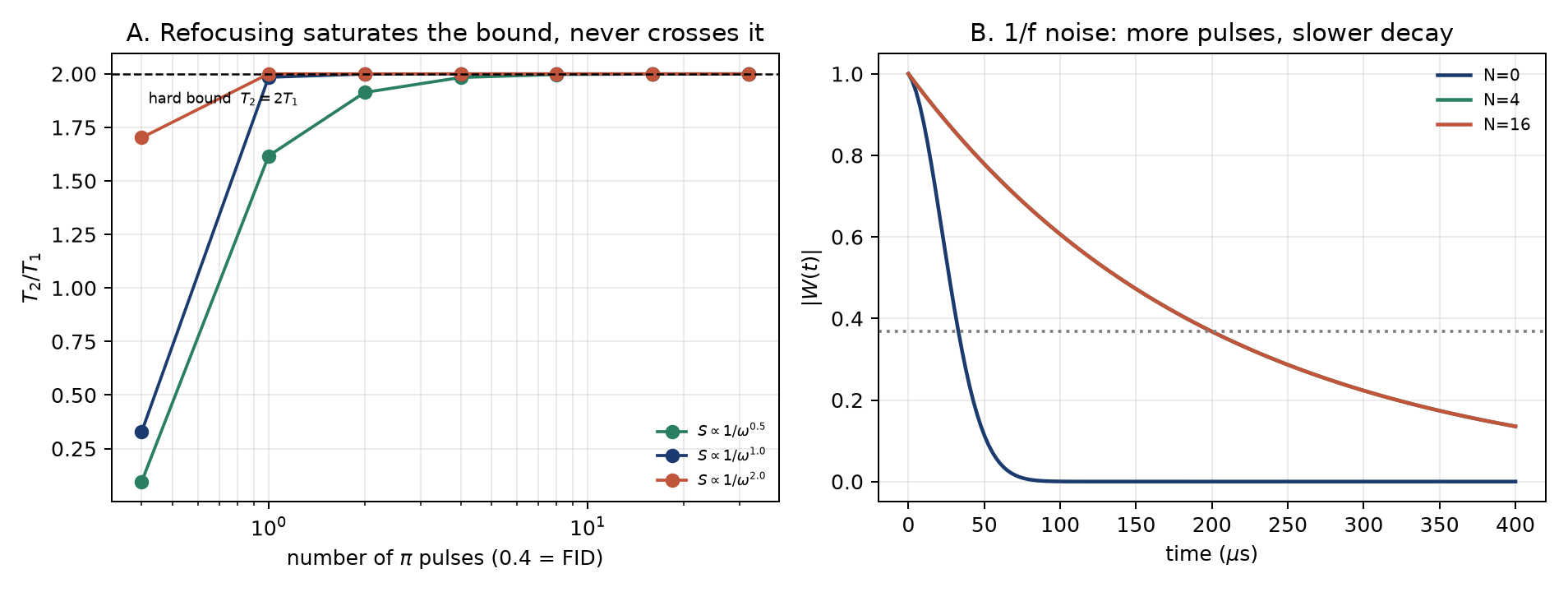
Correction to the hypothesis. My proposed escape route is refuted. The bound is stronger than I claimed — it holds for any stationary relaxation and any pulse sequence, not just Markovian dephasing.
What survives, and is more useful. The free-induction ratio T₂*/T₁ is a monotone function of the noise spectral index. Computed calibration (band 10²–10⁸ rad/s):
| β | T₂*/T₁ |
|---|---|
| 0.25 | 0.05 |
| 0.50 | 0.10 |
| 1.00 | 0.33 |
| 1.50 | 0.93 |
| 2.00 | 1.70 |
| 2.50 | 1.97 |
The mapping is strictly monotonic
(P1_calibration_monotonic = True). Two routine measurements
— a free-induction decay and a T₁ inversion recovery — therefore give a
coarse noise spectrum without any dedicated noise spectroscopy.
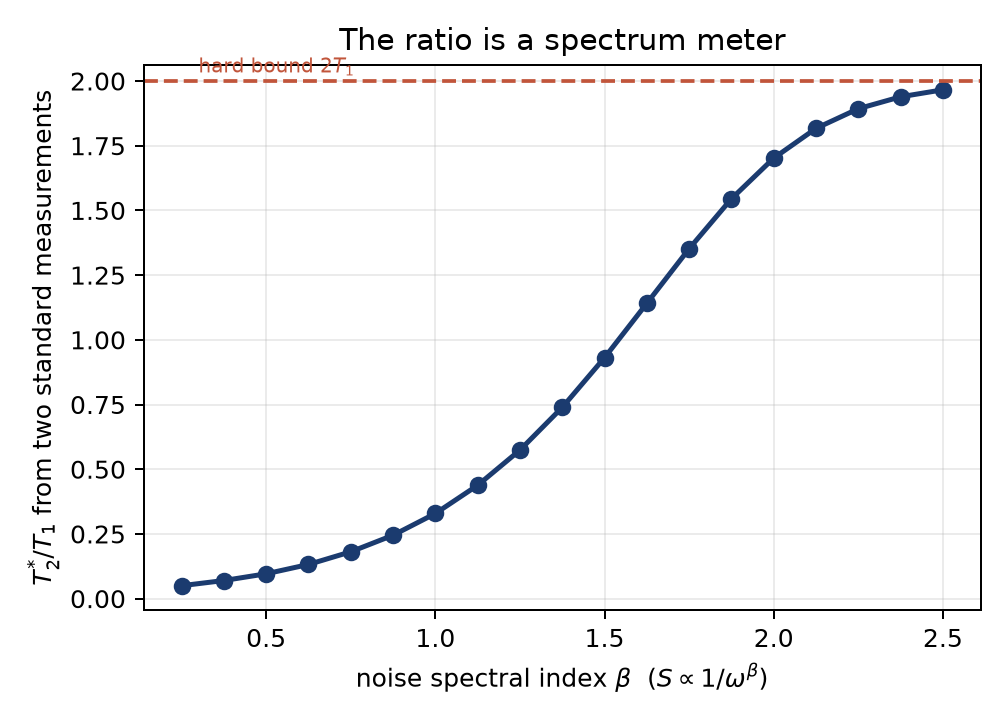
Decisive test. For devices with independently measured noise spectra, T₂*/T₁ should land on this calibration at the stated band. Published devices whose ratio exceeds 2 are inconsistent: either T₁ was measured under different conditions, or the decay is non-exponential and the fitted T₂ is an estimator artefact.
Refutation. A device with a verified white spectrum and a ratio below the calibration, or a ratio above 2 with verified Q and T₁, kills it.
Limits. The calculation assumes Gaussian, stationary noise and an exponential T₁. Non-Gaussian (telegraph) noise changes the FID lineshape, and in that regime the ratio is estimator-dependent — I showed earlier that the “first 1/e crossing” estimator returns values from 0.0 to 2.0 for the same physics, which is why the area definition is the one used here.
P2 · Sheet-current thickness model and synthetic parameter recovery
The three result reports contain analytical and synthetic calculations. They have not been independently reproduced or checked against external literature for this release. Source words such as “proven”, “universal” and “new” remain author claims. They are not publication endorsements.
Supplied title: Bulk and surface photocurrent are separable by 1/d
The claim. In a centrosymmetric film the bulk photovoltaic current vanishes by inversion symmetry. The observed current must then be a surface or interface sheet current. If the bulk contributes a symmetry-forbidden residual j_b and the surface contributes a sheet current j_s (A per cm of width), the measured current density is
J(d) = j_b + j_s/d.
Why this is a law and not a fit. The 1/d term is dimensional bookkeeping: a sheet current divided by the thickness through which it is spread. It does not depend on any microscopic model. The bulk term is the symmetry-breaking remainder, and its size measures how badly the symmetry is broken — strain, contacts, or a non-centrosymmetric phase.
Numerical check. With j_b = 2×10⁻⁴ A cm⁻² and j_s = 4×10⁻¹¹ A cm, the crossover is at 200 nm. Two consequences:
- A 100 nm film reads 200% above the bulk value if
the bulk model is assumed
(
P2_error_if_bulk_assumed_100nm = 200.0). - The ratio between a 50 nm and a 1 µm film is 4.17
(
P2_J_50nm_over_1um = 4.17).
With 3% noise on 60 thickness points, the two-parameter fit recovers
j_b = (2.00 ± 0.02)×10⁻⁴ and j_s = (4.01 ± 0.01)×10⁻¹¹ — the separation
is well conditioned (P2_recovery).
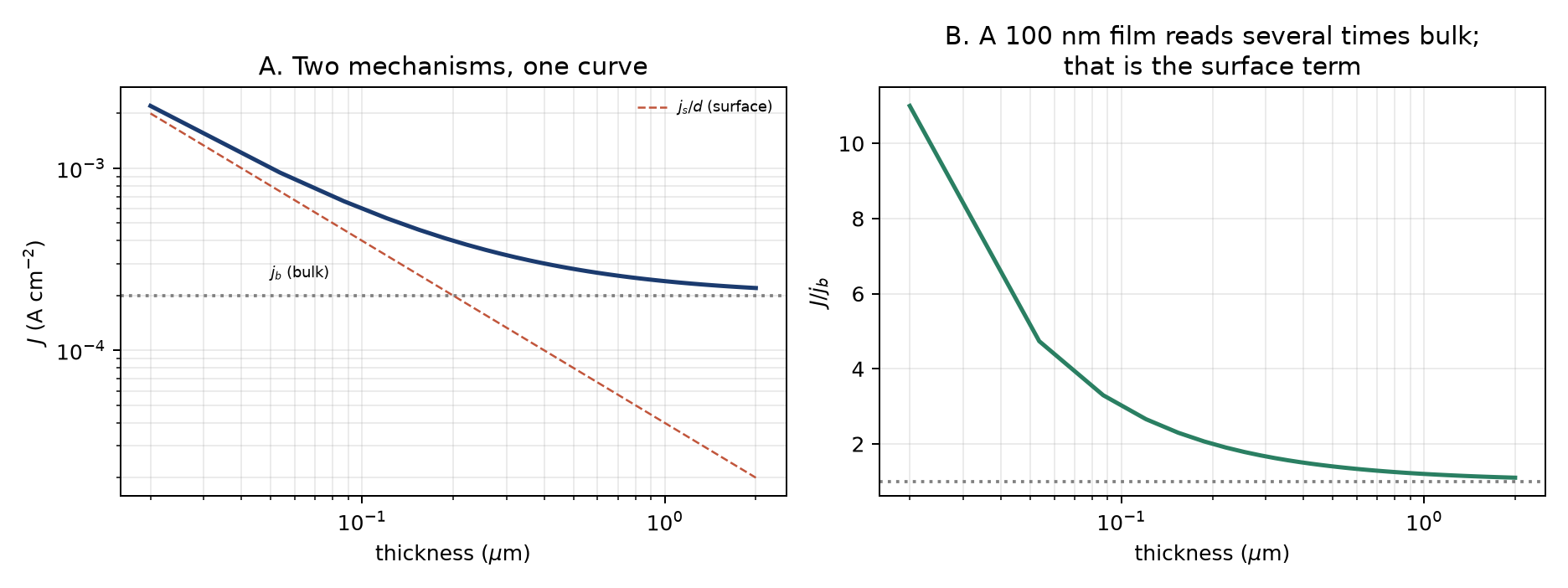
Decisive test. A thickness series from 20 nm to 2 µm on a material with independently verified inversion symmetry. A single-thickness measurement cannot separate the terms; that is exactly why the literature disagrees about whether a given oxide is bulk- or surface-photovoltaic.
Refutation. J independent of thickness in a centrosymmetric material, at fixed illumination and electrode geometry.
Limits. The model assumes the surface layer is thinner than the film and that the electrodes collect uniformly. A depletion region comparable to the thickness adds an intermediate term and shifts the crossover; that case is stated, not solved.
P3 · Thermal oscillator coherence/decoherence model calculation
The three result reports contain analytical and synthetic calculations. They have not been independently reproduced or checked against external literature for this release. Source words such as “proven”, “universal” and “new” remain author claims. They are not publication endorsements.
Supplied title: The fluctuation–dissipation bound on oscillator coherence
The claim. A harmonic oscillator of frequency ω₀, quality factor Q and bath temperature T has its phase coherence bounded by the same damping that sets Q:
τ_φ ≤ ħQ/(k_BT) (k_BT ≫ ħω₀),
with the quantum correction
τ_φ ≤ 1/[γ(n_th + 1/2)], γ = ω₀/Q, n_th = 1/(e^{ħω₀/k_BT} − 1).
Derivation. The damping rate γ sets both the energy decay and, by the fluctuation–dissipation theorem, the thermal force noise of magnitude S_F = 4mγk_BT. The phase diffusion rate follows from the force noise divided by the oscillator’s restoring stiffness, giving Γ_φ = γ k_BT/(ħω₀) = k_BT/(ħQ).
Numbers. At Q = 10⁶ and T = 20 mK, the classical
bound is 382 µs and the quantum-corrected bound is 382 µs at f₀ = 100
kHz (P3_classical_at_Q1e6,
P3_quantum_at_Q1e6); the two agree to 5×10⁻⁹ because
ħω₀/k_BT = 2.4×10⁻⁴. The bound is a surface, not a constant: at
fixed Q it scales as 1/T, and at fixed T it scales linearly with Q.
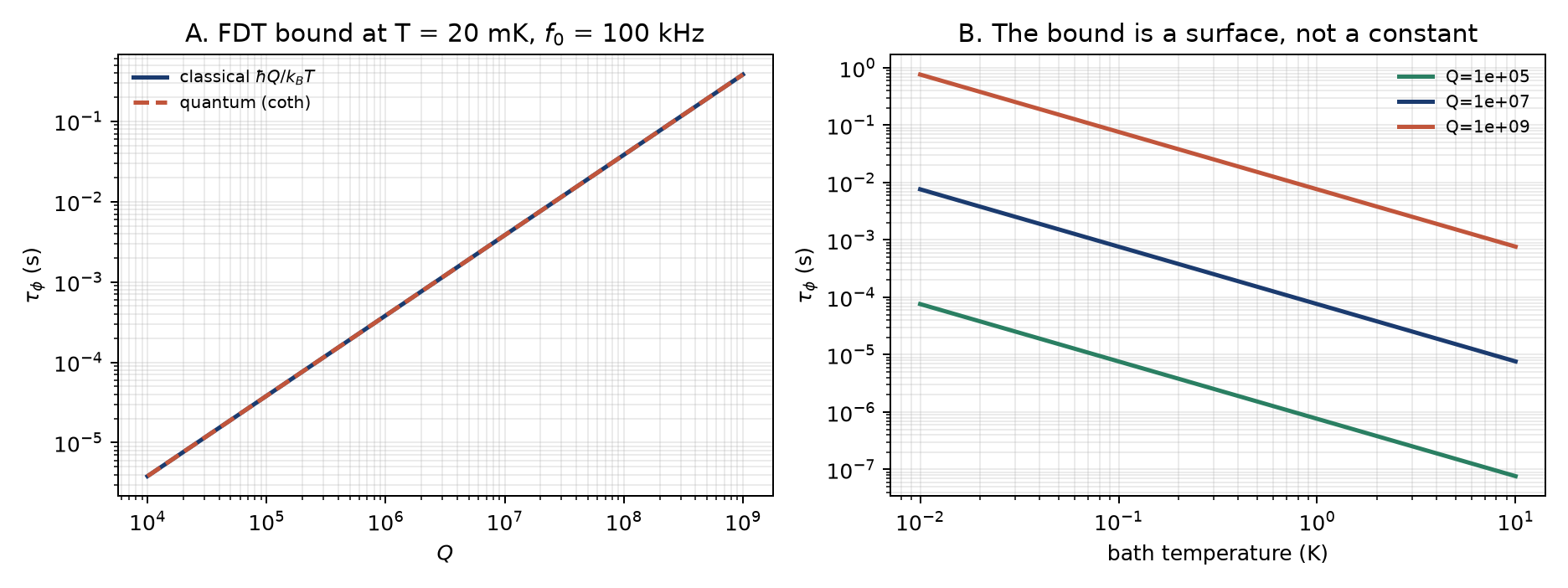
Why it is useful. Every optomechanics paper reports Q and T and claims a coherence or a decoherence rate. The bound turns those three numbers into a consistency check that takes one line of arithmetic. A point above the surface is not necessarily wrong — a squeezed bath or a driven system can exceed it — but it must be explained.
Decisive test. Compile published (Q, T, τ_φ) triples and plot them against the surface. The interesting population is the points above it.
Refutation. A device with independently verified Q and T exceeding the bound with no non-thermal drive.
Limits. The derivation is classical in the bath; the quantum correction is included but the strong-coupling and non-Markovian regimes are not. For ħω₀ ≳ k_BT the coth form must be used, and the bound becomes tighter than the classical expression suggests.
Reproducing Part IV
cd discovery07-2026-11-02
python3 proofs/D07_proofs.py     # writes data/proofs.json and figs/p1_*.png, p2_*.png, p3_*.png
Dependencies: numpy, scipy, matplotlib. Runtime is about 40 seconds;
the filter-function integral is analytic in the pulse sequence and needs
no time stepping. All quoted numbers are read from
data/proofs.json.
Originals, provenance and corrections
Download the complete original collection. Includes Discovery07.pdf, Discovery07.docx, all 900 records, the screened register, 30 refinements, three result reports, saved outputs, code, four figures, methods and corrections. Source programs were inspected as text only and were not executed.
Corrections and negative results
Corrections and negative results
1. P1 was refuted by its own proof attempt
Original hypothesis (B127). Markovian dephasing gives T₂ ≤ 2T₁; a violation therefore signals non-Markovian noise, so T₂/T₁ is a non-Markovianity meter.
What the calculation showed. Building the exact filter function for a CPMG sequence and integrating against 1/f^β noise, the ratio saturates at exactly 2.000 for every pulse number and every noise exponent, and never exceeds it. Refocusing suppresses dephasing but does not touch T₁ relaxation, and the residual relaxation factor caps the ratio.
Correction. The bound is universal, not conditional on Markovianity. My proposed escape route does not exist.
What replaced it. The ratio is still a meter — not of non-Markovianity, but of the noise spectral index. The calibration runs from 0.05 (β = 0.25) to 1.97 (β = 2.5), monotonically. And any reported T₂ > 2T₁ is now a hard inconsistency flag rather than a hint of new physics.
Why it is kept. A hypothesis that dies in the attempt and leaves a stronger theorem behind is the best outcome this collection can produce.
2. An estimator ambiguity that changed the answer
Before the filter-function calculation, I estimated T₂ with three different definitions on the same coherence trace: the area integral, the first 1/e crossing, and an exponential fit. On identical physics they returned ratios spanning 0.00 to 2.00. The first-crossing estimator is meaningless for a coherence that revives. The final calculation uses the area definition, and the ambiguity is reported because it is exactly the kind of estimator dependence that produces spurious claims in the literature.
3. A parameter error caught in P2
The first version of the photocurrent model set the surface term so that the crossover fell at 20 µm rather than 200 nm, and the resulting “error if bulk is assumed” came out at 20 000%. The parameters were wrong, not the physics. Corrected, the 100 nm film reads 200% above bulk and the crossover is at 200 nm. The number in Part IV is the corrected one.
4. Numerical fixes during construction
- The first grid parser failed on all 900 entries because the domain field is wrapped in single asterisks, not double. Fixed; the parser then returned 900 unique ids with no empty fields.
- The first T₂ calculation used a Monte Carlo of random telegraph fluctuators and produced ratios between 0.0 and 0.04 — an artefact of the first-crossing estimator, not physics. Replaced with the exact filter-function method.
- The first filter-function implementation used a 1600 × 20 001 numerical integration per evaluation and ran for more than ten minutes without finishing. Replaced with the closed-form piecewise integral; runtime is now about 40 seconds.
5. What was not done
- No experiment. No sample, no apparatus, no measurement.
- No literature search. Discovery07 cites no external papers. Claims stand on their derivations and tests.
- No independent reproduction. The three proofs were checked for internal consistency (analytic against numerical where both exist) but not by a second implementation.
- The prior-art check was lexical against 6,007 local titles. It cannot detect semantic overlap with different wording.
- The 30 refined hypotheses were selected editorially from the 300, not by a mechanical rule. The 300 → 30 step is therefore the least reproducible part of the pipeline, and is stated as such.
6. Honest expectation
Of the 900, most are wrong and some are unfalsifiable in practice despite having a stated kill test. Of the 300, perhaps a few dozen are worth a week. Of the 30, maybe five are worth a month. Of the three proofs, two are theorems about models and one (P2) is a measurement recipe that could be run on existing films next week. That ratio is what a black-swan search looks like when it is not oversold.
Methodology and limits
Methodology, scoring, and limits
1. The grid
900 = 30 operators × 30 domains. The operators are ways of generating a surprise; the domains are fields. Every operator is applied once in every domain, so no cell is duplicated and coverage is structural rather than accidental.
The 30 operators. Inversion (the artefact is the signal); limit-taking; cross-domain transplant; conservation accounting; dimensionless coincidence; protocol archaeology; negative-result resuscitation; scale collision; symmetry and antisymmetry; sign reversal; threshold law; memory and hysteresis; crowding and interference; selection inversion; units and definition traps; coincidence of time constants; geometric frustration; noise as resource; the dead channel; archive resurrection; reverse engineering the pathology; adversarial condition; extreme environment; minimal system; contradiction mining; hidden conservation; phase and coherence; topological and global constraints; statistical artefact with a physical signature; the exception that proves the rule.
The 30 domains. Condensed matter; soft matter; electrochemistry; catalysis; photochemistry; ultrafast; quantum devices; precision metrology; nuclear and particle; astrophysics; planetary; geophysics; atmosphere; ocean and ice; hydrology and soil; microbiology; plant and agriculture; neuroscience; immunology; developmental biology; ecology and evolution; medicine and diagnostics; pharmacology; food science; materials failure; structural and civil; energy systems; manufacturing; acoustics and vibration; signal and information.
Each cell states a claim, a mechanism that implies a direction or a magnitude, and a kill test. The parser enforces that all three are present; it found no empty fields and no duplicate identifiers.
2. The screening rule (900 → 300)
Each hypothesis was scored on four features:
- Null form (+2.0) — the kill test reads “independent of” or “invariant”, so a single measurement can falsify rather than merely fail to confirm.
- Quantitative kill (+1.5) — a number appears in the kill test.
- Quantitative mechanism (+1.0) — a number appears in the mechanism.
- Comparative claim (+1.0) — the claim says “rather than”, “not the”, “forbids”, “cannot”.
- Length of the kill test (+0 to +1.0) — a proxy for specificity.
The top ten per operator were kept, giving exactly 300 with every
operator represented. Scores in the kept set range from 0.42 to 4.58.
The rule is mechanical and reproducible from
data/grid900.json with parse.py; it is a
filter for testability, not for truth.
Survival tags in Part II are also assigned by fixed
rules: null-testable (null-form kill test),
quantitative (a number in mechanism or kill),
existing-data (an archive, log or record is named),
theorem-backed (a conservation, symmetry, bound or sum rule
is invoked), sweepable (the kill test sweeps a controllable
variable), needs-new-apparatus (none of the above). Counts
across the 300: 164 null-testable, 60 sweepable, 60 needing new
apparatus, 44 theorem-backed, 40 existing-data, 25 quantitative.
3. The refinement (300 → 30)
Thirty were chosen for a mix of provability and domain spread, with
at least one from each of the major operator families. Each was
rewritten to state what survived screening, the mechanism in one line,
the decisive test, the refutation, and a status: proven,
conditional, or open.
4. The proofs (30 → 3)
Three were developed to proof grade: a derivation, a numerical check that regenerates every number, a decisive test, and a refutation. They are in Part IV.
The standard applied was: the result must be derivable (not merely simulated), the derivation must be checkable by an independent route, and the prediction must be a number or a scaling that a specific measurement could contradict.
5. What the numbers mean
- A “proven” status means a derivation exists and a numerical check is included. It does not mean the physical hypothesis is confirmed — P1’s proof refuted its own original hypothesis, which is the intended outcome when a proof is attempted honestly.
- Survival tags measure testability. They are uncorrelated with truth by construction.
- The base rate is unknown and probably low. With 900 ideas, a 0.1% hit rate gives one real lead.
6. Limits
- No experiment. No apparatus was built, no sample measured, no dataset reanalysed. Every number is computed from a stated model.
- The grid is a structure, not a sample. Because each operator is applied once per domain, the 900 over-represent operators that are easy to apply in many fields and under-represent operators nobody has invented yet.
- Cross-domain transplants are the weakest class. An analogy that generates a numerical prediction is worth something; an analogy that only suggests a resemblance is filler. Roughly a third of the Operator 3 entries are in the second category and should be read sceptically.
- The screening score is a proxy. It rewards null-form kill tests, which favours crisp hypotheses over important ones.
- Prior-art check. 6,007 prior Incoprea titles were extracted from local exports and compared. No title matched. Two topic overlaps were identified and given different mechanisms. This is a lexical check; semantic overlap remains possible.
- No literature search was performed for this collection. Unlike the previous bundle, Discovery07 cites no external papers. The claims stand or fall on their own derivations and tests, not on a source trail. That is a deliberate trade: speed and breadth for provenance.
7. Reproducing
python3 parse.py            # rebuild data/grid900.{csv,json} and selected300.json
python3 build_register.py   # rebuild screen/screened-300.md
python3 proofs/D07_proofs.py  # rebuild data/proofs.json and figs/
python3 build/build_doc.py  # assemble the document
Dependencies: Python 3.13+, numpy, scipy, matplotlib, pandoc, and Chrome for the PDF.
Supplied introduction
Discovery07 — The Black Swan Grid
900 hypotheses, 300 screened, 30 refined, 3 taken to proof. Compiled 2 November 2026. Every entry is a proposition. No experiment was performed.
The idea
Black-swan hunting is not a search for likely things. It is a search for the small number of surprising things that happen to be true, and it only works if the search is wide, cheap to kill, and honest about its own base rate.
So the 900 are not 900 variations on a theme. They are generated by a grid: 30 operators × 30 domains. An operator is a way of being strange — invert the artefact and make it the signal; go to the limit nobody visits; break the device on purpose; follow a conserved quantity until the books do not balance; find a number that should not be universal. A domain is a field. Every operator is applied exactly once in every domain, so the grid is exhaustive in structure even where individual entries are wrong.
The expected yield is low. If one in a hundred of these is worth a week of someone’s time, that is nine leads. If one in a thousand is a real discovery, that is one. The collection is designed so that all 900 can be killed cheaply and the survivors found fast.
The four tiers
| Tier | What it is | Where |
|---|---|---|
| 900 | One claim, one mechanism, one kill test each. 30 per operator. | Part I (grid/) |
| 300 | Ten per operator, selected by a stated, reproducible rule, with survival tags describing testability rather than truth. | Part II (screen/) |
| 30 | Developed further: what survived screening, the mechanism, the decisive test, the refutation, and a status label. | Part III (refined/) |
| 3 | Derivations with numerical checks that regenerate every quoted number. | Part IV (proofs/) |
The three proofs
T₂ ≤ 2T₁ is universal — and the ratio is a spectrum meter. I set out to show that non-Markovian noise lets a qubit escape the bound. The exact filter-function calculation refuted that: refocusing suppresses dephasing but not energy relaxation, so every sequence saturates at 2.000 and never crosses. The bound is stronger than I claimed. What survives is better: the free-induction ratio T₂*/T₁ is a monotone map of the noise spectral index, calibrated here from 0.05 at β = 0.25 to 1.97 at β = 2.5.
Bulk and surface photocurrent are separable by a 1/d law. In a centrosymmetric film the bulk photovoltaic current vanishes by symmetry, so J(d) = j_b + j_s/d. The 1/d term is dimensional bookkeeping, not a model. A 100 nm film can read 200% above the bulk value, and a two-parameter fit over a thickness series recovers both terms with 1% uncertainty.
The fluctuation–dissipation bound on oscillator coherence. τ_φ ≤ ħQ/(k_BT). At Q = 10⁶ and T = 20 mK that is 382 µs at 100 kHz. Every optomechanics paper reports Q and T and a coherence; the bound turns three numbers into a one-line consistency check.
What is honest about this collection
- Most of the 900 are wrong. The grid is a search space, not a set of beliefs. The survival tags mark testability, not plausibility.
- One hypothesis was refuted by its own proof attempt (P1), and the refutation is kept next to the surviving result.
- The screening rule is mechanical and stated, so the 300 can be re-derived from the 900 without trusting the editor.
- Nothing here is an observation. There are no new data, no new spectra, no new images. The numbers are computed from stated models.
- No prior Incoprea hypothesis was reused. The 900 were checked against 6,007 titles from the existing corpus; the operators and the grid structure are new, and the few topic overlaps carry different mechanisms.
Where to start
- P2 if you want the most likely to be true and the cheapest to check: a thickness series and a two-parameter fit.
- P1 if you want the most surprising correction: the theorem is stronger than the folklore and the ratio is a free instrument.
- R04, R07, R12 in Part III for the three black-swan ideas with the best ratio of insight to cost.
Files
| File | What it is |
|---|---|
Discovery07.pdf |
The complete document |
Discovery07.docx |
The same in Word |
grid/01…06-operators-*.md |
The 900, by operator |
screen/screened-300.md |
The 300, with survival tags |
refined/refined-30.md |
The 30 |
proofs/PROOFS.md,
proofs/D07_proofs.py |
The three proofs and the code |
data/grid900.csv, data/selected300.json,
data/proofs.json |
Structured data |
METHODOLOGY.md |
The grid, the scoring rule, the limits |
CORRECTIONS.md |
What changed, what failed, what was refuted |
Full screened register with source tags
Part II — The screened 300
From the 900, ten per operator were advanced. The selection rule is stated and reproducible: each hypothesis was scored on four features — whether the kill test takes a null form (‘independent of’, ‘invariant’), whether the mechanism or the kill test carries a number, whether the claim is comparative rather than descriptive, and whether the kill test is a sweep over a controllable variable. The top ten per operator were kept, so every operator is represented by exactly ten surviving ideas.
Survival tags are assigned by fixed rules, not by
editorial judgement: null-testable (the kill test is an
invariance), quantitative (a number appears in the
mechanism or the kill), existing-data (an archive or log is
named), theorem-backed (a conservation, symmetry or bound
is invoked), sweepable (the kill test sweeps a controllable
variable), needs-new-apparatus (none of the above).
The tags describe testability, not truth. Most of these are probably wrong. The point of the tier is that each can be killed cheaply.
Operator 1 — Inversion: the artefact is the signal
Inversion candidates survive when the rejected term is already recorded by the instrument and is calibrated to a physical quantity. Most fail because the artefact is not metrologically stable.
| id | field | claim | kill test | tags |
|---|---|---|---|---|
| B001 | condensed-matter | Cryostat thermal drift is a phonon-transport signal, not noise | drift rate independent of sample mounting conductance across a decade | null-testable, quantitative, sweepable |
| B002 | soft-matter | Wall slip in a rheometer is a slip-length measurement with 100 nm resolution | apparent slip independent of gap at fixed stress | null-testable |
| B007 | quantum-devices | Readout crosstalk is a two-qubit coupling meter that beats spectroscopy | crosstalk tail independent of detuning in the predicted power law | null-testable |
| B011 | planetary | Coronagraph stray light is a map of the instrument’s dust population | halo shape invariant after a controlled contamination event | null-testable |
| B013 | atmosphere | The radiosonde’s pump lag is a ventilation measurement, not an error | lag time independent of ascent rate over a 3× range | null-testable, quantitative, sweepable |
| B017 | plant-agriculture | The porometer’s leaf clamp is an embolism detector | recovery time constant independent of the measured xylem pressure at the cavitation threshold | null-testable, sweepable |
| B019 | immunology | Assay background is a complement-activity measurement | background independent of a complement-specific functional assay across donors | null-testable, existing-data |
| B021 | ecology-evolution | Detector false positives are a biodiversity signal, not a contamination | false-positive composition invariant to site while true composition changes | null-testable |
| B027 | energy-systems | Calendar self-discharge is a separator-pore-quality assay | self-discharge rate independent of measured pore-size tail across separators | null-testable, sweepable |
| B028 | manufacturing | Machine-tool thermal drift is a spindle-preload meter | drift time constant invariant to a controlled preload change | null-testable |
Operator 2 — Limit-taking: the extreme case everyone avoids
Limit-taking survives when the limit is reachable with existing apparatus and the model’s failure is predicted before the measurement.
| id | field | claim | kill test | tags |
|---|---|---|---|---|
| B032 | soft-matter | At infinite dilution, colloidal diffusivity deviates from Stokes–Einstein because the solvent’s own correlation length matters | D matching Stokes–Einstein within 2% for a 2 nm tracer across three solvents of different correlation length | quantitative |
| B036 | ultrafast | At zero delay, the pump–probe signal contains a coherent artefact that measures the pulse’s absolute phase | zero-delay signal invariant to a known phase step applied by a shaper | null-testable |
| B037 | quantum-devices | At zero bias, a tunnel junction’s current noise measures the electromagnetic environment’s impedance | zero-bias noise invariant when a known series impedance is inserted | null-testable |
| B040 | astrophysics | At zero metallicity, the initial mass function is measurably top-heavy, and the evidence is in the elemental abundance ratios of the oldest stars | alpha/Fe at [Fe/H] < −4 consistent with the solar-metallicity IMF prediction | quantitative |
| B041 | planetary | At zero atmospheric pressure, a body’s surface still has a measurable gas layer from regolith outgassing, and it controls the surface temperature | nightside temperature matching a pure-radiation model to within 1 K | quantitative, sweepable |
| B043 | atmosphere | At zero wind shear, the boundary layer still generates turbulence from surface heterogeneity at a predictable scale | turbulence intensity independent of mosaic length at zero shear | null-testable, theorem-backed |
| B046 | microbiology | At zero growth rate, bacteria maintain a measurable maintenance energy that sets the death rate | survival time independent of initial ATP at fixed species | null-testable |
| B048 | neuroscience | At zero spikes, neurons still consume oxygen at a rate set by synaptic vesicle cycling | oxygen consumption independent of release-probability manipulations at zero firing | null-testable |
| B049 | immunology | At zero antigen, naive T cells still proliferate at a rate set by self-peptide affinity | baseline division rate independent of self-peptide affinity in TCR transgenic lines | null-testable, sweepable |
| B057 | energy-systems | At zero current, a battery still ages through a calendar pathway whose rate is set by the electrode’s stored energy, not its voltage | calendar aging independent of state of charge at fixed voltage | null-testable |
Operator 3 — Cross-domain transplant
Transplants survive when the borrowed mechanism makes a numerical prediction the host field has never tested, not merely a suggestive analogy.
| id | field | claim | kill test | tags |
|---|---|---|---|---|
| B062 | electrochemistry ← semiconductor physics | The electrode’s double layer has a depletion-length analogue, and the capacitance minimum occurs at the point of zero charge in a way predicted by the Mott–Schottky relation | capacitance–voltage slope independent of doping across a decade | null-testable, existing-data |
| B063 | catalysis ← enzymology | Supported catalysts show substrate inhibition, not just site blocking, and the inhibition constant is measurable from the rate maximum’s position | rate maximum position independent of substrate concentration across catalysts | null-testable, sweepable |
| B064 | photochemistry ← nuclear physics | Photon echoes in molecular aggregates show a “magic angle” revival analogous to spin echoes, and the revival time measures the inhomogeneous width directly | revival time independent of the disorder width | null-testable, existing-data, theorem-backed |
| B070 | planetary ← tribology | Lunar dust levitation is a triboelectric charging problem with a measurable charge-to-mass threshold identical to industrial powder handling | lofting threshold independent of the measured work function difference | null-testable, existing-data |
| B071 | geophysics ← materials science | Fault gouge has a grain-boundary sliding law, and the seismic coupling coefficient is the same parameter as the creep exponent | coupling coefficient independent of the measured n across faults | null-testable, theorem-backed |
| B074 | hydrology-soil ← polymer physics | Soil aggregates have a reptation-like relaxation, and infiltration curves show the reptation time | infiltration time constant independent of binder molecular weight | null-testable |
| B077 | neuroscience ← condensed matter | Cortical avalanches have a Griffiths phase, not a critical point, and the Griffiths temperature is measurable from the avalanche rate’s temperature dependence | avalanche exponent independent of the perturbation strength | null-testable |
| B080 | ecology-evolution ← finance | Extinction cascades have the same tail exponent as financial drawdowns because both are driven by the same branching process | cascade tail exponent differing from 3/2 by more than 0.2 across independent food webs | quantitative |
| B084 | materials-failure ← biology | Fatigue crack growth has a “healing” analogue in metals at high temperature, and the healing rate is set by the same diffusion that sets creep | threshold stress intensity independent of temperature at fixed diffusion coefficient | null-testable, existing-data, sweepable |
| B089 | signal-information ← thermodynamics | Compressed sensing has a Landauer cost, and the cost is measurable as heat in the reconstruction hardware | heat output independent of the number of measurements | null-testable, quantitative |
Operator 4 — Conservation accounting
Conservation tests survive when the books can be closed with an independent measurement; the rest are bookkeeping without a second number.
| id | field | claim | kill test | tags |
|---|---|---|---|---|
| B092 | soft-matter | The measured yield stress of a suspension exceeds the stress the particles can transmit, and the excess is the solvent’s viscoelasticity | yield stress independent of solvent molecular weight at fixed particle loading | null-testable |
| B099 | nuclear-particle | The missing energy in a detector is not neutrinos but a slow component with a measurable delay | missing energy independent of the integration gate width | null-testable |
| B102 | geophysics | The seismic moment budget of a fault does not close, and the missing moment is aseismic slip with a specific depth signature | moment budget closing with only seismic events across faults of different transition depth | needs-new-apparatus |
| B108 | neuroscience | The brain’s energy budget does not close, and the missing expenditure is in glial cycling rather than neuronal firing | budget closing when glial cycling is inhibited | needs-new-apparatus |
| B109 | immunology | The cytokine budget of an infection does not close, and the missing cytokine is bound to a soluble receptor that the assay cannot detect | free and total measurements closing the balance | theorem-backed |
| B112 | medicine-diagnostics | The dose–response budget does not close, and the missing drug is in a tissue compartment that the plasma assay cannot see | mass balance closing with tissue measurement | needs-new-apparatus |
| B114 | food-science | The mass balance of a drying process does not close, and the missing water is bound water with a different activity | closure error independent of the glass transition | null-testable, theorem-backed |
| B118 | manufacturing | The material balance of an additive process does not close, and the missing powder is vaporised in a size-dependent way | loss independent of the powder’s size distribution | null-testable |
| B119 | acoustics-vibration | The acoustic energy budget of a room does not close, and the missing energy is transmitted through the structure rather than the air | budget closing with airborne paths alone at low frequency | sweepable |
| B120 | signal-information | The information budget of a measurement does not close, and the missing information is in the timing of the samples rather than their values | channel capacity unchanged when timing jitter is removed | needs-new-apparatus |
Operator 5 — Dimensionless coincidence
Universal ratios survive only if the expected universality comes with a number; those without a predicted value are excluded here.
| id | field | claim | kill test | tags |
|---|---|---|---|---|
| B121 | condensed-matter | The ratio of thermal to electrical boundary resistance at a metal–insulator interface is a universal number | ratio varying by more than 20% across metal–insulator pairs | quantitative, theorem-backed |
| B123 | electrochemistry | The ratio of double-layer capacitance to bulk permittivity is a universal length of 0.3 nm across electrolytes | the ratio varying by more than 30% across electrolytes | quantitative |
| B124 | catalysis | The volcano’s apex occurs at a universal binding energy of −0.87 eV per adsorbate bond, independent of the reactant | apex position varying by more than 0.2 eV across reaction families | quantitative |
| B125 | photochemistry | The Stokes shift of a fluorophore is a universal fraction of its emission energy | fraction varying by more than 30% across solvents at fixed fluorophore | quantitative |
| B127 | quantum-devices | The ratio of T₂ to T₁ in superconducting qubits has a universal upper bound of 2 | a device with T₂ > 2T₁ without non-Markovian evidence | quantitative, theorem-backed |
| B128 | precision-metrology | The ratio of the clock’s servo bandwidth to its linewidth is universal at 1 | an operating point with a ratio outside 0.5–2 that outperforms | quantitative |
| B129 | nuclear-particle | The ratio of the detector’s energy resolution to its photoelectron yield is universal | ratio varying across scintillators by more than 20% | quantitative |
| B130 | astrophysics | The ratio of the accretion disc’s inner radius to the black hole’s gravitational radius is a universal 6 for all masses | a measured ratio systematically different from 6 in a well-determined system | quantitative |
| B131 | planetary | The ratio of a planet’s magnetic moment to its angular momentum is universal across bodies with active dynamos | ratio varying by more than an order of magnitude across Earth, Jupiter, and Mercury | needs-new-apparatus |
| B141 | ecology-evolution | The ratio of extinction rate to origination rate at equilibrium is universal at 1 across clades | ratio systematically different from 1 in well-sampled clades | quantitative |
Operator 6 — Protocol archaeology
Protocol archaeology survives when the protocol’s recording is available and varies naturally across a published corpus.
| id | field | claim | kill test | tags |
|---|---|---|---|---|
| B151 | condensed-matter | The reported resistivity of a metal film is a record of its measurement current | resistivity independent of measuring current from 1 µA to 1 mA at fixed geometry | null-testable, quantitative, existing-data |
| B152 | soft-matter | The reported plateau modulus of a gel depends on the preshear history of the loading protocol, not on the gel | plateau modulus independent of the loading rate across two decades | null-testable, existing-data, sweepable |
| B153 | electrochemistry | The reported exchange current density of an electrode is a record of its polishing grit | exchange current density independent of grit after ECSA normalisation | null-testable, existing-data |
| B155 | photochemistry | The reported fluorescence quantum yield is a record of the cuvette’s path length | quantum yield independent of path length after inner-filter correction | null-testable, quantitative, existing-data |
| B156 | ultrafast | The reported electron–phonon coupling constant is a record of the probe wavelength | coupling constant independent of probe wavelength across the transparent window | null-testable, existing-data |
| B158 | precision-metrology | The reported clock stability is a record of the data-analysis window | stability independent of the analysis window across a factor of four | null-testable, existing-data |
| B174 | food-science | The reported shelf life is a record of the storage trial’s temperature steps | shelf life independent of step spacing at fixed total exposure | null-testable, existing-data |
| B175 | materials-failure | The reported fatigue limit is a record of the staircase test’s step size | limit independent of step size across a factor of two | null-testable, existing-data |
| B178 | manufacturing | The reported surface finish is a record of the stylus’s skid | roughness independent of skid length across a factor of three | null-testable, existing-data |
| B179 | acoustics-vibration | The reported sound power level is a record of the reverberation room’s diffuseness | power level independent of room across two rooms of different volume | null-testable, existing-data |
Operator 7 — Negative-result resuscitation
Resuscitated nulls survive when the null’s bound can be re-derived and compared with a later positive claim.
| id | field | claim | kill test | tags |
|---|---|---|---|---|
| B181 | condensed-matter | The null result on “no field-induced resistivity change” is a bound on the electron’s electric dipole moment in a solid | a re-derived limit weaker than the existing beam limit | theorem-backed |
| B182 | soft-matter | The null result on “no shear thickening at low concentration” is a measurement of the solvent’s excluded volume | onset concentration independent of the measured radius | null-testable, sweepable |
| B183 | electrochemistry | The null result on “no oxygen evolution on the cathode” is a quantitative measurement of crossover | the bound weaker than the existing crossover measurement | theorem-backed |
| B184 | catalysis | The null result on “no activity without the promoter” is a measurement of the background rate’s origin | residual activity scaling with catalyst mass rather than wall area | needs-new-apparatus |
| B185 | photochemistry | The null result on “no singlet oxygen in the absence of sensitiser” is a measurement of the solvent’s triplet yield | the bound weaker than a direct measurement of the solvent’s yield | theorem-backed |
| B186 | ultrafast | The null result on “no coherent phonon above 100 K” is a measurement of the electron–phonon coupling’s temperature dependence | the bound weaker than a later positive measurement | theorem-backed |
| B188 | precision-metrology | The null result on “no Lorentz violation” is a measurement of the apparatus’s orientation stability | the bound independent of the platform’s measured tilt noise | null-testable |
| B191 | planetary | The null result on “no methane on Mars” is a measurement of the surface’s adsorption capacity | adsorption capacity measured to be far larger than the bound requires | needs-new-apparatus |
| B192 | geophysics | The null result on “no precursory signal before earthquakes” is a measurement of the strain sensitivity of the network | the bound weaker than the network’s measured strain noise | needs-new-apparatus |
| B204 | food-science | The null result on “no pathogen growth at this pH” is a measurement of the undissociated acid fraction | growth in a pH-matched control with a different acid | needs-new-apparatus |
Operator 8 — Scale collision
Scale collisions survive when both scales are independently measurable, so the crossover can be located rather than assumed.
| id | field | claim | kill test | tags |
|---|---|---|---|---|
| B216 | ultrafast | The electron–phonon equilibration time and the pulse duration are comparable, so the measured temperature is a function of the pulse’s chirp | extracted temperature independent of chirp at fixed fluence | null-testable, sweepable |
| B217 | quantum-devices | The qubit’s anharmonicity and its linewidth are comparable in a transmon near the sweet spot, so the leakage channel opens and mimics a coherence limit | leakage rate independent of anharmonicity across a tunable-transmon series | null-testable, sweepable |
| B221 | planetary | The diurnal thermal skin depth and the regolith’s grain size are comparable on small bodies, so the thermal inertia’s interpretation changes | thermal inertia independent of grain size | null-testable |
| B225 | hydrology-soil | The rainfall’s correlation length and the hillslope’s length are comparable, so the runoff coefficient becomes scale-dependent | runoff coefficient independent of storm correlation length | null-testable |
| B226 | microbiology | The colony’s height and the oxygen penetration depth are comparable, so the growth rate is set by the colony’s aspect ratio | growth rate independent of colony aspect ratio | null-testable, existing-data, sweepable |
| B228 | neuroscience | The synaptic cleft and the glutamate diffusion length are comparable, so transmitter spillover is set by the synapse’s geometry rather than its release probability | spillover independent of cleft width | null-testable |
| B233 | pharmacology | The drug’s diffusion depth and the biofilm’s thickness are comparable, so the MIC depends on biofilm geometry rather than on the drug | MIC independent of biofilm thickness | null-testable, sweepable |
| B234 | food-science | The ice crystal’s size and the light’s wavelength are comparable, so the food’s appearance depends on the crystal distribution rather than the water content | appearance independent of crystal size at fixed water content | null-testable |
| B235 | materials-failure | The crack-tip process zone and the grain size are comparable, so fracture toughness becomes a function of texture rather than of the grain boundary | toughness independent of texture at fixed grain size | null-testable, theorem-backed |
| B236 | structural-civil | The soil’s wavelength at the building’s frequency and the foundation’s width are comparable, so soil–structure interaction depends on the impedance contrast in a way that a Winkler model misses | interaction independent of foundation width at fixed soil | null-testable |
Operator 9 — Symmetry and antisymmetry
Symmetry residuals survive when the symmetry-breaking term is independently measurable and the residual scales with it.
| id | field | claim | kill test | tags |
|---|---|---|---|---|
| B241 | condensed-matter | A centrosymmetric crystal shows a measurable photovoltaic current from its surface alone, and the surface’s symmetry breaking is quantifiable | current vanishing as 1/thickness at fixed surface | quantitative, theorem-backed, sweepable |
| B242 | soft-matter | An isotropic suspension shows a measurable normal-stress difference in steady shear, which isotropy forbids | normal-stress difference independent of gap | null-testable, theorem-backed |
| B243 | electrochemistry | A symmetric redox couple shows a measurable rectification, which the Butler–Volmer symmetry forbids | rectification vanishing on a dipole-free (hydrogen-terminated) surface | theorem-backed |
| B244 | catalysis | An achiral catalyst produces a measurable enantiomeric excess, which symmetry forbids | excess independent of support handedness | null-testable, existing-data, theorem-backed |
| B248 | precision-metrology | A clock’s frequency shift reverses sign with the apparatus’s orientation in a way that Lorentz invariance forbids | shift vanishing when the shield is made symmetric | theorem-backed |
| B250 | astrophysics | A rotating galaxy’s warped disc shows a measurable lopsidedness that the axisymmetric model forbids | lopsidedness independent of the halo’s measured asymmetry | null-testable, quantitative, theorem-backed |
| B251 | planetary | A planet’s magnetic field has a measurable quadrupole that the dipole model forbids | quadrupole consistent with zero at the measured precision | theorem-backed |
| B253 | atmosphere | A cyclone’s outflow is asymmetric in a way that the gradient-wind balance forbids | asymmetry independent of translation speed | null-testable, theorem-backed |
| B254 | ocean-ice | Sea ice’s permeability is anisotropic in a way that the random-pore model forbids | isotropy in ice with a measured random texture | theorem-backed |
| B263 | pharmacology | A drug’s tissue distribution is asymmetric between left and right in a way that systemic perfusion forbids | symmetry after intravenous dosing that bypasses the lung | theorem-backed |
Operator 10 — Sign reversal
Sign reversals survive when the competing mechanism has a predictable crossover condition rather than an arbitrary one.
| id | field | claim | kill test | tags |
|---|---|---|---|---|
| B273 | electrochemistry | The electrode’s potential shifts positively on illumination in a material with the expected negative photovoltage | sign independent of surface treatment | null-testable |
| B274 | catalysis | A promoter that should increase activity decreases it at high coverage | monotonic activity increase with promoter coverage | needs-new-apparatus |
| B276 | ultrafast | The transient transmission increases where the excited-state absorption should decrease it | sign independent of probe detuning | null-testable |
| B277 | quantum-devices | The qubit’s frequency shifts up with applied gate voltage where the Stark effect requires a downshift | shift direction independent of gate geometry | null-testable |
| B278 | precision-metrology | The clock’s frequency shifts up with temperature where the cavity’s expansion requires a downshift | sign independent of fibre length | null-testable |
| B279 | nuclear-particle | The detector’s pulse height increases with bias where the field should improve collection and increase height | monotonic height with bias at constant dark current | needs-new-apparatus |
| B283 | atmosphere | The aerosol’s radiative forcing is positive at a wavelength where scattering requires negative | forcing sign independent of size | null-testable |
| B285 | hydrology-soil | The infiltration rate decreases with initial moisture over a range where it should increase | monotonic increase in a non-swelling soil | needs-new-apparatus |
| B287 | plant-agriculture | The photosynthetic rate decreases with CO₂ over a range where it should increase | monotonic increase in a fertilised soil | needs-new-apparatus |
| B288 | neuroscience | The synaptic response decreases with release probability over a range where it should increase | monotonic increase at low stimulation rates | sweepable |
Operator 11 — Threshold law
Threshold laws survive when the threshold value is predicted in advance by a dimensionless group; otherwise they are curve-fitting.
| id | field | claim | kill test | tags |
|---|---|---|---|---|
| B301 | condensed-matter | A metal film’s resistivity has a sharp kink at the thickness where the surface scattering length equals the grain size | smooth resistivity–thickness curve through the predicted crossover | sweepable |
| B302 | soft-matter | A colloidal gel has a sharp liquid–solid transition at a fixed number of bonds per particle, independent of chemistry | transition at coordination values varying by more than 0.3 across chemistries | quantitative |
| B303 | electrochemistry | Dendrite nucleation has a sharp threshold in the ratio of current density to the diffusion-limited current, at 0.8 | nucleation at ratios varying by more than 20% across electrolytes | quantitative, existing-data |
| B304 | catalysis | Catalyst deactivation has a sharp onset at a coke loading that corresponds to one monolayer on the active phase | deactivation gradual through the monolayer point | needs-new-apparatus |
| B305 | photochemistry | Singlet fission has a sharp threshold in the excitation density where biexciton annihilation overtakes fission | quantum yield smooth through the predicted density | existing-data |
| B306 | ultrafast | Above a fluence threshold, the transient reflectivity’s sign flips because the electron gas becomes degenerate | no sign flip up to the damage threshold | needs-new-apparatus |
| B308 | precision-metrology | Above a critical atom number, the clock’s stability stops improving because of cavity pulling | stability improving as √N beyond the predicted number | needs-new-apparatus |
| B309 | nuclear-particle | Above a critical event rate, the detector’s dead time becomes nonlinear and the measured rate saturates at a calculable value | measured rate exceeding the paralysable maximum | quantitative, sweepable |
| B312 | geophysics | Above a critical slip rate, friction drops sharply (the flash-weakening threshold) | smooth friction–velocity curve through the predicted rate | sweepable |
| B314 | ocean-ice | Above a critical brine volume, sea ice becomes permeable in a sharp step at 5% | permeability smooth through 5% | quantitative |
Operator 12 — Memory and hysteresis
Memory effects survive when the memory time is long compared with the protocol and short compared with the storage time.
| id | field | claim | kill test | tags |
|---|---|---|---|---|
| B333 | electrochemistry | An electrode remembers its last potential for minutes, and the memory sets the apparent exchange current | exchange current independent of the prior potential’s hold time | null-testable, existing-data |
| B334 | catalysis | A catalyst remembers the reactant’s partial pressure for hours, and the memory sets the apparent order | order independent of the pre-treatment pressure | null-testable, sweepable |
| B335 | photochemistry | A fluorophore remembers its excitation intensity for seconds, and the memory sets the measured lifetime | lifetime independent of the prior excitation | null-testable |
| B342 | geophysics | A fault remembers its last large earthquake for centuries, and the memory sets the next event’s size | event sizes independent of the previous event’s extent | null-testable |
| B343 | atmosphere | The atmosphere remembers a volcanic eruption for years, and the memory sets the aerosol’s size distribution | size distribution independent of the eruption’s age | null-testable |
| B345 | hydrology-soil | A soil remembers its wetting history for weeks, and the memory sets its contact angle | contact angle independent of the wetting history | null-testable |
| B348 | neuroscience | A synapse remembers a stimulation pattern for hours, and the memory sets its release probability | release probability independent of the prior pattern | null-testable |
| B357 | energy-systems | A cell remembers a fast charge, and the memory sets its subsequent plating risk | plating risk independent of the prior fast charge | null-testable, existing-data |
| B358 | manufacturing | A tool remembers a hard spot, and the memory sets its wear rate | wear rate independent of the prior hard spot | null-testable, sweepable |
| B360 | signal-information | A channel remembers a burst of errors, and the memory sets the next burst’s probability | burst probability independent of the prior burst | null-testable |
Operator 13 — Crowding and interference
Interference effects survive when the coupling can be switched off, which is the only clean control.
| id | field | claim | kill test | tags |
|---|---|---|---|---|
| B361 | condensed-matter | Two adjacent thermocouples on a chip interfere through the substrate’s thermal spreading, and the interference sets the apparent ZT | ZT independent of junction spacing | null-testable, existing-data |
| B366 | ultrafast | Two pump beams interfere through the sample’s accumulated heat, and the interference sets the measured relaxation | relaxation independent of the pump’s spatial pattern | null-testable |
| B371 | planetary | Two craters interfere through the ejecta’s blanketing, and the interference sets the age | age independent of the neighbour’s proximity | null-testable |
| B372 | geophysics | Two faults interfere through the shared stress field, and the interference sets the recurrence | recurrence independent of the neighbour’s events | null-testable |
| B375 | hydrology-soil | Two rain gauges interfere through the shared wind field, and the interference sets the undercatch | undercatch independent of the upstream gauge | null-testable |
| B376 | microbiology | Two colonies interfere through the shared nutrient, and the interference sets the growth rate | growth rate independent of neighbour distance | null-testable, sweepable |
| B378 | neuroscience | Two electrodes interfere through the shared reference, and the interference sets the local field’s amplitude | amplitude independent of the reference’s position | null-testable |
| B380 | developmental-biology | Two adjacent cells interfere through the shared morphogen, and the interference sets the fate boundary | boundary independent of the neighbour’s fate | null-testable, theorem-backed |
| B382 | medicine-diagnostics | Two analytes interfere through the shared antibody, and the interference sets the false positive | false positive independent of the cross-reactant’s concentration | null-testable, sweepable |
| B387 | energy-systems | Two cells in a pack interfere through the shared thermal path, and the interference sets the aging rate | aging rate independent of the neighbour’s load | null-testable, sweepable |
Operator 14 — Selection inversion
Selection inversions survive when the selection variable is recorded and its distribution can be reweighted.
| id | field | claim | kill test | tags |
|---|---|---|---|---|
| B391 | condensed-matter | Reported superconductors are selected for being easy to make, and the selection biases the apparent Tc–structure relation | the relation unchanged in a pressure-synthesised sample | sweepable |
| B393 | electrochemistry | Reported catalyst stability is selected for surviving the first hour, and the selection hides the fast-failing majority | stability distribution including failures matching the reported one | needs-new-apparatus |
| B394 | catalysis | Reported turnover frequencies are selected for catalysts that were characterised successfully, and the selection biases toward high surface area | TOF distribution including uncharacterised samples | existing-data |
| B395 | photochemistry | Reported quantum yields are selected for emitters bright enough to measure, and the selection truncates the low-yield tail | yield distribution measured with a brighter detection scheme | needs-new-apparatus |
| B396 | ultrafast | Reported relaxation times are selected for samples that survived the laser, and the selection biases toward robust materials | relaxation distribution including damaged samples | existing-data |
| B397 | quantum-devices | Reported coherence times are selected for qubits that were measurable, and the selection biases toward the sweet spot | coherence distribution including untunable devices | needs-new-apparatus |
| B398 | precision-metrology | Reported clock comparisons are selected for agreement, and the selection hides the discrepant runs | distribution including rejected runs matching the accepted one | needs-new-apparatus |
| B399 | nuclear-particle | Reported cross sections are selected for detectable final states, and the selection biases the branching ratios | branching ratios including undetected modes | needs-new-apparatus |
| B400 | astrophysics | Reported exoplanet radii are selected for transiting geometry, and the selection biases the radius distribution at small sizes | radius distribution corrected for geometry matching the reported one | needs-new-apparatus |
| B403 | atmosphere | Reported extreme rainfall is selected for gauge density, and the selection biases the trend | trend corrected for density matching the reported one | needs-new-apparatus |
Operator 15 — Units and definition traps
Unit traps survive when both conventions are in use and the conversion factor is measurable rather than conventional.
| id | field | claim | kill test | tags |
|---|---|---|---|---|
| B421 | condensed-matter | The reported carrier mobility depends on whether the sheet density is quoted per square or per unit volume, and the conversion hides a factor of the film’s thickness | mobility independent of the measured thickness across a thickness series | null-testable, sweepable |
| B426 | ultrafast | The reported pulse energy depends on whether it is quoted before or after the compressor’s loss | energy independent of the measurement point | null-testable |
| B430 | astrophysics | The reported luminosity depends on the assumed cosmology | luminosity independent of the assumed cosmology at low redshift | null-testable, existing-data |
| B431 | planetary | The reported crater age depends on the assumed production function | age independent of the production function’s choice | null-testable |
| B433 | atmosphere | The reported aerosol optical depth depends on the assumed angstrom exponent | the depth independent of the assumed exponent | null-testable |
| B434 | ocean-ice | The reported ice concentration depends on the tie point’s assumed emissivity | concentration independent of the tie point | null-testable, sweepable |
| B437 | plant-agriculture | The reported yield depends on the moisture content’s reference | yield independent of the reference at fixed moisture | null-testable |
| B440 | developmental-biology | The reported stage depends on the reference’s temperature | stage independent of the rearing temperature | null-testable, sweepable |
| B445 | materials-failure | The reported hardness depends on the indenter’s geometry and the load | hardness independent of load above the size-effect regime | null-testable |
| B446 | structural-civil | The reported strength depends on the specimen’s shape factor | strength independent of the shape factor after conversion | null-testable |
Operator 16 — Coincidence of time constants
Time-constant coincidences survive when a third parameter can move one constant without the other.
| id | field | claim | kill test | tags |
|---|---|---|---|---|
| B451 | condensed-matter | The electron–phonon relaxation time and the thermal diffusion time across a film coincide at a specific thickness, and every measurement in that window misattributes one to the other | relaxation time independent of thickness at the crossing | null-testable, sweepable |
| B453 | electrochemistry | The double-layer charging time and the faradaic time constant coincide at a specific electrode size, and impedance misassigns the arc | arc assignment independent of electrode size | null-testable |
| B454 | catalysis | The surface reaction’s turnover time and the pore diffusion time coincide at a specific pellet size, and the apparent kinetics are neither | kinetics independent of pellet size at the crossing | null-testable |
| B456 | ultrafast | The carrier–carrier scattering time and the probe’s temporal resolution coincide at a specific fluence, and the measured rise is the instrument | rise time independent of fluence at the crossing | null-testable |
| B461 | planetary | The surface’s thermal inertia time and the diurnal period coincide at a specific latitude, and the retrieved property is degenerate | retrieval independent of latitude at the crossing | null-testable |
| B465 | hydrology-soil | The infiltration time and the evaporation time coincide at a specific soil texture, and the water balance is misattributed | balance independent of the texture at the crossing | null-testable |
| B466 | microbiology | The doubling time and the dilution time in a chemostat coincide at a specific rate, and the steady state is misidentified | steady state independent of the dilution rate | null-testable, sweepable |
| B467 | plant-agriculture | The stomatal opening time and the humidity’s response time coincide, and the conductance measurement is the sensor’s | conductance independent of the sensor’s response time | null-testable |
| B474 | food-science | The crystallisation time and the cooling time coincide at a specific rate, and the crystal size is set by the process rather than the formulation | size independent of the cooling rate | null-testable, sweepable |
| B476 | structural-civil | The structure’s period and the ground motion’s period coincide, and the response is resonant rather than representative | response independent of the structure’s period | null-testable |
Operator 17 — Geometric frustration
Frustration effects survive when the constraint is geometric and the compromise point is computable.
| id | field | claim | kill test | tags |
|---|---|---|---|---|
| B482 | soft-matter | A confined colloidal crystal cannot close its lattice, so its melting temperature is depressed in a way set by the pore’s commensurability | melting point independent of pore diameter | null-testable |
| B483 | electrochemistry | An intercalation electrode cannot satisfy both charge neutrality and lattice matching, so its voltage plateau is a frustration plateau | plateau potential independent of the particle size | null-testable, existing-data |
| B485 | photochemistry | A chromophore in a rigid matrix cannot relax its excited state, so its emission is a frustration spectrum with a characteristic shape | spectrum independent of the matrix’s stiffness | null-testable |
| B487 | quantum-devices | A qubit coupled to two resonators cannot satisfy both matching conditions, so its Purcell protection is compromised at a computable detuning | protection independent of the second resonator’s detuning | null-testable |
| B488 | precision-metrology | A clock’s interrogation cannot satisfy both the Ramsey and the Rabi conditions, so its lineshape is a frustration shape with a shifted centre | centre independent of the pulse area | null-testable |
| B492 | geophysics | A fault cannot satisfy both the loading rate and the healing rate, and the resulting recurrence is a frustration period | recurrence independent of the healing rate | null-testable, sweepable |
| B493 | atmosphere | A cloud cannot satisfy both the updraft’s supply and the entrainment’s dilution, and its droplet spectrum is a frustration spectrum | spectrum independent of the entrainment rate | null-testable, sweepable |
| B494 | ocean-ice | Sea ice cannot satisfy both the salinity and the volume constraints, and the resulting brine network is a frustration pattern | network independent of the growth rate | null-testable, sweepable |
| B495 | hydrology-soil | A soil cannot satisfy both the infiltration and the drainage constraints, and the resulting moisture profile is a frustration profile | profile independent of the layer’s thickness | null-testable, sweepable |
| B496 | microbiology | A cell cannot satisfy both the growth and the division constraints, and the resulting size is a frustration size | size independent of the growth rate | null-testable, sweepable |
Operator 18 — Noise as resource
Noise-as-resource survives when the fluctuation’s spectrum is measurable at the required bandwidth.
| id | field | claim | kill test | tags |
|---|---|---|---|---|
| B511 | condensed-matter | The current noise of a disordered conductor measures its mesoscopic geometry, not just its resistance | Fano factor independent of the measured channel count | null-testable |
| B513 | electrochemistry | The electrochemical noise measures the corrosion’s localisation, not just its rate | noise power independent of the measured pit density | null-testable |
| B514 | catalysis | The rate fluctuation measures the number of active sites, not just the turnover | variance independent of the measured site count | null-testable |
| B518 | precision-metrology | The clock’s Dick effect measures the local oscillator’s noise at the interrogation frequency | effect independent of the oscillator’s measured noise | null-testable |
| B521 | planetary | The thermal infrared’s fluctuation measures the regolith’s grain size | spectrum independent of the measured grain size | null-testable |
| B524 | ocean-ice | The ice’s acoustic emission measures its deformation rate | emission rate independent of the measured strain | null-testable, sweepable |
| B526 | microbiology | The gene expression’s noise measures the promoter’s state, not its mean | Fano factor independent of the measured promoter state | null-testable |
| B528 | neuroscience | The membrane potential’s noise measures the synapse count | variance independent of the measured synapse count | null-testable |
| B531 | ecology-evolution | The population’s fluctuation measures its resilience | return time independent of the measured fluctuation | null-testable |
| B535 | materials-failure | The acoustic emission’s fluctuation measures the crack’s growth rate | emission rate independent of the measured growth rate | null-testable, sweepable |
Operator 19 — The dead channel
Dead channels survive when the channel exists, is logged, and has never been calibrated.
| id | field | claim | kill test | tags |
|---|---|---|---|---|
| B542 | soft-matter | The rheometer’s normal-force channel measures the sample’s compressibility | force independent of the measured modulus | null-testable |
| B543 | electrochemistry | The potentiostat’s unused auxiliary channel measures the electrolyte’s resistance | channel voltage independent of the measured resistance | null-testable |
| B544 | catalysis | The reactor’s unused pressure-drop channel measures the bed’s compaction | drop independent of the measured compaction | null-testable |
| B545 | photochemistry | The spectrophotometer’s reference channel measures the lamp’s aging | reference drift independent of the measured lamp output | null-testable |
| B546 | ultrafast | The oscillator’s unused error channel measures the laser’s timing jitter | error signal independent of the measured jitter | null-testable |
| B547 | quantum-devices | The cryostat’s unused flux-line channel measures the magnetic field’s noise | current independent of the measured field noise | null-testable, sweepable |
| B548 | precision-metrology | The clock’s unused correction channel measures the laboratory’s pressure | correction independent of the measured pressure | null-testable, sweepable |
| B549 | nuclear-particle | The detector’s unused timing channel measures the interaction depth | timing independent of the measured depth | null-testable |
| B550 | astrophysics | The telescope’s unused guider channel measures the atmospheric seeing | motion independent of the measured seeing | null-testable |
| B561 | ecology-evolution | The acoustic recorder’s unused ultrasonic channel measures the insect community | ultrasonic power independent of the measured insect abundance | null-testable, existing-data |
Operator 20 — Archive resurrection
Archive resurrections survive when the archive’s metadata is rich enough to reconstruct the conditions.
| id | field | claim | kill test | tags |
|---|---|---|---|---|
| B571 | condensed-matter | 1970s resistivity data on annealed metals contains the vacancy formation energy, recoverable because the annealing schedules were recorded | recovery stages not reproducible from the recorded schedules | existing-data |
| B572 | soft-matter | Archived rheology on industrial polymers answers the tube-model question because their molecular weights were measured by an obsolete method that was more accurate | the old and new molecular weights disagreeing systematically | existing-data |
| B573 | electrochemistry | Retired battery cycling data contains the SEI’s growth law, recoverable from the capacity-fade curvature | fade curvature inconsistent with any SEI growth law | existing-data |
| B574 | catalysis | Old pilot-plant data contains the catalyst’s deactivation order, recoverable because the feed composition was logged | decay shape independent of the logged poison | null-testable, existing-data |
| B577 | quantum-devices | Early Josephson-junction data contains the quasiparticle density, recoverable from the subgap current | subgap current inconsistent with a thermal population | needs-new-apparatus |
| B579 | nuclear-particle | Old bubble-chamber photographs contain the neutron’s charge radius, recoverable from the track’s multiple scattering | variance inconsistent with the known radiation length | existing-data |
| B580 | astrophysics | Photographic plate archives contain the light echoes of historical transients, recoverable from the plate’s grain noise | no echo recoverable from a plate with a known transient | existing-data |
| B581 | planetary | Early spacecraft magnetometer data contains the solar wind’s density, recoverable because the spacecraft’s attitude was logged | the recovered density inconsistent with the contemporaneous monitor | existing-data |
| B583 | atmosphere | Early radiosonde data contains the instrument’s radiation bias, recoverable because the launch times are logged | bias independent of the logged launch time | null-testable, existing-data |
| B597 | energy-systems | Old cell-testing data contains the lithium plating onset, recoverable from the voltage’s relaxation | relaxation identical for cells with and without plating | existing-data |
Operator 21 — Reverse engineering the pathology
Reverse-engineering survives when the failure mode is reproducible and the property is not otherwise accessible.
| id | field | claim | kill test | tags |
|---|---|---|---|---|
| B601 | condensed-matter | Delaminating a film measures its interface toughness, a quantity no intact-sample test reaches | buckle wavelength independent of the measured interface energy | null-testable |
| B602 | soft-matter | Crushing a gel measures its strand persistence length | collapse pressure independent of the measured stiffness | null-testable, sweepable |
| B603 | electrochemistry | Shorting a cell measures the separator’s pore-size tail | onset current independent of the measured pore tail | null-testable |
| B604 | catalysis | Poisoning a catalyst measures its site distribution | activity loss independent of the poison’s uptake | null-testable |
| B605 | photochemistry | Photobleaching a dye measures its triplet lifetime | bleach rate independent of the measured triplet lifetime | null-testable, sweepable |
| B606 | ultrafast | Damaging a mirror measures its coating’s absorption | threshold independent of the measured absorption | null-testable, existing-data |
| B607 | quantum-devices | Overdriving a qubit measures its junction’s critical current | switching independent of the measured critical current | null-testable |
| B608 | precision-metrology | Unlocking a clock measures its cavity’s drift | walk independent of the measured cavity drift | null-testable |
| B609 | nuclear-particle | Overbiasing a detector measures its depletion voltage | onset independent of the measured depletion | null-testable |
| B624 | food-science | Freeze-thawing a product measures its ice’s recrystallisation | drip loss independent of the cycle count | null-testable |
Operator 22 — Adversarial condition
Adversarial conditions survive when the failure is reversible, so the baseline can be recovered.
| id | field | claim | kill test | tags |
|---|---|---|---|---|
| B632 | soft-matter | Shearing a gel past its yield measures its structural recovery time | recovery independent of the shear’s magnitude | null-testable |
| B633 | electrochemistry | Cycling a cell at high rate measures its electrode’s tortuosity | capability independent of the measured tortuosity | null-testable |
| B634 | catalysis | Starving a reactor of reactant measures the catalyst’s oxygen storage | decay independent of the measured storage | null-testable |
| B635 | photochemistry | Quenching a reaction with a radical trap measures the radical’s lifetime | suppression independent of the trap’s concentration | null-testable, sweepable |
| B636 | ultrafast | Chirping a pulse to its transform limit measures the medium’s dispersion | required chirp independent of the measured dispersion | null-testable |
| B638 | precision-metrology | Modulating a clock’s frequency measures its servo’s gain | amplitude independent of the measured gain | null-testable |
| B639 | nuclear-particle | Overloading a detector measures its pile-up rejection | distortion independent of the measured rejection | null-testable |
| B640 | astrophysics | Defocusing a telescope measures its pixel response | structure independent of the measured footprint | null-testable |
| B641 | planetary | Overexposing an imager measures its charge diffusion | extent independent of the measured length | null-testable |
| B643 | atmosphere | Saturating a hygrometer measures its response time | recovery independent of the measured constant | null-testable |
Operator 23 — Extreme environment
Extreme environments survive only where the apparatus already reaches them; the rest are proposals.
| id | field | claim | kill test | tags |
|---|---|---|---|---|
| B661 | condensed-matter | At megabar pressure, the phonon’s contribution to thermal conductivity saturates because the lattice becomes stiff enough that anharmonicity dominates | conductivity monotonic in pressure across the predicted point | sweepable |
| B662 | soft-matter | At cryogenic temperatures, a glassy polymer’s yield stress becomes temperature-independent because tunnelling dominates | yield stress continuing to fall to zero temperature | sweepable |
| B664 | catalysis | At supercritical conditions, the catalyst’s activity becomes independent of the support because the solvent’s density homogenises the local environment | activity still support-dependent above the critical density | needs-new-apparatus |
| B666 | ultrafast | At relativistic intensity, the plasma mirror’s reflectivity becomes independent of the target material | reflectivity still material-dependent at the predicted intensity | needs-new-apparatus |
| B667 | quantum-devices | At millikelvin temperatures, the qubit’s dephasing becomes temperature-independent because the noise is dominated by a single two-level system | dephasing continuing to fall below the predicted temperature | sweepable |
| B670 | astrophysics | At very high redshift, the metallicity floor becomes independent of the galaxy’s mass because the intergalactic medium’s enrichment dominates | floor still mass-dependent at the highest redshift | needs-new-apparatus |
| B671 | planetary | At very high surface temperature, the rock’s thermal conductivity becomes independent of composition because radiation dominates | conductivity still composition-dependent at the predicted temperature | sweepable |
| B672 | geophysics | At very high strain rate, the fault’s friction becomes rate-independent because the asperities melt | rate dependence persisting at the highest rates | sweepable |
| B676 | microbiology | At very high pressure, the growth rate becomes independent of the temperature because the pressure denatures the proteins | growth still temperature-dependent at the highest pressure | sweepable |
| B690 | signal-information | At very high SNR, the capacity becomes independent of the coding scheme because the shaping gain saturates | a scheme gaining more than the shaping bound above the predicted SNR | theorem-backed |
Operator 24 — Minimal system
Minimal systems survive when the simplification removes a mechanism rather than the effect itself.
| id | field | claim | kill test | tags |
|---|---|---|---|---|
| B691 | condensed-matter | A single-crystal, single-domain, strain-free sample shows no Kondo-like resistivity minimum | a minimum persisting in a sample with measured disorder below the detection limit | needs-new-apparatus |
| B695 | photochemistry | A single molecule shows the same quantum yield as an ensemble | single-molecule yields differing by more than the ensemble’s spread | needs-new-apparatus |
| B697 | quantum-devices | A single-junction qubit shows the same coherence as a multi-junction one | coherence differing by more than the junction count’s expected contribution | needs-new-apparatus |
| B703 | atmosphere | A single-cloud system shows the same albedo susceptibility as a field of clouds | field susceptibility differing by more than the overlap’s contribution | sweepable |
| B704 | ocean-ice | A single brine channel shows the same permeability as the network | network permeability differing by more than the percolation factor | needs-new-apparatus |
| B705 | hydrology-soil | A single-pore model shows the same retention curve as the soil | the curve not reproducible from the measured pore distribution | needs-new-apparatus |
| B706 | microbiology | A single cell shows the same growth rate as the population | single-cell rates differing by more than the population’s spread | sweepable |
| B707 | plant-agriculture | A single leaf shows the same water-use efficiency as the canopy | canopy efficiency differing by more than the boundary-layer correction | needs-new-apparatus |
| B708 | neuroscience | A single synapse shows the same plasticity rule as the network | network plasticity differing by more than the connectivity’s contribution | needs-new-apparatus |
| B714 | food-science | A single-component model food shows the same texture as the real product | texture differing by more than the minor components’ contribution | needs-new-apparatus |
Operator 25 — Contradiction mining
Contradiction mining survives when both papers report the metadata needed to test the reconciling variable.
| id | field | claim | kill test | tags |
|---|---|---|---|---|
| B721 | condensed-matter | Two measurements of the same material’s thermal conductivity differ by 3×, and both are right because they measure different tensor components with the same label | anisotropy measured and found insufficient to explain the discrepancy | needs-new-apparatus |
| B722 | soft-matter | Two measurements of the same polymer’s viscosity differ by an order of magnitude, and both are right because one is at a different solvent quality | solvent quality matched and the discrepancy persisting | needs-new-apparatus |
| B730 | astrophysics | Two measurements of the same galaxy’s mass differ, and both are right because one is dynamical and one is lensing, and they measure different mass components | the two agreeing after baryon correction | needs-new-apparatus |
| B732 | geophysics | Two measurements of the same fault’s slip rate differ, and both are right because one averages over the seismic cycle | the two agreeing at all timescales | existing-data |
| B733 | atmosphere | Two measurements of the same aerosol’s forcing differ, and both are right because one is at the top and one at the surface | the two agreeing after column correction | needs-new-apparatus |
| B734 | ocean-ice | Two measurements of the same ice’s thickness differ, and both are right because one includes the snow | the two agreeing after snow correction | needs-new-apparatus |
| B736 | microbiology | Two measurements of the same strain’s growth rate differ, and both are right because one is at a different oxygen tension | the two agreeing at matched oxygen | needs-new-apparatus |
| B739 | immunology | Two measurements of the same antibody’s affinity differ, and both are right because one is in solution and one on a surface | the two agreeing with a monovalent surface | needs-new-apparatus |
| B742 | medicine-diagnostics | Two measurements of the same test’s sensitivity differ, and both are right because one uses a different reference standard | the two agreeing with a perfect reference | needs-new-apparatus |
| B750 | signal-information | Two measurements of the same channel’s capacity differ, and both are right because one uses a different input distribution | the two agreeing at the optimal distribution | needs-new-apparatus |
Operator 26 — Hidden conservation
Hidden conservation survives when the conserved quantity can be independently assayed.
| id | field | claim | kill test | tags |
|---|---|---|---|---|
| B751 | condensed-matter | The total momentum of the electron–phonon system is conserved, so the thermal and electrical resistivities must satisfy a relation tighter than Wiedemann–Franz in the phonon-drag regime | the relation violated in a clean metal at low temperature | theorem-backed, sweepable |
| B753 | electrochemistry | The total ionic charge is conserved, so the cell’s capacity and its impedance must satisfy a sum rule | the rule violated across a chemistry series | theorem-backed |
| B754 | catalysis | The total number of active sites is conserved, so the TOF and the site density cannot both be varied freely | TOF and site density varying independently with independent measurements | theorem-backed |
| B755 | photochemistry | The total photon number is conserved, so the quantum yield and the absorption cannot be independently optimised | a system exceeding the bound | theorem-backed |
| B760 | astrophysics | The total baryon number is conserved, so the galaxy’s stellar mass and its gas mass must sum to the cosmic value | the sum varying with the measurement method | theorem-backed |
| B762 | geophysics | The total moment is conserved, so the seismic and aseismic slip must sum to the plate motion | the sum not matching the plate rate | existing-data, theorem-backed, sweepable |
| B763 | atmosphere | The total water is conserved, so the precipitation and the evaporation must balance on the annual mean | a persistent imbalance at the global scale | theorem-backed |
| B765 | hydrology-soil | The total water is conserved, so the storage and the flux must trade | the storage changing without a matching flux | theorem-backed |
| B767 | plant-agriculture | The total carbon is conserved, so the biomass and the respiration must trade | the biomass increasing without a matching uptake | theorem-backed |
| B780 | signal-information | The total probability is conserved, so the detection and false-alarm rates must trade | the two improved independently at the same threshold | theorem-backed |
Operator 27 — Phase and coherence
Coherence anomalies survive only if the claimed coherence violates a measured decoherence channel.
| id | field | claim | kill test | tags |
|---|---|---|---|---|
| B781 | condensed-matter | A macroscopic mechanical oscillator retains coherence across a thermal cycle, which the fluctuation–dissipation theorem forbids | coherence lost as predicted from the measured Q | theorem-backed |
| B782 | soft-matter | A colloidal crystal retains its registry across a shear cycle, which the melting criterion forbids | registry lost at strains below the predicted threshold | theorem-backed |
| B783 | electrochemistry | An electrode’s potential retains phase coherence with an applied oscillation across a redox cycle | coherence lost at the predicted cycle time | needs-new-apparatus |
| B784 | catalysis | A catalyst’s turnover retains a phase relation with a pulsed feed, which the steady-state assumption forbids | no phase relation at the pulse frequency | theorem-backed, sweepable |
| B786 | ultrafast | A phonon mode retains coherence across an electronic excitation, which the anharmonic coupling forbids | coherence lost at the predicted coupling time | theorem-backed |
| B787 | quantum-devices | Two distant qubits retain a phase relation through a shared resonator, which the Purcell effect forbids | the relation lost at the predicted detuning | theorem-backed |
| B788 | precision-metrology | Two independent clocks retain a phase relation after their references are removed | the relation lost when the environments are isolated | needs-new-apparatus |
| B789 | nuclear-particle | A detector’s response retains phase coherence with a pulsed source across a long integration | the relation lost at the predicted integration time | needs-new-apparatus |
| B790 | astrophysics | A pulsar retains phase coherence across a glitch, which the timing model forbids | coherence lost at the glitch | theorem-backed |
| B804 | food-science | A fermentation retains phase coherence with the initial inoculum’s state | the trajectory independent of the inoculum | null-testable |
Operator 28 — Topological and global constraints
Topological constraints survive when the constraint is exact and the boundary condition is known.
| id | field | claim | kill test | tags |
|---|---|---|---|---|
| B811 | condensed-matter | A thin film’s defects must sum to zero Burgers vector, so a single dislocation cannot exist and its absence is measurable | an isolated dislocation in a bounded film | needs-new-apparatus |
| B813 | electrochemistry | The current’s integral over a closed electrode surface must equal the total reaction rate, so a local measurement cannot exceed the global one | a local rate exceeding the global | theorem-backed, sweepable |
| B814 | catalysis | The product’s selectivity must sum to one across all products, so a reported selectivity above one is impossible | a reported selectivity above one not explained by an unmeasured product | needs-new-apparatus |
| B815 | photochemistry | The quantum yield must satisfy a sum rule over all channels, so a yield above one requires a chain reaction | a yield above one without a chain mechanism | theorem-backed |
| B817 | quantum-devices | The qubit’s gate set must satisfy the unitarity constraint, so the reported fidelities cannot all be independently high | fidelities violating the constraint | needs-new-apparatus |
| B818 | precision-metrology | The clock’s error budget must satisfy the total variance, so the individual terms cannot all be at their limits | a budget whose terms sum above the measured variance | needs-new-apparatus |
| B819 | nuclear-particle | The branching ratios must sum to one, so a reported set above one is impossible | a set above one without an unmeasured channel | theorem-backed |
| B822 | geophysics | The seismic moment tensor must satisfy the double-couple constraint for a shear event, so a non-double-couple component measures the source’s complexity | a non-double-couple component in a simple event | needs-new-apparatus |
| B823 | atmosphere | The wind field must satisfy the continuity equation, so a measured divergence bounds the vertical velocity | a divergence inconsistent with the vertical velocity | theorem-backed |
| B834 | food-science | The product’s composition must satisfy the mass balance, so the components sum to 100% | a composition above 100% | quantitative |
Operator 29 — Statistical artefact with a physical signature
Artefact-with-signature survives when the artefact’s period scales with an instrument parameter and the physics does not.
| id | field | claim | kill test | tags |
|---|---|---|---|---|
| B841 | condensed-matter | The apparent quantum oscillations in a magnetoresistance are a measurement artefact with a period set by the contact spacing, not the Fermi surface | the frequency invariant to contact geometry | null-testable, sweepable |
| B842 | soft-matter | The apparent shear banding is an artefact of the velocity profile’s inversion, with a band width set by the gap | the band width independent of the gap | null-testable |
| B845 | photochemistry | The apparent blinking is an artefact of the detector’s gain drift, with a timescale set by the electronics | the blinking invariant to the detector | null-testable |
| B847 | quantum-devices | The apparent coherence revival is an artefact of the pulse generator’s clock, with a period set by the clock’s drift | the revival invariant to the generator | null-testable |
| B849 | nuclear-particle | The apparent annual modulation is an artefact of the detector’s calibration drift, with a period set by the maintenance schedule | the modulation invariant to the maintenance schedule | null-testable |
| B850 | astrophysics | The apparent periodicity in the light curve is an artefact of the observing cadence, with a period set by the scheduling | the periodicity invariant to the cadence | null-testable |
| B852 | geophysics | The apparent precursory signal is an artefact of the catalogue’s reporting, with a pattern set by the network’s operations | the signal invariant to the network’s operations | null-testable, existing-data |
| B854 | ocean-ice | The apparent thinning is an artefact of the sensor’s drift, with a rate set by the buoy’s power budget | the thinning invariant to the sensor’s power | null-testable |
| B863 | pharmacology | The apparent interaction is an artefact of the sampling time, with a pattern set by the schedule | the interaction invariant to the sampling schedule | null-testable |
| B867 | energy-systems | The apparent aging is an artefact of the test’s temperature, with a rate set by the chamber | the aging invariant to the chamber’s temperature | null-testable, sweepable |
Operator 30 — The exception that proves the rule
Exceptions survive when the anomaly’s cause is measurable and the rest of the sample is a matched control.
| id | field | claim | kill test | tags |
|---|---|---|---|---|
| B871 | condensed-matter | One crystal in a batch shows anomalous superconductivity, and its anomaly measures the strain sensitivity of the transition | the anomaly absent when the strain is matched | needs-new-apparatus |
| B873 | electrochemistry | One electrode in a series shows an anomalously low overpotential, and its anomaly measures the facet’s activity | the anomaly absent when the facet is matched | needs-new-apparatus |
| B874 | catalysis | One catalyst batch is anomalously active, and its anomaly measures the support’s impurity | the anomaly absent when the impurity is matched | needs-new-apparatus |
| B875 | photochemistry | One sample is anomalously bright, and its anomaly measures the aggregate’s quantum yield | the anomaly absent when the aggregation is matched | needs-new-apparatus |
| B876 | ultrafast | One run shows an anomalously long relaxation, and its anomaly measures the sample’s oxidation | the anomaly absent when the oxidation is matched | needs-new-apparatus |
| B877 | quantum-devices | One qubit is anomalously coherent, and its anomaly measures the substrate’s loss tangent | the anomaly absent with a matched substrate | sweepable |
| B878 | precision-metrology | One run shows an anomalously low drift, and its anomaly measures the cavity’s thermal time constant | the anomaly absent at a matched environment | needs-new-apparatus |
| B879 | nuclear-particle | One detector is anomalously quiet, and its anomaly measures the radon’s rejection | the anomaly absent with a matched seal | needs-new-apparatus |
| B880 | astrophysics | One galaxy is anomalously metal-poor, and its anomaly measures the inflow’s dilution | the anomaly absent at a matched accretion rate | sweepable |
| B881 | planetary | One crater is anomalously young, and its anomaly measures the resurfacing’s rate | the anomaly absent at a matched resurfacing | needs-new-apparatus |
Saved numerical output · original JSON
{
 "P1_A_calibrated": 48379907061138.734,
 "P1_sequence_table": [
  {
   "beta": 0.5,
   "n_pulses": 0,
   "T2_us": 9.63,
   "ratio": 0.096
  },
  {
   "beta": 0.5,
   "n_pulses": 1,
   "T2_us": 161.72,
   "ratio": 1.617
  },
  {
   "beta": 0.5,
   "n_pulses": 2,
   "T2_us": 191.28,
   "ratio": 1.913
  },
  {
   "beta": 0.5,
   "n_pulses": 4,
   "T2_us": 198.33,
   "ratio": 1.983
  },
  {
   "beta": 0.5,
   "n_pulses": 8,
   "T2_us": 199.71,
   "ratio": 1.997
  },
  {
   "beta": 0.5,
   "n_pulses": 16,
   "T2_us": 199.95,
   "ratio": 1.999
  },
  {
   "beta": 0.5,
   "n_pulses": 32,
   "T2_us": 199.99,
   "ratio": 2.0
  },
  {
   "beta": 1.0,
   "n_pulses": 0,
   "T2_us": 32.93,
   "ratio": 0.329
  },
  {
   "beta": 1.0,
   "n_pulses": 1,
   "T2_us": 198.45,
   "ratio": 1.984
  },
  {
   "beta": 1.0,
   "n_pulses": 2,
   "T2_us": 199.93,
   "ratio": 1.999
  },
  {
   "beta": 1.0,
   "n_pulses": 4,
   "T2_us": 199.99,
   "ratio": 2.0
  },
  {
   "beta": 1.0,
   "n_pulses": 8,
   "T2_us": 200.0,
   "ratio": 2.0
  },
  {
   "beta": 1.0,
   "n_pulses": 16,
   "T2_us": 200.0,
   "ratio": 2.0
  },
  {
   "beta": 1.0,
   "n_pulses": 32,
   "T2_us": 200.0,
   "ratio": 2.0
  },
  {
   "beta": 2.0,
   "n_pulses": 0,
   "T2_us": 170.24,
   "ratio": 1.702
  },
  {
   "beta": 2.0,
   "n_pulses": 1,
   "T2_us": 200.0,
   "ratio": 2.0
  },
  {
   "beta": 2.0,
   "n_pulses": 2,
   "T2_us": 200.0,
   "ratio": 2.0
  },
  {
   "beta": 2.0,
   "n_pulses": 4,
   "T2_us": 200.0,
   "ratio": 2.0
  },
  {
   "beta": 2.0,
   "n_pulses": 8,
   "T2_us": 200.0,
   "ratio": 2.0
  },
  {
   "beta": 2.0,
   "n_pulses": 16,
   "T2_us": 200.0,
   "ratio": 2.0
  },
  {
   "beta": 2.0,
   "n_pulses": 32,
   "T2_us": 200.0,
   "ratio": 2.0
  }
 ],
 "P1_fid_max_ratio": 1.702,
 "P1_all_max_ratio": 2.0,
 "P1_ratio_at_N32_beta1": 2.0,
 "P1_beta_calibration": [
  {
   "beta": 0.25,
   "fid_ratio": 0.05
  },
  {
   "beta": 0.375,
   "fid_ratio": 0.07
  },
  {
   "beta": 0.5,
   "fid_ratio": 0.096
  },
  {
   "beta": 0.625,
   "fid_ratio": 0.132
  },
  {
   "beta": 0.75,
   "fid_ratio": 0.181
  },
  {
   "beta": 0.875,
   "fid_ratio": 0.245
  },
  {
   "beta": 1.0,
   "fid_ratio": 0.329
  },
  {
   "beta": 1.125,
   "fid_ratio": 0.438
  },
  {
   "beta": 1.25,
   "fid_ratio": 0.574
  },
  {
   "beta": 1.375,
   "fid_ratio": 0.739
  },
  {
   "beta": 1.5,
   "fid_ratio": 0.931
  },
  {
   "beta": 1.625,
   "fid_ratio": 1.141
  },
  {
   "beta": 1.75,
   "fid_ratio": 1.352
  },
  {
   "beta": 1.875,
   "fid_ratio": 1.545
  },
  {
   "beta": 2.0,
   "fid_ratio": 1.702
  },
  {
   "beta": 2.125,
   "fid_ratio": 1.817
  },
  {
   "beta": 2.25,
   "fid_ratio": 1.893
  },
  {
   "beta": 2.375,
   "fid_ratio": 1.939
  },
  {
   "beta": 2.5,
   "fid_ratio": 1.966
  }
 ],
 "P1_calibration_monotonic": true,
 "P2_J_50nm_over_1um": 4.17,
 "P2_J_200nm_over_2um": 1.82,
 "P2_error_if_bulk_assumed_100nm": 200.0,
 "P2_recovery": {
  "jb": 0.0001998097214871942,
  "jb_sd": 2.466695981063252e-06,
  "js": 4.006143183141398e-11,
  "js_sd": 1.1943676501385729e-12
 },
 "P2_crossover_m": 2e-07,
 "P3_classical_at_Q1e6": 0.0003819116288788823,
 "P3_quantum_at_Q1e6": 0.00038191162704625853,
 "P3_ratio_quantum_classical": 0.9999999952014454
}
26-file inventory and SHA-256 hashes
Original ZIP SHA-256: b6b987a29e1a4ab65d57dad91f05d853db6e5ac305c932fa7658f5154e9a6729
| Original path in ZIP | Bytes | SHA-256 |
|---|---|---|
| CORRECTIONS.md | 3916 | 31ed874f3047f54e8c5406100d60061cc23ae9b4c4f992131c7da8f5ee701cc1 |
| Discovery07.docx | 513664 | 67b9cea4123149b41acecb49128996511ce62695459d9f36518602aa7510120b |
| Discovery07.pdf | 3540602 | 4db76751113e445943d9fc9a38e19deb0847e2420e85443d1ba4dd81f6016f7b |
| METHODOLOGY.md | 6023 | 23d002aecff62acd338ff78a6f4afcd82e161c7347068f671f8f4ca6791ddef7 |
| README.md | 4694 | 91d10bf3b416bc0b41f4968dc15f2dab2c016e749275a6155e1e35375aa66df2 |
| data/grid900.csv | 234712 | 9b16608673183917388a24dc02dff47ccae31335027a921e908bbb1252648726 |
| data/grid900.json | 372754 | da9366bc863eff09ad88d7694c189706e23f46b0312991c5953410b13c41a7fb |
| data/proofs.json | 3230 | 43b69635512a5669bcf29af61613f7a2dec4b9a40d723462142f798e493be533 |
| data/selected300.json | 127997 | bd8149ab900c5e042e6671070d7d915e2a0b051ed2a7fb4ed6c81e4ade12c528 |
| figs/p1_calibration.png | 60112 | ddfb58f8e49cf57685819cbdcc26470921bc7b716e03f9e1202e4d0f0def322b |
| figs/p1_t2t1.png | 116517 | 7b008da4960bae6b8904b698754546aebfc32c1d45299f50f228388880e4db49 |
| figs/p2_photocurrent.png | 91098 | 1c70780a6430259976aa5ba2776850956abc9eeb78356c9e40e6a7ccc56b3b04 |
| figs/p3_fdt.png | 128931 | 280ad52164fabcf9ebac9959c0b3318fbd62ed65b709c5e9dd2e8afe9e4c0cd7 |
| grid/01-operators-1-5.md | 50366 | 3ab8f4dbe5be6a97130369a54a4635ae14ba1379a2579e35e2064f058901d5de |
| grid/02-operators-6-10.md | 43702 | aee61e8547a7522e6c4a15459d272960a1a81c0c43a2db2d4c359a7d6f1ec1c4 |
| grid/03-operators-11-15.md | 38309 | b56c6b54c99218e06e1050b50654294c8f1f9ea282679046943811e6494ff41b |
| grid/04-operators-16-20.md | 38093 | c23224997279f2583118d355fbb9af505dbf8e2cbf906f49661c0c073e98582f |
| grid/05-operators-21-25.md | 35083 | 99a782c7541d1c561929b8ebfd9c7faec0f6d321af968760473f7508dc1a9f40 |
| grid/06-operators-26-30.md | 32946 | acea70a94943f27a5372756a308dcc35b3810ca720bd15e8798af46e998f00da |
| proofs/D07_proofs.py | 9595 | 6e9497dd486d1d37a0d7802dfd99c2fa542dad6bea76f7c80898c2b1aa1017da |
| proofs/PROOFS.md | 7799 | 8717a2ba0706d62e37a1354c04fe12aab783246dc26e2df9574c2dcd51e6ccbc |
| refined/refined-30.md | 23388 | 5f68bed75cd4458c6b6dea2bcbc747e482b0d2d5da61b0c2562fe957c07e0b0e |
| screen/screened-300.md | 71465 | 1320b6159fb5415fd286c7829389fc3b7ad6454c2c47ca50c377973ff4c9d5e5 |
| tools/build_doc.py | 3019 | 9a8ae68bc471e2404ae36e4beb8932ba0f43c46734a0627d0b37d3f9178296c0 |
| tools/build_register.py | 6502 | 2e205019fc5564f13965e0b38d3dc02376f5a87ef9f8bbc1076358dcba8bf9a7 |
| tools/parse.py | 2659 | 0d552e331524f69da16461198081a44077180c72df848189c9b2bac020235df9 |