058 / 75 · A Little Meat or Fish
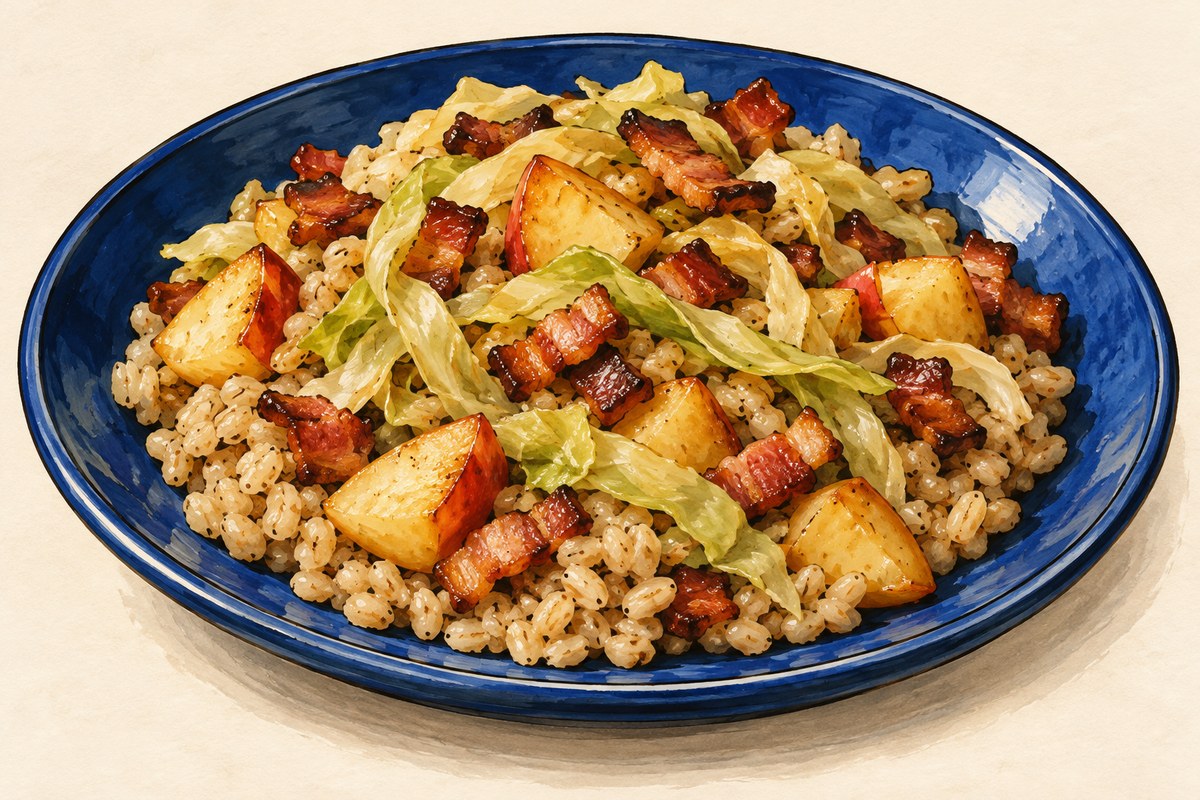
Bacon, Apple and Cabbage Skillet with Creamy Barley
4 plates, each with one-quarter of the creamy barley and bacon-cabbage-apple mixture · Active 30 min · Total 1 hr 15 min
Print recipe · PDFA little bacon seasons a large skillet of cabbage and apple rather than becoming the main bulk of the meal. Creamy pearl barley sits underneath to catch the savory juices. The apples go in late enough to keep recognizable pieces, bringing a gentle sweetness against the browned bacon and peppery cabbage.
Choose pearl barley for this timing
Pearl barley cooks more predictably in the stated window than hulled barley, which has a different texture and usually needs longer. Simmer it in plenty of water, then taste a few grains. They should be tender with some chew, not hard at the center. Drain before adding milk so the final consistency is creamy rather than a large bowl of barley cooking water.
Render the bacon before the vegetables
Start the bacon in a moderately heated skillet so some fat comes out before its edges become crisp. The onion and cabbage then cook in that seasoned pan, with the small measured amount of oil helping them make contact. Stir to move the pale top leaves down and give the lower pieces a chance to lift. Cabbage volume falls considerably; do not try to force all of it against one small hot patch.
Keep the apples in pieces
Cut firm apples into chunks and add them toward the end. They should soften without disappearing into sauce. A softer eating apple may break down sooner, so check it before the cabbage finishes. Divide the bacon pieces along with the vegetables instead of leaving them for the first plate served. This gives each person the same balance and makes a modest package of bacon contribute to four full grain-and-vegetable dinners.
Ingredients
- 1 1/4 cups pearl barley, rinsed (250 g dry)
- 4 cups water for barley (1 L)
- 1 cup milk (240 ml)
- 4 oz bacon, cut into short strips (120 g)
- 1 tablespoon neutral oil (15 ml)
- 1 medium onion, sliced (150 g prepared)
- About 6 packed cups green cabbage, cut into 1/2-inch/1 cm strips (600 g prepared)
- 2 firm apples, cored and cut into 1/2-inch/1.5 cm chunks (300 g prepared)
- 1/4 cup water for cabbage (60 ml)
- 1 tablespoon plain white vinegar (15 ml)
- 1/2 teaspoon dried thyme (0.5 g)
- 1/2 teaspoon fine salt (3 g), divided equally between barley and vegetables
- 1/2 teaspoon ground black pepper (1 g)
Set out
medium saucepan, colander, wide 12-inch/30 cm lidded skillet, knife and board, wooden spoon, measuring jug
Allergens
barley, milk. Check labels and substitutions.
Make it
- Put barley and its 1 L water in the saucepan. Bring to a boil, reduce to a gentle simmer and cook partly covered for 40–50 minutes until the grains are tender with a little chew. Add a little water if the pan threatens to dry before they are tender. Drain any excess water.
- Meanwhile, put bacon in the wide skillet over medium heat and cook for 8–10 minutes, stirring, until its fat has rendered and the edges are browned. Add oil and onion and cook for 5 minutes.
- Add cabbage, the 60 ml water, thyme, 1.5 g salt and pepper. Toss carefully, cover and cook over medium-low heat for 10–12 minutes, stirring twice, until the cabbage has wilted and nearly softened.
- Add apple chunks and vinegar. Cover and cook for 7–9 minutes until the apples are just tender and the cabbage is fully cooked. Uncover for the last 2 minutes if the pan is very wet. Keep hot while finishing the barley.
- Return drained barley to its saucepan. Add milk and the remaining 1.5 g salt and simmer gently for 4–5 minutes, stirring, until creamy and hot. Divide between 4 plates and add one-quarter of the cabbage, apple, bacon and pan juices to each.
Bacon as seasoning
The measured 120 g is shared between four meals. There is no need to add extra slices to make the dish match the described portion.
Ingredient labels
Barley contains gluten. Check the bacon label for additional allergens; milk is added to the barley.
A useful detail
The barley sets the overall schedule. Begin it first, then cook the skillet mixture while it simmers; the final milk stage takes place after the barley is tender and drained.
Another way
- Use 120 g diced cooked ham instead of bacon. Start onion in the measured oil, add ham with the cabbage, and keep within the ham’s original refrigerated storage deadline.
- Use 250 g dry short pasta instead of barley, cooking it separately by its package and tossing with the measured milk at the end. The dish and timing change.
Keep it well
Cool leftovers in shallow containers and refrigerate within 2 hours, or 1 hour above 90°F/32°C. Keep at 40°F/4°C or below for up to 3 days. Reheat the portion needed to 165°F/74°C throughout, adding a little water to loosen the barley. Previously cooked ham used in a variation keeps its original storage deadline.