012 / 75 · Cupboard Suppers
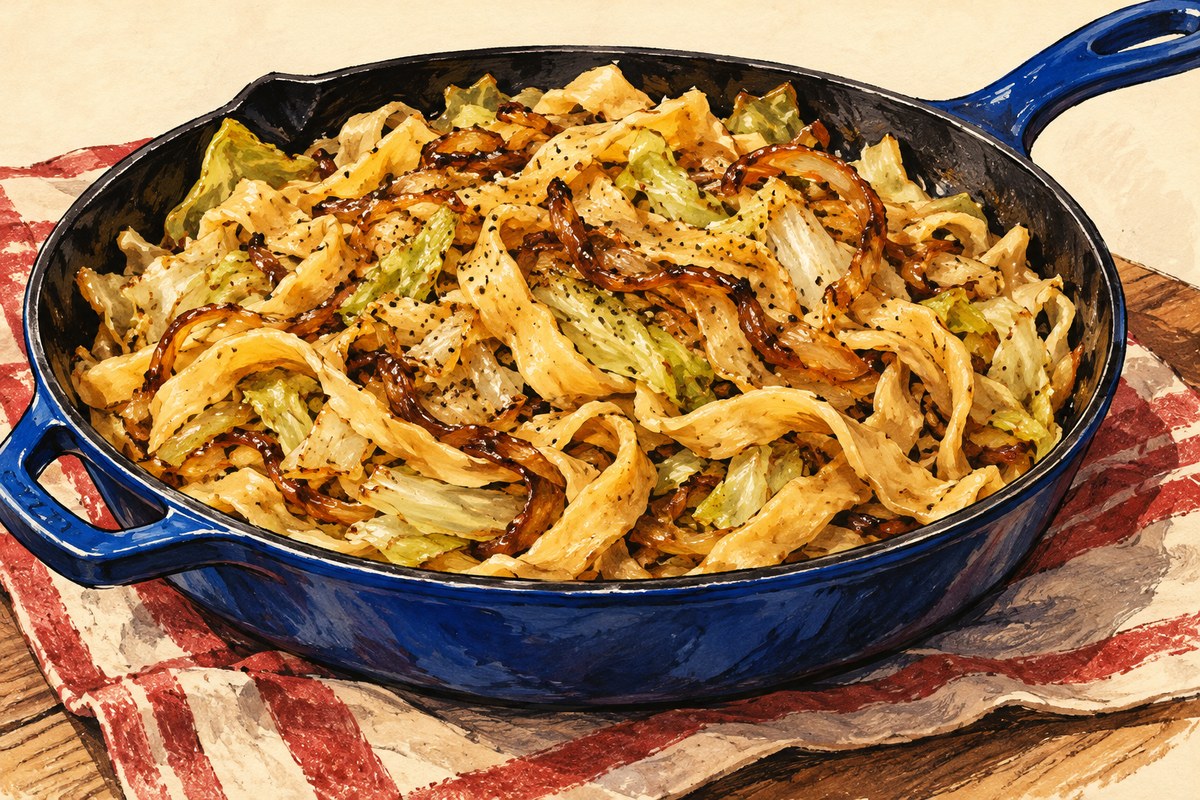
Hand-Cut Noodles with Cabbage and Browned Onions
3 generous plates of fresh noodles and cabbage · Active 45 min · Total 1 hr 10 min
Print recipe · PDFA little flour and three eggs make a substantial pan of fresh noodles. While the dough rests, cabbage and onions cook slowly until sweet and golden at the edges. Cutting the noodles yourself is the main task; there is no pasta machine, separate filling or expensive finishing cheese to manage.
Resting saves work later
The dough may look rough when it first comes together. Knead until it is firm and even, then cover it for the full rest instead of repeatedly adding water to make it feel soft. During that pause the flour hydrates and the dough becomes easier to roll. This is a practical use of waiting time because the onion and cabbage need their own unhurried cooking.
Cut broad, open ribbons
Roll half the dough at a time so an ordinary board and rolling pin are enough. A roughly rectangular sheet is useful, but tidy edges are unnecessary. Dust lightly before making loose folds, slice across them and immediately unfold the ribbons. Compressed folds can stick into a thick bundle. Uneven homemade noodles are welcome; thick unseparated stacks, which cook at a different speed, are not.
Brown the vegetables before the noodles arrive
Cabbage releases water as it cooks. Keep the skillet uncovered and give the moisture time to leave before looking for golden patches. Fresh noodles need only a short boil, so do not start them while the cabbage is still raw and bulky. The final toss coats the ribbons with the buttery onion mixture. It does not need to become another long frying stage that dries the fresh pasta.
Ingredients
- 2 1/2 cups all-purpose flour for the dough (300 g)
- 2 tablespoons all-purpose flour for dusting (15 g)
- 3 large eggs (150 g without shells)
- 2 tablespoons water (30 ml)
- 1 teaspoon fine salt (6 g), divided equally between dough and vegetables
- 2 tablespoons unsalted butter (28 g)
- 1 tablespoon neutral oil (15 ml)
- 2 medium onions, thinly sliced (300 g prepared)
- About 1/2 medium green cabbage, cored and thinly sliced (500 g prepared)
- 1/2 teaspoon ground black pepper (1 g)
- 2 quarts water for boiling the noodles (2 L)
Set out
large mixing bowl, knife and board, rolling pin, clean towel, 12-inch/30 cm skillet, 5-quart/5 L pot, colander or tongs, wooden spoon
Allergens
wheat, egg, milk. Check labels and substitutions.
Make it
- Mix 300 g flour, eggs, 30 ml water and 1/2 teaspoon/3 g salt in the bowl. Bring together by hand, then knead for 6–8 minutes until firm and fairly smooth. Cover and rest for 20 minutes. Do not taste raw dough.
- Meanwhile, heat butter and oil in the uncovered skillet over medium-low heat. Add onions and cook for 10 minutes, stirring. Add cabbage, the remaining 1/2 teaspoon/3 g salt and pepper. Cook uncovered for another 15–18 minutes, turning regularly, until tender with some golden patches. Reduce the heat if the onion threatens to burn.
- Divide the rested dough in half. Using the measured dusting flour as needed across both halves, roll each into a sheet roughly 10 by 14 inches/25 by 35 cm and about 1/16–1/12 inch/1.5–2 mm thick. Fold very loosely, cut into 1/3-inch/8 mm ribbons and immediately open them out.
- Bring the measured 2 L water to a boil in the large pot. Cook the noodles in 2 batches for about 3–4 minutes each, separating them gently, until cooked through with no floury center. Thickness matters more than a rigid timer.
- Drain each batch and add it to the cooked cabbage. When all the noodles are ready, toss over medium-low heat for 1–2 minutes. If the skillet is too full for a safe toss, combine in the drained large pot instead.
- Divide evenly between 3 plates. Serve the noodles with the browned onion and cabbage distributed throughout, rather than leaving the vegetables under the last portion.
No machine required
A rolling pin and knife do the shaping. The dough rest overlaps with vegetable cooking, which is why the total time is shorter than adding every individual step together.
Timing
Allow about 20 minutes for rolling and cutting both sheets and about 8 minutes for two noodle-boiling batches. The dough rest overlaps the beginning of the cabbage cooking; a small workspace or extra dough rest adds time.
Ingredient labels
The base includes wheat flour, eggs and butter. Purchased noodles in the shortcut variation may have additional allergens.
A useful detail
A relaxed dough rolls more easily than a freshly kneaded one. If it springs back as you roll, cover it for another 5 minutes; this adds to the total time but avoids forcing it into a thick sheet.
Another way
- Replace the cabbage with 500 g thinly sliced savoy cabbage; begin checking tenderness a few minutes earlier.
- Use 300 g dry wide egg noodles instead of making the dough when time is limited. Omit the dough flour, eggs, dough water and dough salt; cook the purchased noodles according to their label.
Keep it well
Refrigerate cooked noodles and cabbage in shallow portions within 2 hours, or 1 hour above 90°F/32°C, at 40°F/4°C or below. Use within 3 days and reheat to 165°F/74°C throughout; 1–2 tablespoons/15–30 ml water per portion helps loosen them. Uncooked cut noodles can be frozen in a single layer, then bagged for up to 1 month; boil from frozen and check that the centers are fully cooked.