018 / 75 · Beans and Grains That Go Further
Lentil-Stuffed Cabbage Parcels in Tomato Sauce
8 cabbage parcels; 2 per serving with one quarter of the tomato sauce · Active 35 min · Total 1 hr 15 min
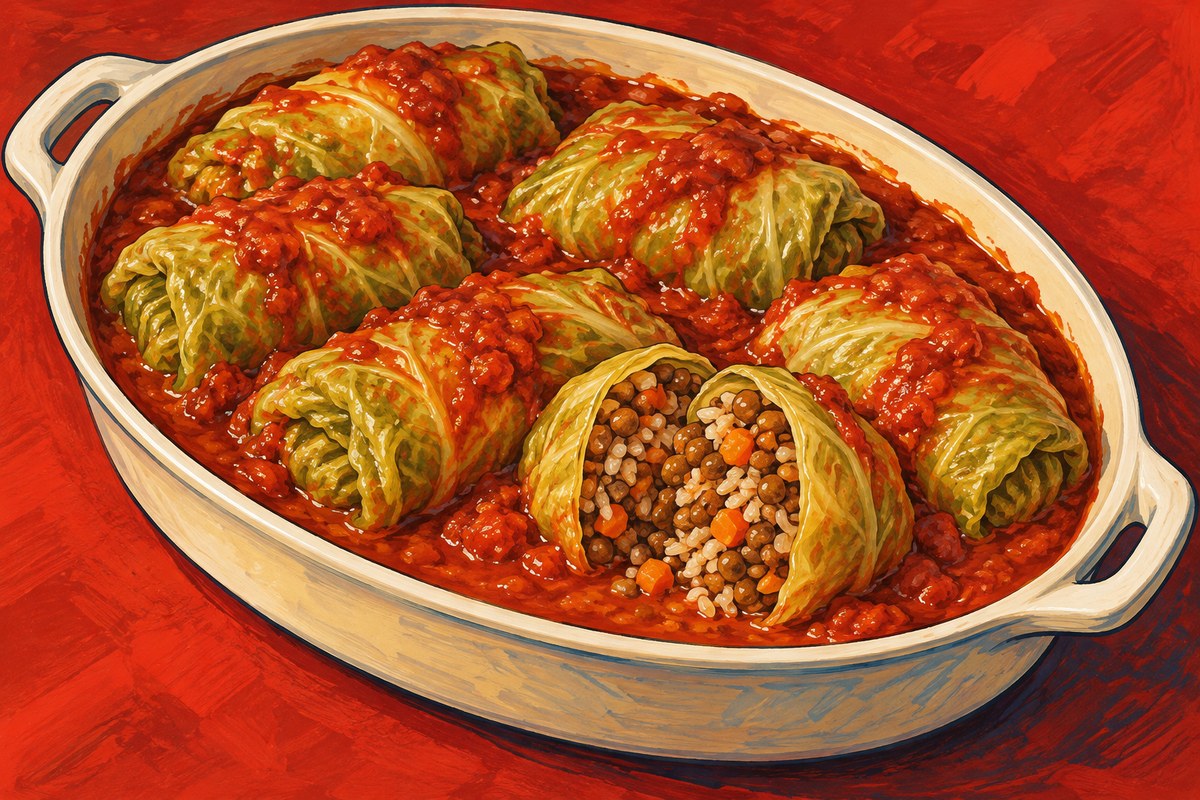
Print recipe · PDFCabbage leaves can hold a substantial lentil-and-rice filling when their thick ribs are trimmed and the filling is cooked before wrapping. The parcels then bake in a simple tomato sauce until the leaves are tender. This takes more assembly than a one-pan supper, but the eight-parcel count makes the result easy to divide. The cabbage leaves are wrappers, not raw decoration; they should be soft enough to cut with the side of a fork.
Choose flexible leaves
A medium cabbage with broad outer leaves is easier to wrap than a very small, tightly packed head. Blanch eight usable leaves until flexible and shave the thick raised rib with a small knife. Do not cut a large hole through the center. If a leaf tears, overlap two smaller pieces and keep the seam underneath when it enters the dish.
Leave space for the folds
Divide the cooked filling into eight piles before wrapping. Put a pile near the base of a leaf, fold the sides inward and roll toward the tip. A tightly stuffed parcel can split as the rice warms. The sauce and foil keep the leaves moist during baking, so cover the dish securely rather than leaving the tops exposed to dry oven heat.
Ingredients
- 8 large cabbage leaves (about 450 g after trimming)
- 1/2 cup long-grain white rice (100 g dry)
- 3/4 cup water (180 ml), for rice
- 1 tablespoon neutral oil (15 ml)
- 1 large onion, finely diced (150 g)
- 1 large carrot, grated (120 g)
- 2 garlic cloves, minced (6 g)
- 2 cups cooked green or brown lentils, drained (400 g)
- 1 teaspoon dried mixed herbs (1 g)
- 3/4 teaspoon fine salt (4.5 g), divided
- 1/2 teaspoon ground black pepper (1 g)
- 1 can crushed tomatoes (28 oz/800 g)
- 1/2 cup water (120 ml), for sauce
Set out
Large saucepan for cabbage, Small lidded saucepan for rice, Skillet, 9 x 13-inch/23 x 33 cm baking dish, Foil, Food thermometer
Allergens
No major US allergen identified in the base ingredients. Check labels and substitutions.
Make it
- Heat oven to 375°F/190°C. Simmer rice with 3/4 cup/180 ml water in the covered small saucepan for 12–15 minutes or according to the package; remove from heat and rest covered for 5 minutes.
- Blanch cabbage leaves in a large pan of boiling water for 3–5 minutes until flexible. Lift out, cool enough to handle and shave down the thick ribs.
- Heat oil in the skillet. Cook onion and carrot over medium heat for 7 minutes; add garlic for 30 seconds. Fold in cooked lentils, cooked rice, mixed herbs, half the salt and pepper. Divide filling into eight equal portions.
- Mix crushed tomatoes with the sauce water and remaining salt in the baking dish. Wrap each filling portion in a cabbage leaf, folding sides inward and rolling; set seam-side down in the sauce. Spoon some sauce over the tops and cover with foil.
- Bake for 35–40 minutes until cabbage is tender and the centers reach 165°F/74°C. Divide into four servings of two parcels with sauce.
Keep the rest of the cabbage in the plan
Only eight broad leaves are needed. Refrigerate the remaining cabbage and use its firmer inner leaves for a shredded pan supper or slaw. The trimmed rib pieces can be finely chopped and cooked in soup; they do not need to be discarded because they were too thick for wrapping.
A useful detail
Cooked lentil weight is specified. Do not substitute the same weight of dry lentils into the filling; cook and drain them separately first.
Another way
- Use 400 g drained canned lentils when a cooked batch is not ready.
- Replace the grated carrot with 120 g finely diced celery, cooking until softened with the onion.
Keep it well
Cool parcels and sauce promptly in shallow portions and refrigerate as quickly as possible, ideally within 1 hour. Keep at 40°F/4°C or below and eat within 24 hours of cooking. Reheat covered once to 165°F/74°C at the center, then eat promptly; do not plan another cooling and reheating cycle. Freeze suitable portions promptly after cooling, within that original window, for up to 2 months. Thaw in the refrigerator and reheat once to 165°F/74°C.