Sequence changes ideal storage accounting.
At the same peaks and variance, the order of supply and demand can change the energy capacity required by a fixed balancing model.
10.7%
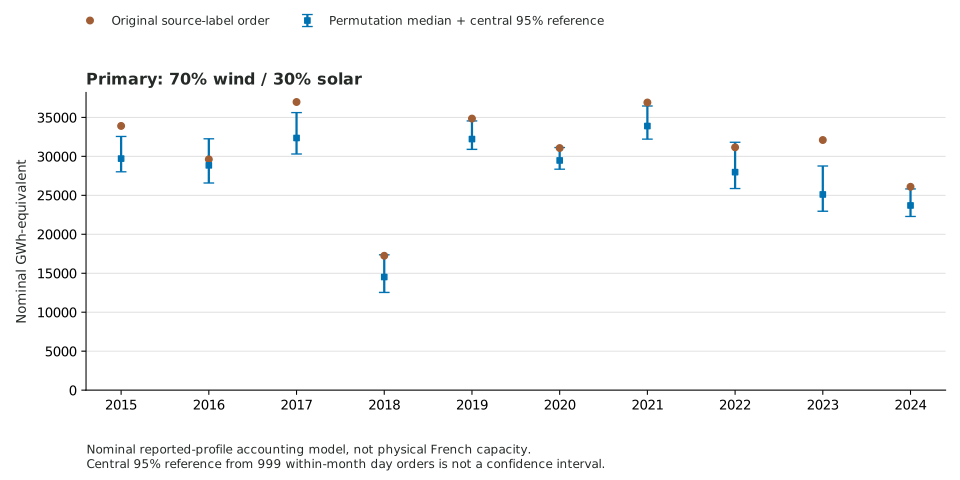
Median extra nominal capacity in the reported order relative to the median of within-month day reorders, across ten year-labelled profiles in the primary 70% wind / 30% solar scenario.
10 / 10
Primary year-labelled profiles above their reordered-reference median. This is a descriptive result, not an independent-years significance test.
The check
We used 175,344 complete source-labelled actual-value rows from RTE’s 2015–2024 profiles. Wind and solar shapes were scaled to a hypothetical 70/30 annual-energy mix equal to model demand. For each year-labelled profile, 999 reorders changed the sequence of whole days within each month while preserving all values, matched demand and generation, within-day patterns, monthly totals, annual variance and peak.
A useful result with a narrow scope
The primary original/reference ratios ranged from 1.0269 to 1.2781. Removing the two daylight-saving transition dates gave a median ratio of 1.0972; zero-clipping the signed generation inputs gave 1.1089. Other wind/solar mixes changed the magnitude; one 90/10 profile lay below its reference median. All five scenarios are reported.
What follows
Peaks and variance alone do not determine the ideal cyclic energy requirement of these constructed sequences. This is compatible with the original proposal, which already includes duration; it does not prove its causal explanation, establish a new theorem, or estimate actual French storage needs.
Read the complete methods, results and limits →