Bursts create backlog. They do not change this queue’s load threshold.
The exact result
At the same mean input 0.8 and capacity 1, constant fluid arrivals have zero after-service backlog. Bursts 4, 0, 0, 0, 0 repeat the bounded queue 3, 2, 1, 0, 0, mean 1.2 and maximum 3. The five-cycle map is F(q)=max(0,q−1), so excess initial backlog drains.
What the computation adds
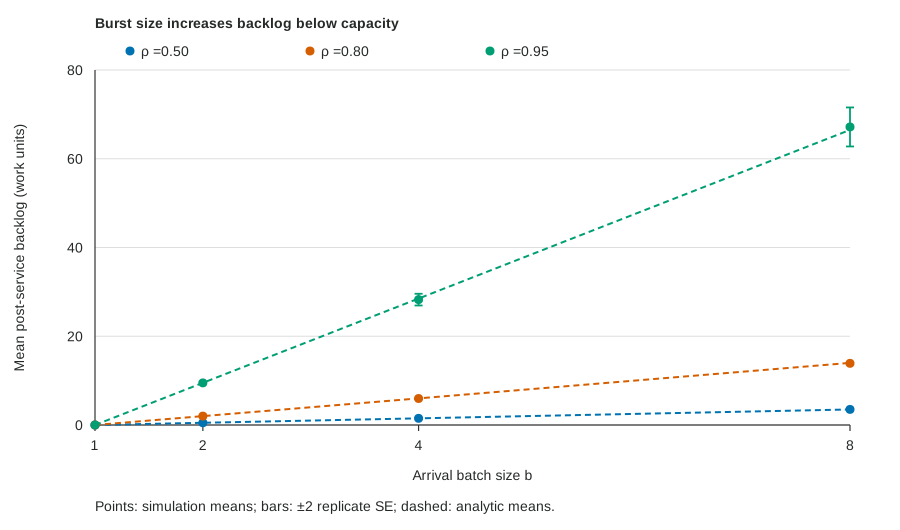
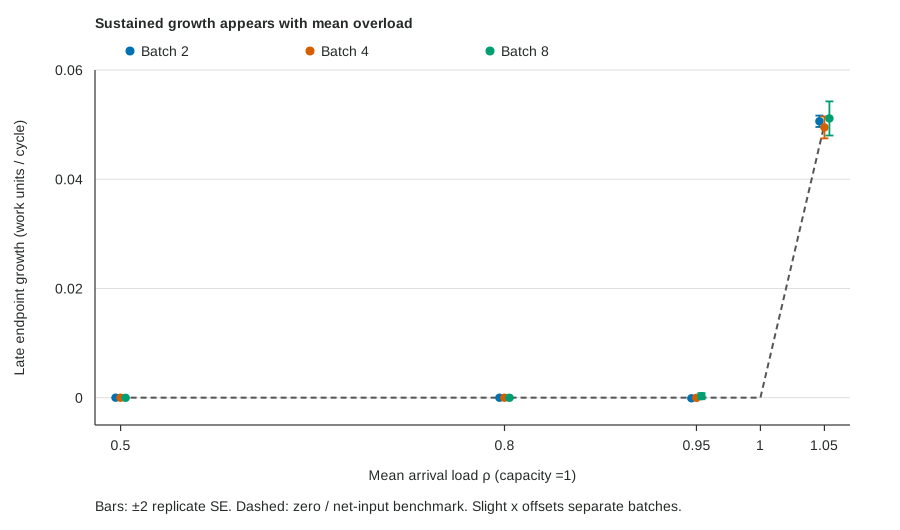
Fifteen valid conditions, 64 separately seeded replicates each, 96 million total cycles. At load 0.8, average backlog rose with batches 2, 4, 8 to 2.008, 5.972, 13.897. At load 1.05, queues grew by roughly 0.05 work units/cycle. The plan, seeds and complete computed results are public.
Higher temporary backlog and threshold exceedances are not mathematical instability or physical gridlock. Stability below capacity comes from the stated assumptions and mathematical argument, not from a short simulation.
Read and reproduce
- Full readable report, all 15 conditions and limitations · Markdown report.
- Locally saved pre-execution plan · Portable standard-library experiment code.
- Condition results · All 960 replicate results and seeds · Stored run checkpoints.
- Primary mathematical sources and scope · Original hypothesis, preserved unchanged.