075 / 75 · Small Meals and Simple Snacks
Savory Cottage Cheese Oat Cakes
8 small savory oat cakes;2 snack-sized servings of 4 cakes each · Active 30 min · Total 1 hr
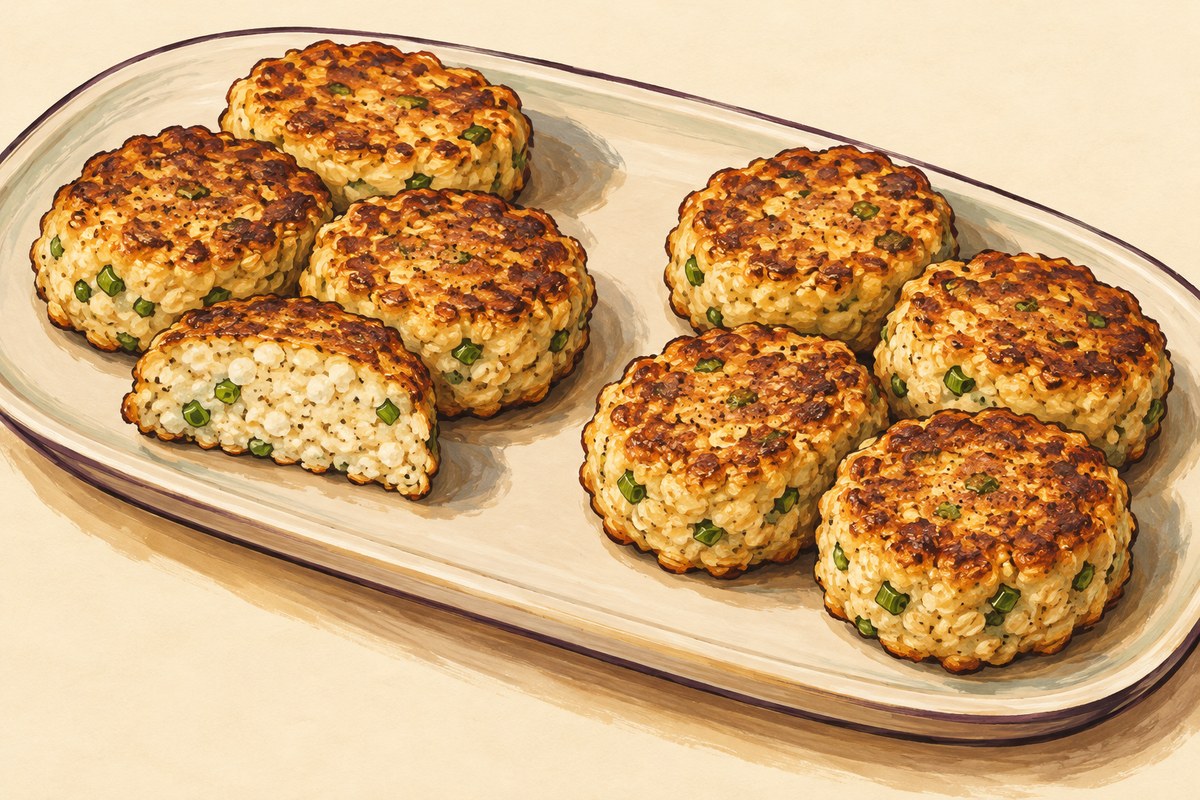
Print recipe · PDFThese are soft savory oat cakes cooked in a skillet, with cottage cheese and eggs holding the mixture together. A short rest gives the oats time to absorb moisture before the first spoonful reaches the pan. Green onion supplies a clear savory flavor without a separate sauce. Eight equally weighed cakes make the portions easier to understand than an unpredictable collection of large and small pancakes.
Rest the batter before judging it
Rolled oats take up liquid gradually. If you cook the mixture immediately, the first cakes can spread more than the last ones. Stir the cottage cheese before weighing, beat in the eggs and then add oats and finely sliced green onion. Leave the batter for fifteen minutes. It should be thick and spoonable, with cottage-cheese curds still visible. Do not add flour simply because it is not smooth like an ordinary pancake batter; the recipe is designed around soft curds and oats.
Small cakes are easier to turn
Divide the finished batter into eight equal weights. Each should make a roughly three-inch round in the skillet, not a large thin crepe. Use a broad flexible spatula and wait until the underside is golden and the top edges look set before turning. Moderate heat lets the egg center cook while the oats color gently. If the outside darkens quickly, lower the heat; adding more oil is not a solution to a cool raw center under a scorched crust.
Check the center of a thick cake
Color is a useful cue for turning, but it is not the final doneness test for an egg mixture. Insert a food thermometer sideways into the center of a thick cake, keeping its tip away from the skillet. Every batch should reach 160°F/71°C and have no wet egg batter inside. Keep the first batch on a heatproof plate in a low oven while finishing the second, then share all eight cakes equally. There is no cream, dip or extra cheese topping included in the serving estimate.
Ingredients
- About 1 cup plain 2% cottage cheese, stirred (250 g)
- 1 cup ordinary rolled oats (80 g dry)
- 2 large eggs (100 g edible contents)
- 2 small green onions, washed, trimmed and finely sliced (30 g)
- 2 teaspoons olive oil for both batches (10 ml/about 9 g), divided
- 1/8 teaspoon fine salt (0.75 g)
- 1/8 teaspoon black pepper (0.3 g)
Set out
25 cm/10-inch nonstick skillet, Mixing bowl and fork, Kitchen scale, Broad flexible spatula, Food thermometer, Heatproof plate and low oven for holding the first batch, Oven mitts
Allergens
Milk, Egg; check oats for processing-related gluten and other allergens. Check labels and substitutions.
Make it
- Beat eggs in the bowl, then stir in cottage cheese, oats, green onion, salt and pepper. Rest for 15 minutes. Heat the holding oven to 200°F/95°C and put a heatproof plate inside.
- Weigh the finished batter and divide it into 8 equal portions, roughly 58 g each. Heat half the oil in the nonstick skillet over medium-low to medium heat. Add 4 portions and spread each gently into a round about 3 inches/8 cm across, leaving space between them.
- Cook for 4–5 minutes on the first side until golden and edges are set. Turn carefully and cook for 3–5 minutes more, adjusting heat to prevent scorching. Check the center of the thickest cakes from the side with a thermometer: they must reach 160°F/71°C with no wet egg batter. Continue gently if necessary.
- Move the cooked first batch to the plate in the low oven. Add remaining measured oil and repeat with the other 4 portions, again checking the egg centers. Serve 4 cakes per person immediately, without adding an unlisted topping.
A useful kitchen skill
Let oats hydrate before portioning a soft batter, then use equal cake weights and a measured egg-dish endpoint.
A useful detail
The 60-minute total includes weighing, the 15-minute oat rest, portioning and two sequential 8–10-minute skillet batches. The texture is soft and curdy inside, not dry and crisp like a cracker. The estimate counts all the pan oil.
Another way
- Use 30 g finely chopped fresh spinach instead of green onion, squeezing away obvious wash water and updating the estimate.
- Use 5 g chopped dill and 25 g sliced green onion in place of 30 g green onion for a different herb flavor; the estimate changes slightly.
Keep it well
Cool leftovers promptly in a shallow container and refrigerate at 40°F/4°C or below within 2 hours, or 1 hour above 90°F/32°C. Use within 2 days. Freeze chilled cakes separated by baking parchment at 0°F/−18°C for up to 1 month for quality. Thaw in the refrigerator and reheat the needed cakes to 165°F/74°C throughout; do not rely on surface browning alone.