030 / 75 · Fish Without Fuss
Haddock and Chickpea Chowder
3 main-meal bowls, each with about 600 ml chowder and 30 g whole-wheat bread · Active 25 min · Total 1 hr 5 min
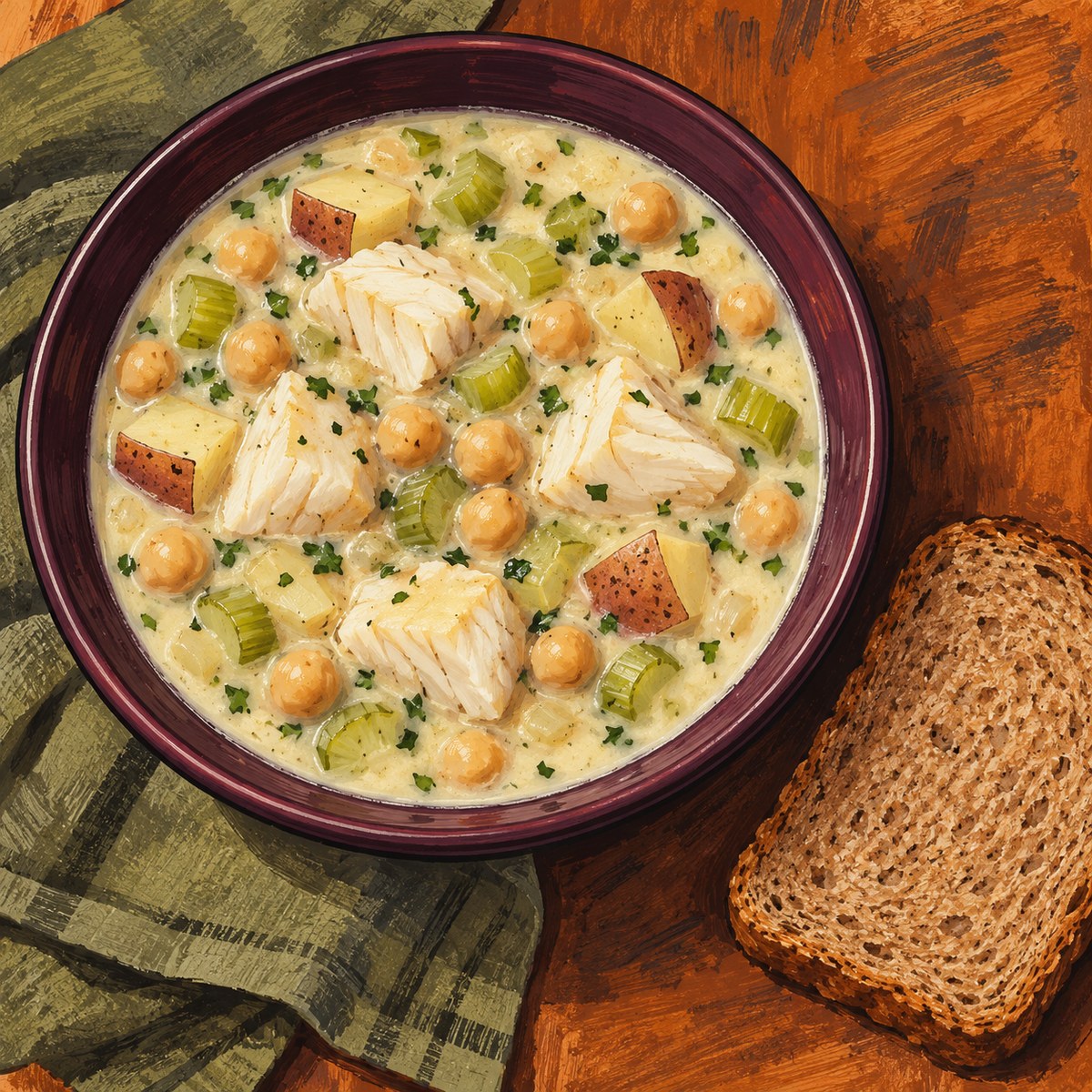
Print recipe · PDFA chowder needs its firm vegetables cooked before delicate fish is added. Potato and chickpeas give this milk-based soup substance without cream, while a little crushed potato thickens the broth. Haddock enters only near the end. This recipe makes three main-meal portions, each with measured bread, so the batch and per-portion estimate have a clear relationship.
Let potato do the thickening
Cut the potato into small, even cubes so the simmering time is useful rather than a guess. A knife should pass through a larger cube easily before the milk and fish go in. Crush only a few cubes against the pan with a spoon; the rest should remain recognizable. This releases some potato into the liquid without a separate flour paste. The chickpeas come from a commercially canned product and are weighed after draining. Dry chickpeas cannot be added to this short soup method and expected to soften.
Keep the final simmer gentle
Milk can catch on the base of a saucepan if the heat is high and the soup is not stirred. Bring it back to steaming with small bubbles, then lower the fish pieces into the hot broth. Move them as little as possible while they cook so they remain chunks rather than dissolving into threads. Check the thickest piece reaches 145°F/63°C and is opaque and easily flaked. Use a wide spoon to divide fish and chickpeas among all three bowls before ladling the remaining broth. The parsley is stirred in at the end. Serve promptly rather than leaving milk soup lukewarm on the stove. If keeping portions for another day, use shallow containers for prompt refrigerator cooling; a large hot pot cools slowly at its center.
Ingredients
- 10 1/2 oz raw boneless skinless haddock, cut in 3 cm/1 1/4-inch chunks (300 g)
- About 1 1/2 cups canned chickpeas, well drained (240 g edible)
- 2 medium potatoes, scrubbed and cut in 1.5 cm/5/8-inch cubes (270 g raw, skin on)
- 1 small onion, finely diced (90 g)
- 1 large celery stalk, finely sliced (60 g)
- 2 teaspoons olive oil (10 ml/about 9 g)
- Scant 2 cups 2% milk (450 ml/about 463.5 g)
- Scant 2 cups drinking water (450 ml)
- About 1 1/2 tablespoons finely chopped parsley (6 g)
- 1/4 teaspoon fine salt (1.5 g)
- 1/8 teaspoon black pepper (0.3 g)
- 3 slices whole-wheat bread (90 g total), for serving
Set out
3-litre/3-quart saucepan with lid, Wooden spoon, Sieve, Knife and separate raw-fish board, Kitchen scale, Food thermometer, Ladle, 3 large bowls, at least 750 ml capacity
Allergens
Fish, Milk, Wheat; check bread for additional allergens. Check labels and substitutions.
Make it
- Heat oil in the saucepan over medium-low heat. Soften onion and celery for 6–7 minutes, stirring. Add potato, water, salt and pepper. Bring to a simmer, cover partly and cook for 12–15 minutes until the largest potato cubes are tender.
- Crush a few potato cubes against the side of the pan with the spoon, leaving most whole. Stir in drained chickpeas and milk. Heat gently for 4–5 minutes until steaming with small bubbles, stirring along the base to prevent catching.
- Add cold raw haddock chunks and stir once gently. Clean raw-fish equipment and wash hands. Keep the soup at a very gentle simmer for about 6–8 minutes, depending on thickness, until the thickest fish pieces reach 145°F/63°C, turn opaque and separate readily. Avoid a hard boil.
- Stir in parsley. Divide fish, chickpeas and potato evenly among 3 large bowls and ladle over the remaining broth. Serve each with 30 g of the measured bread.
A useful kitchen skill
Cook firm vegetables until tender before adding delicate fish, then portion the solids first so each bowl receives a fair share of the measured ingredients.
A useful detail
The 65-minute total allows chopping and water heating as well as the gentle fish finish. Yield is roughly 1.8 litres/7 1/2 cups soup, varying with evaporation; divide the whole batch into three equal portions rather than relying on ladle size.
Another way
- Use 300 g raw cod instead of haddock, checking 145°F/63°C and recalculating for cod.
- Replace 60 g celery with 60 g finely diced leek, washing its layers first; the estimate changes.
Keep it well
Refrigerate promptly in shallow containers at 40°F/4°C or below within 2 hours, or 1 hour above 90°F/32°C. Use within 2 days. Reheat only the needed soup portion to 165°F/74°C throughout, stirring gently so the milk base heats evenly. Do not repeatedly warm and cool the whole batch. Store bread separately.