MODERN KITCHENS · 096 / 100
Early Dia and Jenne-jeno crop context · Inland Niger Delta, Mali · c. 500 BCE–500 CE
Evidence: historically informed adaptation. The historical evidence and modern cooking choices are distinguished below.
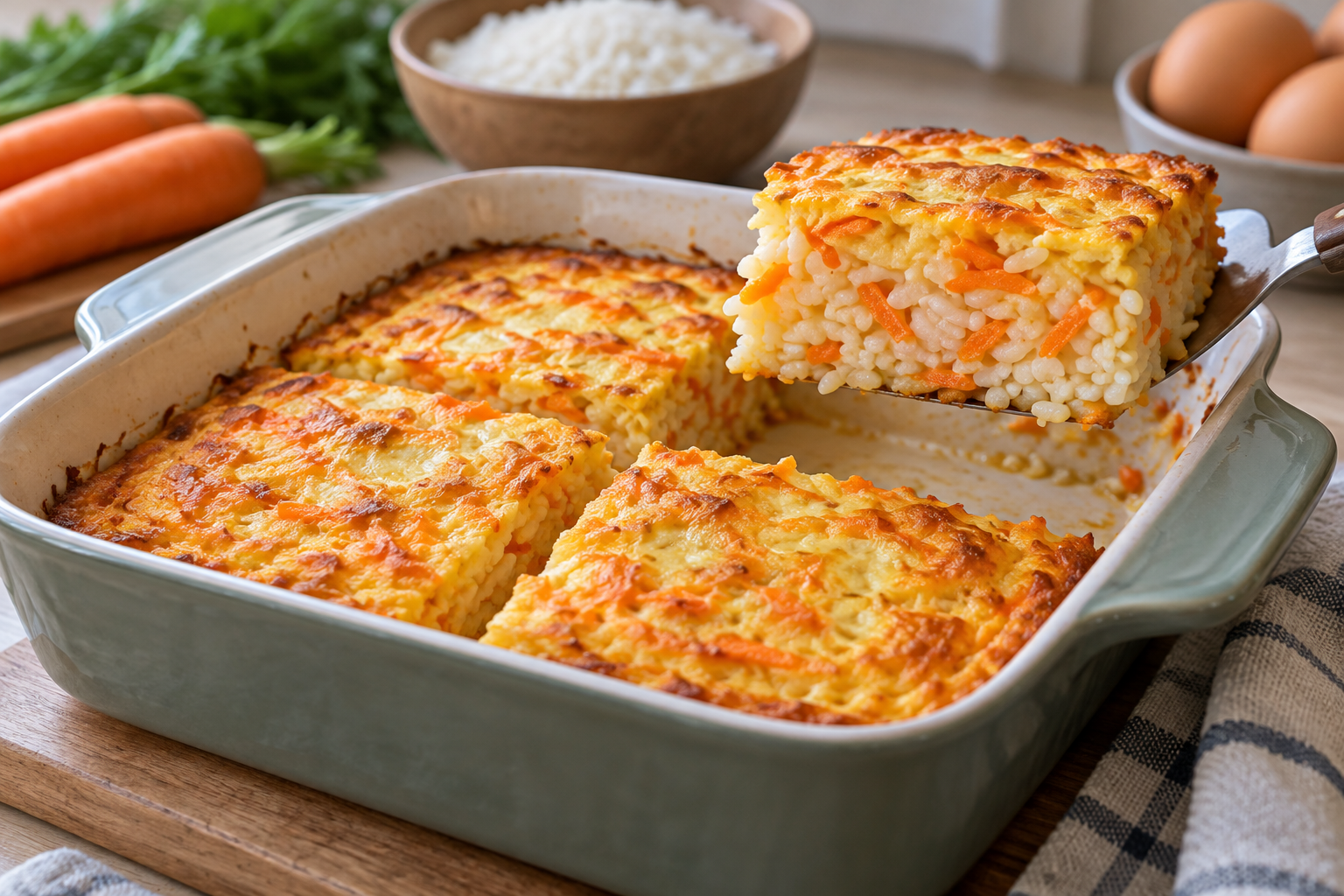
African rice has a history independent of Asian rice. Research at Dia considers early grains and identification limits. Early delta subsistence research places rice within a wider resource complex. Neither source gives this bake.
We use ordinary supermarket Asian rice as a declared modern substitute for the less accessible African species. Eggs, carrot and the oven format are also contemporary choices in this recipe, not a recovered ancient combination. The historical chapter stays centered on the separate rice story without pretending that one commercial bag reproduces the region's early fields or grain processing.
Cook the rice first and soften the carrot in a skillet. Let the ingredients stop steaming heavily before stirring them into the beaten eggs, so the mixture does not scramble during assembly. A shallow baking dish provides a manageable depth. The center should set firmly, with no liquid egg remaining; a thermometer gives the clearest endpoint.
Serve warm squares as a vegetarian lunch or substantial side. The rice stays visible within the egg structure, which makes the dish different from soft porridge or flour dumplings. Its usefulness comes from familiar equipment and an ordinary shopping list. African rice evidence inspired the subject, while the species substitution, egg binder, carrot, measured proportions and controlled baking method were written as a modern adaptation with their limits stated.
Rice, carrot and egg bake
Serves 4 · Preparation 20 min · Cooking 50 min · 5 minutes rice rest; 15 minutes rice cooling; 5 minutes final rest
A modern adaptation for home cooking. Times are approximate.
Ingredients
- 180 g ordinary white long-grain rice, explicitly Asian rice
- 330 ml water for rice
- 200 g carrot, grated
- 150 g egg, about 3 medium eggs
- 120 ml water for egg mixture
- 20 ml neutral oil, divided
- 4 g salt, divided
Method
- Cook rice with 330 ml water, covered on low heat, 12–15 minutes or according to package. Rest 5 minutes. Spread in a shallow dish to cool 15 minutes.
- Heat oven to 190°C. Oil a 20 cm square shallow baking dish with 5 ml oil. Soften grated carrot in remaining oil 5 minutes.
- Beat eggs with 120 ml water and salt. Fold in warm-not-hot rice and carrot. Spread evenly in the dish.
- Bake 25–30 minutes until center reaches 74°C (165°F) and no liquid egg remains. Rest 5 minutes and cut into four portions.
Substitutions and adjustments
- Use brown rice cooked according to its packet, with additional time.
- If African Oryza glaberrima is available, cook according to its package; the water and timing may differ.
Historical choices: Ancient African rice supplies the subject; Asian rice substitution, egg-carrot mixture and oven-bake format are modern.
Troubleshooting: Loose slices need 5–10 more minutes of resting. Liquid center needs further baking.
Storage and reheating: Cool promptly, refrigerate up to 1 day and reheat once to 74°C.
Kitchen note: Cook the casserole center to 74°C (165°F). Cool cooked rice promptly and keep at 4°C or colder; reheat once.
Sources and further reading
- Murray, Searching for the origins of African rice domestication. Article and chronology figures inspected: Dia grains and uncertainty identifying naked wild/domestic rice; ordinary Asian rice is a declared modern substitute.
- McIntosh and McIntosh, Initial perspectives on Inland Niger Delta subsistence. Primary abstract inspected via cached full text: rice, fish and cattle supported at early Jenne-jeno; no rice bake or seared-beef recipe.
Browse Ancient Recipes for Modern Kitchens · More creative work at Incoprea