MODERN KITCHENS · 084 / 100
Late Preclassic El Mirador food-resource context · Maya lowlands, Guatemala · c. 300 BCE–100 CE
Evidence: historically informed adaptation. The historical evidence and modern cooking choices are distinguished below.
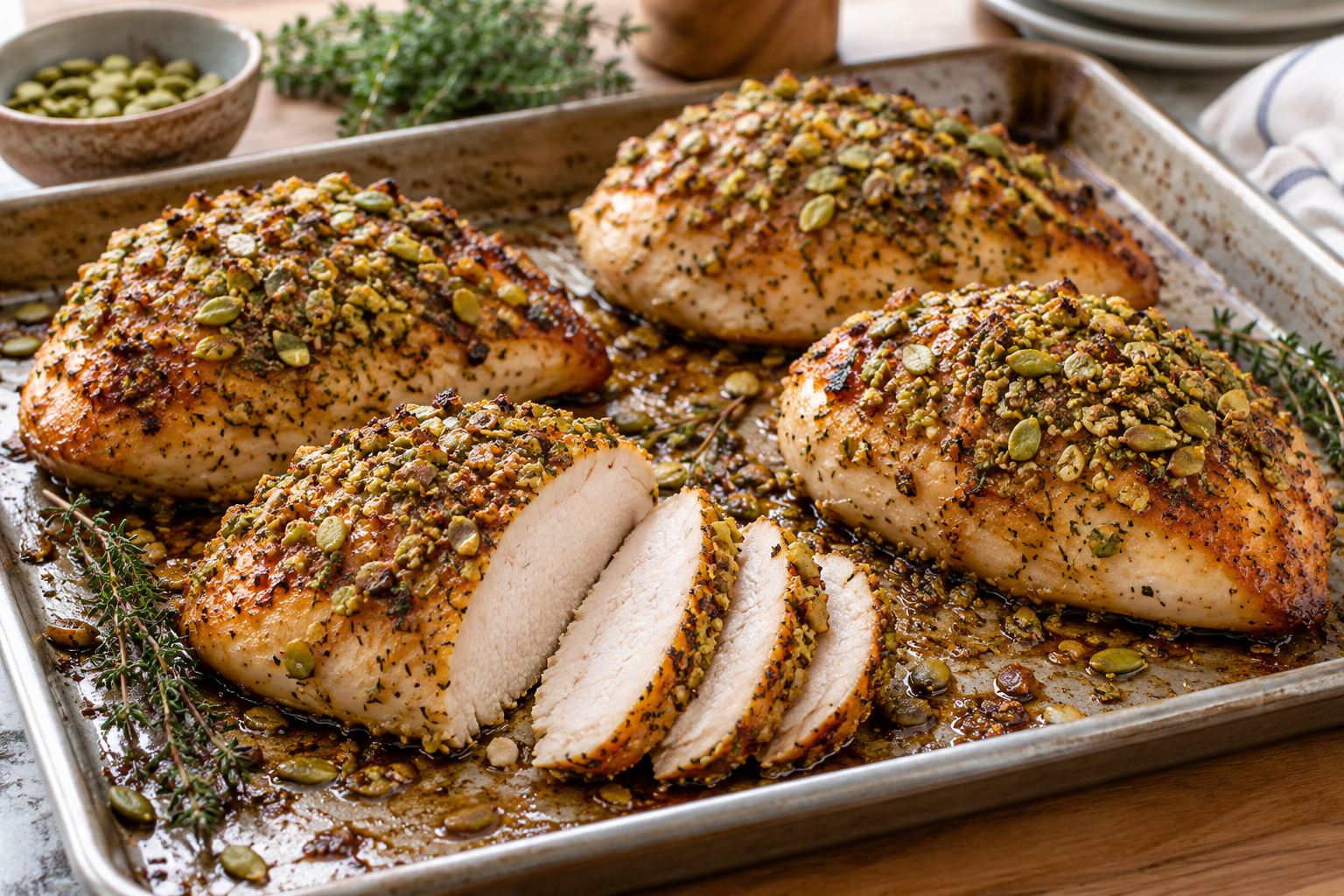
A turkey can tell a story of movement as well as a meal. Research at El Mirador identifies Mexican turkeys in Late Preclassic Maya contexts. Mesoamerican crop research provides a separate squash connection. Neither source attests this crust.
We coat supermarket turkey breast with ground pumpkin seeds and roast it as a modern main course. The seed-and-bird combination, contemporary turkey cut, neutral oil and oven method are our choices. The archaeological evidence does not show that the imported birds were prepared this way, or that all turkey management had one purpose. A modern food illustration cannot resolve those questions.
Flatten the breast pieces lightly so their thickness is even. A coarse seed coating gives the surface texture without hiding the meat beneath breadcrumbs. Moderate oven heat helps the interior finish before the seeds scorch. Use a thermometer in the thickest part; a colored crust alone is not a safe doneness check for poultry.
Serve sliced portions with vegetables or a plain grain. This is a useful modest roast rather than a whole ceremonial bird requiring specialist equipment or several hours. Its distinct profile comes from whole turkey portions and a dry seed crust. The historical introduction anchors the bird's ancient movement, while the practical recipe supplies modern measures and safe cooking instructions. The origin of an ingredient and the origin of a finished dish remain separate.
Turkey breast with pumpkin-seed crust
Serves 4 · Preparation 15 min · Cooking 35 min · 5 minutes resting
A modern adaptation for home cooking. Times are approximate.
Ingredients
- 650 g boneless turkey breast, cut into four pieces about 2 cm thick
- 70 g hulled pumpkin seeds, finely chopped
- 20 ml neutral oil
- 15 ml lime juice
- 3 g salt
- 1 g dried thyme, optional modern seasoning
- 0.5 g ground black pepper, optional modern seasoning
Method
- Heat oven to 190°C. Line a tray. If needed, cover turkey with baking paper and tap gently to an even 2 cm thickness.
- Mix oil, lime and salt; brush turkey. Press chopped pumpkin seeds onto top and sides. Add the optional thyme and pepper to the seed coating.
- Roast 25–35 minutes until thickest center reaches 74°C. If seeds darken early, cover loosely with foil.
- Rest 5 minutes, slice and serve.
Substitutions and adjustments
- Use chicken breast instead, an explicitly modern change outside the precontact bird story.
- Use unsalted sunflower kernels if pumpkin seeds are unavailable; the seed species changes.
Historical choices: El Mirador turkey evidence and ancient squash resources are separate anchors; this seed-crusted roast is modern.
Troubleshooting: Uneven pieces finish at different times; remove each when it reaches 74°C. Protect seeds with foil if needed.
Storage and reheating: Refrigerate up to 3 days or freeze 2 months. Reheat to 74°C.
Kitchen note: Keep raw poultry separate and cook the thickest center to 74°C. Wash hands and surfaces after contact.
Sources and further reading
- Thornton et al., Earliest Mexican turkeys in the Maya region. Primary article inspected: El Mirador turkey remains in Late Preclassic contexts c. 300 BCE–100 CE; captive management is an interpretation, no seed-crust recipe.
- Plaza of the Columns project, Plant-based Diet and Plants. Project's first-hand flotation research lists maize, beans, squash and amaranth; not proof of our combinations or techniques.
Browse Ancient Recipes for Modern Kitchens · More creative work at Incoprea