MODERN KITCHENS · 078 / 100
Mature Harappan crop traditions · Indus Valley, South Asia · c. 2600–1900 BCE
Evidence: historically informed adaptation. The historical evidence and modern cooking choices are distinguished below.
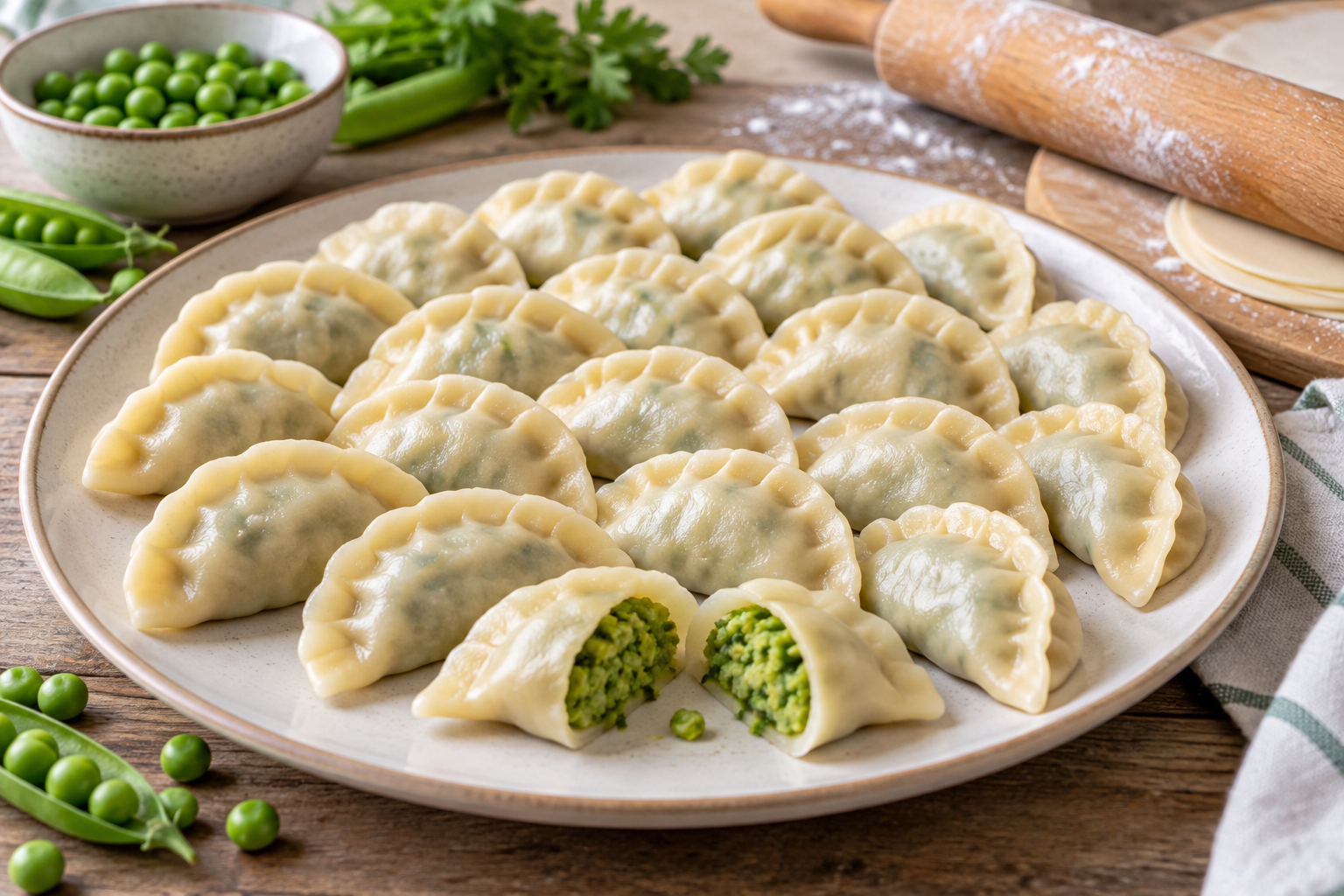
Pea and wheat both appear in the Harappa crop record. Excavation-report research reminds us to connect seeds with their archaeological setting. Those observations establish ingredients, not a surviving stuffed-dumpling recipe.
This recipe openly joins them in a modern form. Frozen green peas replace mature dried field peas for speed, while ordinary wheat flour makes a small wrapper. We do not call the result an ancient samosa or suggest that modern dumpling shapes can be dated from the mere presence of grain. The filling, closure and simmering schedule were chosen to make an approachable food in a home kitchen.
Set up the dough and filling together: let the dough rest while you cook and cool the peas. Drain the peas thoroughly before mashing, since a wet filling makes the wrappers harder to close. The mash should sit in a small mound with no liquid running around it. Keep unused dough pieces covered and roll one or a few wrappers at a time, so the edges remain flexible enough to pinch.
Roll each portion into an even thin circle, keeping the centre free of tears. If it springs back strongly, cover it and give it a little more rest before continuing rather than forcing it with extra flour. Put the filling in the middle and leave a clean border. Fold, gently press out trapped air and pinch the whole seam closed. Brush loose flour from an edge that refuses to stick; a fingertip barely moistened with water can help, but a soaked edge becomes slippery. Use less filling if you cannot close a wrapper without stretching it.
Lower the dumplings into gently simmering water and free any that settle against the bottom with a careful sweep of a spoon. Avoid a fierce boil that knocks the seams apart. At the end of the stated cooking window, cut one through its thickest folded edge: it should have no dry or pasty flour layer. Floating by itself does not establish that the wrapper is cooked. The intended finish is tender, with a distinct pea centre, rather than crisp or chewy.
Serve with a little oil or plain yogurt as a modern accompaniment. For another vegetable dish to round out the meal, browse the Incoprea cooking collection. The related Ancient Recipes for Modern Kitchens cookbook is in preparation. As throughout this article, the crop sources establish peas and wheat; the filling, closure, simmering schedule and serving suggestions are contemporary choices, with no claim to a surviving Harappan dumpling recipe.
Pea-filled wheat dumplings
Serves 4 · Preparation 35 min · Cooking 25 min · 20 minutes dough rest, overlapping with 10 minutes filling cooling
A modern adaptation for home cooking. Times are approximate.
Ingredients
- 240 g plain all-purpose wheat flour
- 130–145 ml warm water
- 250 g frozen green peas
- 15 ml neutral oil, divided
- 4 g salt, divided
- 10 ml lemon juice
Method
- Mix flour with 2 g salt and 130 ml water. Knead 5 minutes to a firm smooth dough, adding the remaining water a little at a time only if dry. Cover and rest 20 minutes. Keep the dough covered between tasks.
- Boil peas 3–4 minutes until hot and soft. Drain thoroughly; mash with 5 ml oil, remaining salt and lemon. Cool 10 minutes. The filling should mound on a spoon without free liquid.
- Divide dough into twenty pieces and keep unused pieces covered. Roll each into a thin, even 8 cm circle. Put 1 heaped teaspoon filling in the centre, leaving a clean border. Fold, gently press out air and pinch the entire edge closed; use a little less filling if needed rather than stretching the seam.
- Simmer dumplings in a large pan of gently boiling water in two batches of ten, 7–9 minutes per batch. Gently loosen any that settle against the base. Check one through the thickest folded edge: it should have no dry or pasty flour layer, with the thinner edges becoming translucent. Continue gently if needed; floating alone is not a doneness test.
- Lift with a slotted spoon and let excess water drain. Toss gently with the remaining oil and serve hot.
Substitutions and adjustments
- Use 250 g cooked well-drained split peas for a closer mature-pulse ingredient, allowing extra cooking time beforehand.
- Plain flour makes the most manageable wrapper; wholewheat flour needs additional water.
Historical choices: Harappan peas and wheat are documented separately; frozen peas, stuffing and dumpling method are modern inventions.
Troubleshooting: Seam will not stick: brush away excess flour and use a barely damp fingertip if needed. Leaks: reduce filling, remove trapped air and pinch every part of the edge. Dough springs back: cover and rest before rolling again. Tough or pasty folds: roll more evenly and continue gentle cooking; do not taste raw dough.
Storage and reheating: Refrigerate up to 2 days. Reheat gently in a covered skillet with water until centers reach 74°C.
Kitchen note: Cook flour wrappers thoroughly; do not taste raw dough. Refrigerate cooked dumplings within 2 hours.
Sources and further reading
- James et al., Taphonomy and labour at Harappa. Primary paper inspected, especially pp. 4–5: barley, wheat, lentil, pea, small chickpea quantities; charred finds have multiple pathways and do not preserve these recipes.
- Miller, Urban Palaeoethnobotany at Harappa. Excavation-report context emphasizes combining plant remains with archaeological context; no exact bread, soup or dumpling recipe.
Browse Ancient Recipes for Modern Kitchens · More creative work at Incoprea