MODERN KITCHENS · 072 / 100
Jia Sixie and the Qimin Yaoshu · Northern China · c. 540 CE
Evidence: adapted surviving recipe. The historical evidence and modern cooking choices are distinguished below.
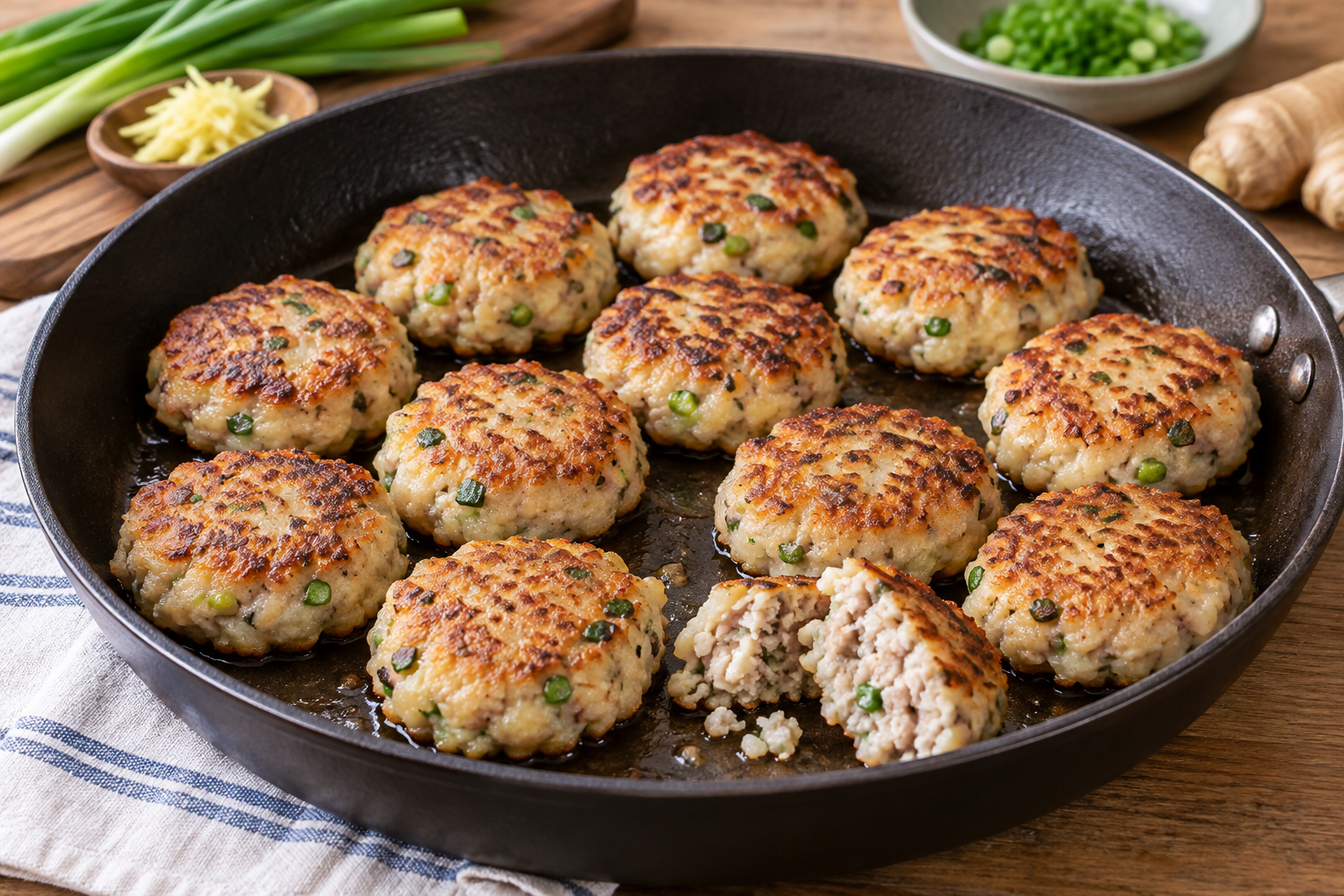
Here the evidence moves beyond an ingredient list. A fish-cake passage in the Qimin Yaoshu directs the cook to mince fish with cooked fatty pork and season the mixture before slow frying. The text's wider context is sixth-century agriculture and household production.
This adaptation follows that recognizable sequence while choosing modern products and workable quantities. The original includes vinegar, scallion, pickled melon, ginger, citrus peel and fish sauce. A little commercial cucumber pickle stands in for the preserved melon; fresh lemon zest replaces an uncertain ancient citrus product. Those substitutions are explicit rather than concealed beneath an authenticity claim.
The main practical challenge is making a mixture that holds together without flour or breadcrumbs. Pat the fish dry before mincing, especially if it was frozen, and check carefully for bones. Keep it chilled while the pork cooks. Break the pork into fine crumbs and let it lose its heat in a shallow bowl before mixing it with the cold fish. The ten-minute cooling guide is approximate: if the pork is still warm, cool it further in the refrigerator rather than warming the raw fish with it.
Finely mince the fish rather than leaving large chopped cubes. Squeeze liquid from the pickle, mix firmly until the fish mixture is tacky, then keep the stated chilling step. Shape twelve thin cakes of similar thickness with lightly damp hands. If they slump into puddles, stop before frying: check for excess liquid and mince or work the mixture finer. Chilling can firm a suitable mixture, but it cannot remove a pool of thawing liquid. These are preparation cues; use the stated texture checks as you cook.
Slide a broad spatula fully underneath each cake and turn only once the first side has formed a crust. Moderate heat lets the centre finish before the exterior darkens; lower it if browning runs ahead of the thermometer. Serve with plain rice and a fresh vegetable from the Incoprea cooking collection. This is one of the surviving-text adaptations in Ancient Recipes for Modern Kitchens, our cookbook in preparation. The historical passage supplies the sequence; commercial fillets, substitutions, measured portions and temperature checks are modern. The illustration depicts the modern adaptation.
Minced fish and pork pan cakes
Serves 4 · Preparation 25 min · Cooking 30 min · 10 minutes pork cooling; 20 minutes chilling
A modern adaptation for home cooking. Times are approximate.
Ingredients
- 450 g boneless white fish fillet, finely minced
- 150 g ground pork
- 35 g scallions, finely chopped
- 25 g commercial cucumber pickle, finely chopped and squeezed dry
- 10 g fresh ginger, grated
- 2 g finely grated lemon zest (about 1 teaspoon)
- 10 ml fish sauce (2 teaspoons)
- 10 ml white wine vinegar (2 teaspoons)
- 30 ml neutral oil for frying
Method
- Keep fish refrigerated while preparing the pork. Cook ground pork in a nonstick pan 6–8 minutes, breaking it into fine crumbs, until it reaches 71°C. Spread in a shallow bowl and cool for the indicated 10 minutes; if still warm, refrigerate until cool before combining with fish.
- Pat fish dry, check for bones and mince very finely. Squeeze the chopped pickle dry. Mix fish, cooled pork, scallions, pickle, ginger, zest, fish sauce and vinegar. Stir firmly 1 minute until tacky and cohesive; cover and refrigerate 20 minutes.
- With lightly damp hands form twelve cakes about 8 cm wide and 1 cm thick. They should hold their shape on a plate. If loose, check for excess moisture and work the fish finer before proceeding. Heat oil over medium heat.
- Fry in two batches 4–5 minutes per side. Leave the first side alone until a crust forms, then support each cake with a broad spatula to turn gently. Cook until golden and the centres reach 74°C, checking several cakes. Lower the heat if the outside darkens too quickly.
- Drain briefly on paper and serve hot with clean utensils. Do not use raw-mixture utensils for the finished cakes.
Substitutions and adjustments
- Use boneless cod, pollock or haddock.
- Lemon zest and cucumber pickle explicitly substitute for historical citrus peel and pickled melon.
Historical choices: The original Qimin Yaoshu fish-cake sequence survives; proportions, fillets, pickle substitutes and temperature checks are modern.
Troubleshooting: Loose before frying: pat fish dry, squeeze pickle, finely mince fish and use cooled pork; do not expect chilling to absorb excess liquid. Breaking on turning: let the first side set and use a broad spatula. Brown outside but below 74°C inside: lower the heat and continue cooking, checking the centre again.
Storage and reheating: Refrigerate up to 2 days. Reheat to 74°C in a covered skillet with a splash of water.
Kitchen note: Check carefully for fish bones. Cook ground pork to 71°C before mixing, then finished cakes to 74°C. Refrigerate within 2 hours.
Sources and further reading
- Jia Sixie, Qimin Yaoshu, fish cakes: 作饼炙法. Original Chinese fish-cake passage inspected: fish, cooked fatty pork, vinegar, scallion, pickled melon, ginger, citrus peel and fish sauce; modern measures and commercial substitutes supplied here.
- Chinese Text Project, Qimin Yaoshu. Context for the agricultural text attributed to Jia Sixie in the sixth century CE; no modern translation copied.
Browse Ancient Recipes for Modern Kitchens · More creative work at Incoprea