MODERN KITCHENS · 055 / 100
Ancient Iranian provisioning references · Iranian plateau and Achaemenid court context · Achaemenid Iranian food context, approximately 550–330 BCE
Evidence: historically informed adaptation. The historical evidence and modern cooking choices are distinguished below.
A food list may place grain and roots side by side without telling us to cook them together. Polyaenus’s Persian provisioning account names barley and a salted root translated as turnip, while Iranica’s scholarly discussion preserves a different root wording and notes interpretive limits. We keep that uncertainty instead of declaring one modern cultivar the exact ancient food.
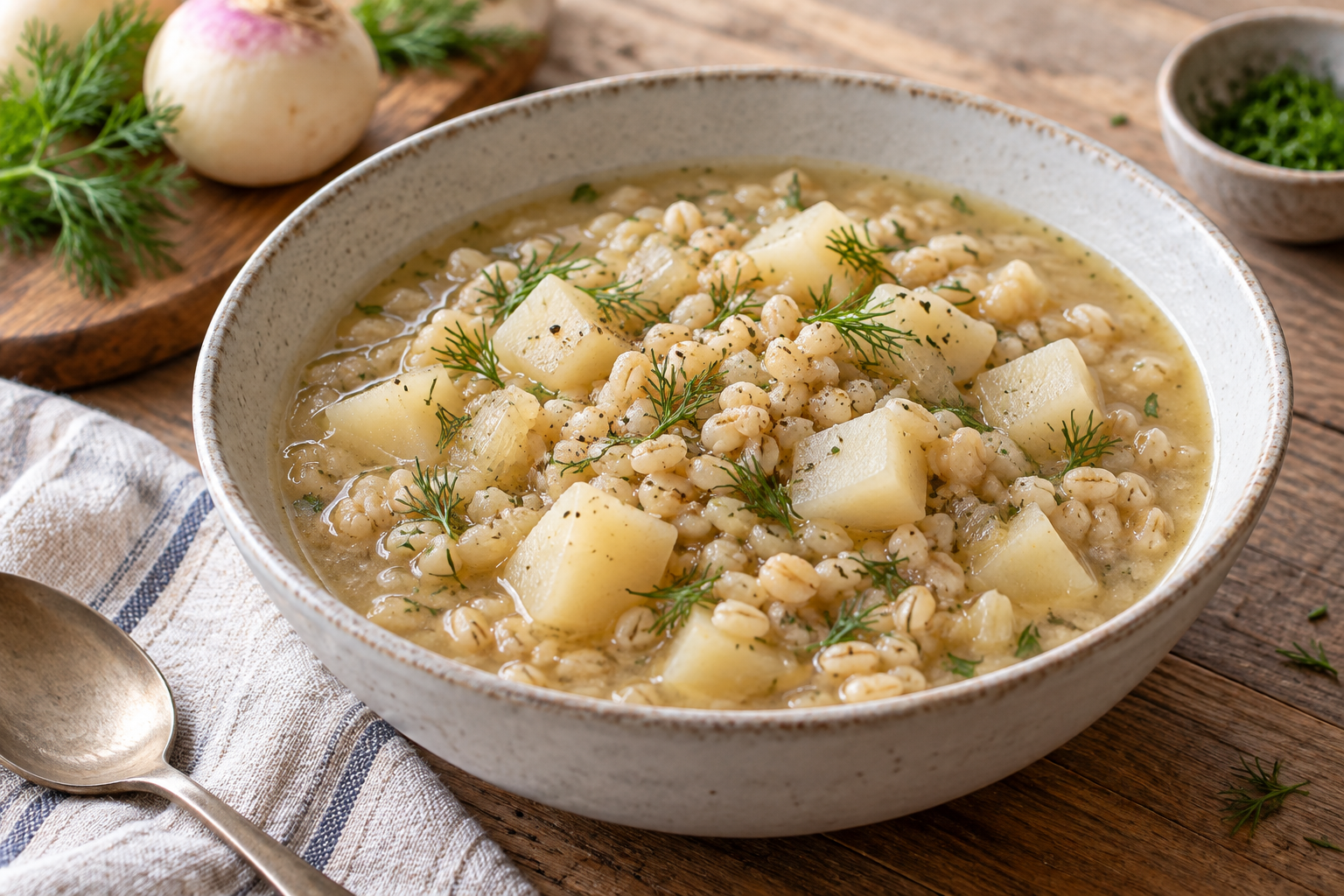
The historical frame is the Achaemenid world, approximately 550–330 BCE, reported partly by later Greek authors. The pot below is a modern vegetarian construction. It does not reproduce the salted or brined product in the list; fresh supermarket turnips are used so no home preservation is required.
Barley gives the liquid body while the root remains in separate bite-sized pieces. Start the grain first, then add turnip so it does not disappear before the barley softens. Pearl barley is a modern processed choice and may cook faster than more intact grain. A low simmer lets the cook check both textures without aggressively breaking up the roots.
The finished dish sits between a thick soup and a loose grain bowl. It should be easy to eat with a spoon, with enough broth to keep the turnip moist. Garlic and a little dill are practical flavour choices. Serve as a modest main with bread or as a substantial side. The method asks the reader to make something useful from limited evidence while respecting its limits: ingredients in a list are a starting point, and this combination, water ratio, root preparation and cooking sequence remain our own contemporary decisions.
Turnip and barley pot
Serves 4 · Preparation 15 min · Cooking 55 min
A modern adaptation for home cooking. Times are approximate.
Ingredients
- 150 g pearl barley
- 400 g turnips, peeled and cut into 2 cm pieces
- 150 g onion, diced
- 2 garlic cloves, chopped
- 15 ml (1 tbsp) olive oil
- 1 litre water or low-salt vegetable stock
- 10 g fresh dill, chopped
- 3 g (½ tsp) salt, if needed
Method
- Soften onion in oil in a lidded saucepan for 6–7 minutes. Add garlic and stir 30 seconds.
- Add barley and liquid. Bring to a boil, cover and simmer 15 minutes.
- Add turnip and simmer 25–30 minutes until grain and roots are tender. Add water if too thick.
- Stir in dill, check salt and simmer 2 minutes. Serve with distinct turnip pieces and a little broth.
Substitutions and adjustments
- Swede/rutabaga is a modern root alternative; cut smaller and allow longer cooking.
- Use 400 g cooked barley, adding it for the final 10 minutes.
Historical choices: Barley and a translated preserved-root term anchor the discussion; fresh turnips, combined pot and proportions are modern, with root identification uncertainty retained.
Troubleshooting: Bitter turnip: select smaller fresh roots and peel well. Hard barley: continue cooking with extra liquid.
Storage and reheating: Refrigerate promptly in shallow containers up to 3 days. Reheat to a boil with water as needed.
Kitchen note: Wash produce and use clean utensils. Refrigerate perishable food promptly; this is not a preservation recipe.
Sources and further reading
- Polyaenus, Stratagems 4.3.32: older translation on Attalus. Barley and salted turnips in an older translation; not a combined pot.
- Iranica: Cooking in ancient Iran. Alternative turnip-radish interpretation and cautions about ancient provisioning texts.
Browse Ancient Recipes for Modern Kitchens · More creative work at Incoprea