MODERN KITCHENS · 054 / 100
Ancient Iranian food records read with Greek accounts · Iranian plateau and Achaemenid court context · Achaemenid Iranian food context, approximately 550–330 BCE
Evidence: historically informed adaptation. The historical evidence and modern cooking choices are distinguished below.
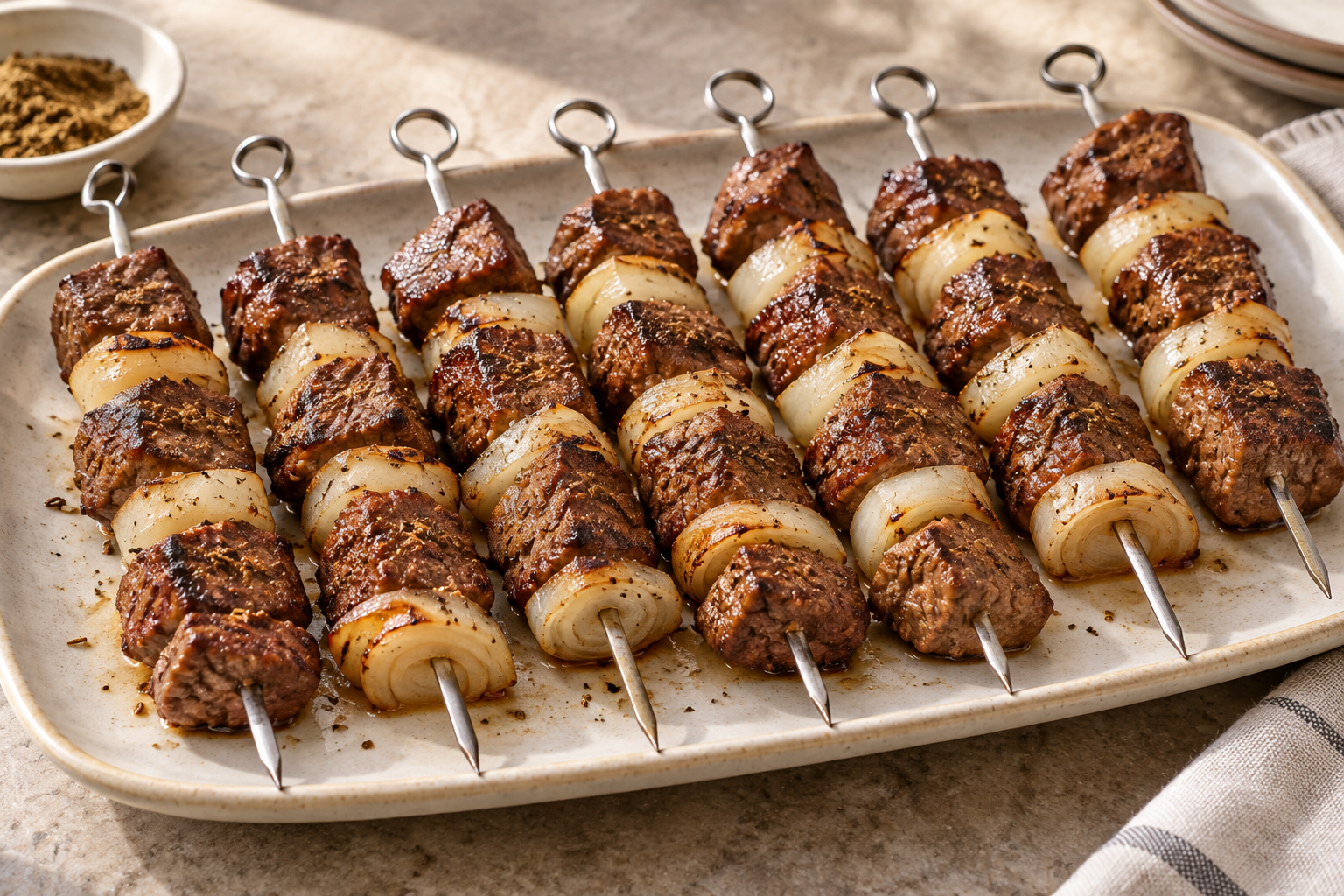
Beef and onions have a source context without requiring us to invent an ancient skewer recipe. Iranica’s ancient-cooking study discusses beef and provisioning, while Polyaenus’s Persian food list includes oxen and onions. The list is preserved in a later Greek work; it is not an unmediated household menu from the Achaemenid period.
The ingredient discussion concerns approximately 550–330 BCE. Polyaenus wrote centuries later, and modern scholarship warns that such reports need interpretation. Our quick skewers are openly newly devised. They use supermarket sirloin, a suitable quick-cooking cut, rather than a large ancient roast or the tougher beef chosen for a long braise.
Keep the cubes modest and similar in size. Onion layers cook more evenly when cut into small squares instead of thick intact wedges. Metal skewers are convenient, but the same pieces can be spread on a tray if skewers are unavailable. A little cumin gives a clear savoury flavour without hiding the meat beneath a complex marinade.
Use the oven’s grill or broiler with care and turn the pieces so they brown evenly without becoming heavily charred. A thermometer and a rest period give a reliable modern endpoint. Serve with a grain side and vegetables. The dish has a different texture and timetable from a slow stew: browned pieces remain separate and the onion has lightly coloured edges. Ancient records establish the ingredients’ conversation; cut selection, threading, portions, oven placement and safe cooking checks belong to the practical recipe written here.
Quick beef and onion skewers
Serves 4 · Preparation 20 min · Cooking 12 min · 3 minutes resting
A modern adaptation for home cooking. Times are approximate.
Ingredients
- 600 g beef sirloin steak, cut into 2 cm cubes
- 200 g onion, cut into small 1.5 cm layered squares
- 20 ml (4 tsp) olive oil
- 2 g (1 tsp) ground cumin
- 3 g (½ tsp) salt
Method
- Heat oven grill/broiler to high. Set a rack about 15 cm/6 inches below the heat, with a rimmed tray beneath.
- Toss beef and onion with oil, cumin and salt. Thread loosely onto eight metal skewers, leaving small gaps; or spread pieces on the tray.
- Grill/broil 8–12 minutes, turning several times, until beef reaches at least 63°C/145°F in the thickest cubes and onion edges colour. Move the tray lower if it browns too quickly.
- Rest beef 3 minutes before serving; transfer with clean utensils to a clean plate.
Substitutions and adjustments
- Use beef rump or another steak cut intended for quick cooking.
- Cook unthreaded pieces in a hot frying pan in two batches, checking the same endpoint.
Historical choices: Beef and onion references inform a new skewer dish; cut, cumin quantity, threading and modern broiler method are not an attested ancient formula.
Troubleshooting: Tough beef: use a steak cut, not stewing chuck. Burnt onion: make small separated layers and move farther from heat.
Storage and reheating: Refrigerate within 2 hours and use within 3 days. Reheat to 74°C/165°F; beef will become firmer.
Kitchen note: Use whole-cut steak, not ground beef. Cook to at least 63°C/145°F and rest 3 minutes. Handle metal skewers with oven gloves.
Sources and further reading
- Iranica: Cooking in ancient Iran. Beef and ancient food evidence; cautions about limited source detail.
- Polyaenus, Stratagems 4.3.32: older translation on Attalus. Later Greek report of Persian oxen and onions; no skewers or measured recipe.
- FoodSafety.gov: safe minimum internal temperatures. Modern safety endpoints; not historical evidence.
- USDA FSIS: keep food safe. Modern refrigeration and reheating guidance; not historical evidence.
Browse Ancient Recipes for Modern Kitchens · More creative work at Incoprea