MODERN KITCHENS · 050 / 100
Ancient Egyptian flax and bread context · Nile Valley, Egypt · New Kingdom Egypt, approximately 1550–1070 BCE
Evidence: historically informed adaptation. The historical evidence and modern cooking choices are distinguished below.
Flax has a history larger than its modern seed packet. UCL’s flax account distinguishes fibre harvesting from mature seed production. That distinction matters: a linen-related find does not automatically show that a particular household ate flaxseed crackers. The seeds in our dough are a practical contemporary food choice.
The Metropolitan Museum’s model bread loaf from Hatshepsut’s foundation deposit supplies a dated New Kingdom bread context, approximately 1473–1458 BCE. Its form and purpose do not identify this cracker formula. We use the wider period of roughly 1550–1070 BCE for the ingredient discussion while making the thin modern bake explicit.
Wheat flour supplies the structure, and a modest quantity of commercial food-grade flaxseed gives a visible texture. Letting the dough rest briefly makes it easier to roll. Thinness is the key practical detail: a thick piece will become a hard small flatbread rather than a crisp cracker. An ordinary rolling pin and baking tray are all that is required.
Prick the dough before baking so large bubbles do not dominate the surface. Break or cut it into manageable pieces and cool completely before storing; trapped steam softens a crisp bake. Serve beside a soup or a cheese spread. The recipe does not ask the cook to extract oil, process fibre or imitate ancient preservation. Its historical value is partly a lesson in evidence: the same plant can supply several products, and knowing one product was used does not prove the others occurred in this exact food.
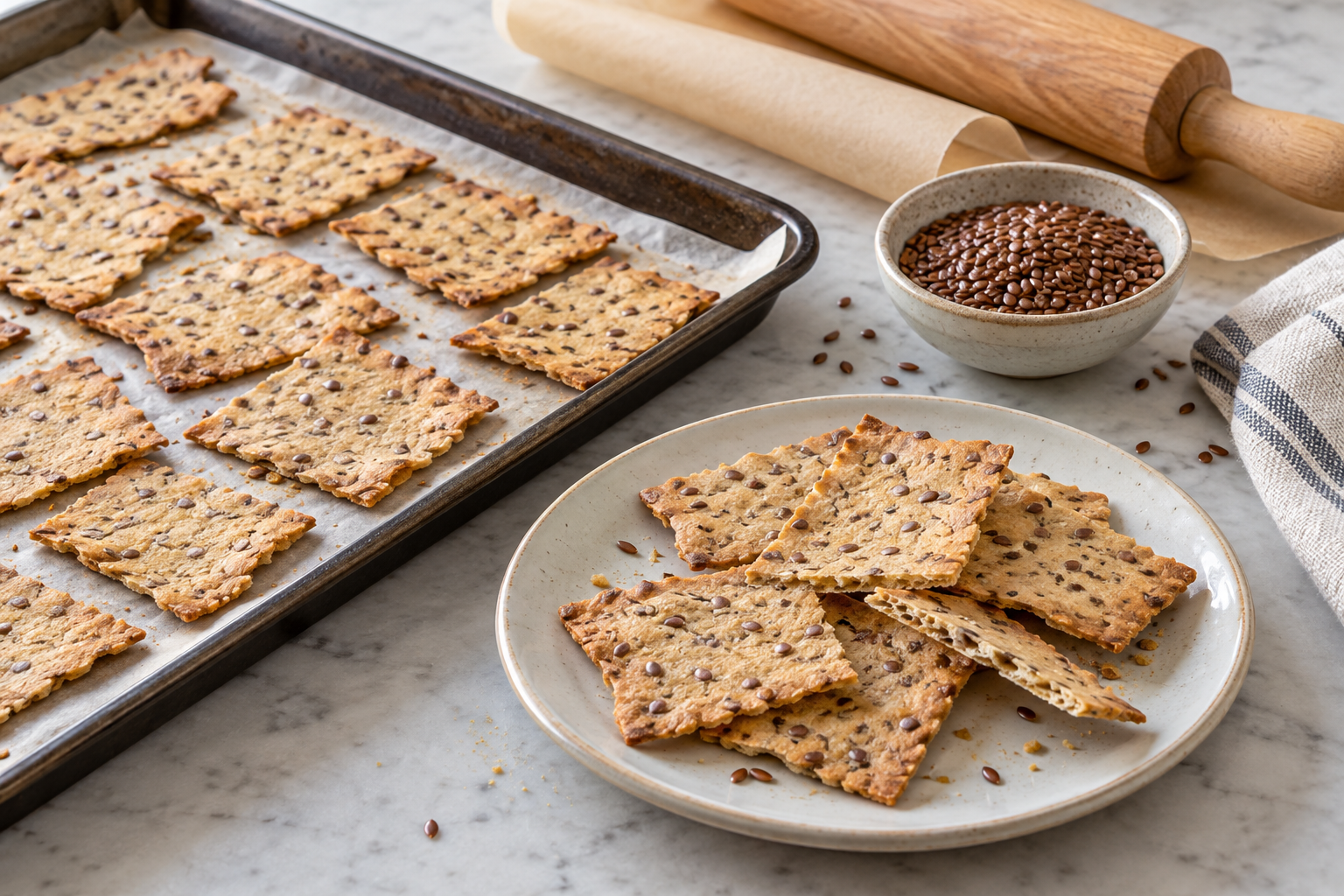
Thin wheat and flaxseed crackers
Serves 8 · Preparation 20 min · Cooking 20 min · 15 minutes dough rest; 30 minutes cooling
A modern adaptation for home cooking. Times are approximate.
Ingredients
- 180 g plain all-purpose wheat flour
- 30 g (3 tbsp) commercial food-grade flaxseed
- 20 ml (4 tsp) olive oil
- 100–120 ml water
- 3 g (½ tsp) salt
Method
- Mix flour, flaxseed and salt. Add oil and 100 ml water; knead briefly, adding water only until the dough holds together.
- Cover and rest 15 minutes. Heat oven to 190°C/375°F.
- Roll between two sheets of baking paper to about 2 mm thickness. Remove the top sheet, prick with a fork and cut into small rectangles.
- Transfer lower paper and dough to a tray. Bake 15–22 minutes until lightly golden and dry; remove thinner edge pieces sooner if needed.
- Cool completely on a rack before serving or storing.
Substitutions and adjustments
- Use sesame seeds for a different modern seed cracker, with a different evidence connection.
- Wholemeal wheat flour may replace half the flour; it may need a little extra water.
Historical choices: Flax-production and bread evidence are contextual; edible flaxseed quantity and the thin-cracker method are modern, not attested by the cited object.
Troubleshooting: Chewy crackers: roll thinner or return cooled pieces to a 150°C/300°F oven for 5–8 minutes.
Storage and reheating: Keep fully cooled dry crackers in an airtight container for 3 days; discard if damp or mouldy. Freeze for longer storage.
Kitchen note: Use commercial food-grade seeds; bake flour fully. Contains wheat. Do not confuse fibre-processing flax with a food ingredient.
Sources and further reading
- UCL Digital Egypt for Universities. Explains fibre versus mature seed production; does not prove flax crackers.
- The Met: Hatshepsut foundation-deposit model bread. Dated bread context, ca. 1473–1458 BCE; different from this modern cracker.
Browse Ancient Recipes for Modern Kitchens · More creative work at Incoprea