MODERN KITCHENS · 042 / 100
Greek literary fruit and nut traditions · Greek-speaking Mediterranean · Classical through Roman-era Greek food references, approximately 500 BCE–250 CE
Evidence: historically informed adaptation. The historical evidence and modern cooking choices are distinguished below.
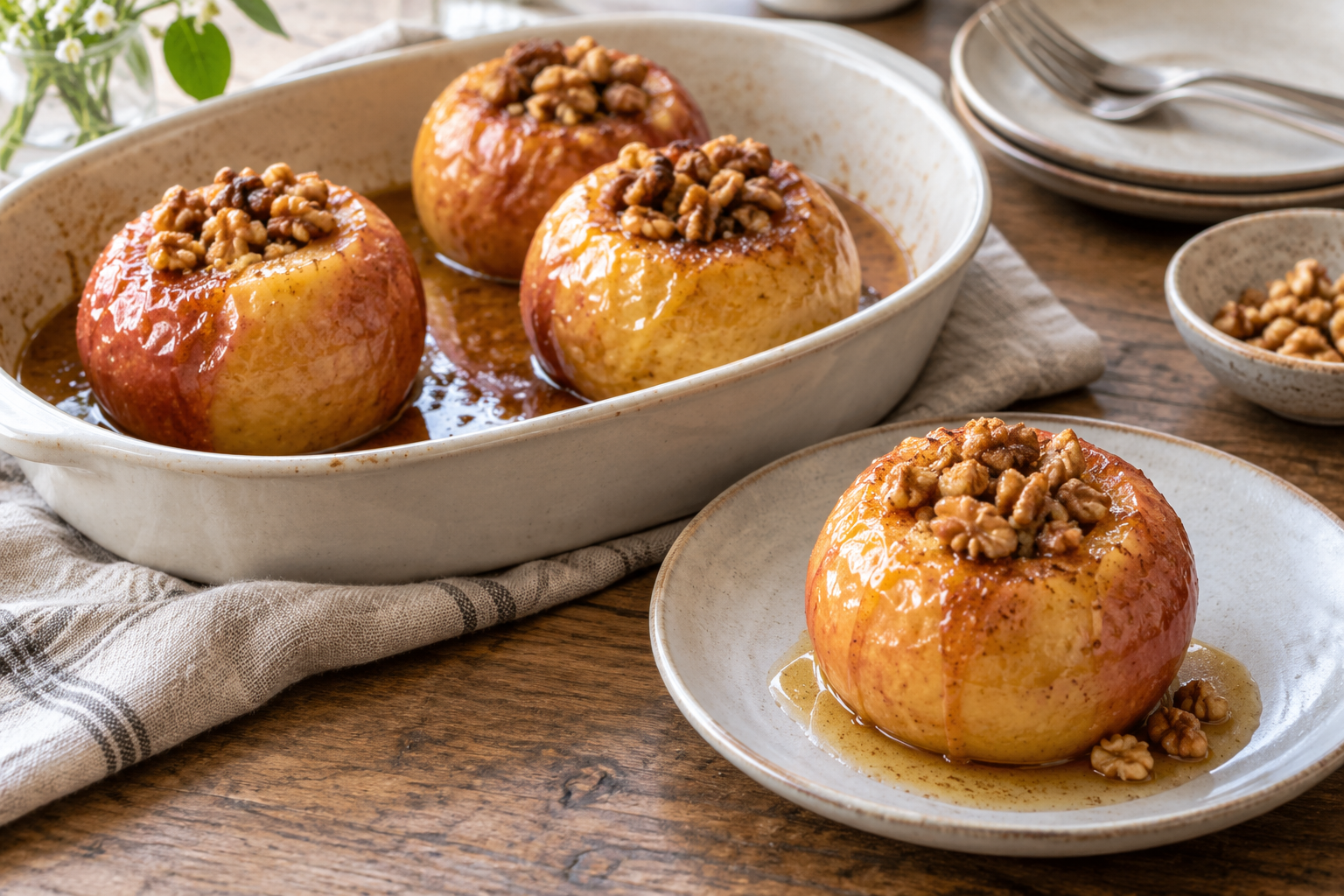
Fruit and nuts are more than incidental decorations in ancient food texts. Athenaeus’s discussion of nuts preserves Greek references to walnuts, while his sweet-food passages place honey in the culinary conversation. Neither gives us this exact stuffed-apple dessert. The filling and baking directions are our own.
The broad setting is the Greek-speaking Mediterranean, with earlier quotations collected around 200 CE. A modern dessert apple is not interchangeable with every fruit translated as an ancient apple, and walnut varieties have changed too. Naming those limits makes a simple dessert more useful historically: it invites comparison without asserting an unbroken recipe tradition.
Remove the core without cutting through the bottom. That small choice keeps the filling and juices in the apple. Use only a modest amount of honey, because the fruit becomes sweeter as it softens and excess filling may burn on the tray. Chopped nuts should fit loosely in the hollow so steam can move through it.
The baked apple is ready when a thin knife enters the side easily while the fruit still holds its shape. Some apples collapse sooner than others; check them separately rather than forcing every one through the same time. Spoon the warm pan liquid over the finished portions. This makes a quiet dessert or a warm breakfast accompaniment, with no need for pastry, rare spices or special moulds. Ancient ingredient references anchor the subject; cultivar choice, hollowing, filling proportions and oven schedule belong to a practical contemporary recipe.
Baked apples with walnut-honey centres
Serves 4 · Preparation 15 min · Cooking 35 min · 5–10 minutes cooling
A modern adaptation for home cooking. Times are approximate.
Ingredients
- 4 medium (about 700 g) eating apples
- 40 g walnuts, chopped
- 30 g (about 1½ tbsp) honey
- 10 g butter or 10 ml olive oil
- 100 ml water
Method
- Heat oven to 190°C/375°F. Core apples from the stem end, keeping a 1 cm base intact; widen each hollow slightly.
- Mix walnuts and honey. Divide among apples and top each with a little butter or oil.
- Stand in a small baking dish and pour water around, not into, the apples.
- Bake 30–40 minutes until a knife slips into the flesh easily. Cover loosely if filling browns too soon.
- Cool 5–10 minutes, then serve with pan juices.
Substitutions and adjustments
- Use chopped almonds if walnuts are unavailable.
- Maple syrup is a clearly modern honey alternative.
Historical choices: Ancient honey and nut references inspire a newly specified stuffed-apple dessert; no complete ancient recipe is claimed.
Troubleshooting: Apple splits: shorten cooking next time or choose firmer fruit. Hard centre: cover and bake longer with extra water.
Storage and reheating: Refrigerate cooled apples up to 3 days. Warm gently in a covered dish until hot throughout.
Kitchen note: Contains tree nuts; remove all core and seeds before filling. Do not give honey to children under 12 months.
Sources and further reading
- Athenaeus, Deipnosophistae: public-domain translation. Book II, 52: walnut references and discussion; no stuffed apple.
- Athenaeus, Deipnosophistae: public-domain translation. Book II, 46–47: honey and sweet foods; contextual ingredient evidence.
Browse Ancient Recipes for Modern Kitchens · More creative work at Incoprea