MODERN KITCHENS · 037 / 100
Greek literary food traditions · Greek-speaking Mediterranean · Classical through Roman-era Greek food references, approximately 500 BCE–250 CE
Evidence: historically informed adaptation. The historical evidence and modern cooking choices are distinguished below.
Olives and cheese appear together among the foods discussed in Athenaeus’s Book II and among the seasonings and accompaniments he lists. That pairing makes an inviting starting point, but a list of foods is not a recipe for filled bread. This particular skillet round is a modern invention.
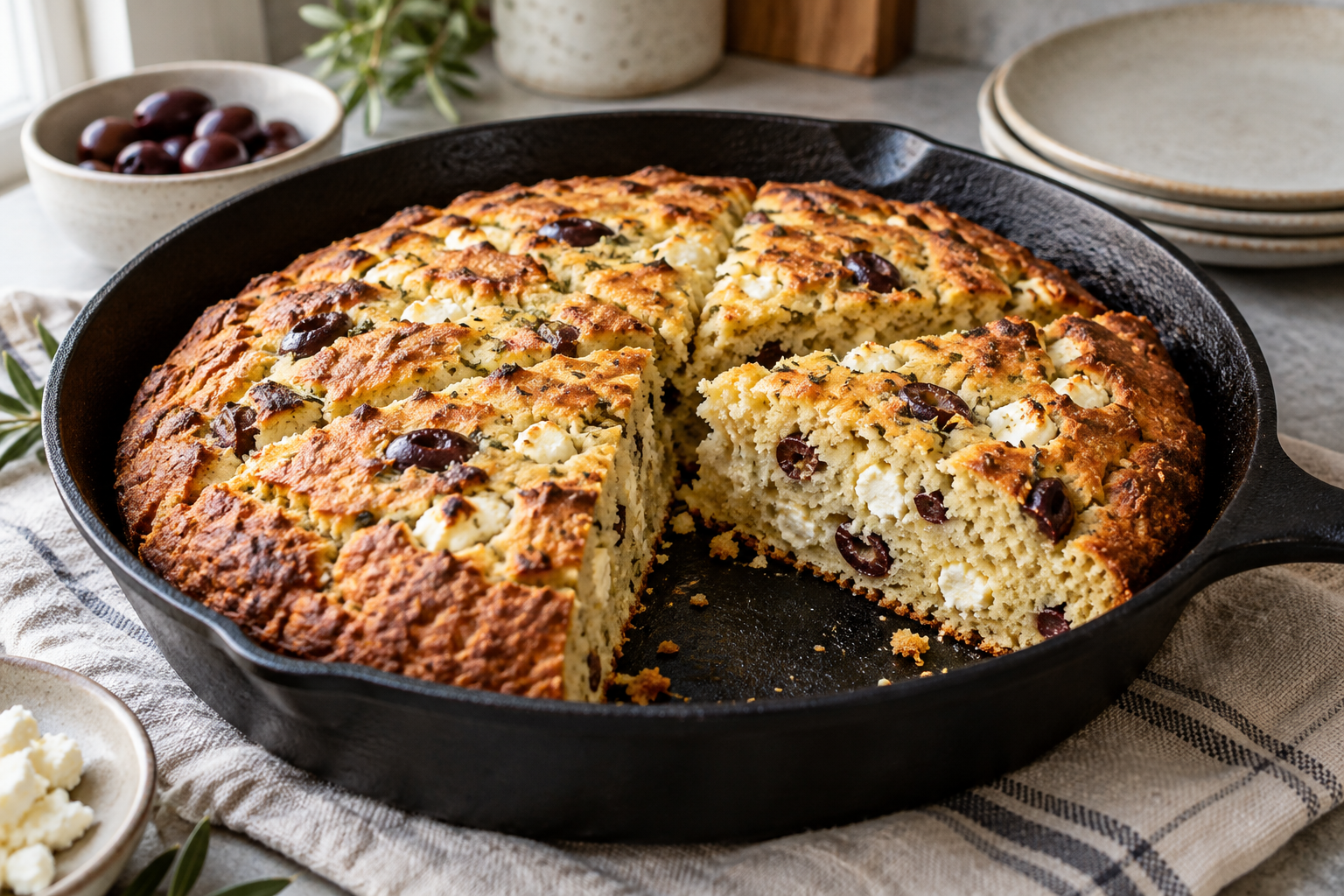
The historical setting is the Greek-speaking Mediterranean, with classical material preserved by a writer active around 200 CE. We use pasteurized feta for convenience without asserting that ancient cheese had the same protected name, brine strength or texture. Pitted olives also arrive ready to use. Both ingredients are salty, so the dough needs less salt than an ordinary loaf.
Baking powder is the largest departure from antiquity. It provides a reliable, quick lift and removes the need for a long fermentation or specialist starter. The dough is pressed into an ordinary oven-safe frying pan, not reconstructed historical equipment. Keeping the round modest in thickness helps the centre cook before the crust becomes too dark.
A short cooling period matters because a hot quick bread can feel damp even when cooked. Slice it into wedges and serve alongside soup or cooked vegetables. Olive pieces should remain distinct rather than being blended into the dough, and the cheese can form small pockets. If the mixture is dry, add milk one spoonful at a time; it should hold together without flowing. The usefulness of this adaptation lies in an accessible meal component and an honest boundary: ancient foods inform it, while the leavening, dough formula and skillet bake are contemporary decisions.
Olive and feta quick bread
Serves 8 · Preparation 15 min · Cooking 30 min · 15 minutes cooling
A modern adaptation for home cooking. Times are approximate.
Ingredients
- 250 g (2 cups) plain all-purpose wheat flour
- 10 g (2½ tsp) baking powder
- 1 g (¼ tsp) salt
- 180 ml (¾ cup) pasteurized milk
- 30 ml (2 tbsp) olive oil, plus 5 ml for pan
- 80 g pitted olives, coarsely chopped
- 100 g pasteurized feta, crumbled
Method
- Heat oven to 200°C/400°F. Oil a 23 cm/9-inch oven-safe frying pan or round cake tin.
- Mix flour, baking powder and salt. Stir milk and oil into the dry ingredients just until no dry flour remains.
- Fold in olives and cheese. Press the soft dough into the pan in an even layer.
- Bake 25–30 minutes until deeply golden and a skewer from the centre has no wet dough. If needed, cover loosely with foil near the end.
- Cool 15 minutes before cutting into eight wedges.
Substitutions and adjustments
- Use pasteurized crumbled goat cheese; reduce salt if it is salty.
- Plain unsweetened dairy-free milk works as a modern dough substitution.
Historical choices: Ancient references identify olives and cheese; feta choice, baking powder and skillet loaf are modern inventions.
Troubleshooting: Wet centre: bake 5–10 minutes longer under loose foil. Dry dough: add up to 30 ml extra milk.
Storage and reheating: Cool, wrap and refrigerate up to 3 days because of the cheese. Warm wedges in a 170°C/340°F oven for 8–10 minutes.
Kitchen note: Use pasteurized dairy. Bake flour fully; do not taste raw dough.
Sources and further reading
- Athenaeus, Deipnosophistae: public-domain translation. Book II, 60D: cheese and olives mentioned as appetizers; not filled bread.
- Athenaeus, Deipnosophistae: public-domain translation. Book II, 68A: cheese and olives in a seasoning list; baking powder is wholly modern.
Browse Ancient Recipes for Modern Kitchens · More creative work at Incoprea