MODERN KITCHENS · 035 / 100
Greek literary food traditions · Greek-speaking Mediterranean · Classical through Roman-era Greek food references, approximately 500 BCE–250 CE
Evidence: historically informed adaptation. The historical evidence and modern cooking choices are distinguished below.
A tray of tender chickpeas is a useful way to meet a food that ancient writers noticed in several forms. Athenaeus’s chickpea discussion preserves references to boiling and roasting. His compilation, written around the turn of the third century CE, quotes much older Greek authors; it is not a record of one standard national menu.
The seasoning lists elsewhere in Book II supply another glimpse of an expansive kitchen vocabulary. They do not describe this onion-topped casserole. The combination, proportions and two-stage method below are our own modern construction, informed by the ancient pulse context rather than recovered from a complete surviving recipe.
Using canned chickpeas makes the dish manageable on a weekday. They are already safely cooked, so the oven can concentrate the onion and broth instead of spending hours softening dry beans. A shallow dish lets some chickpeas stay moist underneath while those at the top acquire firmer surfaces. Keep the onions in thin half-moons so they soften within the same timetable.
The finished casserole should be spoonable, with a little liquid remaining beneath the golden top. If it becomes dry before the onion softens, add hot water along the edge and cover briefly. Parsley is a modern optional finishing choice, useful for a fresh contrast but unnecessary to the historical anchor. Serve with bread and a vegetable side. This is a complete contemporary supper inspired by ancient evidence, with no claim that a Greek household baked this exact tray.
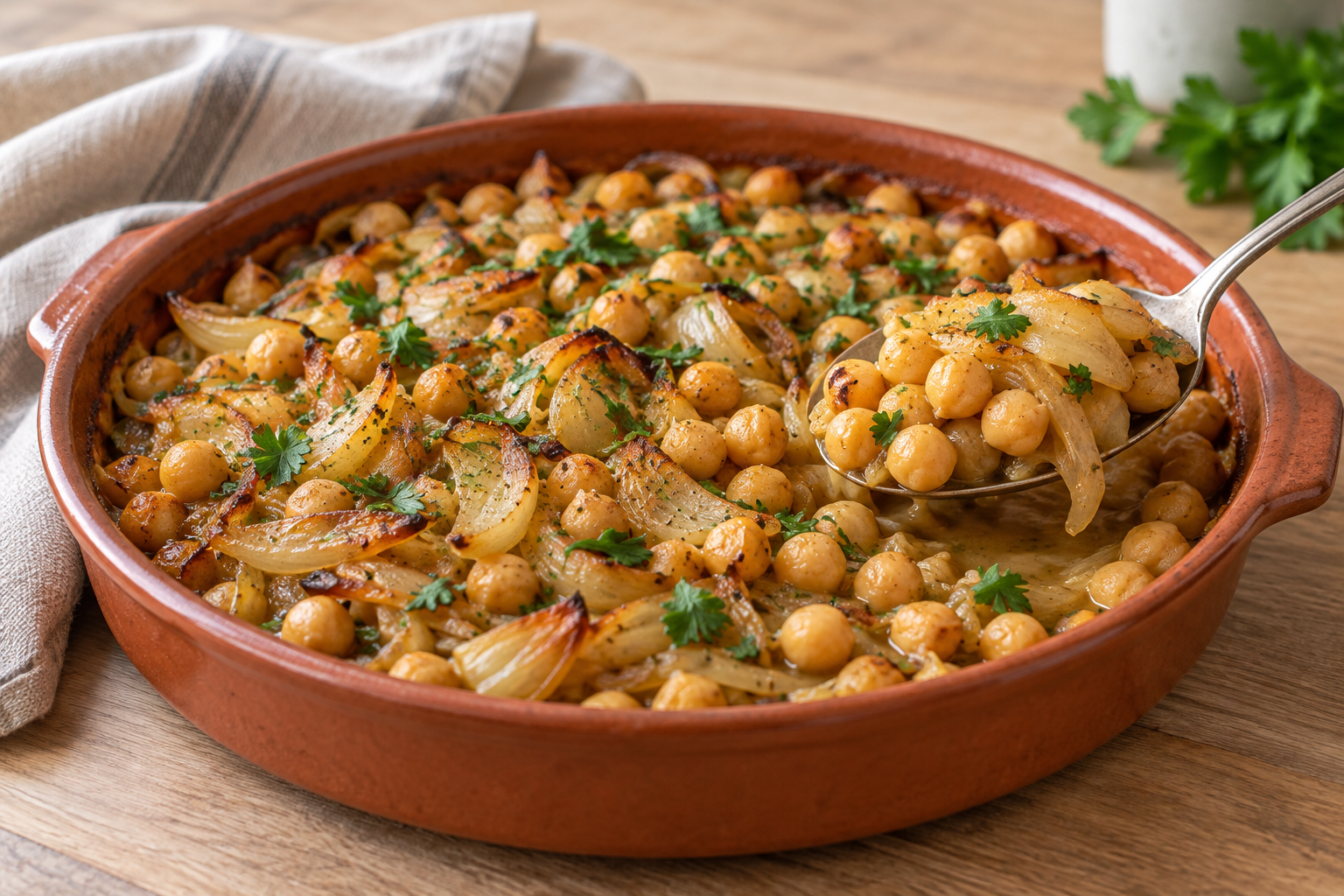
Baked chickpeas with onion
Serves 4 · Preparation 15 min · Cooking 45 min · 5 minutes resting
A modern adaptation for home cooking. Times are approximate.
Ingredients
- 500 g canned cooked chickpeas, drained and rinsed
- 300 g onions, thinly sliced
- 30 ml (2 tbsp) olive oil
- 250 ml (1 cup) low-salt vegetable stock
- 2 g (½ tsp) ground cumin
- 3 g (½ tsp) salt, less if stock is salted
- 10 g fresh parsley, chopped, optional
Method
- Heat the oven to 190°C/375°F. Use a shallow 1.5-litre baking dish.
- Cook onion with oil in a frying pan over medium-low heat for 10 minutes, stirring, until soft and lightly golden.
- Put chickpeas, stock, cumin and salt in the baking dish. Spread onion over the top.
- Bake 30–35 minutes until bubbling and the onions are golden. Add 50 ml hot water if the dish looks dry.
- Rest 5 minutes; scatter with optional parsley and serve.
Substitutions and adjustments
- Use 500 g fully home-cooked chickpeas in place of canned.
- Water replaces stock; increase salt only after tasting.
Historical choices: The Greek texts anchor chickpeas and broad seasoning practice, not this casserole. Canned pulses, onion topping and oven schedule are modern.
Troubleshooting: Onion still firm: cover and bake 10 minutes longer. Too wet: bake uncovered 5–10 minutes.
Storage and reheating: Refrigerate in a shallow covered container within 2 hours; keep 3 days. Reheat covered until steaming throughout, ideally 74°C/165°F.
Kitchen note: Wash produce and use clean utensils. Refrigerate perishable food promptly; this is not a preservation recipe.
Sources and further reading
- Athenaeus, Deipnosophistae: public-domain translation. Book II, chickpeas: ancient references to boiled and roasted pulses; no onion casserole.
- Athenaeus, Deipnosophistae: public-domain translation. Book II seasoning vocabulary; contextual evidence, not the present ingredient combination.
Browse Ancient Recipes for Modern Kitchens · More creative work at Incoprea