MODERN KITCHENS · 027 / 100
Roman · Roman Mediterranean · Roman imperial tradition; surviving compilation approximately 4th–5th centuries CE
Evidence: adapted surviving recipe. The historical evidence and modern cooking choices are distinguished below.
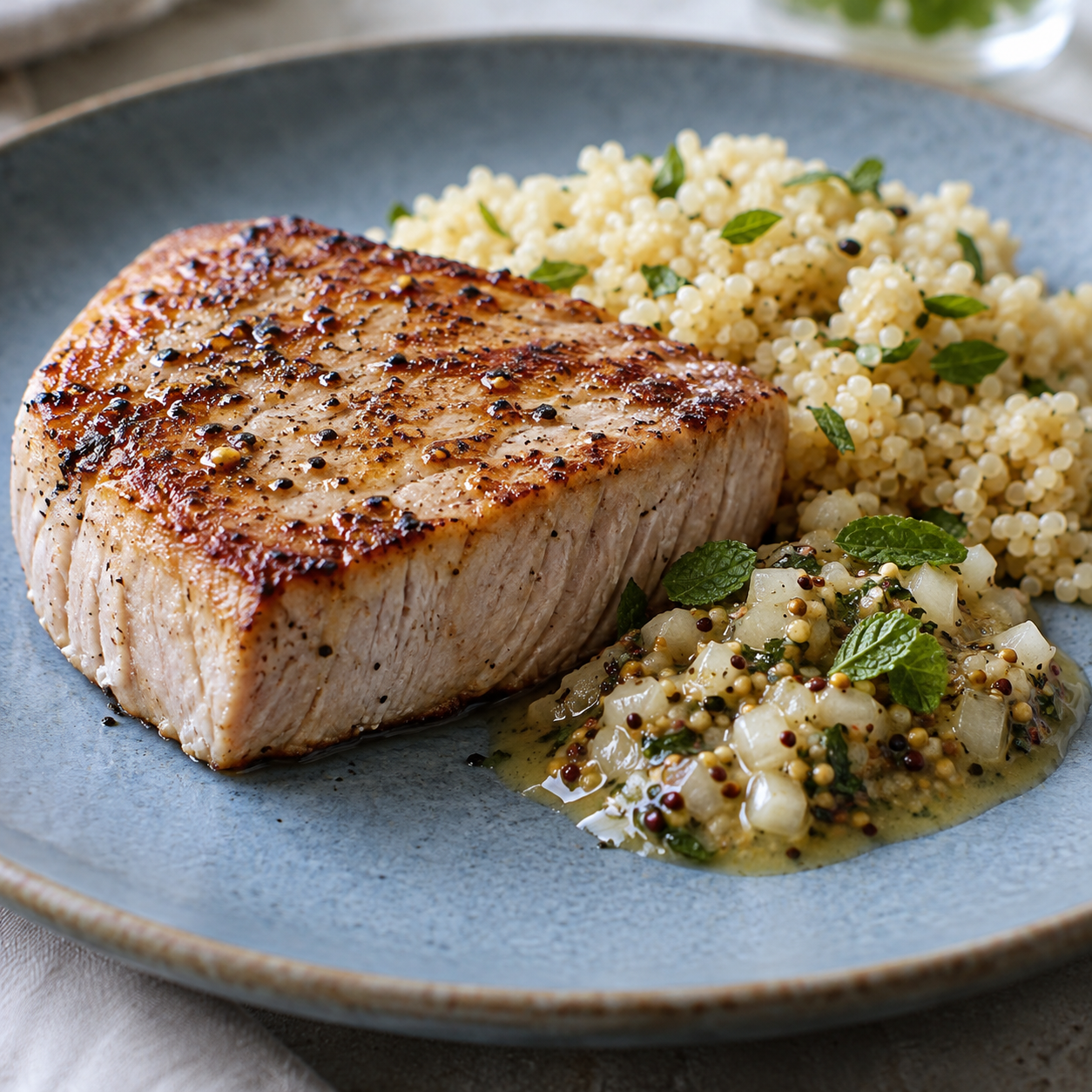
A lean fish steak benefits from a small lively sauce. Apicius 426 gives a tunny-related sauce with cumin, mint and mustard among its ingredients. Our version uses ordinary tuna steaks and a quickly cooked onion dressing. It retains that flavour relationship while omitting rare aromatics and choosing safe modern cooking rather than a raw-centred restaurant style.
The steaks should be similar in thickness. Pat them dry and warm the pan before adding them so the surface takes colour quickly. Because this recipe cooks tuna through, a little sauce is useful for moisture. The source’s fish categories and commercial preparations should not be equated automatically with the frozen or fresh supermarket cut chosen here.
Mint is added near the end so its freshness survives the short simmer. Mustard is measured conservatively, and honey softens the vinegar’s edge. Those ratios are modern. The edition notes are relevant when interpreting the terse ancient list, especially where English culinary labels imply more certainty than the text supplies.
Serve the fish promptly once it reaches the stated endpoint; extended holding in a hot pan can make it dry. Spoon sauce over the steak just before eating, with bread or grain alongside. If tuna is expensive or unavailable, another firm boneless fish steak can take the same sauce with its own cooking time. The substitution changes the species, and is presented as a modern practical option.
Pan-Cooked Tuna with Mint and Mustard Sauce
Serves 4 · Preparation 15 min · Cooking 20 min
A modern adaptation for home cooking. Times are approximate.
Ingredients
- 600 g tuna steaks, about 2 cm thick
- 20 ml (4 tsp) olive oil
- 100 g onion, finely chopped
- 2.5 ml (½ tsp) ground cumin
- 10 g (2 tsp) prepared Dijon-style mustard
- 10 g (1½ tsp) honey
- 15 ml (1 tbsp) wine vinegar
- 100 ml water
- 5 g fresh mint, chopped
- 1.25 ml (¼ tsp) salt
- 1.25 ml (¼ tsp) black pepper
Method
- Cook onion in half the oil over medium heat for 6 minutes. Add cumin, mustard, honey, vinegar and water; simmer 4 minutes. Stir in mint.
- Pat tuna dry and season with salt and pepper. Heat remaining oil in a separate frying pan.
- Cook tuna 3–5 minutes per side, depending on thickness, until the centre reaches 63°C/145°F and is cooked through.
- Serve promptly with the warm sauce.
Substitutions and adjustments
- Firm white fish such as cod can replace tuna; cook to 63°C/145°F.
- Use mild prepared mustard if Dijon is too strong.
Historical choices: Apicius 426 links tunny sauce to cumin, mint and mustard. Fresh steaks, cooked-through endpoint and simplified sauce are modern choices.
Troubleshooting: Dry fish: remove at 63°C/145°F and serve immediately; spoon sauce over rather than returning to the pan.
Storage and reheating: Cool in shallow containers and refrigerate within 2 hours. Keep up to 3 days; reheat leftovers to 74°C/165°F until steaming throughout.
Kitchen note: Cook fish to 63°C/145°F. Contains fish and mustard.
Sources and further reading
- Apicius, Book 9, recipe 426 (Vehling numbering). Inspected surviving recipe and editorial notes. Apicius 426 links tunny sauce to cumin, mint and mustard. Fresh steaks, cooked-through endpoint and simplified sauce are modern choices. Quantities and modern timetable are our own; translation contains editorial additions.
- LacusCurtius: edition and translation notes. Explains limitations and bracketed additions of the 1936 Vehling translation; not proof of an exact ancient appearance.
- NYAM collections announcement via CHSTM. Institutional account places the recipe collection in the fourth and fifth centuries; individual material may be earlier.
Browse Ancient Recipes for Modern Kitchens · More creative work at Incoprea