MODERN KITCHENS · 024 / 100
Roman · Roman Mediterranean · Roman imperial tradition; surviving compilation approximately 4th–5th centuries CE
Evidence: adapted surviving recipe. The historical evidence and modern cooking choices are distinguished below.
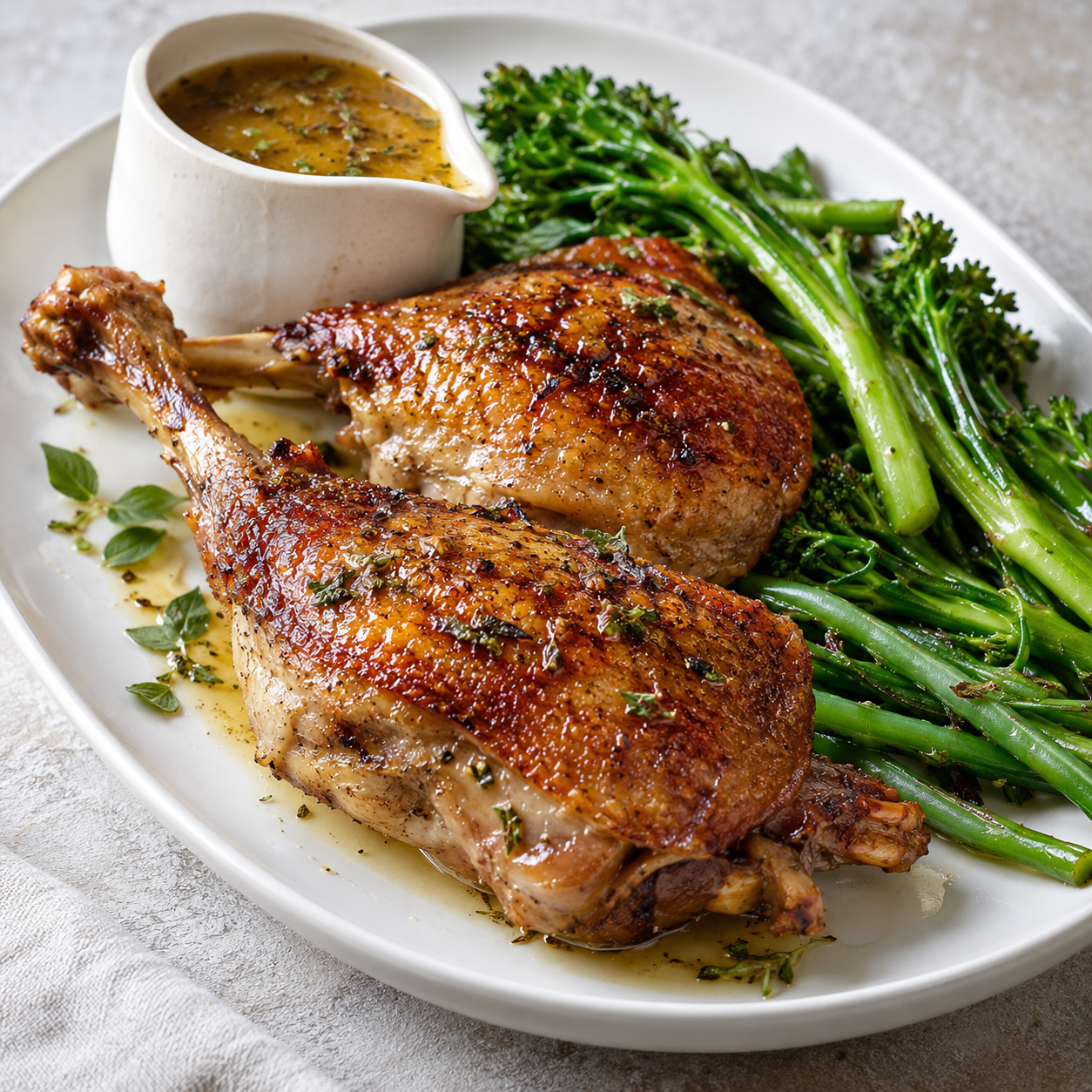
A roast bird and a sweet-sharp gravy can be explored without cooking a whole duck. Apicius 216 gives a sauce for roast duck or crane with honey, vinegar and aromatics. This adaptation uses supermarket duck legs and oregano, serving the gravy separately. It omits the passage’s additional organ and vegetable components rather than pretending to reproduce every detail.
Duck legs contain enough fat to cook without a heavy coating of oil. Pat the skin dry, season it and place the pieces skin-side up so rendered fat can collect beneath them. A moderate oven gives the meat time to soften. If duck is unavailable, skin-on chicken thighs make an accessible substitute with their own shorter timetable.
The gravy is a small saucepan preparation, using stock, vinegar and honey with oregano. A little cornflour supplies predictable body. These measurements are modern and distinct from a translated ancient list. Consult the edition notes for the limits of the English wording, including its inserted culinary explanations.
Look for tender meat and crisp skin, while using a thermometer for the poultry safety endpoint. Drain excess fat carefully before serving, and never pour hot fat into a sink. Spoon only a little gravy over the meat so the skin retains its texture. Cooked vegetables or grain can complete the meal. This is a clear home roast inspired by an attested sauce, not a promise of an ancient table’s exact appearance.
Roast Duck Legs with Honey and Oregano Gravy
Serves 4 · Preparation 15 min · Cooking 95 min · 10 minutes resting
A modern adaptation for home cooking. Times are approximate.
Ingredients
- 4 duck legs, about 1.1–1.3 kg total
- 2.5 ml (½ tsp) salt
- 2.5 ml (½ tsp) black pepper
- 200 ml low-salt chicken stock
- 20 g (about 1 tbsp) honey
- 15 ml (1 tbsp) wine vinegar
- 2.5 ml (½ tsp) dried oregano
- 4 g (1 tsp) cornflour/cornstarch
- 15 ml (1 tbsp) cold water
Method
- Heat oven to 180°C/350°F. Pat duck dry, season with salt and pepper and place skin-side up on a rack above a roasting tray.
- Roast 75–95 minutes until the meat is tender, skin crisp and each leg reaches at least 74°C/165°F. Rest 10 minutes.
- Simmer stock, honey, vinegar and oregano in a small saucepan for 5 minutes. Mix starch with cold water; stir in and simmer 1 minute until lightly thickened.
- Carefully spoon off excess rendered fat, reserving it only if desired. Serve legs with a little gravy.
Substitutions and adjustments
- Use 8 skin-on chicken thighs; roast 35–45 minutes to 74°C/165°F.
- Vegetable stock works in the gravy.
Historical choices: Apicius 216 attests a roast-bird honey-vinegar aromatic sauce. Duck legs, oregano-only blend and a small starch-thickened gravy are modern simplifications.
Troubleshooting: Skin still soft: finish under a hot grill/broiler for 2–4 minutes, watching constantly. Do not add honey directly before broiling.
Storage and reheating: Cool in shallow containers and refrigerate within 2 hours. Keep up to 3 days; reheat leftovers to 74°C/165°F until steaming throughout.
Kitchen note: Cook duck or chicken to 74°C/165°F. Handle hot rendered fat carefully.
Sources and further reading
- Apicius, Book 6, recipe 216 (Vehling numbering). Inspected surviving recipe and editorial notes. Apicius 216 attests a roast-bird honey-vinegar aromatic sauce. Duck legs, oregano-only blend and a small starch-thickened gravy are modern simplifications. Quantities and modern timetable are our own; translation contains editorial additions.
- LacusCurtius: edition and translation notes. Explains limitations and bracketed additions of the 1936 Vehling translation; not proof of an exact ancient appearance.
- NYAM collections announcement via CHSTM. Institutional account places the recipe collection in the fourth and fifth centuries; individual material may be earlier.
Browse Ancient Recipes for Modern Kitchens · More creative work at Incoprea