059 / 75 · Sweet things worth the space
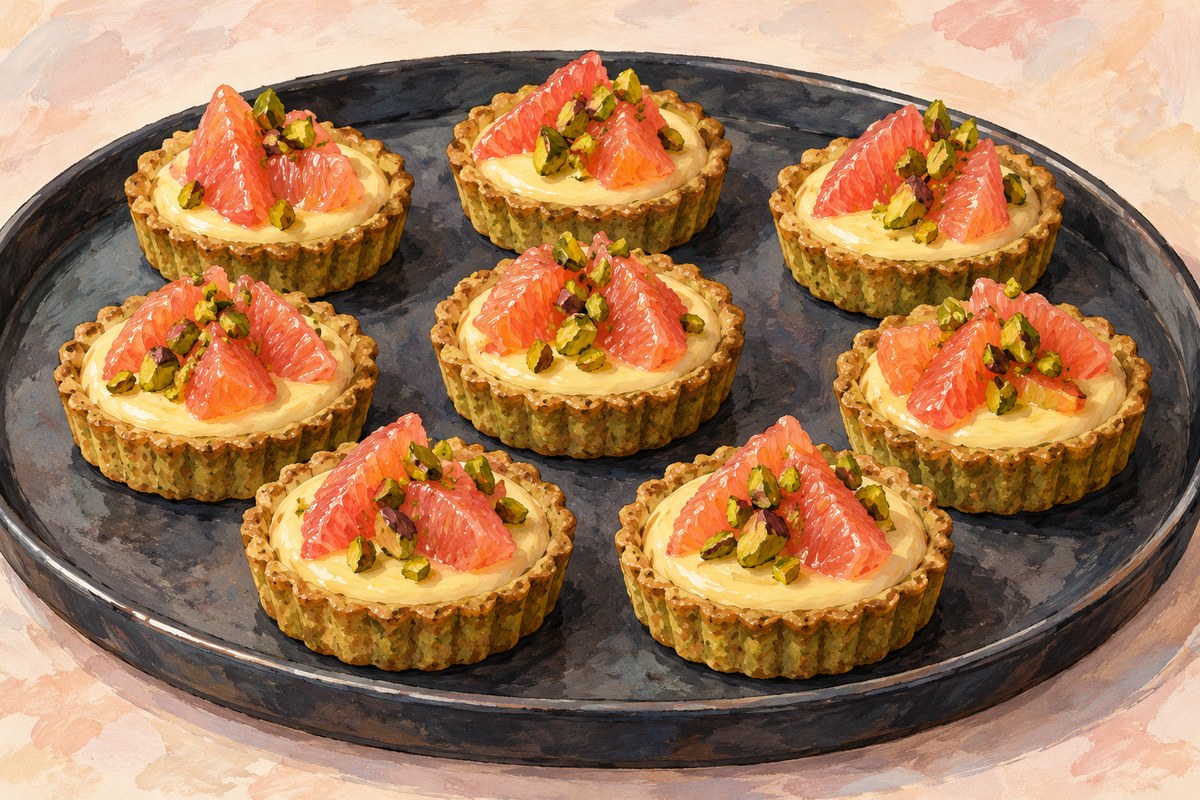
Pink Grapefruit and Pistachio Custard Tartlets
8 individual 8 cm custard tartlets, each with 30 g grapefruit · Active 1 hr 15 min · Cook 40 min · Total 3 hr 40 min
Print recipe · PDFPink grapefruit gives a sharp finish to a sweet milk custard, while ground pistachio belongs in the pastry itself. The tartlets are small enough to carry in a single layer. Drain the fruit thoroughly so the filling stays neat rather than wet.
Press the pastry instead of dusting a counter
A weighed portion of dough can be pressed between paper and then into each small tin. That avoids an unmeasured handful of dusting flour and keeps the cases close in thickness. Cover both the base and the sides; the pastry is the vessel for the custard.
Fruit is the last layer
Ready-to-eat grapefruit segments need blotting after draining. Add them only when the custard is cold and the cases are cool. A thin, measured nut finish is enough; there is no glaze or hidden syrup to leak into the pastry during transport.
Ingredients
- 140 g all-purpose flour
- 50 g ready-to-eat unsalted roasted pistachios:40 g ground for pastry and 10 g chopped for finishing
- 80 g cold unsalted butter, diced
- 40 g powdered sugar for pastry
- 25 g beaten egg without shell for pastry
- 1 g fine salt
- 300 ml milk made with pasteurized milk
- 60 g egg yolk without shell for custard
- 40 g fine sugar for custard
- 20 g cornstarch
- 30 g honey
- 240 g ready-to-eat canned pink grapefruit segments, drained and blotted
Set out
Oven, Eight removable-base tartlet tins, about 8 cm across and 3 cm deep, each at least 150 ml, Rimmed tray, Baking paper and dry baking weights, Digital scales, Food processor, Saucepan and whisk, Shallow heatproof custard container, Ice-water bath, Food thermometer, Rigid single-layer cold carrier
Allergens
Wheat, Milk, Egg, Tree nuts (pistachios). Check labels and substitutions.
Make it
- Pulse flour, 40 g ground pistachios, powdered sugar and salt in the processor. Pulse in the butter, then the 25 g beaten egg, just until the dough holds. Divide into eight equal portions, about 41 g. Press each over a tin base and sides, about 2.5 mm thick, using paper to prevent sticking rather than extra flour. Chill 20 minutes. Heat the oven to 350°F (180°C).
- Line each cold case with a small piece of paper and baking weights. Bake 15 minutes, remove weights and paper carefully, then bake 8–10 minutes more until fully golden and dry, with no raw pastry. Cool at least 20 minutes before removing the tins.
- While the pastry chills, make the custard. Whisk yolk, fine sugar, cornstarch and honey with 50 ml of the milk. Heat the other 250 ml milk until steaming, then whisk it gradually into the yolk mixture. Return all of it to the saucepan. Cook over medium-low heat, whisking, until it bubbles gently, then whisk for 1 minute. Check it exceeds 170°F (77°C) and is thick throughout.
- Spread the custard in a shallow container and cool in an ice-water bath, stirring, for about 10 minutes. Refrigerate at 40°F (4°C) or below for at least 2 hours until fully cold. Keep bath water out of the food. The hot custard must enter refrigeration within 2 hours of cooking, or 1 hour above 90°F (32°C).
- Whisk the cold custard smooth and divide it equally among the eight cold cases, about 50–55 g each. Put 30 g drained grapefruit on each and divide the remaining 10 g chopped pistachios among them, about 1.25 g each. Chill the assembled tartlets 30 minutes before travel.
Bring it
Pack the eight cold tartlets flat in a rigid shallow carrier with dividers. The removable tin bases can support them during travel if clean; keep the custard tops clear of the lid. Bring a small lifter. Keep at 40°F (4°C) or colder in an ice-packed cooler and at the gathering. Count all time out of cold control during packing, transport and display together: no more than 2 hours, or 1 hour above 90°F (32°C).
Finish at the gathering
Ready to serve cold. The host needs only a plate and eight small forks; all blind baking, custard cooking and fruit draining have been done at home.
Make it yours
For a winter dinner party, serve one tartlet per person. For an all-year milestone birthday, the same eight individual pieces make a small dessert table without adding icing or a new garnish.
Ingredient labels
Check pistachio processing labels for other nuts and peanuts. Honey is present. Any replacement seed has its own label and cross-contact considerations; the base still contains wheat, milk and egg.
A useful detail
The 220-minute schedule assumes 35 minutes to prepare the cases, 20 chilling while custard cooks, 25 baking with the end of custard cooling alongside, and 120 custard chilling beginning about minute 60. Cases cool while custard chills. Assemble about minute 180, allow 10 minutes for that job, then chill 30 more. Allow extra time if the custard is not yet 40°F. Active work is about 75 minutes, including case pressing, custard whisking and ice-bath stirring, removing weights, filling and fruit placement; those hands-on jobs overlap some waiting stages.
Another way
- Use 240 g drained ready-to-eat canned mandarin segments instead of grapefruit, still 30 g per tartlet.
- Replace all 50 g pistachios with 50 g ready-to-eat unsalted roasted sunflower seeds, keeping 40 g in pastry and 10 g as the finish. This changes the nut profile but does not establish an allergen-free product.
Keep it well
Refrigerate covered at 40°F (4°C) or below and use assembled tartlets within 2 days; the cases are crispest the day they are filled. Custard is perishable despite its sugar. Do not freeze the assembled fruit-and-custard tarts for this recipe.