036 / 75 · Savory surprises to pass
Salmon and Pea Potato Coins
24 small potato coins, about 2⅓ in/6 cm wide; 2 coins with pickle yogurt per portion · Active 50 min · Cook 55 min · Total 1 hr 55 min (warm service)
Cold-travel planning: 3 hr 25 min; follow the stated cooling endpoint and finishing route.
Print recipe · PDFCanned salmon and peas make a familiar potato cake feel bright and compact. These shallow coins are deliberately small, with a lemon-pickle yogurt alongside instead of a heavy blanket of sauce. Cook the peas completely before mixing and keep the waiting egg mixture cold while you fry the batches.
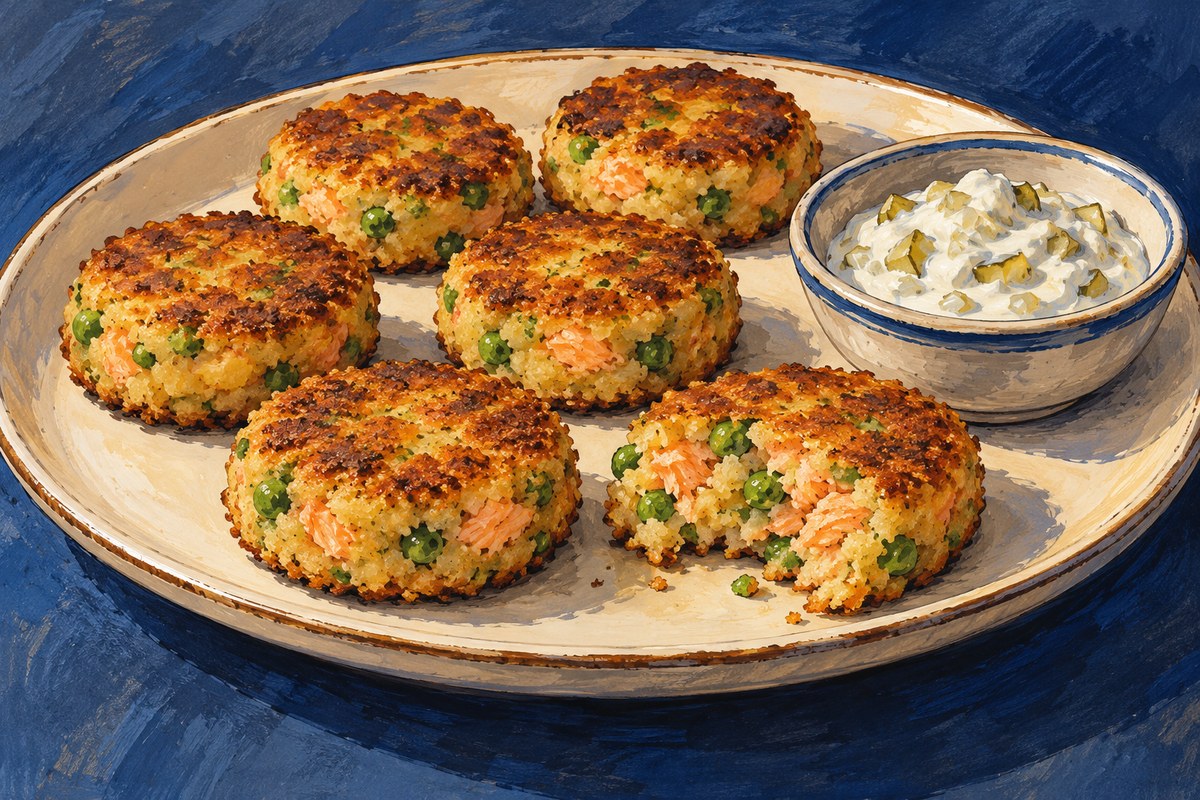
A coin that holds together
The potatoes need to drain and steam dry before mashing. Extra water makes a mixture that spreads in the pan, while a smooth but not gluey mash holds the salmon flakes in place. Mash some of the cooked peas and leave the rest whole for small green spots. Chill the shaped coins briefly if the kitchen is warm, and use a broad thin spatula rather than poking them repeatedly while the first crust sets.
Four batches are part of the recipe
Twenty-four cakes do not all fit into one skillet. Six at a time leave useful turning space in a large nonstick pan, and the clock allows four rounds. Keep the waiting cakes covered in the refrigerator, bringing out only the next six. The yogurt is already fully flavored with pickle and lemon, so no additional dip or garnish is needed at the destination. Two coins are a modest buffet portion, not a complete dinner.
Ingredients
- 1⅓ lb (600 g) potatoes, peeled and diced, prepared weight
- 5¼ oz (150 g) frozen peas
- 2 small cans ready-to-eat salmon, drained to give 8½ oz (240 g), checked for large hard bones
- 1 large egg, 50 g without shell
- ½ cup (60 g) plain dry breadcrumbs
- 1 tbsp (15 g) Dijon mustard
- 1 tbsp (15 ml) lemon juice for cakes
- 2 tbsp (10 g) chopped fresh dill
- ¼ tsp (1.5 g) fine salt
- ¼ tsp (0.5 g) black pepper
- 2 tbsp (30 ml/28 g) neutral oil for all four frying batches
- ¾ cup (180 g) plain yogurt made with pasteurized milk
- ⅓ cup (60 g) drained commercial dill pickles, finely chopped
- 2 tsp (10 ml) lemon juice for yogurt
Set out
Saucepan, Colander, Potato masher, Large mixing bowl, Small sauce bowl, 12 in/30 cm nonstick skillet, Broad spatula, Food thermometer, Two shallow trays and refrigerator space, Oven with rack over sheet for brief hot batch holding, Cooler with ice packs, Small second saucepan for cooking peas separately
Allergens
Fish (salmon), Egg, Wheat, Milk, Mustard. Check labels and substitutions.
Make it
- Boil the potato dice in water until tender, 12–15 minutes. Cook the frozen peas separately for the full package time. Drain both thoroughly. Let the potatoes steam dry in the colander for 5 minutes, mash, then spread shallowly and cool 15 minutes. Roughly crush half the peas.
- Mix yogurt, chopped pickles and the 10 ml lemon juice in the small bowl; refrigerate. Flake the salmon into the mixing bowl and add the cooled potatoes, all peas, egg, breadcrumbs, mustard, 15 ml lemon juice, dill, salt and pepper. Mix gently but completely.
- Weigh and divide the mixture into 24 equal pieces, about 50 g each. Shape into coins about 2⅓ in/6 cm wide and ⅝ in/1.5 cm thick. Set on shallow trays, cover and refrigerate at 40°F (4°C) or below while waiting. Heat the oven to 200°F (95°C) for brief holding.
- Heat one-quarter of the oil in the skillet over medium heat. Fry 6 coins for 3–4 minutes per side until golden and at least 160°F (71°C) in the center. Transfer to the oven rack and keep at least 140°F (60°C). Repeat with the remaining three batches, dividing the remaining oil equally and taking only the next batch from the refrigerator. Serve 2 coins with one-twelfth of the pickle yogurt.
Bring it
For a predictable journey, take fully cooked chilled coins and yogurt separately in a cooler at 40°F (4°C) or below. Keep the coins flat with parchment between cold layers. During packing, travel and display, keep cold food at 40°F (4°C) or below and hot food at 140°F (60°C) or above. Allow no more than 2 hours combined outside those controls, or 1 hour above 90°F (32°C). Discard food beyond that limit.
Finish at the gathering
A 375°F (190°C) oven and rack will reheat the cold coins in about 12–18 minutes; verify 165°F (74°C). The fully cooked coins can also be served cold without host equipment. Set out the cold yogurt with its own spoon.
Make it yours
These fit a spring anniversary lunch or a year-round shared buffet. Offer two on a small plate with a little yogurt; do not add unlisted lemon wedges or other last-minute food that guests cannot identify from the label.
Ingredient labels
Check canned fish, pickles, mustard and breadcrumbs for additional allergens. The tuna variation still contains fish.
A useful detail
The 115-minute total covers potato and pea preparation, cooling, shaping and four sequential frying batches. The coins contain raw egg before frying; do not treat the mixed batter as ready to eat just because the salmon is canned. The displayed 115-minute total is for warm service. For the chilled Bring it route, plan a further 60–90 minutes of refrigerator chilling after the stated initial cooling, about 205 minutes overall before cold transport. Use shallow portions and check that all perishable components are at 40°F (4°C) or below; a clock alone does not establish that endpoint, and actual cooling may take longer.
Another way
- Use 240 g drained canned tuna instead of salmon, retaining the egg-dish endpoint and the same cold waiting procedure.
- Use 10 g chopped parsley instead of dill, with the same measured pickle yogurt.
Keep it well
Chill cooked coins promptly in a single layer, then cover and refrigerate at 40°F (4°C) or below for up to 3 days. Store yogurt separately within the same window or its earlier ingredient deadline. Reheat coins to 165°F (74°C); keep the yogurt cold. Respect the combined travel-and-display limit in “Bring it.”