029 / 75 · Savory surprises to pass
Beetroot and Cheddar Scone Wedges
12 savory scone wedges from two 7 in/18 cm rounds; 1 wedge per buffet portion · Active 25 min · Cook 25 min · Total 1 hr 5 min (warm service)
Cold-travel planning: 2 hr 35 min; follow the stated cooling endpoint and finishing route.
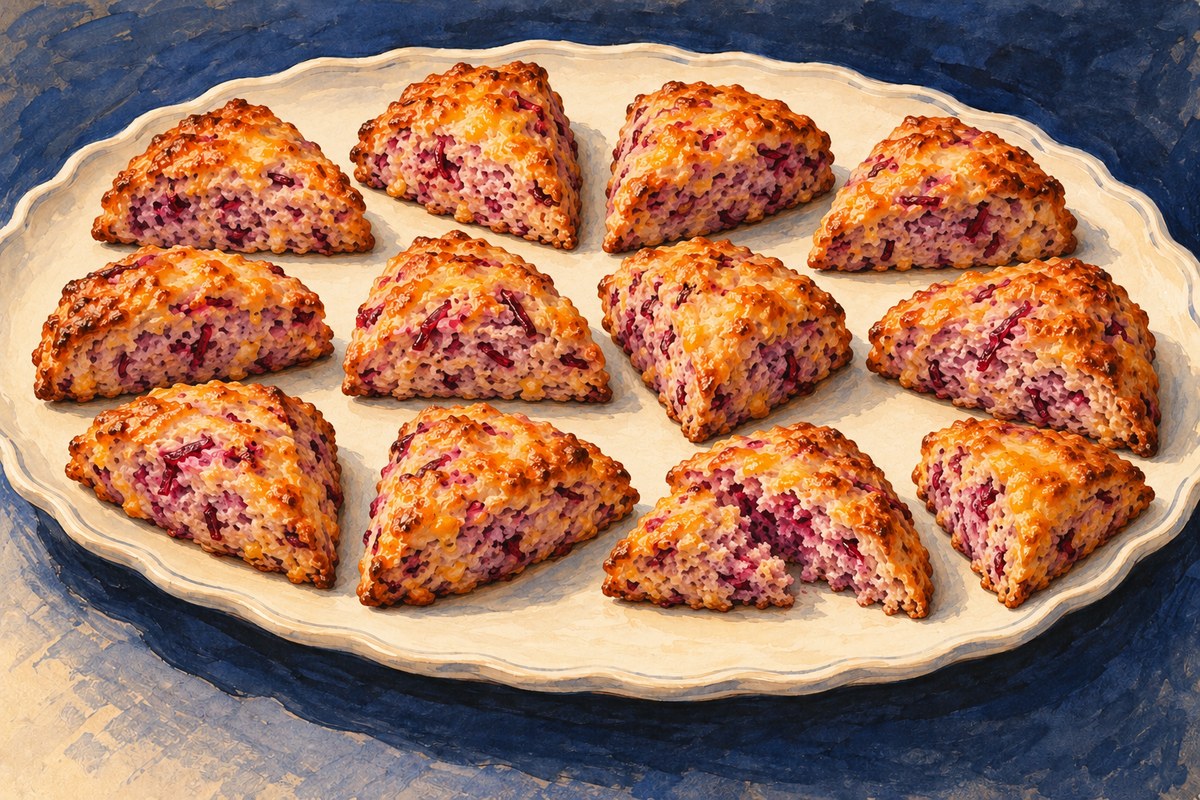
Print recipe · PDFCooked beetroot colors these savory scones from the inside, while cheddar keeps them firmly on the snack table rather than the dessert tray. Two small rounds make twelve manageable wedges. Let the wedges cool on a rack before closing the transport box; trapped steam softens the edges you have just baked.
Start with beetroot that is ready to eat
Plain cooked vacuum-packed beetroot is convenient, but choose a package without vinegar or sweet pickle liquid. Blot it before grating so the dough does not inherit an unpredictable puddle. The beetroot remains visible as little purple flecks; there is no need to blend the entire mixture into a pink paste. Cold butter and a light hand leave the scone tender, while the cheese brings both salt and the browned spots along the cut edges.
Make a small shape on purpose
A large thick round has a long journey from a browned top to a cooked center. Dividing the dough into two flatter rounds gives the heat a shorter route and lets you separate the wedges before baking. Keep a little space between them so the cut sides dry. They are good at room temperature for a short serving period, but the cheese-and-egg bake still needs the same sensible transport and display clock as other perishable party food.
Ingredients
- 2½ cups (300 g) all-purpose flour, plus 1 tbsp (8 g) for the work surface
- 1 tbsp (12 g) baking powder
- ½ tsp (3 g) fine salt
- 1 tsp (2 g) smoked paprika
- 4 tbsp (60 g) cold unsalted butter, diced
- 5¼ oz (150 g) plain ready-to-eat cooked beetroot, blotted dry then coarsely grated
- 3½ oz (100 g) cheddar, coarsely grated
- 1 large egg, 50 g without shell
- ⅓ cup plus 1 tbsp plus 1 tsp (100 ml) milk
Set out
Oven, Large baking sheet, Parchment paper, Grater, Mixing bowl, Fork, Knife or bench scraper, Wire rack, Food thermometer, Shallow transport box and cooler with ice packs, Small jug or second bowl for beating egg and milk
Allergens
Wheat, Milk, Egg. Check labels and substitutions.
Make it
- Heat the oven to 400°F (200°C). Line the sheet. Mix the 300 g flour, baking powder, salt and paprika in the bowl. Rub the butter into the dry mixture until it resembles coarse crumbs with a few small flakes.
- Stir in the beetroot and cheddar. Beat the egg with the milk in a separate jug or bowl, then add to the flour mixture. Use a fork and then your hands to bring the dough together; it will be soft but should hold a mound. Do not knead until smooth or taste the raw dough.
- Dust the work surface with the measured extra flour. Divide the dough into two equal pieces. Pat each into a 7 in/18 cm round about ¾ in/2 cm thick. Cut each round into 6 wedges. Arrange all 12 wedges on the lined sheet with 1 in/2.5 cm between them.
- Bake 20–25 minutes until the wedges are firm, the bottoms are browned and a cut center has no wet floury dough; an egg-containing center must reach at least 160°F (71°C). If necessary, return an underdone wedge to the oven. Transfer to the rack and cool 15 minutes before packing or serving.
Bring it
Cool the scones on the rack, refrigerate and carry in a shallow box in a cooler at 40°F (4°C) or below. Separate layers with parchment only after they are cold. During packing, travel and display, keep cold food at 40°F (4°C) or below and hot food at 140°F (60°C) or above. Allow no more than 2 hours combined outside those controls, or 1 hour above 90°F (32°C). Discard food beyond that limit.
Finish at the gathering
They need no host equipment if served chilled or allowed a brief serving period at room temperature. For a warm plate, ask for a 350°F (180°C) oven and 10–15 minutes, checking that refrigerated wedges reach 165°F (74°C). A toaster slot is unsuitable because loose cheese can drip.
Make it yours
Offer the wedges at a winter afternoon party, or pack them for an anniversary picnic with a cooler. Their color supplies the visual interest; avoid making the food depend on a holiday-shaped cutter.
Ingredient labels
Check baking powder and any substituted cheese for additional allergens.
A useful detail
Allow 65 minutes from weighing to the end of rack cooling. The prepared beetroot weight is after blotting. Its moisture varies, so use the stated soft mound rather than a flowing batter as the mixing cue; do not add unmeasured milk. The displayed 65-minute total is for warm service. For the chilled Bring it route, plan a further 60–90 minutes of refrigerator chilling after the stated initial cooling, about 155 minutes overall before cold transport. Use shallow portions and check that all perishable components are at 40°F (4°C) or below; a clock alone does not establish that endpoint, and actual cooling may take longer.
Another way
- Replace the smoked paprika with 1 tsp (2 g) ground cumin for an earthier version.
- Use 100 g firm mature Gouda in place of cheddar. Keep the same wedge size and check the ingredient label for milk and any other allergens.
Keep it well
Refrigerate cooled scones in a covered container at 40°F (4°C) or below for up to 2 days. Freeze cooled individual wedges for up to 1 month for quality. Thaw in the refrigerator. Reheat at 350°F (180°C) until 165°F (74°C) if serving them hot; cover loosely if the cheese edges darken too quickly. Respect the combined travel-and-display limit in “Bring it.”