026 / 75 · Savory surprises to pass
Red Cabbage and Apple Rye Cups
12 filled rye cups; 1 cup per buffet portion · Active 35 min · Cook 40 min · Total 1 hr 15 min (warm service)
Cold-travel planning: 2 hr 45 min; follow the stated cooling endpoint and finishing route.
Print recipe · PDFA little rye cup gives red cabbage something more interesting to do than wait beside a roast. Apple softens into the tangy filling, and cheddar makes a savory lid. They are small enough to pass on a platter, yet the cabbage is cooked properly before it goes anywhere near the bread.
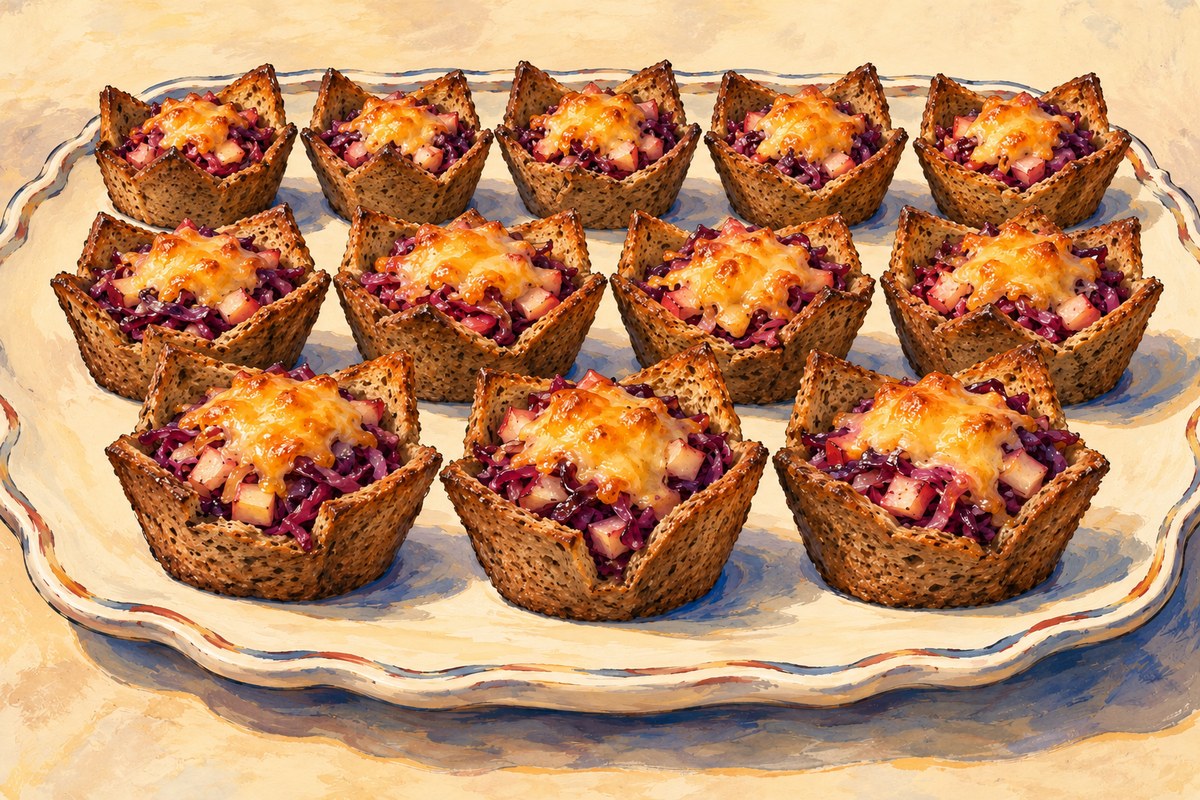
Treat the bread as a container
Choose soft rye sandwich bread rather than dense, brittle rye crispbread. A rolling pin flattens each slice so it can bend into the muffin pan. The short corner cuts overlap inside the cup; they should not sever the middle. Brushing the bread before its first bake helps the folds toast instead of remaining leathery. A standard muffin pan is useful here because it gives every little container the same shape, making the filled cups easier to pack in a single layer.
Dry filling travels better
The cabbage begins as a surprisingly large heap, then collapses with the apple and onion. Let the covered stage soften it, and then remove the lid so the last visible liquid evaporates. A wet spoonful would soak the bread before guests arrived. The vinegar gives a clear edge beside the cheese, while a small amount of sugar balances the cabbage without turning it into a sweet relish. At the table, offer these as a warm savory bite with a napkin or small plate.
Ingredients
- 12 soft rye sandwich-bread slices, 10 cm/4 in across, 300 g total after any crust trimming
- 2 tbsp (30 g) unsalted butter, melted
- 1 tbsp (15 ml/14 g) neutral oil
- 1 small onion, finely sliced, 80 g prepared weight
- 3 cups (250 g) finely shredded red cabbage
- 1 medium apple, cored and finely diced, 150 g prepared weight
- 1 tbsp (15 ml) cider vinegar
- 2 tsp (10 g) brown sugar
- ½ tsp (1 g) caraway seeds
- ½ tsp (3 g) fine salt
- ¼ cup (60 ml) water
- 4¼ oz (120 g) cheddar, finely grated
Set out
Oven, 12-hole standard metal muffin pan, each well about ⅓ cup/80 ml, Rolling pin, Small knife, Pastry brush, Large lidded skillet, Baking sheet, Wire rack, Food thermometer, Shallow lidded transport container and cooler with ice packs
Allergens
Wheat, Rye, Milk. Check labels and substitutions.
Make it
- Heat the oven to 375°F (190°C). Brush the muffin wells with a little of the measured melted butter. Roll each bread slice to about ⅛ in/3 mm thick. Cut a ¾ in/2 cm slit into the middle of each edge; overlap the corners as you press a slice into each well. Brush with the remaining butter. Bake 8–10 minutes until the exposed edges begin to crisp.
- Meanwhile, heat the oil in the skillet over medium heat. Add the onion and cook 5 minutes. Add the cabbage, apple, vinegar, sugar, caraway, salt and water. Cover and cook 12–15 minutes, stirring once, until the cabbage is tender. Uncover and cook 3–5 minutes more until there is no puddle in the pan.
- Divide all the cabbage mixture among the 12 bread cups, about 2½ tbsp each, pressing gently rather than piling above the bread edges. Divide the cheddar over the tops. Bake 10–12 minutes until the cheese is melted and the filling reaches 165°F (74°C).
- Rest 5 minutes in the pan. Loosen the edges carefully and transfer to a rack for 5 minutes so the bases do not steam against the metal. Serve warm, or cool promptly for cold transport and reheat as described below.
Bring it
For a short trip with verified hot holding, use a preheated insulated carrier and check that the filling stays at least 140°F (60°C). The simpler route is to chill the cups in a single layer, transport at 40°F (4°C) or below and keep the rack or sheet separate. During packing, travel and display, keep cold food at 40°F (4°C) or below and hot food at 140°F (60°C) or above. Allow no more than 2 hours combined outside those controls, or 1 hour above 90°F (32°C). Discard food beyond that limit.
Finish at the gathering
Ask for an oven and a baking sheet before choosing the chilled route. Reheat at 350°F (180°C) for 12–18 minutes to a 165°F (74°C) center, then rest 3 minutes. If no oven is available, bring them fully cooked and chilled and serve small cold batches; they will be softer but still savory.
Make it yours
Use the same cups at a birthday lunch with a bright napkin instead of a seasonal decoration. For a larger party, bake a second separate batch rather than overfilling the 12 wells.
Ingredient labels
Check the bread label for sesame, soy, egg or other added allergens. The optional cumin variation adds no declared major allergen by itself.
A useful detail
The 75-minute total includes bread shaping, the overlapping first toast and cabbage cooking, the second bake and 10 minutes of settling. Thin bread is essential; very thick slices reduce the filling space. The displayed 75-minute total is for warm service. For the chilled Bring it route, plan a further 60–90 minutes of refrigerator chilling after the stated initial cooling, about 165 minutes overall before cold transport. Use shallow portions and check that all perishable components are at 40°F (4°C) or below; a clock alone does not establish that endpoint, and actual cooling may take longer.
Another way
- Use 150 g firm pear instead of apple, keeping the dice small and cooking the filling until dry.
- Replace caraway with ½ tsp (1 g) cumin seeds for a different savory note; the cabbage still needs the same covered softening stage.
Keep it well
Cool in a single layer and refrigerate promptly within the combined party limit, at 40°F (4°C) or below. Use within 2 days for bread quality. Reheat on a sheet at 350°F (180°C) for about 12–18 minutes, until the centers reach 165°F (74°C). Do not store warm cups in a sealed deep stack. Respect the combined travel-and-display limit in “Bring it.”