055 / 75 · Fruit Salads for the Table
Mandarin Buttermilk Sunburst
One two-layer mandarin-buttermilk sunburst, about 3¾ cups (900 ml); 6 modest dessert portions · Active 55 min · Total 12 hr 30 min
Print recipe · PDFSmall canned mandarin segments form a simple radial pattern in an orange-juice top band, with a smooth ivory buttermilk layer below. The pattern comes from the listed fruit itself. The two layers are prepared in sequence and stay refrigerated through their final set.
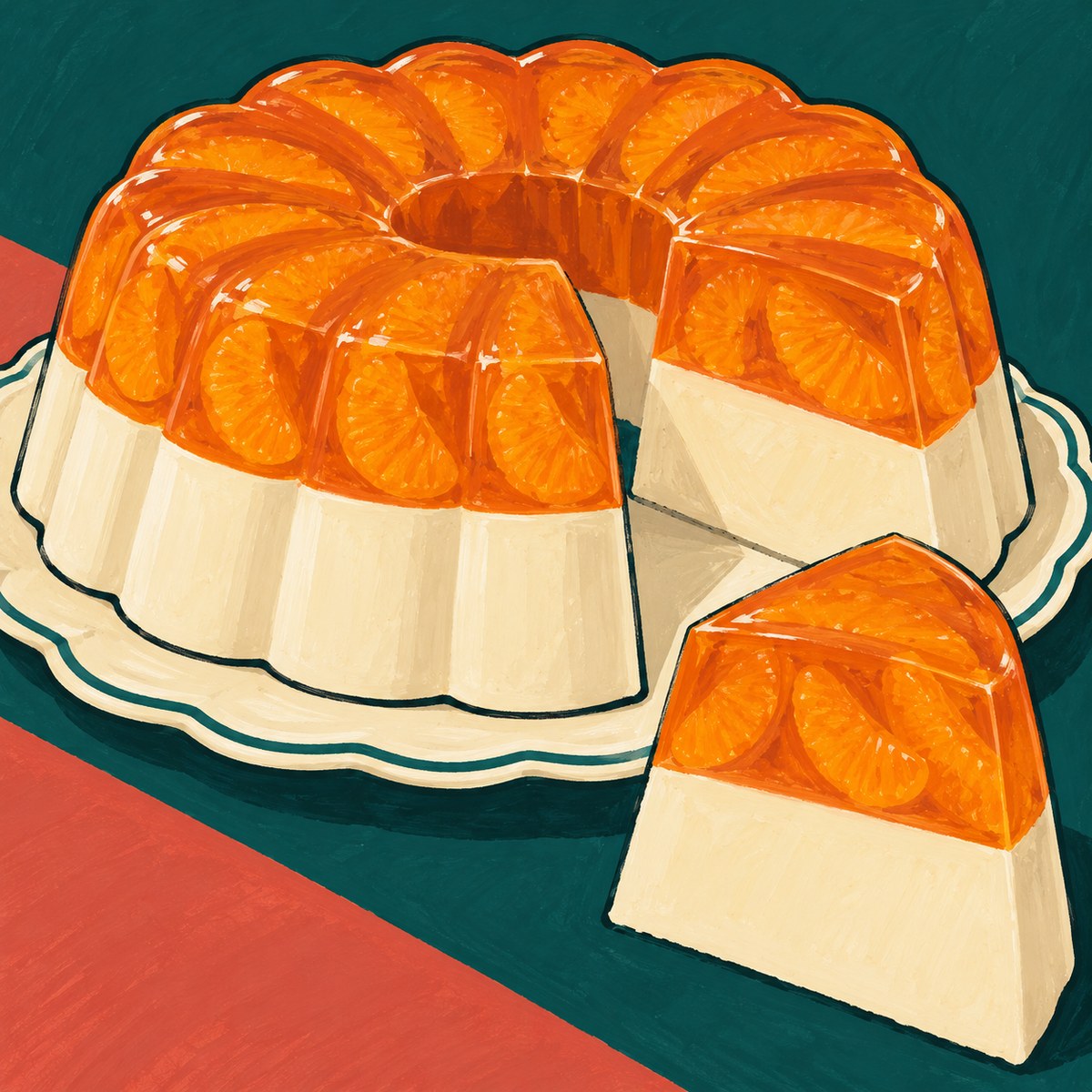
Anchor a simple pattern with a thin first pour
Arrange drained mandarin pieces like short rays around the bottom of a ring mold. A thin amount of cooled orange gel holds them in place after a brief refrigerator chill, then the rest of the orange mixture covers them. The pattern need not be geometrically perfect. Do not add a cherry in the center or fruit slices outside the ring unless separately choosing a different serving dish.
The ivory band is cultured dairy
Milk dissolves the second gelatin portion; cold cultured buttermilk is tempered in gradually so it is not boiled. Prepare that mixture only after the orange layer is softly firm and tacky. Spoon it over the back of a spoon while lukewarm, avoiding a hot stream that would melt the top band. The first layer becomes uppermost after unmolding: orange with mandarin rays above smooth white dairy. The finished dessert is mildly tangy, with its sugar stated openly and no extra whipped topping.
Ingredients
- Unflavored powdered gelatin, 16 g total, divided 7 g for orange layer and 9 g for buttermilk layer, of specified setting strength
- 6 tablespoons cold drinking water (90 ml), divided 45 ml per layer
- ¾ cup strained pasteurized orange juice (180 ml), divided
- 1 tablespoon lemon juice (15 ml)
- ¼ cup granulated sugar (50 g total), divided 15 g orange and 35 g buttermilk
- ¾ cup ready-to-eat canned mandarin segments AFTER draining (120 g), packed in juice, patted dry and large pieces cut once
- ½ cup pasteurized whole milk (120 ml)
- 1¼ cups pasteurized cultured buttermilk (300 ml), kept cold
- ¼ teaspoon neutral oil (1.25 ml), for wiping mold
Set out
Metal ring mold of at least 1¼-liter capacity, Food scale reading 0.1 g for gelatin, Small saucepan washed between layers, Mixing bowls and whisk, Sieve and clean towel, Measuring jug, Paper towel, Food thermometer, Cold platter, Refrigerator
Allergens
Milk. Check labels and substitutions.
Make it
- Check mold capacity, dry and oil lightly. Drain mandarins, pat dry, weigh 120 g and arrange in a loose radial pattern around mold bottom. Bloom 7 g gelatin over 45 ml cold water 5–10 minutes. Warm 90 ml orange juice with 15 g sugar to 140–150°F (60–65°C), remove from heat and stir into gelatin until dissolved. Add remaining 90 ml juice and lemon; cool until lukewarm.
- Spoon about 3 tablespoons (45 ml) orange mixture gently over fruit, enough to help anchor it. Refrigerate 15–20 minutes until lightly set. Keep remaining orange mixture covered at cool room temperature only during that brief stage, not for a long warm hold. Spoon remaining mixture gently over fruit; if it has begun setting, gently warm only until fluid, without boiling, then cool to lukewarm first. Refrigerate 45–60 minutes until softly firm and tacky.
- Only then bloom 9 g gelatin over 45 ml cold water in clean saucepan 5–10 minutes. Add milk and 35 g sugar, warm gently while stirring until dissolved, about 120–140°F (50–60°C), and remove before boiling. Whisk 3 tablespoons cold buttermilk gradually into warm mixture; when smooth and lukewarm, whisk back into remaining cold buttermilk.
- Spoon lukewarm dairy mixture gently over back of spoon onto set orange layer. Keep at least ½ inch (1.25 cm) headroom; refrigerate excess separately. Cover and refrigerate at 40°F (4°C) or below at least 8 hours after final layer until firm. Allow 12½ hours total for anchoring and two separate stages.
- For unmolding, set a cold plate beside the refrigerator. Dip only the outside of the metal mold in warm, not hot, water, about 100°F (38°C), for 5–8 seconds without letting water touch food. Dry the outside, loosen just the upper edge with a clean fingertip and invert onto the plate. If stuck, repeat a brief dip rather than shaking violently. Refrigerate again immediately if not serving now. The orange band and mandarin rays are uppermost above the ivory buttermilk base. Cut 6 modest dessert portions.
Gelatin starting strength
Use food-grade unflavored powdered gelatin with a manufacturer benchmark of 7 g for about 2 cups (500 ml) plain liquid. Weigh the stated grams: envelope sizes and powder density vary. A flavored dessert packet, collagen peptides, sheet gelatin or agar is not an equal substitute.
Cold service
This is an original retro-inspired recipe, not a recovered 1960s formula. Gelatin is animal-derived; the vegetable ingredients do not make the dish vegetarian. A reliable refrigerator and the stated earlier ingredient deadlines are essential.
Ingredient labels
Read cultured dairy, canned fruit, juice and gelatin labels. This is animal-gelatin dessert, not vegetarian.
A useful detail
Orange layer: 7 g gelatin, 45 ml water + 180 ml orange + 15 ml lemon, 15 g sugar and 120 g mandarin, about 375 ml. Dairy layer: 9 g gelatin, 45 ml water + 120 ml milk + 300 ml buttermilk and 35 g sugar, about 500 ml. Estimated total 900 ml includes ordinary volume variation; no can juice is added.
Another way
- Use 120 g drained canned peach pieces in a simple ring arrangement instead of mandarins, accepting a different top pattern.
- Use 300 ml pasteurized plain pourable kefir instead of buttermilk only as a separately named cultured-dairy variation, keeping the same tempering and labels.
Keep it well
Keep covered at 40°F (4°C) or below. Use within 2 days of assembly or the earliest ingredient deadline, whichever comes first. Include the overnight setting period in that limit. Keep total unrefrigerated preparation and serving below 2 hours, or 1 hour above 90°F (32°C). Chill slices promptly after service; discard food exceeding those limits. Do not freeze; freezing damages the gel and releases water.