042 / 75 · Lunch Plates and Buffet Slices
Mushroom Barley Stock Terrine
One mushroom-barley terrine, about 4 cups (950 ml); 6 substantial cold side portions · Active 45 min · Total 13 hr
Print recipe · PDFCooked pearl barley and browned mushrooms make a savory stock terrine with a little chew. The grain is simmered fully before assembly, and the mushrooms are cooked until their released water is gone. The clear brown base stays visible between the pieces.
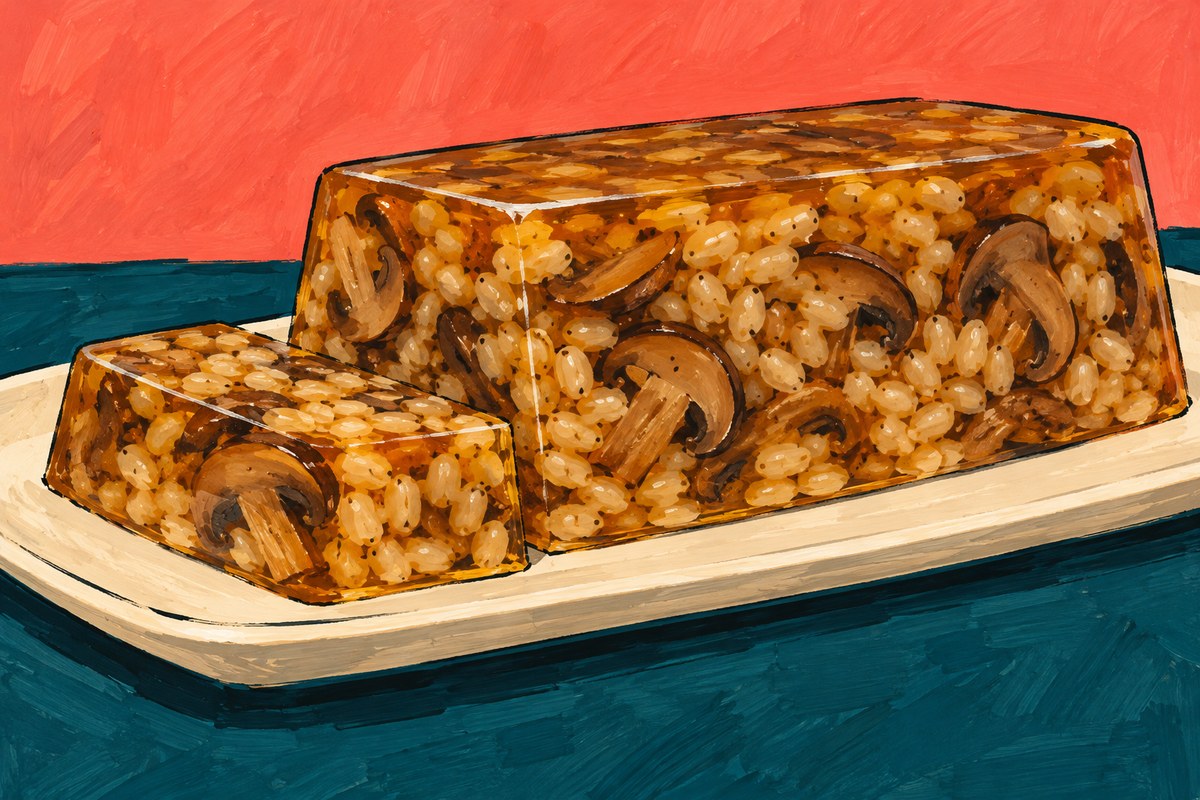
Pearl barley is a cooked ingredient, not an instant addition
Use ordinary pearl barley and follow its packet’s full simmering time, often 45–60 minutes. Taste for a fully tender grain after that cooking; there is no raw flour or egg mixture to taste. Drain well. The 60 grams of dry grain commonly yields about 175–200 grams cooked, but use the whole cooked batch rather than discarding a few grains to hit an exact volume. This variation is allowed in the roomy mold and estimated finished yield.
Brown mushrooms before adding stock
Slice mushrooms thinly and cook them in a wide skillet with measured oil. They first release water, then begin to brown as that moisture evaporates. Stop when fully cooked and the pan has no watery pool. Cool them promptly in a shallow refrigerator dish beside the drained barley. Warm mushrooms would thin and warm the partly set broth. Thyme is cooked with the garlic for a short final stir so neither sits as a dusty raw seasoning in the cold slice.
A grain side held in animal gelatin
The earthy ingredients do not make the terrine vegetarian because the unflavored gelatin is animal-derived. Six side portions each contain roughly 30 grams cooked barley. Serve alongside other separately prepared foods. The overnight set is included in the stated time, and the freshly cooked grain’s original storage clock continues inside the finished loaf.
Ingredients
- ⅓ cup pearl barley (60 g dry), not quick-cook or raw soaked grain
- 3 cups drinking water (720 ml) for barley, plus more if its packet requires; drained after cooking
- 7 oz washed trimmed mushrooms (200 g raw), thinly sliced
- 2 teaspoons olive oil (10 ml)
- 1 small garlic clove (3 g), finely minced
- ¼ teaspoon dried thyme (0.25 g)
- 2 standard ¼-ounce envelopes unflavored powdered gelatin (14 g total), of specified setting strength
- 6 tablespoons cold drinking water (90 ml), for gelatin
- 2 cups clear ready-to-use low-sodium vegetable or mushroom broth (480 ml), divided
- 1 tablespoon cider vinegar (15 ml)
- ⅛ teaspoon black pepper
- ¼ teaspoon neutral oil (1.25 ml), for wiping mold
Set out
Covered barley saucepan and sieve, Wide skillet, Knife and board, Two shallow cooling dishes, Small broth saucepan, Mixing bowl and spoon, Scale and measuring jug, Metal loaf mold of at least 1¼-liter capacity, Paper towel, Food thermometer, Cold platter, Refrigerator
Allergens
Barley (gluten). Check labels and substitutions.
Make it
- Rinse barley if its label directs, put in saucepan with 720 ml drinking water and simmer by full packet directions, usually 45–60 minutes, until fully tender. Add water only if needed to keep cooking safely. Drain thoroughly; use all cooked grain, commonly 175–200 g. Spread in shallow dish and refrigerate promptly until cold, allowing 30–45 minutes.
- Meanwhile heat olive oil in skillet over medium heat. Cook sliced mushrooms 10–12 minutes, stirring, until fully cooked, their liquid evaporates and edges brown. Add garlic and thyme and cook 1 minute without scorching. Transfer to separate shallow dish and refrigerate promptly until cold.
- Check mold capacity, dry and oil lightly. Bloom gelatin over 90 ml cold water in mixing bowl 5–10 minutes. Heat 240 ml broth with pepper to 140–150°F (60–65°C), remove from heat and stir into gelatin until dissolved. Add remaining 240 ml broth and vinegar.
- Refrigerate 25–40 minutes, stirring gently every 10 minutes, until lightly syrupy. Fold in all cold drained barley and cold cooked mushrooms with their oil. Spoon into loaf with at least ½ inch (1.25 cm) headroom; refrigerate excess separately.
- Cover and refrigerate at 40°F (4°C) or below at least 8 hours until firm. Allow 13 hours total for full grain cooking, cooling and setting. For unmolding, set a cold plate beside the refrigerator. Dip only the outside of the metal mold in warm, not hot, water, about 100°F (38°C), for 5–8 seconds without letting water touch food. Dry the outside, loosen just the upper edge with a clean fingertip and invert onto the plate. If stuck, repeat a brief dip rather than shaking violently. Refrigerate again immediately if not serving now. Cut 6 cold side portions.
Gelatin starting strength
Use food-grade unflavored powdered gelatin with a manufacturer benchmark of 7 g for about 2 cups (500 ml) plain liquid. Weigh the stated grams: envelope sizes and powder density vary. A flavored dessert packet, collagen peptides, sheet gelatin or agar is not an equal substitute.
Cold service
This is an original retro-inspired recipe, not a recovered 1960s formula. Gelatin is animal-derived; the vegetable ingredients do not make the dish vegetarian. A reliable refrigerator and the stated earlier ingredient deadlines are essential.
Ingredient labels
Barley contains gluten. Broth may add wheat, soy, celery or other allergens. Gelatin is animal-derived, so this is not vegetarian.
A useful detail
Free gel liquid totals 585 ml; barley is fully cooked and drained, roughly 175–200 g, while 200 g raw mushrooms commonly reduce to 120–140 g cooked. Fourteen grams gelatin supports roughly 950 ml finished mixture with modest yield variation. Cooking water is drained, not included in the 585 ml.
Another way
- Use 200 g raw sliced cremini mushrooms instead of white mushrooms, cooking until no watery pool remains.
- Use 15 ml red wine vinegar instead of cider vinegar for a differently sharp broth.
Keep it well
Keep covered at 40°F (4°C) or below. Use within 2 days of assembly or the earliest ingredient deadline, whichever comes first. Include the overnight setting period in that limit. Keep total unrefrigerated preparation and serving below 2 hours, or 1 hour above 90°F (32°C). Chill slices promptly after service; discard food exceeding those limits. Do not freeze; freezing damages the gel and releases water. Start with freshly cooked barley and mushrooms as directed; the overnight set counts inside their original storage clock.