056 / 75 · Plant Meals with a Proper Center
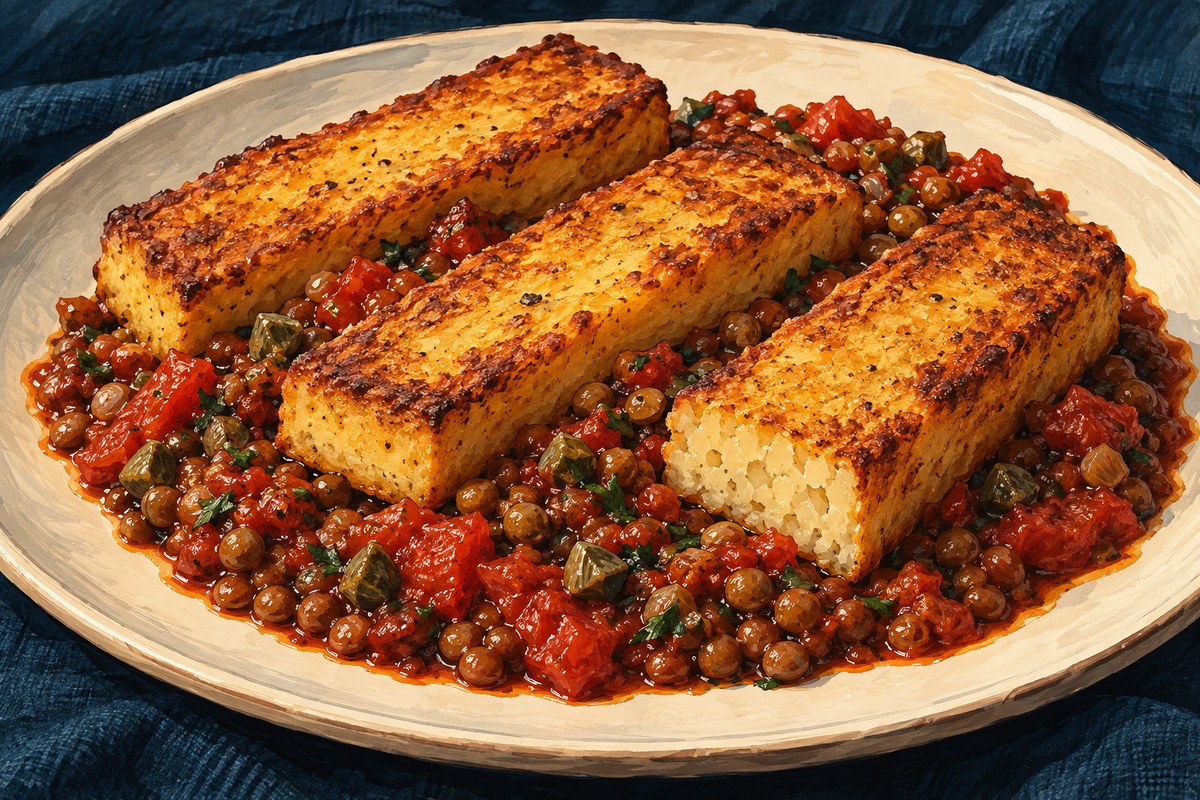
Crisp Chickpea Panisse with Tomato-Caper Lentils
12 panisse fingers;3 per serving with one quarter of all tomato-caper lentils · Active 40 min · Cook 45 min · Total 5 hr
Print recipe · PDFChickpea flour cooks into a thick paste, chills into a slab and then fries into golden fingers with soft centers. Those fingers sit over warm lentils in a fresh tomato-caper sauce. The contrast is the point: crisp edges above a spoonable base. The cold setting period is essential, so plan this meal in two stages rather than starting just before dinner.
Cook the paste before asking it to set
Panisse begins with chickpea flour and water, not a scoop of hummus. Whisk the flour into cold measured water before heating so dry lumps are not sealed inside a hot gel. Once it thickens, use a sturdy spoon and stir right along the pan base. Maintain a low bubbling cook for the full stated time, scraping the corners; raw flour should not remain in a quickly warmed paste. The hot mixture is thick enough to spit, so lower the heat and keep hands clear rather than leaning over the pan.
A measured slab makes useful fingers
Spread the cooked paste into the lightly oiled 20 cmsquare mold and level it while still hot. It will be about 1.5 cmdeep. A thinner layer becomes a different, crisper snack; a deep loaf takes longer to chill and produces thick centers. Refrigerate promptly after a short rack cool and give it a full three hours to become firm throughout. Cut two rows and six columns to make twelve broad fingers. Dry surfaces brown better, so pat away visible moisture before the skillet stage without pressing the fingers flat.
Keep the crisp part separate until serving
The tomato sauce can simmer while the panisse fries in two batches. Canned capers should be drained before weighing and chopped so their sharpness spreads through the lentils. Add the already cooked lentils only after the tomatoes have softened into a sauce. They need thorough heating, not a long hard boil that breaks them apart. Plate the lentils first and put three panisse fingers on top immediately. For a later meal, save the components separately: the sauce is useful moisture, but it softens the fried surface during storage.
Ingredients
- 5 1/3 oz chickpea flour/besan (150 g)
- 1 3/4 cups plus 2 tablespoons water (450 ml/450 g)
- 5 teaspoons olive oil (25 ml/22.5 g), divided
- 1/2 teaspoon fine salt (3 g), divided
- 1 small onion, finely diced (100 g)
- 2 garlic cloves, minced (6 g)
- 1 lb 5 oz ripe tomatoes, chopped with all their juices (600 g)
- 14 oz plain cooked green or brown lentils, boiled, drained and cooled (400 g cooked edible weight)
- About 1 1/2 tablespoons capers, drained and chopped (20 g)
- 1 tablespoon lemon juice (15 ml/15 g)
- A small handful fresh parsley, chopped (8 g)
- 1/4 teaspoon ground black pepper (0.5 g)
Set out
Kitchen scale, heavy saucepan, whisk and sturdy spoon, Square 20 cm/8 inch food-safe dish or mold, at least 4 cm/1 1/2 inches deep, Refrigerator space for the mold, 12 inch/30 cm nonstick skillet, spatula and clean holding plate, Second saucepan for sauce and food thermometer
Allergens
Chickpea; check besan packaging for wheat or other cross-contact statements.. Check labels and substitutions.
Make it
- Whisk chickpea flour, measured water and half the salt in the heavy saucepan until smooth. Heat over medium heat, whisking until thick. Reduce to low and cook at a gentle bubble for 8–10 minutes, stirring firmly along the base and corners, until very thick, smooth and cooked through. Do not taste raw flour paste.
- Use 1 teaspoon/5 ml oil to grease the 20 cmsquare mold. Scrape in all the paste and level to about 1/2–5/8 inch/1.5 cmdeep. Cool on a rack for 15–20 minutes, then refrigerate promptly at 40°F/4°C or below for at least 3 hours and until firm and cold throughout. Keep total ambient cooling under 2 hours, or 1 hour above 90°F/32°C.
- Use lentils cooked today or yesterday and safely chilled. For the sauce, heat 2 teaspoons/10 ml oil in the second saucepan over medium heat. Soften onion for 6–7 minutes, add garlic for 30 seconds, then tomatoes and all their juices, capers, remaining salt and pepper. Simmer uncovered for 12–15 minutes until saucy. Fold in lentils and heat gently for 4–5 minutes until the whole mixture reaches 165°F/74°C. Stir in lemon juice and parsley off the heat.
- Turn the cold slab onto a clean board and cut into 12 equal fingers:2 rows by 6 columns, each about 4×1 1/3×1/2 inches/10×3.3×1.5 cm. Pat visible surface moisture dry. Heat the remaining 2 teaspoons/10 ml oil in the nonstick skillet, using half for each batch of six. Fry over medium heat forabout 7–9 minutes per batch, turning carefully to brown broad faces and edges, until crisp and at least 165°F/74°C in the center. Extend frying as needed to reach that endpoint, especially for a slab held cold for up to 2 days.
- Divide all tomato-caper lentils between four plates and serve three panisse fingers over each. The 5-hour total includes cooking the paste, short cooling, at least 3 hours of chilling and the final sauce/frying stages. Longer chilling is fine within the stated storage limits.
Split the work at a useful natural pause
Make the slab before a day when time at dinner will be short, then leave it safely chilled. The final meal needs only sauce and frying. That cold-stage preparation offers a practical alternative to repeatedly reheating an entire batch of stew.
A useful detail
The chickpea-flour paste is fully cooked before chilling; the later frying forms a crust. Oil 25 ml is fully counted:5 ml mold,10 ml sauce and 10 ml frying. No grain or protein powder is added to make the slab set.
Another way
- Replace 20 g capers with 20 g pitted chopped green olives for a milder briny finish.
- Use 400 g cooked drained black lentils instead of green or brown lentils, keeping their original safe storage clock. Variations change the estimate.
Keep it well
Keep the cooked chilled slab covered at 40°F/4°C or below for up to 2 days before frying. Keep lentil sauce for up to 2 days and no later than 3 days after the lentils were originally cooked, whichever comes first. Cool saved cooked components in shallow containers within 2 hours, or 1 hour above 90°F/32°C. Reheat sauce and saved fingers to 165°F/74°C; a hot skillet or oven restores some surface texture. Store sauce away from the fingers.