040 / 75 · Cook Once, Keep It Interesting
Harissa Chickpea Chicken with Roasted Cauliflower
6 portions of chicken, chickpeas, cauliflower and couscous · Active 30 min · Cook 40 min · Total 1 hr 5 min
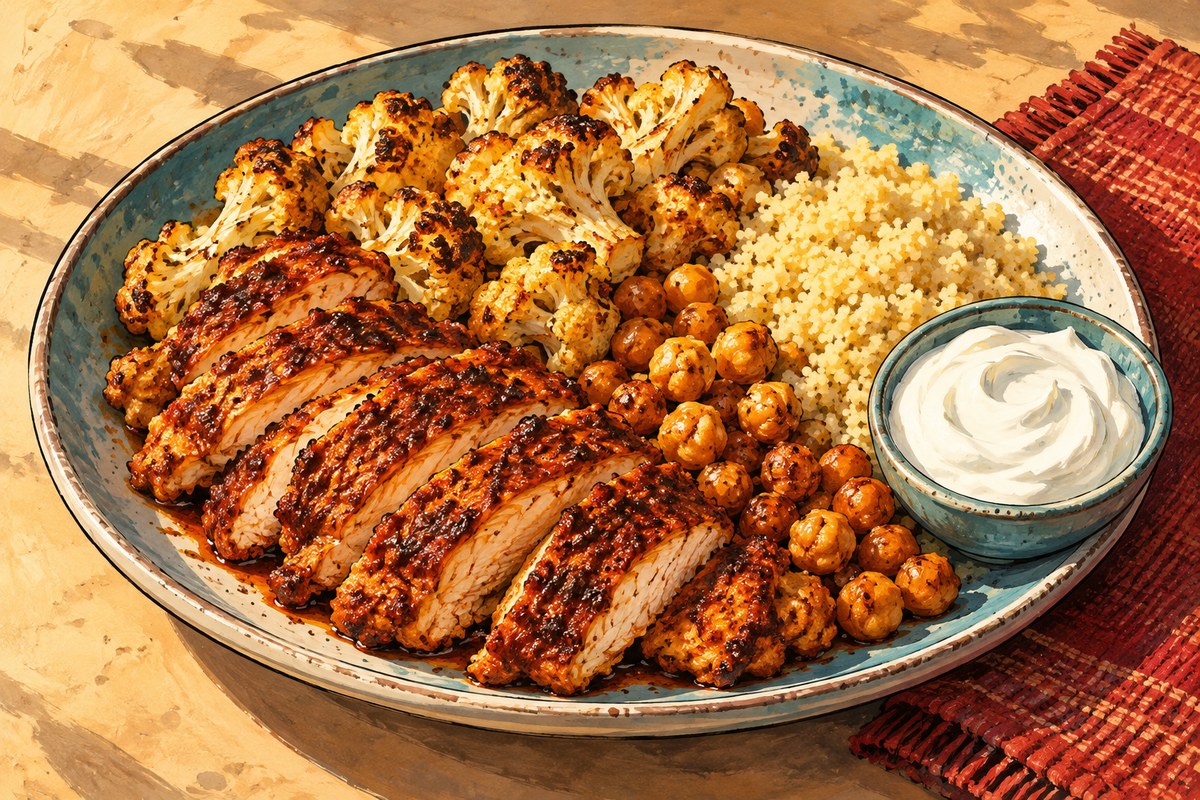
Print recipe · PDFHarissa gives this tray of chicken, chickpeas and cauliflower a warmly spiced coating, while a measured portion of couscous catches the juices at serving. The vegetables need room to roast, so the recipe uses two trays instead of compressing everything into one crowded pan. That small equipment choice makes the difference between browned edges and a wet pile. Six complete portions can be served at once or divided for later meals, with the couscous kept separate until packing or eating.
A paste with a variable personality
Harissa ranges from gently aromatic to sharply hot. Read the label and taste a tiny amount of the paste on its own before mixing the coating. The base uses a measured quantity; the milder variation replaces part of it with tomato paste rather than suggesting an undefined splash of something else. Either version needs the lemon and oil to spread evenly over chicken and vegetables.
Separate pans, better edges
Cauliflower gives off steam as it roasts, while the chicken releases juices of its own. Keeping them on separate trays allows the cauliflower and chickpeas to brown without waiting for the chicken liquid to evaporate. Pat the chickpeas dry after rinsing. Their skins may wrinkle and split slightly in the oven; that is fine. Turn the cauliflower once so a broad cut surface can make contact with the hot tray.
Finish the grain at the right moment
Couscous is quick, so make it while the trays finish rather than far in advance. Fluff it with a fork after the covered rest, then distribute it equally. If you are making lunches, let the cooked components lose their fierce heat in shallow containers and refrigerate promptly. Keep the lemon yogurt in its own small container so a reheated portion still has a cool, fresh finishing sauce.
Ingredients
- 2 lb boneless skinless chicken thighs (900 g), visible fat trimmed
- 1 large cauliflower, cut into 1 1/2-inch/4 cm florets (800 g edible florets)
- 2 cans chickpeas (15 oz/425 g each), drained, rinsed and patted dry (510 g drained total)
- 3 tablespoons olive oil (45 ml/42 g), divided
- 3 tablespoons harissa paste (45 g)
- 3 tablespoons lemon juice (45 ml/45 g), divided
- 2 garlic cloves (6 g), finely grated
- 2 teaspoons ground cumin (4 g)
- 3/4 teaspoon fine salt (4.5 g), divided
- 1 1/2 cups dry couscous (260 g)
- 1 1/2 cups boiling water (360 ml/360 g)
- 3/4 cup plain nonfat Greek yogurt (180 g)
Set out
Two large rimmed baking trays, each with a usable base at least 15 x 11 inches/38 x 28 cm; an additional tray or a later batch if needed for a loose single layer, Large mixing bowl, Medium heatproof bowl with cover, Instant-read thermometer, Small bowl
Allergens
Wheat, Milk, Check harissa label for additional allergens. Check labels and substitutions.
Make it
- Heat oven to 425°F/220°C with racks in upper and lower thirds. Mix 2 tablespoons oil, harissa, 2 tablespoons lemon juice, garlic, cumin and 1/2 teaspoon salt. Put half this mixture in a separate clean bowl for vegetables before adding any raw chicken.
- Coat chicken in one half of the mixture and arrange on one tray with space between pieces. Toss cauliflower and chickpeas with the reserved clean mixture and remaining tablespoon oil; spread on the second tray. Check actual space: cauliflower and chickpeas must fit loosely in one layer, not be piled. If they crowd the tray, use an additional oven-safe tray if your oven permits adequate airflow, or roast in an extra batch and extend total time; keep uncooked chicken refrigerated until its turn.
- Roast both trays for 30–35 minutes, turning cauliflower and rotating trays halfway, until cauliflower is tender with browned edges and chicken reaches 165°F/74°C. Remove either tray early if ready; cauliflower may need 5 minutes longer depending on size.
- During the final 10 minutes, put couscous and remaining 1/4 teaspoon salt in the heatproof bowl. Pour over boiling water, cover and stand 5 minutes or follow the package hydration time. Fluff thoroughly.
- Mix yogurt with remaining tablespoon lemon juice. Slice chicken and divide it, vegetables, couscous and yogurt into six equal portions. Keep yogurt separate if storing or reheating.
Two trays are still one batch
Rather than mixing everything after roasting, divide the cauliflower and chickpeas first, then add an equal share of sliced chicken. This prevents the first servings taking most of the crisp vegetables. Portion the couscous separately so the whole batch yields six useful meals instead of six uneven containers.
A useful detail
Do not reuse a bowl or utensil that touched raw chicken for the cooked vegetables or sauce. The coating is divided before the chicken is added for that reason. The 65-minute base assumes the stated trays and a loose vegetable layer; additional vegetable batches require longer.
Another way
- For a gentler batch, use 1 tablespoon/15 g harissa plus 2 tablespoons/30 g tomato paste in place of the 3 tablespoons harissa; keep the other coating ingredients unchanged.
- Replace couscous with 3 cups/585 g cooked brown rice, portioned equally; this changes cooking time and nutrition. Use freshly cooked hot rice or rice cooled and refrigerated within 1 hour of its original cooking and used within 24 hours. Reheat rice only once to 165°F/74°C and eat immediately. Rice reheated from a chilled batch must not be stored for another reheating; earlier rice cooking is outside the base time.
Keep it well
Refrigerate chicken, vegetables and couscous in shallow containers and yogurt separately at 40°F/4°C or below within 2 hours, or 1 hour above 90°F/32°C. Keep up to 3 days. Freeze the cooked chicken and vegetables up to 2 months. Reheat hot components to 165°F/74°C and add cold yogurt afterward. Pack chilled with two cold sources. If using the rice variation, its stricter 24-hour original-cooking limit and single-reheat rule override the longer base storage period; keep rice separate.