069 / 75 · Crisp, Tangy and Warm Sides
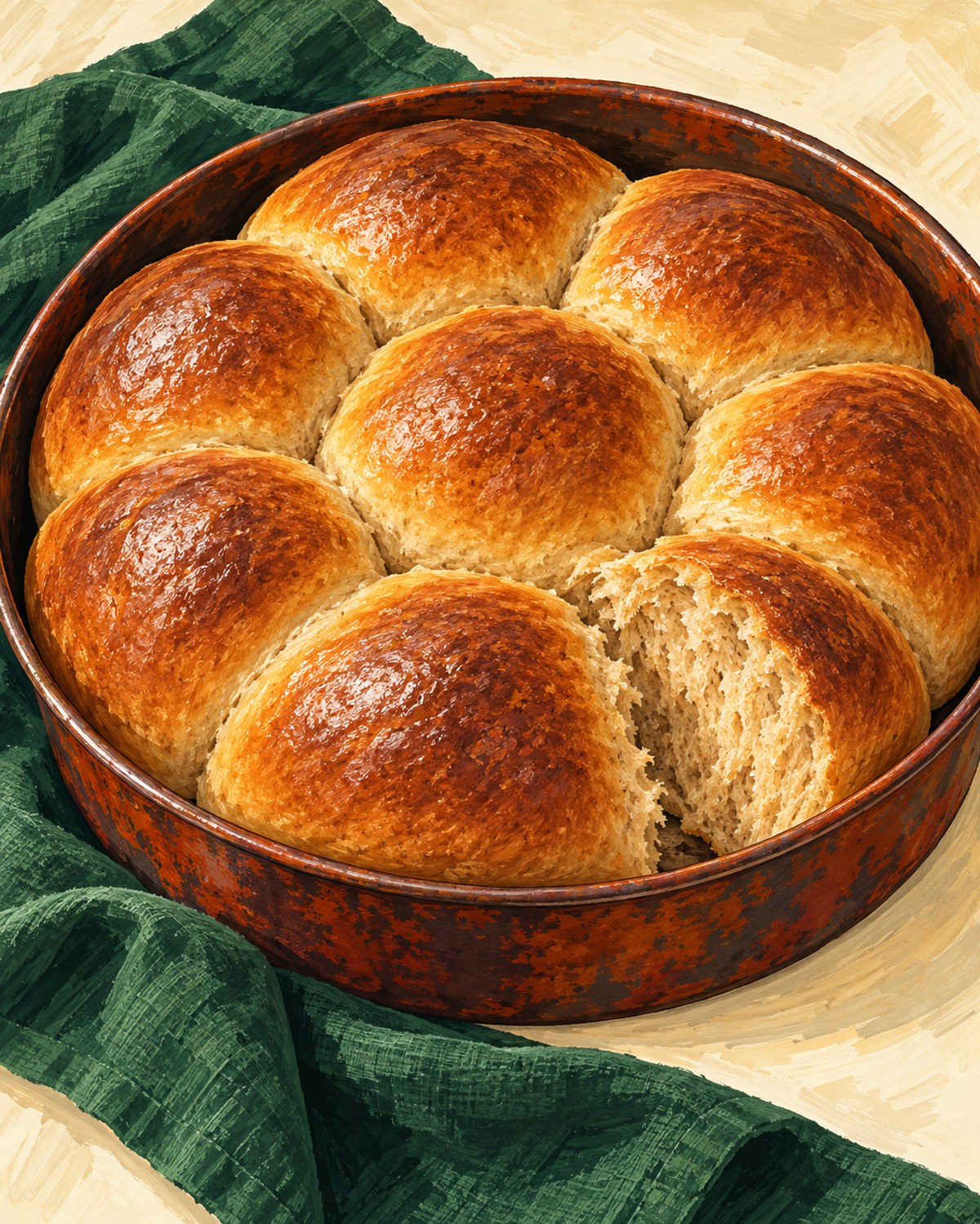
Soft Whole-Wheat Supper Rolls
8 soft whole-wheat supper rolls in one 9-in/23-cm round metal pan · Active 30 min · Total 3 hr 35 min
Print recipe · PDFEqual parts whole-wheat and bread flour give these rolls a soft but substantial crumb. Milk, a little honey and butter enrich the dough without an egg wash. Two rises and a cooling pause belong in the stated time, so these are planned supper bread rather than a last-minute task beside a finished casserole.
Let the whole-wheat flour hydrate
Warm the milk gently, checking that it is only lukewarm rather than hot. Stir it with the whole-wheat flour and water, then give that mixture ten minutes before adding the remaining dough ingredients. The bran has time to absorb moisture, making it easier to judge the dough. Instant yeast is specified; a different yeast product may need its own preparation. A soft slightly tacky dough is expected after kneading. Use only the separate small dusting allowance on the board, rather than repeatedly adding flour until every trace of stickiness disappears.
A rise follows the dough, not a deadline
Cover the bowl and leave it in a comfortably warm draft-free place until roughly doubled. A cool kitchen can take longer than the range. Do not use an unverified hot oven to force the dough, since excessive heat can harm yeast and warm milk dough unnecessarily. Divide into eight equal pieces and tuck the edges under to make loose smooth tops. One center roll with seven around it fits the stated round pan. The second rise should make them visibly puffy and close together before baking.
No extra finish is hidden
The written butter is divided between dough, pan and the thin warm finish. There is no egg wash, seed scattering or decorative flour blanket. Bake until the tops are golden and the center rolls are cooked through, using the stated internal temperature as a useful bread-quality check. Let them stand briefly in the pan, then move to a rack so the bottoms do not sit in steam. Pull apart only after the short cooling pause; cutting very hot bread can make a well-baked crumb seem gummy.
Ingredients
- 1 1/2 cups whole-wheat flour (180 g)
- 1 1/2 cups bread flour (180 g)
- 1 tablespoon bread flour (8 g), for dusting; unused flour may remain
- 1 cup pasteurized milk (240 ml)
- 2 tablespoons drinking water (30 ml)
- 1 1/2 tablespoons honey (30 g)
- 1 1/4 teaspoons instant yeast (4 g; check packet)
- 1 teaspoon fine salt (6 g)
- 2 tablespoons plus 1 teaspoon butter (35 g), divided:25 g dough,5 g pan,5 g finish
Set out
Oven, 9-in/23-cm round metal pan with sides at least 2 in/5 cm high, Mixing bowl, Measuring jug, Spoon, Board and dough scraper, Clean cover, Food thermometer, Cooling rack, Pastry brush
Allergens
Milk, Wheat. Check labels and substitutions.
Make it
- Warm milk gently to 100–105°F (38–40°C), not hot. Mix with whole-wheat flour and water in the bowl and rest 10 minutes. Melt 25 g dough butter and let it become lukewarm. Stir bread flour, honey, instant yeast, salt and melted dough butter into the hydrated mixture.
- Knead on the board 8–10 minutes until smooth and elastic, using only the separate dusting flour if needed. The dough should remain soft and slightly tacky. Return to the bowl, cover and rise 60–90 minutes until roughly doubled; allow longer in a cool room.
- Grease the pan with 5 g butter. Divide dough into 8 equal pieces and tuck each into a round. Put one in the center and seven around it. Cover and rise 30–45 minutes until puffy and close together. During the end of the rise, heat oven to 375°F (190°C).
- Bake 22–26 minutes until golden and center rolls reach about 190–200°F (88–93°C) as a bread-quality check, with no raw dough inside. Brush warm tops with remaining 5 g butter. Rest 5 minutes in the pan, then move to the rack and cool at least 15 minutes before pulling apart. Do not taste raw flour dough.
Plan around the oven, not against it
Bake these before a hotdish that needs a different temperature, then warm only if needed. Their rise can be observed while other preparation happens, but the oven setting still belongs to the bread.
A useful detail
The 215-minute estimate includes 10 minutes hydration, mixing and kneading, both rises at the longer stated range, baking and cooling. A cool room can extend it. Instant yeast and a half whole-wheat, half bread-flour dough are the starting formula.
Another way
- Use 30 g maple syrup instead of honey for a different light sweetness, keeping the same dough texture and rise cues. This does not make the bread dairy-free because milk and butter remain.
Keep it well
Cool plain rolls on the rack and keep covered in the refrigerator at 40°F (4°C) or below for up to 3 days, or freeze promptly for up to 1 month for quality. Thaw in the refrigerator and warm for texture. Added perishable fillings have their own storage deadlines and are outside this plain-roll guidance.